
Customer calls your business at 3 PM. You're on a job site, hands full, can't answer. They call your competitor instead. That's a $3,500 job gone.
This scenario repeats thousands of times daily across small businesses. In our analysis of 130,175 calls from 45 contractors, 74.1% went completely unanswered. Not "went to voicemail." Unanswered - customer hung up and called someone else.
Virtual receptionists solve this problem. An answering service ensures someone (or something) always answers when customers call. But with live agents, AI systems, and hybrid options available in 2025, which type is right for your business?
This guide breaks down what virtual receptionists are, compares live vs AI options honestly, and shows you how to choose. We'll use real data from our call analysis, not marketing claims.
What Is a Virtual Receptionist?
The Simple Definition
A virtual receptionist is a person or AI system that answers your business calls remotely. Unlike an in-house receptionist sitting at your front desk, virtual receptionists work from somewhere else - either call centers (live agents) or cloud-based systems (AI).
When a customer calls your business, the virtual receptionist answers in your company name, handles their request, and you never miss the call. They can answer questions, take messages, schedule appointments, and route urgent calls to you directly.
The "virtual" part simply means they're not physically present at your location. They could be across the country or exist entirely as software.
Virtual vs. In-House Receptionist
An in-house receptionist works 40 hours per week, typically 9 AM to 5 PM Monday through Friday. According to the Bureau of Labor Statistics, the average receptionist salary is $35,000 per year. More recent BLS data shows the median wage is $17.90/hour ($37,230/year). Add benefits and taxes (roughly 30%), and you're at $45,500 annually.
That 40-hour coverage leaves 128 hours per week where calls go to voicemail.
A virtual receptionist provides coverage for a fraction of that cost - typically $100-500 per month depending on the type. Many offer 24/7 coverage, meaning your business never misses a call at 9 PM, on weekends, or during holidays.
The trade-off used to be quality. In-house receptionists knew your business deeply. But modern virtual receptionists - both live and AI - can be trained on your specific business, services, and procedures.
Virtual Receptionist vs. Answering Service
Traditional answering services take messages. That's about it. Customer calls, agent says "I'll have someone call you back," writes down the name and number, you get a pink slip.
Virtual receptionists do more:
- Answer common questions from your knowledge base
- Schedule appointments directly in your calendar
- Route emergencies to you immediately
- Filter spam calls
- Capture detailed information about service requests
- Send instant notifications to you via text or email
The line has blurred as answering services have evolved, but the key difference is capability. Virtual receptionists handle interactions; answering services just take messages.
Types of Virtual Receptionists
The virtual receptionist market has grown to $6.26 billion, evolving significantly. Today, you have three main options:
Live Virtual Receptionists
Real humans working from call centers who answer your business calls. When a customer calls, a trained agent picks up, greets them in your business name, and handles the conversation.
Popular live services include Ruby, AnswerConnect, Nexa, and Davinci.
Live receptionists excel at complex, nuanced conversations. They can read emotional cues, improvise when situations don't fit a script, and provide genuine human empathy. A frustrated customer calling about a problem? A live receptionist can de-escalate in ways AI still struggles with.
The downside is cost and availability. Live services charge per minute or per call, and 24/7 coverage comes at a premium. You're also sharing agents with other businesses, which means wait times during peak periods.
AI Virtual Receptionists
Software systems that use artificial intelligence to understand speech, process requests, and respond appropriately. When a customer calls, AI answers, listens to their request, and either handles it directly or takes appropriate action.
AI receptionists use natural language processing (NLP) to understand what callers want. "What are your hours?" gets answered from a knowledge base. "I need someone Thursday afternoon" checks your calendar and books an appointment. "My basement is flooding" detects urgency and routes to you immediately.
According to Gartner, 85% of customer service leaders plan to pilot AI solutions in 2025. The technology has matured significantly, and AI can now handle 60-70% of routine business calls without human intervention.
The advantage is cost and availability. AI answers instantly (6-8 seconds vs. 30-90 seconds for live services), works 24/7/365 without overtime, and typically costs a flat monthly fee regardless of call volume.
Hybrid Virtual Receptionists
The newest approach combines AI and live agents. AI handles routine calls instantly - questions about hours, pricing, service area, appointment scheduling. Complex or emotional situations route to live agents or directly to you.
This is where the market is heading. You get AI speed and cost savings for the 60-70% of calls that are straightforward, plus human judgment for the situations that need it.
From our analysis of 130,175 calls:
- 60-70% were routine (hours, pricing, scheduling, general questions)
- 25-30% needed human callback (quotes, complex questions)
- 5-10% were urgent (emergencies, upset customers)
A hybrid approach handles each type appropriately.
The Problem Virtual Receptionists Solve
Most Small Business Calls Go Unanswered
We analyzed 130,175 customer service calls from 45 contractors over 7 months. Industry research from Invoca shows 62% of calls to home services businesses go unanswered. The results were worse than expected.
74.1% of calls went completely unanswered.
Not "went to voicemail and customer left message." Unanswered - customer hung up, you never knew they called, they called your competitor.
Industry breakdown from our analysis:
- Roofing contractors: 76.6% missed
- Electrical contractors: 91% missed
- General contractors: 72.9% missed
- Plumbing contractors: 28.6% missed
Even the best-performing industry was missing more than 1 in 4 calls. The electrical contractors were missing 9 out of every 10.
One roofer in our study received 608 calls over 7 months. He missed 466 of them. When we showed him the data, he said: "I had no idea. I thought maybe I missed a few calls here and there."
Why Businesses Miss Calls
You're not ignoring customers intentionally. You physically can't answer because:
You're on a job site. Hands are full, you're on a ladder, you're operating equipment. Can't stop what you're doing for every ring.
You're with a customer. Answering your phone while installing someone's water heater is unprofessional. The customer in front of you deserves your attention.
It's after hours. Calls come in at 7 PM, on weekends, during holidays. You're not working 24/7.
You're understaffed. Most small businesses don't have dedicated phone staff. Everyone's juggling multiple responsibilities.
The Revenue Impact
Let's calculate what those missed calls cost.
In our analysis:
- 31.1% were general service requests
- 25.4% explicitly requested callbacks
- 7.7% were scheduling/appointment calls
- 6.9% were quote/estimate requests
- 6.2% were emergencies
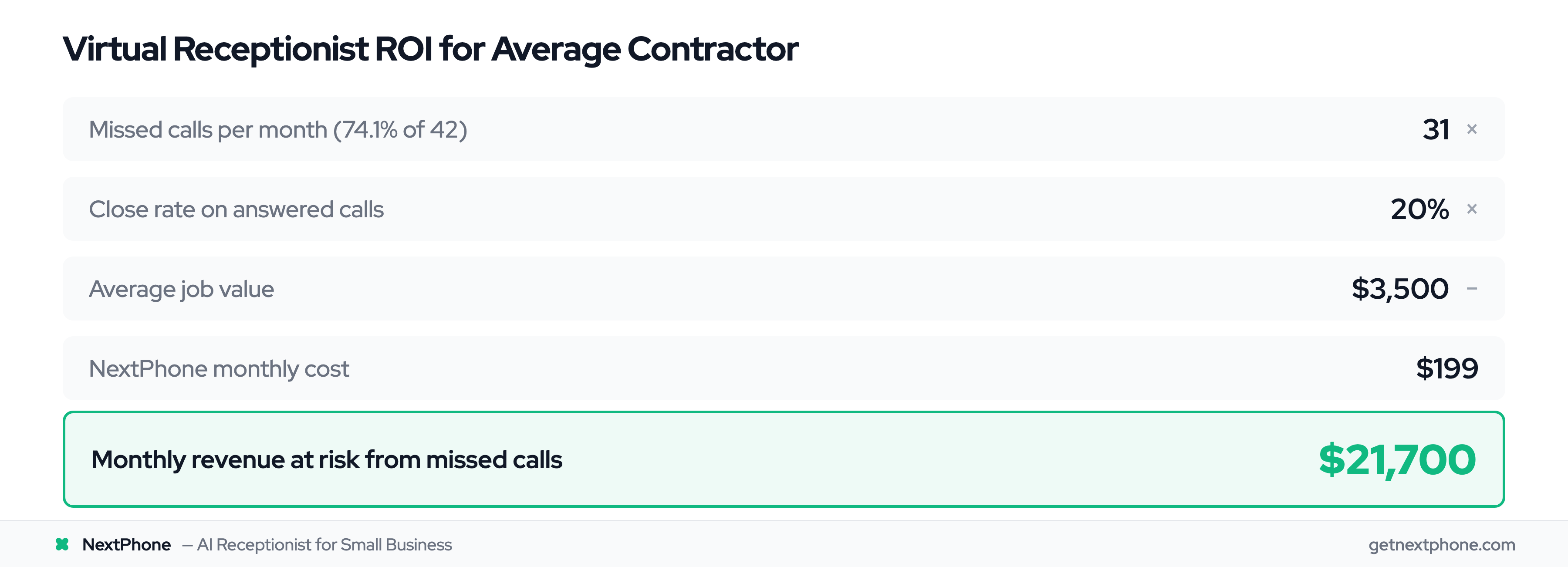
Average contractor in our data: 42 calls/month, 31 missed (74.1% rate).
Conservative calculation:
- 31 missed calls/month
- 20% would have hired you (industry close rate)
- = 6.2 lost jobs per month
- x $3,500 average job value
- = $21,700 lost per month
- = $260,400 lost per year
Our average across all 45 contractors: $189,068 lost annually per business.
That's not accounting for referrals, repeat business, or lifetime customer value. Just the immediate revenue from jobs you didn't book because you didn't answer.
Live Virtual Receptionist: Pros and Cons
How Live Virtual Receptionists Work
You sign up with a service. They assign trained agents to your account. When someone calls your business number, it routes to their call center. An agent answers "Good afternoon, [Your Business Name], how can I help you?" and handles the conversation.
Agents follow scripts you provide, answer from FAQs you give them, and escalate based on rules you set. Better services train agents specifically on your business.
Advantages of Live Receptionists
Human warmth and empathy. A real person can hear frustration in someone's voice and respond appropriately. They can say "I'm so sorry that happened" and mean it in a way AI can't replicate.
Handle complex conversations. Nuanced situations requiring judgment - "Can you fit me in today? I know it's short notice but..." - are better with humans who can assess and accommodate.
Better with upset callers. According to Gartner's 2024 survey, 64% of customers prefer not to interact with AI for customer service. When someone's already frustrated, adding AI to the mix can escalate rather than help.
Can improvise. Situations that don't fit any script? Humans figure it out. AI struggles with the unexpected.
Disadvantages of Live Receptionists
Higher cost. Live services typically charge $95-500/month plus per-call or per-minute fees. High call volume businesses see costs climb quickly.
Wait times. You're sharing agents with other businesses. During busy periods, callers wait 30-90 seconds in queue before someone picks up.
Limited 24/7. True 24/7 coverage is expensive. Many live services charge premiums for after-hours, or don't offer it at all.
Variable quality. Your experience depends on which agent picks up. Some are great, others less so.
Best For
Live virtual receptionists work best for:
- High-touch businesses where every call involves complex discussion
- Industries where customers expect (and pay for) premium service
- Businesses with low call volume (under 50/month)
- Situations involving emotional conversations (complaints, sensitive matters)
AI Virtual Receptionist: Pros and Cons
How AI Virtual Receptionists Work
AI virtual receptionists use speech recognition to understand what callers say and natural language processing to determine what they want. They're programmed with your business information and can answer questions, schedule appointments, take messages, and route calls.
When someone calls: AI answers in 2-3 rings, greets them, listens to their request, and takes action. Simple question? Answered immediately. Appointment request? Checks calendar, books time slot. Emergency? Routes to you within seconds.
Advantages of AI Receptionists
True 24/7/365 coverage. AI doesn't sleep, get sick, take holidays, or need breaks. A call at 3 AM gets the same instant response as 3 PM. 82% of customers expect an immediate response to sales or marketing questions—AI delivers that consistency.
Instant answer. AI picks up in 6-8 seconds. No queue, no hold music, no "please stay on the line."
Lower cost. Most AI services charge flat monthly fees regardless of call volume. $199/month unlimited is common. No per-call surprises.
Perfect consistency. Every call handled the same way. No good days and bad days.
Spam filtering. In our analysis, 7% of calls were spam and robocalls. AI recognizes and blocks these automatically - you never hear about them.
Calendar integration. Book appointments directly, update your schedule in real-time, send confirmations automatically.
Improves over time. AI learns from your specific calls. Week 1 might be 80% accurate; week 4 is 95%+.
Disadvantages of AI Receptionists
Can't handle complexity. "My breaker keeps tripping when I run the dryer and microwave together and there's a burning smell" - that needs your expertise, not AI.
Limited emotional intelligence. An upset customer needs empathy. AI can detect frustration and route the call, but can't provide genuine comfort.
Some customers don't like AI. That Gartner stat again - 64% would prefer not to interact with AI. Implemented poorly, it frustrates rather than helps.
Requires training. You need to provide your business information, common questions, emergency keywords. Setup takes a few hours.
Won't improvise. AI handles what it's programmed to handle. Unusual situations get routed to you rather than figured out.
Best For
AI virtual receptionists work best for:
- High call volume businesses (costs stay flat)
- Businesses with mostly routine calls (hours, pricing, scheduling)
- Need for true 24/7 coverage without premium costs
- Cost-conscious businesses
- Tech-comfortable customer base
Live vs AI: Which Is Right for You?
The Only Exception: Medical Practices with Complex Triage
Medical practices where 100% of calls require complex diagnostic triage genuinely need live services. That's it.
Every other "when live makes sense" scenario is answering service marketing:
"High-touch luxury services" - Your "luxury" caller waits 15-30 seconds while the receptionist finishes another call. AI answers in 1 ring. Which experience is premium?
"Nuanced conversations requiring judgment" - AI routes those to YOUR phone in under 5 seconds. The caller reaches YOU (the actual expert), not a receptionist reading scripts.
"Customers prefer human interaction" - Across 1,446,980 calls, 99% caller satisfaction with AI. They prefer the 1-ring answer speed.
"Budget for $300+/month" - That's $3,600/year more than AI at $199. Being able to afford overpayment doesn't justify overpayment.
"Low volume so per-call works" - At 30 calls/month, per-call at $7.50 = $225 vs flat $199. You're STILL overpaying.
AI Wins at Every Volume, Every Industry
Unless you're a medical practice with complex diagnostic triage, AI at $199/month delivers identical caller experience (99% caller satisfaction) at 1/3 to 1/6 the cost of live services.
The Case for Hybrid
For most small businesses, hybrid is the answer.
Here's the reality from our call data:
- 60-70% of calls are routine. Hours, pricing, service area, scheduling. AI handles these perfectly.
- 25-30% need human callback. Complex quotes, technical questions, detailed discussions. AI captures info, you call back.
- 5-10% are urgent. Emergencies, angry customers. AI detects and routes immediately.
Hybrid gives you AI speed and cost savings for the routine calls, plus appropriate handling for everything else.
Decision Framework
Ask yourself:
- What percentage of calls are routine questions? Higher = AI or hybrid.
- Do you need true 24/7 coverage? Yes = AI or hybrid.
- What's your monthly budget? Under $300 = AI. Over $300 = live or hybrid.
- How comfortable are your customers with technology? Very = AI works. Not at all = live better.
- How many emergencies do you handle? Any = need routing capability (AI or hybrid).
For most contractors and small businesses, the answer points to hybrid or AI with smart routing.
Virtual Receptionist Pricing
Live Virtual Receptionist Pricing
Live services vary widely:
- Ruby: $319/month + $5.19 per call
- AnswerConnect: $325/month + per-minute charges
- Smith.ai: $95/month for 50 calls ($2.85/additional call)
- Nexa: Custom pricing, typically $300-500/month
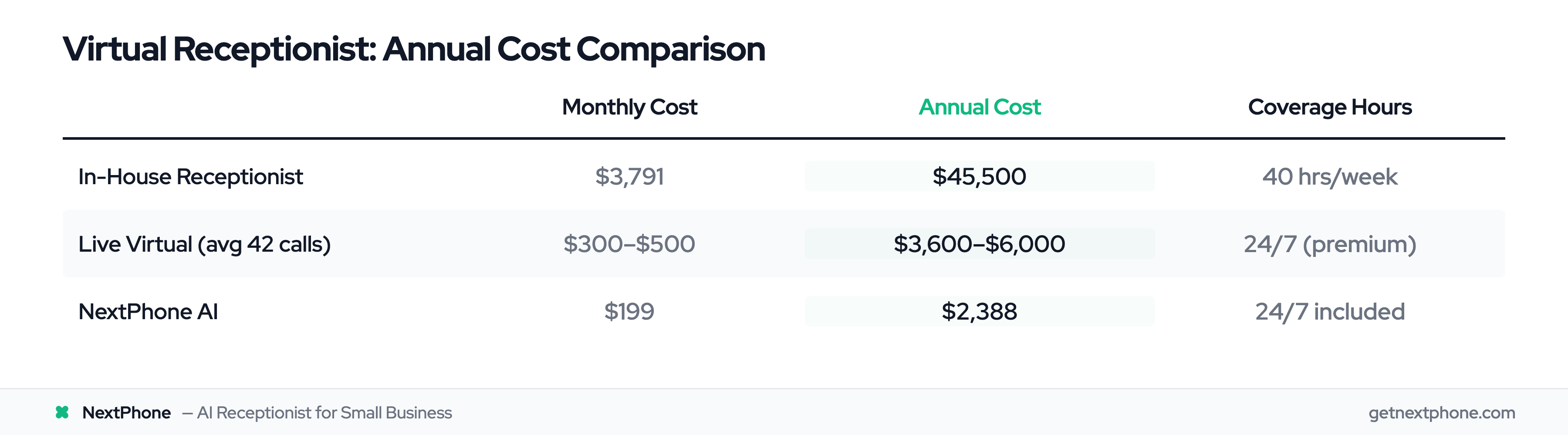
For a business getting 42 calls/month (our average), expect $300-500/month with most live services.
For high-volume businesses (87 calls/month like roofing contractors), costs can hit $600-800/month.
AI Virtual Receptionist Pricing
AI services typically offer flat monthly pricing:
- NextPhone: $199/month unlimited calls
- Other AI platforms: $99-300/month range
No per-call fees. No per-minute charges. 42 calls costs the same as 420 calls.
In-House Receptionist Cost
For comparison:
- Salary: $35,000/year (Bureau of Labor Statistics)
- Benefits/taxes: +30% = $10,500 Total: $45,500/year ($3,791/month)
- Coverage: 40 hours/week (24% of total hours)
Hidden Costs to Watch For
When comparing services, look out for:
- Setup fees: Some charge $500-2,000 to start
- Per-minute overages: Looks cheap until you have a busy month
- Integration fees: $200+ to connect your calendar
- Training fees: Charges for customization
- Long contracts: 12-24 month commitments with cancellation fees
Best approach: Flat monthly pricing, unlimited calls, no contract.
ROI of a Virtual Receptionist
The ROI Formula
(Missed calls x Close rate x Average job value) - Virtual receptionist cost = Net gain
Example Calculation
Using our actual data:
Your numbers:
- 42 calls/month (average from our analysis)
- 74.1% currently missed = 31 missed calls
- 20% close rate (industry standard)
- $3,500 average job value
Without virtual receptionist:
- 31 missed calls x 20% = 6.2 lost jobs/month
- 6.2 x $3,500 = $21,700 lost/month
- $260,400 lost/year
With NextPhone ($199/month):
- Annual cost: $2,388
- If capturing even 10% of missed opportunities: $26,040 gained
- Net: $23,652 gained
- ROI: 991%
If capturing 50% of missed opportunities: $130,200 gained ROI: 5,352%
Conservative Approach
Don't believe the math? Try this:
Capture just ONE additional $3,500 job that you would have missed.
That single job pays for NextPhone for 17 months. Everything after that is profit.
One roofer in our study was missing $666,000 in potential revenue annually. If a virtual receptionist captures even 5% of that opportunity, it's $33,300 gained against $2,388 spent.
How to Choose a Virtual Receptionist Service
Key Features to Look For
Must-haves:
- 24/7 availability (or coverage matching your needs)
- Emergency call detection and routing
- Calendar integration
- Transparent pricing
- No long-term contracts
- Fast setup (hours or days, not weeks)
Nice-to-haves:
- CRM integration
- Custom greetings
- Call recording/transcripts
- Analytics dashboard
Questions to Ask
Before signing up:
- What's included in the base price?
- How are emergencies handled?
- What's the setup process and timeline?
- Can I try before committing?
- What's the cancellation policy?
- How does billing work for overages (if any)?
Red Flags to Avoid
Walk away if you see:
- "Contact us for pricing" (usually expensive)
- Per-minute charges (unpredictable costs)
- Long contracts (12+ months)
- No emergency routing capability
- Setup takes weeks
- Poor reviews mentioning missed calls or quality issues
How NextPhone's Virtual Receptionist Works
Built for Small Businesses
NextPhone was built from our analysis of 130,175 contractor calls. We understand the specific challenges small businesses face - you're on job sites, with customers, dealing with emergencies, and can't answer every ring.
The AI recognizes industry-specific language:
- "Pipe burst" = emergency, route immediately
- "Need estimate" = quote request, capture details
- "What are your hours?" = FAQ, answer instantly
- "Do you work Saturdays?" = scheduling question, check calendar
Hybrid Approach
NextPhone handles calls based on what they actually need:
Routine calls (60-70%): AI answers instantly, provides information or books appointment. You're never interrupted.
Complex calls (25-30%): AI captures detailed message with contact info and service request. You call back when convenient.
Urgent calls (5-10%): AI detects emergency keywords, routes to you within seconds.
Real example from a plumber's week:
- Monday 2 PM: Customer asks about service area. AI answers, books appointment.
- Tuesday 11 PM: "Water heater leaking everywhere!" AI routes immediately. $1,800 job captured.
- Wednesday 3 PM: Request for whole-house repipe quote. AI takes detailed message.
- Friday 9 AM: Robocall. AI blocks it. Plumber never knows.
Four calls, one required the plumber's immediate attention.
Simple Pricing
$199/month unlimited calls.
No setup fees. No per-call charges. No contract.
Setup takes 1-2 hours. Most customers are handling real calls within the first day.
Try NextPhone free for 7 days
AI answering service that answers, qualifies, and books — 24/7.
Get Started FreeFrequently Asked Questions
What is a virtual receptionist?
A virtual receptionist is a person or AI system that answers your business calls remotely. Unlike an in-house receptionist sitting at your front desk, virtual receptionists work from call centers (live agents) or cloud-based systems (AI). They answer in your business name, take messages, schedule appointments, and route urgent calls - all without being physically present at your location. Pricing ranges from $95-500/month for live services to $199/month for AI options like NextPhone.
What's the difference between a live and AI virtual receptionist?
Live virtual receptionists are real humans working from call centers who answer your calls. They excel at complex conversations, emotional situations, and improvising. AI virtual receptionists use artificial intelligence to understand callers and respond. They offer true 24/7 instant coverage at lower cost but can't handle nuanced situations as well. Hybrid options combine both: AI handles routine calls instantly, humans handle complex ones when needed.
How much does a virtual receptionist cost?
Pricing varies by type. Live virtual receptionists typically cost $95-500/month depending on call volume, with some charging per-call fees ($1.50-3.00). AI virtual receptionists usually offer flat monthly pricing ($99-300/month) with unlimited calls. NextPhone charges $199/month unlimited. Compare this to an in-house receptionist at $35,000+/year salary plus benefits.
Is a virtual receptionist worth it for small business?
For most small businesses, yes. Our analysis of 130,175 calls shows the average contractor misses 74.1% of incoming calls, losing $189,068 per year in potential revenue. A virtual receptionist costing $2,388/year (NextPhone) can yield massive ROI if it helps capture even a fraction of those missed opportunities. Even capturing one additional $3,500 job pays for 17 months of service.
Will customers know they're talking to a virtual receptionist?
With live virtual receptionists, callers typically can't tell - agents answer in your business name and follow your scripts. With AI virtual receptionists, the best practice is transparency, but the experience is seamless for routine questions. What matters most is how quickly and effectively the call is handled, not where the receptionist is located.
Can virtual receptionists handle emergencies?
Yes, but differently depending on type. Live virtual receptionists recognize urgency and follow escalation procedures you set. AI virtual receptionists detect emergency keywords ("flooding," "no heat," "burst pipe") and route those calls to you within seconds rather than trying to handle them. In our data, 6.2% of calls were true emergencies requiring immediate human response - good virtual receptionist services handle this routing automatically.
How quickly can I set up a virtual receptionist?
Live virtual receptionist services typically take 1-2 weeks to fully configure with scripts and training. AI virtual receptionists can be set up in hours - connect your phone, provide business information, set routing rules, and go live. NextPhone customers are usually handling real calls within the first day, with accuracy improving over the first month as the AI learns.
Stop Missing Calls
Virtual receptionists ensure every call to your business gets answered. Live agents offer human warmth and judgment. AI offers instant 24/7 coverage at lower cost. Hybrid combines both benefits.
For small businesses missing 74% of calls and losing $189,000+ per year in opportunities, the question isn't whether to get phone coverage. It's which type fits your business.
The businesses succeeding in 2026 aren't trying to answer every call themselves. They're using virtual receptionists to capture opportunities they'd otherwise miss.
Ready to stop missing calls? See how NextPhone's AI virtual receptionist provides 24/7 coverage for $199/month unlimited.