
The Phone Problem That Never Went Away
Despite the rise of email, chat, and social messaging, the phone remains the communication channel customers turn to when something matters. They call when they want answers now. They call when the issue is complicated. They call when they need a human touch.
For businesses, this creates a persistent problem. Staffing phones around the clock is expensive. Hiring enough people to handle peak call times means paying for idle time during slow periods. And every missed call represents missed revenue—research consistently shows that most callers who reach voicemail never call back.
Traditional solutions never fully solved this. Voicemail frustrates customers who want immediate answers. Outsourced call centers often struggle with brand consistency and deep product knowledge. Interactive voice response (IVR) systems—those endless "press 1 for sales, press 2 for support" menus—rank among the most despised customer experiences ever created.
AI phone technology changes the equation. Systems that understand natural speech, interpret intent, and respond conversationally have moved from science fiction to business reality. The voice AI market is projected to grow from $2.4B in 2024 to $47.5B by 2034 at a 34.8% CAGR. According to recent data, 60% of small businesses now use AI for operations—more than double the rate from 2023.
This guide explains how AI phone technology actually works, the business results companies are achieving, and what implementation looks like in practice.
What Is AI Phone Technology?
AI phone technology refers to artificial intelligence systems that can understand, process, and respond to phone conversations naturally. Unlike traditional automated phone systems that rely on button presses and predetermined paths, AI phone technology conducts actual conversations.
Beyond Traditional Phone Systems
The distinction matters more than it might seem. Traditional IVR systems operate on rigid rules. If the caller presses 1, route them to sales. If they press 2, route them to support. The system has no understanding of why someone is calling—it only knows which button they pressed.
AI phone technology operates on understanding. When a caller says, "I ordered something last week and it never arrived," the system recognizes this as a shipping issue, can access order history, look up tracking information, and provide a meaningful response. No menus. No button presses. Just conversation.
The Fundamental Difference
The core capability is intent recognition. AI phone technology doesn't just hear words—it understands what callers want to accomplish.
Consider how different this is in practice. A traditional system forces callers to translate their needs into menu options. "I need to move my dentist appointment to next Thursday" becomes: listen to the full menu, press 3 for scheduling, wait on hold, explain the request to whoever answers.
With AI phone technology, the caller simply states what they need. The system understands that "move my appointment to next Thursday" means rescheduling, identifies the caller, pulls up their appointment, checks availability for Thursday, and handles the change—all through natural conversation.
How AI Phone Technology Works
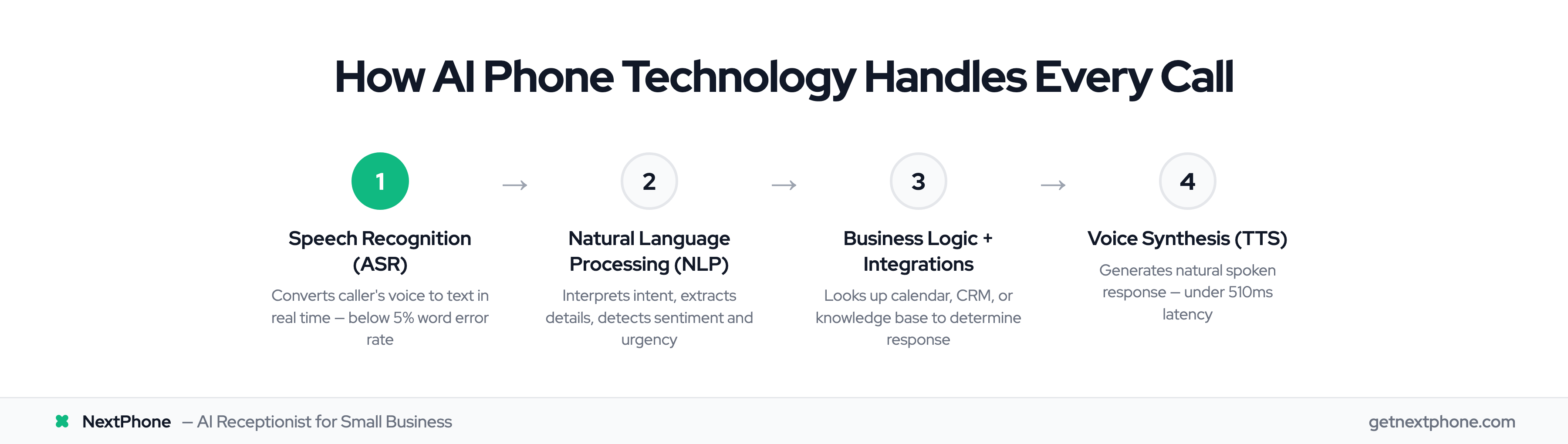
Three core technologies work together to make AI phone conversations possible. Understanding each component helps explain both the capabilities and limitations of current systems.
Automatic Speech Recognition (ASR)
Automatic speech recognition converts spoken words into text. When a caller speaks, ASR captures the audio, breaks it into phonetic components, and produces a written transcript in real time.
Modern ASR has become remarkably accurate. Word error rates—the percentage of words transcribed incorrectly—have dropped below 5% in many business scenarios. This approaches human transcription accuracy.
The technology handles challenges that would have been insurmountable a decade ago:
- Accents and dialects - Systems trained on diverse speech patterns recognize regional variations
- Background noise - Filtering algorithms separate speech from environmental sounds
- Conversational speech - Recognition of incomplete sentences, self-corrections, and natural speech patterns
- Industry vocabulary - Adaptation to specialized terminology in healthcare, legal, financial, and other sectors
This accuracy matters because every transcription error compounds downstream. If ASR mishears "buy" as "bye," the entire response will be wrong.
Natural Language Processing (NLP)
Natural language processing is where the intelligence lives. NLP takes the text produced by ASR and interprets what it actually means.
This goes far beyond keyword matching. When a caller says, "My internet has been acting weird all morning," NLP recognizes this as a service issue requiring troubleshooting. It also detects the implied frustration in "acting weird all morning" and can prioritize accordingly.
Key NLP capabilities for business phone applications include:
Intent classification determines what the caller wants to accomplish. Verizon's AI predicts caller intent 80% of the time. "I need to change my appointment," "Can we reschedule for next week," and "Something came up Tuesday, is there another time available?" all express the same intent: scheduling change.
Entity extraction identifies specific details embedded in conversation. Order numbers, dates, times, names, and account information get pulled from natural speech and made available for processing.
Sentiment analysis detects emotional tone. Is the caller frustrated, satisfied, confused, or neutral? This information can trigger different response strategies or escalation paths.
Contextual interpretation maintains understanding across a conversation. If a caller provides their account number at the start, references to "my account" later in the call connect to that information.
NLP continuously improves through machine learning. As systems handle more conversations, they learn to recognize new phrasings, industry-specific terminology, and regional expressions.
Text-to-Speech and Voice Synthesis
Text-to-speech (TTS) generates the spoken responses callers hear. Modern TTS, powered by large language models, produces speech that sounds remarkably human.
The robotic, obviously-synthesized voices of early phone systems have given way to synthesis with natural rhythm, appropriate emphasis, and even emotional nuance. Response latency has dropped to 510ms for best-in-class voice AI—fast enough that conversations feel fluid rather than stilted with awkward pauses. There's been a 70% rise in vertical voice AI startups according to Y Combinator.
Multilingual support has expanded dramatically. Leading platforms support 18 or more languages, with real-time translation enabling businesses to serve global customers without multilingual staff. For comprehensive data on adoption trends, see these 30+ voice AI statistics.
The Continuous Loop
These three technologies work in a continuous cycle throughout each call:
- ASR transcribes the caller's speech into text
- NLP interprets meaning and decides how to respond
- TTS converts the response into natural speech
- The cycle repeats, with NLP maintaining context from all previous exchanges
This loop happens fast enough that callers experience natural conversation flow. The technology disappears; only the interaction remains.
Core Capabilities of Modern AI Phone Systems
Understanding the technology components explains how AI phone systems work. But what can they actually do for businesses?
24/7 Intelligent Call Answering
The most immediate capability is around-the-clock availability. AI phone systems answer every call, day or night, weekends and holidays, without staffing costs.
This matters more than simple availability numbers suggest. Speed matters too. Testing showed that AI systems can answer 100% of calls within 3 seconds—compared to an industry average of 28 seconds for human-answered calls. Those extra 25 seconds are often the difference between a caller staying on the line and hanging up.
Consistency matters as well. AI doesn't have bad days, doesn't get tired at the end of shifts, and delivers the same quality at 3 AM that it does at 10 AM.
Natural Conversation Handling
Modern AI phone systems handle real conversations, not just single-turn question-and-answer exchanges.
Multi-turn conversations maintain context. A caller can provide information early in the call and reference it later without repetition. "As I mentioned, the order was placed last Monday" works because the system remembers the earlier context.
The technology handles interruptions and corrections naturally. Callers don't need to wait for the AI to finish before speaking. Mid-sentence corrections ("I mean Thursday, not Tuesday") get processed appropriately.
When clarification is needed, systems ask rather than guess. "I want to check on shipping" might prompt "I'd be happy to help with that. Could you provide your order number or the email address on the order?"
Critical to real-world success: AI phone systems recognize when they're out of their depth. Escalation triggers identify situations requiring human judgment, and calls transfer smoothly with full context.
Appointment Scheduling and Management
Scheduling represents one of the highest-value applications. AI phone systems integrate with calendar platforms to:
- Book appointments based on real-time availability
- Reschedule existing appointments through conversation
- Send confirmation texts or emails
- Provide automated reminders
- Handle cancellations and waitlist management
For service businesses—medical practices, salons, law firms, home services—this automation addresses one of the most time-consuming phone tasks while improving customer experience.
Intelligent Call Routing
Even when calls ultimately reach human agents, AI phone technology improves the handoff.
Traditional routing relies on menu selections or basic data like phone number. AI routing considers:
- Detected intent - Matching callers to agents with relevant expertise
- Sentiment - Prioritizing frustrated callers or routing to de-escalation specialists
- Customer value - Connecting important accounts to senior representatives
- Language - Routing to agents who speak the caller's language
- History - Connecting returning callers to agents familiar with their situation
The result is fewer transfers, shorter resolution times, and higher first-call resolution rates.
CRM and Business System Integration
Integration transforms AI phone technology from a standalone tool into a connected business system.
With CRM integration, every call automatically logs to customer records. The AI accesses customer history during calls for personalized service. Lead status and opportunity information update based on conversation outcomes.
Calendar integration enables real-time scheduling. Order management systems provide status information. Knowledge bases supply answers to common questions. Payment processors handle transactions.
This connectivity means AI phone systems don't just answer calls—they take action, update records, and complete tasks that would otherwise require human data entry.
The Business Case for AI Phone Technology
Theory matters less than results. What returns are businesses actually seeing from AI phone technology?
Cost Savings and ROI

The data is compelling. According to industry research, 51% of companies implementing voice AI report cost savings between 26% and 75%. Payback periods can be as short as 60-90 days.
A healthcare network documented projected annual savings of $1.2 million while improving compliance through secure, automated transcription. A casino group freed three days of agent time weekly by automating 300 conversations per week.
Sources of savings include:
- Reduced staffing requirements - Automation handles call volume that would otherwise require additional agents
- Lower training costs - AI doesn't require onboarding and ramp-up time
- Decreased infrastructure - Cloud-based systems reduce telephony equipment needs
- Improved efficiency - Faster call resolution means lower cost per interaction
Productivity Improvements
Beyond direct cost savings, productivity gains compound returns. Research shows 49% of companies report productivity increases of 26-75% after implementation.
Employees save an average of 1.9 hours per week through AI-assisted information retrieval. Up to 80% of routine call volume can be automated, freeing human agents to focus on complex, high-value interactions where they add the most value.
Customer Experience Impact
Financial returns don't come at the expense of customer satisfaction—quite the opposite.
Industry research indicates significant increases in customer satisfaction attributable to eliminated hold times and instant intent routing. Companies report customer satisfaction improvements after implementation.
Consistent quality matters too. AI doesn't have variability between agents or degradation at the end of long shifts. Every caller gets the same high-quality experience.
Small Business Accessibility
AI phone technology is no longer enterprise-only. Solutions start at $39-50 per month. Cloud-based deployment eliminates infrastructure requirements. Usage-based pricing models reduce upfront investment.
For small businesses, the impact can be proportionally larger than for enterprises. A five-person company can't staff 24/7 phone coverage, but AI can. According to surveys, 83% of small business AI users say the technology helps improve systems and efficiency.