
The End of "Press 1 for Sales"
For decades, calling a business meant navigating frustrating phone trees. Press 1 for sales. Press 2 for support. Press 0 to speak with an operator. Listen to the entire menu, because our options have changed. Meanwhile, voice technology adoption has exploded—Statista reports 8.4 billion voice assistants globally by 2024, up from 4.2 billion in 2020.
That era is ending. Voice AI for business has transformed how companies handle phone communications, replacing rigid menu systems with intelligent conversations that understand what callers actually need. 62% of US adults now use voice assistants regularly, and their expectations carry over to business interactions.
The shift has been dramatic. In 2024, voice AI startups raised $2.1 billion in funding—an eightfold increase from the previous year. More than 20% of a recent Y Combinator cohort focused exclusively on voice AI technology. And 26% of contact centers implemented AI for customer experience last year, with another 42% planning to do so by 2025.
This guide explores how voice AI business technology works, the core components that make natural conversations possible, real-world applications across industries, and the measurable returns companies are seeing from implementation. Twilio's report "Inside the Conversational AI Revolution", surveying 457 business leaders and 4,800 consumers, shows adoption accelerating rapidly despite perception gaps between businesses and customers.
What Is Voice AI and How Does It Work?
Voice AI refers to artificial intelligence systems that can understand spoken language, interpret meaning, and respond naturally through synthesized speech. Unlike traditional interactive voice response (IVR) systems that rely on touchtone inputs and predetermined paths, voice AI conducts actual conversations.
The fundamental difference lies in intelligence. Legacy phone systems operate on rules: if the caller presses 1, route to sales. Voice AI operates on understanding: the caller said they want to check on an order placed last week, so pull up their recent orders and provide status.
The Technology Stack
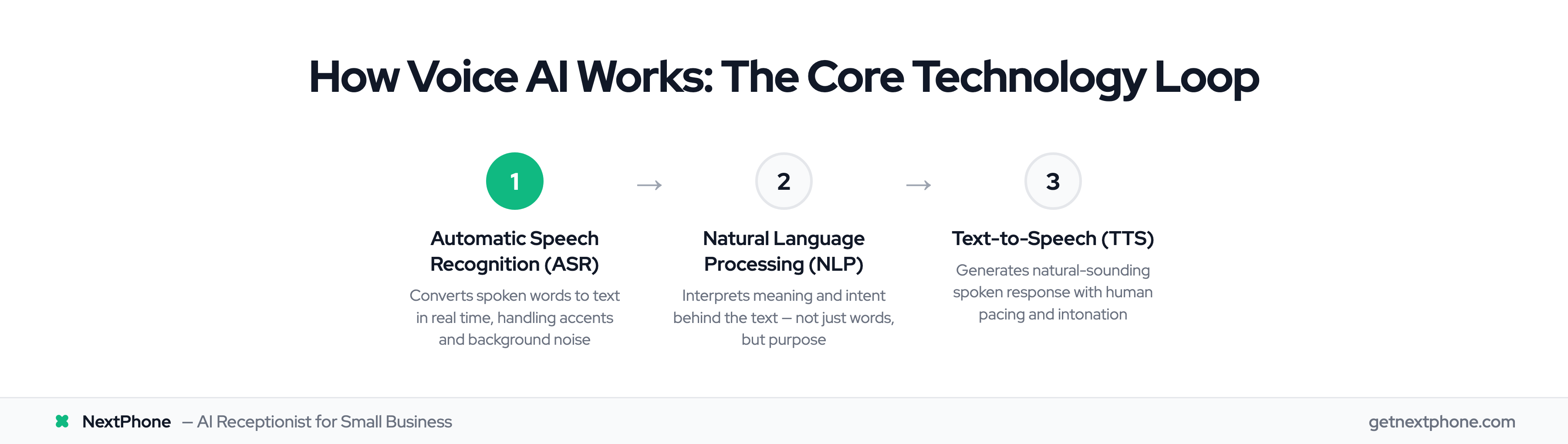
Three core technologies work together to make voice AI possible:
Automatic Speech Recognition (ASR) converts spoken words into text. The system captures audio, breaks it into phonetic components, accounts for accents and speech patterns, and produces a written transcript in real time. Modern ASR handles background noise, multiple speakers, and conversational speech patterns with increasing accuracy.
Natural Language Processing (NLP) interprets what the text actually means. This is where the intelligence lives. NLP analyzes word choices, sentence structure, and context to determine intent. When a caller says "I need to change my appointment," NLP recognizes this as a scheduling request—not a question about change or a complaint about the current time.
Text-to-Speech (TTS) generates natural-sounding spoken responses. Powered by large language models, modern TTS produces speech that sounds human, with appropriate pacing, intonation, and even emotional nuance. The robotic voices of early phone systems have given way to synthesis that callers often mistake for human agents.
These three technologies work in a continuous loop. ASR transcribes the caller's speech. NLP determines meaning and decides how to respond. TTS delivers that response audibly. The cycle repeats throughout the conversation, with the system maintaining context from previous exchanges.
The Role of Large Language Models
The recent explosion in voice AI adoption traces directly to advances in large language models (LLMs). These AI systems, trained on vast amounts of text and conversation data, can generate contextually appropriate responses and maintain coherent multi-turn conversations. Industry voice-AI research documents how LLMs have fundamentally transformed voice interaction capabilities.
When OpenAI reduced pricing on its real-time voice API by 60-87% in late 2024, the economics of voice AI shifted dramatically. OpenAI's 2025 State of Enterprise AI report found 82% of employees now use generative AI at least weekly. Conversations that previously cost dollars can now cost cents. This price reduction, combined with improved quality, has made sophisticated voice AI accessible to businesses of all sizes.
Core Technologies Powering Voice AI
Understanding the underlying technology helps businesses evaluate solutions and set realistic expectations for implementation.
Natural Language Processing (NLP)
NLP makes voice interactions feel natural instead of mechanical. It enables systems to understand not just words, but the context and intent behind them.
Consider a caller who says, "My internet has been acting weird all morning." A keyword-based system might search for "internet" and route to general support. NLP recognizes this as a service issue requiring troubleshooting, detects the implied frustration in "acting weird all morning," and can prioritize accordingly.
Key NLP capabilities for business voice AI include:
- Sentiment analysis - Detecting whether a caller is frustrated, satisfied, or neutral
- Entity extraction - Identifying specific details like order numbers, dates, or account information
- Intent classification - Determining what the caller wants to accomplish
- Contextual interpretation - Understanding references to previous statements in the conversation
NLP continues improving through machine learning. As systems handle more conversations, they learn to recognize new phrasings, industry-specific terminology, and regional expressions. Voice AI statistics show 30+ data points confirming these capabilities are driving adoption across industries.
Intent Recognition
Intent recognition determines what callers actually want to accomplish. This goes beyond understanding words to grasping purpose.
A caller might say "I want to talk to someone about my bill," "My last statement didn't look right," or "Why did my payment go up?" All three express the same intent: billing inquiry. Voice AI systems trained on thousands of similar conversations learn to map diverse phrasings to common intents.
Sophisticated intent recognition handles:
- Multi-intent requests - "I need to reschedule my appointment and update my phone number"
- Implicit intents - "I'm moving next month" (implies address change and possible service transfer)
- Clarification needs - Recognizing when more information is required before proceeding
- Escalation triggers - Identifying when a human agent should take over
The quality of intent recognition directly impacts call resolution. Systems that accurately identify intent on the first try reduce transfers, shorten call times, and improve customer satisfaction.
Speech-to-Text and Text-to-Speech
The input and output layers of voice AI have advanced significantly.
Modern ASR achieves word error rates below 5% in many scenarios—comparable to human transcription accuracy. Systems can handle:
- Multiple accents and dialects
- Background noise and poor audio quality
- Conversational speech with interruptions and corrections
- Industry-specific vocabulary and proper nouns
Text-to-speech has undergone an even more dramatic transformation. LLM-powered synthesis generates speech with natural rhythm, appropriate emphasis, and emotional intelligence. Response latency has dropped below 500 milliseconds, enabling conversations that feel fluid rather than stilted.
Multilingual support has expanded as well. Leading platforms support 18 or more languages, with real-time translation enabling businesses to serve global customers without multilingual staff.
Context Awareness and Memory
The most capable voice AI systems maintain context throughout conversations and across interactions.
Within a single call, context awareness means the system remembers what was discussed. If a caller provides their account number at the start, they shouldn't have to repeat it. If they ask about "that order," the system knows which order they mean.
Across interactions, memory enables personalization. The system can reference previous calls, recognize returning customers, and tailor responses based on history. Integration with CRM systems makes this possible, pulling customer data in real time and logging conversation details for future reference.
Business Applications and Use Cases
Voice AI for business spans industries and functions, with applications continuing to expand.
Customer Service Automation
The highest-volume use case remains customer service. Voice AI handles routine inquiries that previously required human agents:
- Order status - "Where is my package?" queries resolved through shipping system integration
- Appointment management - Scheduling, rescheduling, and confirmation handled conversationally
- Account inquiries - Balance checks, usage information, and statement questions answered instantly
- Password resets - Identity verification and credential updates completed without agent involvement
- FAQ responses - Common questions answered from knowledge bases
Companies report automating 60-80% of routine calls, freeing human agents for complex issues requiring judgment and empathy.
Intelligent Call Routing
Even when calls require human agents, voice AI improves the handoff.
Traditional routing relies on caller selections or basic data like phone number. Voice AI routes based on:
- Detected intent - Matching callers to agents with relevant expertise
- Sentiment analysis - Prioritizing frustrated callers or routing to specialists trained in de-escalation
- Customer value - Connecting high-value accounts to senior representatives
- Language preference - Routing to agents who speak the caller's language
- Previous interactions - Connecting returning callers to agents familiar with their situation
The result is fewer transfers, shorter resolution times, and higher first-call resolution rates.
Industry-Specific Applications
Voice AI adapts to vertical requirements:
Healthcare applications include appointment scheduling, prescription refill requests, symptom triage, and insurance verification. Compliant systems maintain required security standards. One hospital network reported 60% call containment, with wait times dropping below two minutes and projected annual savings of $1.2 million.
Financial services use voice AI for balance inquiries, transaction verification, payment scheduling, and fraud alerts. Secure authentication through voice biometrics adds protection without friction.
Retail and e-commerce deploy voice AI for order management, product inquiries, return initiation, and delivery scheduling. Integration with inventory and shipping systems enables real-time accurate responses.
Hospitality applications span reservations, concierge services, and guest support. Voice AI handles routine booking modifications while routing VIP requests to specialized teams.
Sales and Lead Qualification
Outbound voice AI engages leads at scale:
- Initial outreach to inbound leads before they go cold
- Qualification questions to assess fit and interest
- Appointment scheduling with sales representatives
- Follow-up on proposals and pending decisions
- Re-engagement of dormant opportunities
CRM integration ensures all interaction data flows back to sales teams, maintaining complete visibility into the customer journey.
The ROI of Voice AI

Businesses adopt voice AI for measurable financial returns. The data supports the investment.
Cost Savings
According to industry research, 51% of companies implementing voice technology report cost savings between 26% and 75%. The sources of savings include:
- Reduced staffing requirements - Automation handles volume that would otherwise require additional agents
- Lower training costs - AI systems don't require onboarding and ramp-up time
- Decreased infrastructure - Cloud-based voice AI reduces telephony equipment needs
- Improved efficiency - Faster call resolution means lower cost per interaction
A hospital network case study documented projected annual savings of $1.2 million while improving compliance through secure, automated transcription. Golden Nugget casinos freed three days of agent time weekly by automating 300 conversations per week.
Industry research indicates payback periods as short as 60-90 days for well-implemented voice AI programs.
Productivity Improvements
Beyond cost savings, productivity gains compound returns:
- 49% of companies report productivity increases of 26-75%
- Employees save an average of 1.9 hours per week through voice AI-assisted information retrieval
- 80% of call volume can be automated for routine inquiries
- Human agents handle more complex, higher-value interactions
These productivity improvements translate to better service for complex cases—agents aren't rushed because they're buried in routine calls.
Customer Experience Impact
Customer satisfaction metrics improve alongside operational efficiency:
- 10% CSAT increase attributed to eliminated hold times and instant intent routing (Forrester)
- 27% customer satisfaction improvement reported by adopting companies
- 24/7 availability without the cost of around-the-clock staffing
- Consistent quality - AI doesn't have bad days or vary in training
The combination of faster resolution, reduced wait times, and always-available service directly impacts customer perception and loyalty.
Integration with Business Systems
Voice AI value multiplies through integration with existing business systems.
CRM Integration
Voice-to-CRM connectivity enables:
- Automatic data capture - Conversation details logged without manual entry
- Real-time customer context - AI accesses history during calls
- Lead and opportunity updates - Status changes reflected immediately
- Consistent customer records - Single source of truth across channels
Integration with platforms like Salesforce, HubSpot, and Zoho is standard for enterprise voice AI solutions.
Enterprise System Connectivity
Beyond CRM, voice AI connects to:
- Calendaring systems - Direct appointment booking and modification
- ERP platforms - Order status, inventory availability, and account information
- Ticketing systems - Issue creation and status updates
- Knowledge bases - Access to FAQ and support documentation
- Payment processors - Secure transaction handling
APIs enable custom integrations for proprietary systems, ensuring voice AI fits existing workflows rather than requiring process changes.
Data and Analytics
Every voice AI conversation generates data:
- Call volumes and patterns
- Common intents and resolution rates
- Sentiment trends
- Escalation reasons
- Agent performance comparisons
This data feeds analytics platforms, informing operational decisions and identifying opportunities for improvement. Conversation transcripts can also train and improve AI models over time.
Implementation Considerations
Successful voice AI deployment requires thoughtful planning.
Getting Started
Most successful implementations start focused rather than attempting to automate everything at once:
- Identify high-volume, routine calls - These offer the quickest wins
- Map current call flows - Understanding existing processes reveals automation opportunities
- Define success metrics - Containment rate, CSAT, cost per call, or other relevant KPIs
- Plan human handoff - Determine when and how calls transfer to agents
- Start with pilot programs - Test with limited scope before full rollout
Common Challenges
Realistic expectations include:
- Integration complexity - Connecting to legacy systems may require development work
- Edge case handling - AI won't handle every scenario; plan for exceptions
- Change management - Agents need training on new workflows and AI handoffs
- Brand voice consistency - AI responses should match company communication style
Best Practices
Organizations seeing the best results:
- Maintain clear escalation paths - Make it easy for callers to reach humans when needed
- Monitor continuously - Review transcripts and metrics to identify issues
- Iterate based on data - Use conversation analytics to improve AI performance
- Gather feedback - Post-call surveys and agent input guide refinement
NextPhone Voice AI Capabilities
NextPhone brings voice AI capabilities to businesses ready to modernize their phone systems.
Intelligent Voice Features
NextPhone's voice AI platform delivers:
- Natural language understanding that interprets caller intent without rigid scripts
- Context-aware conversations that remember details throughout interactions
- Real-time transcription for records and compliance
- Seamless CRM integration connecting conversations to customer data
Designed for Business
Unlike enterprise-only solutions, NextPhone makes voice AI accessible:
- Quick setup without complex infrastructure requirements
- Scalable capacity that grows with your business
- Unified communications integration with voice, messaging, and video
- Analytics dashboard for visibility into call patterns and performance
Practical Applications
NextPhone voice AI supports:
- Automated receptionist handling routine calls and routing complex ones
- Appointment scheduling integrated with popular calendar platforms
- Customer service automation for common inquiries
- Lead qualification capturing and scoring inbound interest
- After-hours support providing assistance when staff isn't available
The Future of Voice AI in Business
Voice AI technology continues advancing rapidly.
Emerging Capabilities
Near-term developments include:
- More natural conversations - Reduced latency and improved synthesis make AI increasingly indistinguishable from humans
- Expanded language support - Real-time translation enables global service
- Deeper personalization - AI that knows customer preferences and history in depth
- Proactive engagement - AI initiating outreach based on predicted needs
Market Trajectory
The voice AI agents market is projected to grow from $2.4 billion in 2024 to $47.5 billion by 2034—a compound annual growth rate of 34.8%. This growth reflects both technology advancement and business adoption.
With 81% of companies planning to increase speech technology investment, voice AI is moving from competitive advantage to competitive necessity. Twilio's Q3 FY 2025 results show voice revenue accelerating to mid-teens growth (fastest in 3 years), with AI agent startups on Twilio growing revenue 60% YoY. Their ConversationRelay platform processed 1 million calls in Q2 and tripled volume in Q3. Businesses that delay adoption risk falling behind customer experience expectations set by early adopters.
Conclusion
Voice AI represents a fundamental shift in business phone communications. The technology has matured from experimental to practical, delivering measurable returns through cost savings, productivity improvements, and enhanced customer experience.
The combination of speech recognition, natural language processing, and voice synthesis enables conversations that feel natural while handling volume that would overwhelm human teams. Integration with CRM and business systems extends that value, connecting voice interactions to the broader customer relationship.
For businesses evaluating voice AI, the path forward is clearer than ever. Start with high-volume routine calls, measure results carefully, and expand based on data. The companies seeing the best outcomes treat implementation as an ongoing process of refinement rather than a one-time project.
The question is no longer whether voice AI works for business—the data confirms that it does. The question is how quickly your organization will adopt it.
Frequently Asked Questions
What is voice AI for business?
Voice AI for business refers to artificial intelligence systems that handle phone conversations through natural language understanding and speech synthesis. Unlike traditional IVR menus requiring touchtone input, voice AI conducts actual conversations—understanding spoken requests, determining intent, and responding naturally. The technology combines automatic speech recognition (ASR) to convert speech to text, natural language processing (NLP) to interpret meaning, and text-to-speech (TTS) to generate spoken responses. Businesses use voice AI for customer service automation, intelligent call routing, appointment scheduling, and lead qualification.
How accurate is voice AI speech recognition?
Modern automatic speech recognition achieves word error rates below 5% in many business scenarios, approaching human transcription accuracy. The technology handles diverse accents, dialects, and speech patterns through machine learning trained on millions of conversations. Background noise, audio quality issues, and conversational interruptions are increasingly manageable. Accuracy continues improving as systems learn from more interactions. Industry-specific terminology and proper nouns may require additional training, but most business voice AI platforms adapt quickly to domain vocabulary.
Can voice AI integrate with my existing CRM?
Yes, CRM integration is a standard capability for business voice AI platforms. Most solutions offer native connections to popular platforms like Salesforce, HubSpot, and Zoho. Integration enables voice-to-CRM data capture, where conversation details automatically log to customer records. AI can access customer history during calls for personalized service and update lead status or opportunity stages based on conversation outcomes. Custom integrations through APIs accommodate proprietary systems. The depth of integration varies by platform, so evaluating specific CRM connectivity is worthwhile when selecting a voice AI solution.
What is the typical ROI timeline for voice AI?
Well-implemented voice AI programs can achieve payback in 60-90 days, according to industry research. ROI comes from multiple sources: reduced staffing costs through automation, productivity gains from faster call handling, and improved customer retention from better experience. Fifty-one percent of companies report cost savings between 26% and 75%. Forrester research indicates 331% three-year ROI for AI voice agents. Actual timelines depend on implementation scope, call volume, and how effectively the system handles target use cases. Starting with high-volume, routine calls typically produces the fastest returns.
How does voice AI handle complex customer requests?
Voice AI handles complexity through intent recognition, context awareness, and human handoff protocols. Intent recognition identifies what callers want even when requests involve multiple topics or implicit needs. Context awareness maintains conversation history, so callers don't repeat information. When requests exceed AI capabilities, seamless handoff transfers calls to human agents with full context—the agent sees what was discussed and why the transfer occurred. The best voice AI systems know their limitations and escalate appropriately rather than frustrating callers with inadequate responses.
Is voice AI suitable for small businesses?
Voice AI has become increasingly accessible to small businesses. Cloud-based platforms eliminate infrastructure requirements, and usage-based pricing models reduce upfront investment. Solutions like NextPhone bring enterprise-grade voice AI to smaller organizations without enterprise complexity. Small businesses often see proportionally higher impact because automation addresses capacity constraints—a five-person company can't staff 24/7 coverage, but voice AI can. Starting points include automated receptionist functions, appointment scheduling, and after-hours support. These focused applications deliver value without requiring extensive implementation.
How does voice AI differ from chatbots?
Voice AI and chatbots share underlying technology—both use NLP to understand intent and generate responses—but differ in interaction mode and complexity. Voice AI handles spoken conversations requiring real-time speech recognition and synthesis, while chatbots process text. Voice interactions involve additional challenges: accents, background noise, conversational speech patterns, and the need for sub-second response latency to maintain natural flow. Voice AI also addresses phone-specific needs like call routing and telephony integration. Many businesses deploy both, using chatbots for web and messaging channels while voice AI handles phone communications.