
Introduction
You know that missed call last Tuesday at 2 PM? The one you couldn't answer because you were on a ladder fixing Mrs. Johnson's roof? That call was worth $3,500.
A homeowner three blocks away needed a roof inspection after last week's storm. She called you because her neighbor recommended you. You didn't answer. She called the next roofer in her phone. They answered. They got the job.
This isn't hypothetical. We analyzed 130,175 customer calls from 45 home services businesses over 7 months. The data is brutal: 74.1% of calls went completely unanswered. That translates to $189,068 in lost revenue per business, per year.
This guide isn't going to throw vague "savings" claims at you. We're going to show you the exact ROI formula, plug in real numbers from actual businesses, and calculate what a virtual receptionist is actually worth. You'll see conservative estimates, realistic projections, and the precise break-even point where the investment pays for itself.
Let's do the math.
The Virtual Receptionist ROI Formula
Every ROI calculation comes down to one question: What do you gain versus what do you spend? For virtual receptionist services, the formula is straightforward once you know your numbers.
The Master Formula
Here's the complete virtual receptionist ROI calculation:
Monthly Captured Revenue = Calls per month x Miss rate x Capture rate x Close rate x Average job value
Monthly ROI = Captured Revenue - Virtual Receptionist Cost
Annual ROI = Monthly ROI x 12
ROI Percentage = (Annual Gain / Annual Cost) x 100
That's it. Five variables that determine whether a virtual receptionist makes you money or costs you money. Let's break down each one.
Breaking Down Each Variable
Calls per month: How many inbound calls does your business receive? Check your phone bill or estimate based on a typical week. The average small business in our study received 42 calls per month.
Miss rate: What percentage of those calls go unanswered? Be honest. If you're on job sites 8 hours a day, you're probably missing more than you think. Our data shows 74.1% average across home services businesses.
Capture rate: What percentage of missed calls would a virtual receptionist actually capture? This is where scenarios matter. A 24/7 answering service captures calls you'd otherwise miss entirely. Conservative estimate: 10-30%. Realistic estimate: 50-70%.
Close rate: What percentage of answered leads turn into paying customers? Industry averages range from 15-30% depending on your follow-up. We use 20% as a conservative benchmark.
Average job value: What's your average project worth? A small repair might be $300. A full roof replacement might be $15,000. Use your actual average across all job types.
Plugging In Real Numbers
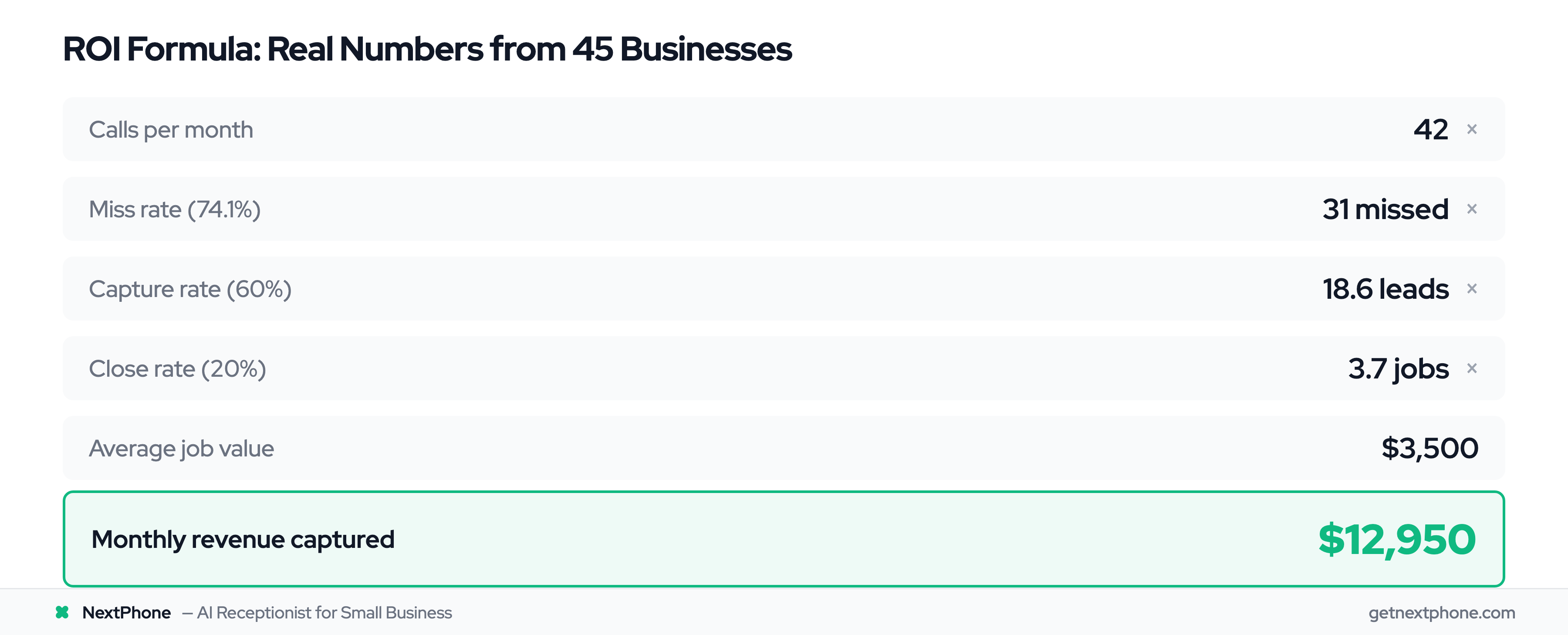
Let's run the formula with actual data from our study:
Starting numbers:
- 42 calls/month (average from our data)
- 74.1% miss rate (our documented average)
- 60% capture rate (realistic estimate)
- 20% close rate (conservative industry standard)
- $3,500 average job value (home services average)
Calculation:
Step 1: 42 calls x 74.1% missed = 31 missed calls per month
Step 2: 31 missed calls x 60% capture rate = 18.6 leads now captured
Step 3: 18.6 leads x 20% close rate = 3.7 new jobs per month
Step 4: 3.7 jobs x $3,500 = $12,950 revenue captured per month
Step 5: $12,950 - $199 (NextPhone cost) = $12,751 monthly gain
Step 6: $12,751 x 12 = $153,012 annual gain
ROI Percentage: ($153,012 / $2,388) x 100 = 6,409% return on investment
That's not a typo. When your average job is worth $3,500 and you're currently missing 74% of your calls, even a modest improvement creates massive returns.
The True Cost of a Missed Call
Before you dismiss those ROI numbers as too good to be true, let's look at what each missed call actually costs you. Research shows the average missed call costs businesses $12.15, with SMBs losing $26,000+ annually.
What Happens When You Miss a Call
When a potential customer calls and gets voicemail, here's the reality:
85% won't call back. They're not going to leave a message and wait for you to return their call. Meanwhile, 42% of SMBs lose $500+/month to missed calls. They have a problem right now. They'll call the next business on their list until someone answers.
They call your competitor immediately. The roofing lead who called you at 2 PM? She's calling another roofer at 2:01 PM. The plumber who answered first gets the emergency job. Your missed call becomes their revenue.
You never know they called. Unless you're checking voicemail religiously (and most business owners aren't), that potential customer disappears without a trace. You can't follow up on leads you don't know exist.
The Dollar Value of Each Missed Call
Here's the math on what each missed call is worth:
Value per call = Close rate x Average job value
With a 20% close rate and $3,500 average job: 20% x $3,500 = $700 potential value per missed call
Now multiply by your monthly missed calls:
31 missed calls x $700 = $21,700 lost per month
$21,700 x 12 = $260,400 lost per year
That's not theoretical. That's the actual value walking out the door every time your phone rings and nobody answers.
Why "They'll Call Back" Is a Lie
One quote from our actual call data: "Needs emergency AC repair, no cooling in 95 degree weather."
That caller isn't waiting for a callback. They're calling the next HVAC company. Same with:
"Wants an estimate for a new roof. No urgency."
The caller says "no urgency" - but they're calling NOW. If you don't answer, they move on. Your "not urgent" call becomes someone else's $15,000 project.
In our data, 6.2% of all calls were true emergencies that couldn't wait. Another 25.4% explicitly requested callbacks - meaning they wanted to talk to someone and couldn't. These are your highest-intent leads, and they're gone if you don't pick up.
Break-Even Analysis: When Does It Pay Off?
The ROI percentages are impressive, but let's talk about the number that matters most: when exactly does a virtual receptionist pay for itself?
The Break-Even Calculation
Break-even formula: Monthly cost / Revenue per captured lead
With NextPhone at $199/month and $700 average value per captured lead:
$199 / $700 = 0.28 leads needed to break even
Translation: You need to capture less than one-third of one additional lead per month to break even.
Or put another way: ONE captured lead every 3.5 months pays for the entire service.
How Few Captured Calls You Actually Need
Let's look at break-even with different job values:
$3,500 roofing job: One job pays for 17.6 months of service $1,200 emergency HVAC call: One job pays for 6 months of service $800 electrical repair: One job pays for 4 months of service $400 small plumbing job: One job pays for 2 months of service
Even if your average transaction is just $400, you only need to capture one additional job every two months to break even. Everything else is profit.
Time to Payback
For most businesses, the payback period is measured in days, not months. Studies show businesses see 30-200% ROI in the first year when implementing automation—virtual receptionist services often exceed these benchmarks.
If you currently miss 31 calls per month and a virtual receptionist captures even 10% of those (3 leads), with a 20% close rate you're looking at 0.6 additional jobs per month.
With a $3,500 average job value, that's $2,100/month in captured revenue from day one.
Payback period: Approximately 3 days at that rate.
The first captured job doesn't just pay for itself - it pays for the entire year and then some.
See how NextPhone captures $189K in missed opportunities for contractors
Your ROI in Three Scenarios

Not everyone captures 60% of their missed calls. Let's run the numbers across three scenarios: conservative, moderate, and realistic.
Conservative Scenario (10% Capture Improvement)
You're skeptical. You don't think AI answering will work that well. You have low call volume. Let's assume you only improve by 10%.
Calculation:
- 31 missed calls x 10% capture = 3.1 additional leads
- 3.1 x 20% close rate = 0.62 jobs
- 0.62 x $3,500 = $2,170/month captured
- $2,170 - $199 = $1,971 net gain per month
- Annual: $23,652 net gain
- ROI: 990%
Even with extremely conservative assumptions, you're still making nearly $24,000 more per year than you would without the service. The $199/month cost becomes trivial.
Moderate Scenario (30% Capture Improvement)
You implement properly, the AI handles routine calls well, and you're capturing leads you would have completely missed.
Calculation:
- 31 missed calls x 30% capture = 9.3 additional leads
- 9.3 x 20% close rate = 1.86 jobs
- 1.86 x $3,500 = $6,510/month captured
- $6,510 - $199 = $6,311 net gain per month
- Annual: $75,732 net gain
- ROI: 3,171%
At the moderate level, you're adding over $75,000 in revenue that would have gone to your competitors.
Realistic Scenario (60% Capture Improvement)
You have decent call volume, the virtual receptionist handles after-hours and on-job-site calls, and you're capturing the majority of what you used to miss.
Calculation:
- 31 missed calls x 60% capture = 18.6 additional leads
- 18.6 x 20% close rate = 3.72 jobs
- 3.72 x $3,500 = $12,950/month captured
- $12,950 - $199 = $12,751 net gain per month
- Annual: $153,012 net gain
- ROI: 6,409%
This is where most home services businesses land after a few months of operation. When you're on job sites 8+ hours a day, a 24/7 answering service captures the vast majority of calls you simply couldn't answer.
Which Scenario Applies to You?
Conservative (10%) if:
- You already answer 50%+ of calls yourself
- You get fewer than 20 calls per month
- You're testing the waters
Moderate (30%) if:
- You're on job sites most of the day
- You get 30-50 calls per month
- You have some after-hours call volume
Realistic (60%) if:
- You miss most calls while working
- You get 40+ calls per month
- You have significant after-hours/weekend calls
- Emergency calls are common in your industry
ROI By Industry
Your specific numbers depend heavily on your industry. Here's how virtual receptionist ROI plays out across different trades.
Roofing Contractors
Roofing contractors in our study saw the highest call volumes and highest project values.
The numbers:
- 87 calls/month average
- 76.6% missed (you're literally on roofs all day)
- $15,000 average project value
- 10.6% of calls are quote requests
ROI calculation (moderate 30% capture):
- 87 x 76.6% = 66.7 missed calls
- 66.7 x 30% = 20 captured leads
- 20 x 15% close rate = 3 additional jobs
- 3 x $15,000 = $45,000/month potential
- $45,000 - $199 = $44,801 monthly gain
Even at 15% close rate (lower than average because roofing is high-consideration), the ROI is extraordinary. One captured roof job pays for nearly 6 years of service.
HVAC and Plumbing
Emergency services have a unique ROI profile because emergencies can't wait.
The numbers:
- 6.2% of calls are emergencies
- $1,200 average emergency job
- 100% close rate on emergencies (if you show up, you get the job)
Emergency-only ROI calculation:
- 42 calls x 6.2% = 2.6 emergency calls/month
- 2.6 x 74.1% = 1.9 missed emergency calls/month
- If virtual receptionist routes all emergencies to your phone: 1.9 captured
- 1.9 x $1,200 = $2,280/month just from emergencies
That's $2,280/month from emergency calls alone - 11X the cost of the service. Non-emergency calls are additional upside.
Electrical Contractors
Electricians had the highest miss rate in our study at 91%. Most room for improvement.
The numbers:
- 91% miss rate (constantly working in tight spaces, power off)
- Even 10% improvement = dramatic results
When you're missing 91% of calls, moving to 81% missed means capturing 10 additional calls per month. With 20% close and $2,000 average job, that's $4,000/month - 20X the service cost.
General Contractors
General contractors see diverse call types: estimates, scheduling, subcontractor calls, customer questions.
The numbers:
- 42 calls/month average
- 74.1% missed
- $3,500 average project (varies widely)
The baseline calculation (shown throughout this article) applies directly. Conservative 990% ROI, realistic 6,409% ROI.
When Virtual Receptionist Isn't Worth It
Honesty time: virtual receptionist services aren't the right solution for everyone.
Low Call Volume Threshold
If you're getting fewer than 10 calls per month, the math gets tight.
- 10 calls x 74% missed = 7.4 missed calls
- 7.4 x 60% capture x 20% close = 0.89 jobs/month
- At $3,500/job: $3,115/month captured
- Still profitable, but with less margin for variables
For very low call volume, consider:
- A callback widget on your website
- Having a family member answer during business hours
- After-hours-only answering service (lower monthly cost)
Very Low-Value Transactions
If your average transaction is under $100, you need to capture many more calls to break even.
- At $100/job: Need 2 additional closed jobs per month ($200/month value)
- At $50/job: Need 4 additional closed jobs per month
Still achievable with decent volume, but tighter margins.
Better Alternatives for Certain Situations
You might not need a virtual receptionist if:
- You already answer 90%+ of calls yourself
- You have a dedicated staff member handling phones
- Your business model is primarily online/email-based
- You're a solo operator with very low call volume
The threshold for clear ROI:
- 15+ calls per month
- $500+ average transaction value
- 50%+ currently missed calls
If you hit all three, the math works in your favor. If you're borderline, run the formula with your specific numbers.
How NextPhone Delivers This ROI
The ROI formula is universal. Here's how NextPhone specifically makes those numbers reality.
24/7 Coverage Captures After-Hours Revenue
In our data, 15.9% of calls contained urgency language. Emergencies don't follow business hours. A burst pipe at 11 PM, an AC failure on a Saturday, a storm-damaged roof on Sunday morning.
NextPhone answers every call, 24/7/365. Those after-hours emergency calls that would have gone to voicemail? They get captured, routed to your phone if urgent, or detailed messages taken for callback.
AI Handles 60-80% of Calls Automatically
Most calls are routine: hours, pricing, availability, scheduling requests.
NextPhone's AI answers these instantly from your knowledge base. Customer gets fast answers. You don't get interrupted from billable work. The AI knows when something's complex and takes detailed messages for your callback. When integrated with your CRM, the results multiply—CRM integration can increase sales up to 29%.
Emergency Routing Captures High-Value Urgent Work
When someone says "burst pipe," "no heat," or "emergency," the AI recognizes it and routes the call to your phone immediately. Those 6.2% emergency calls? They get to you in seconds, not hours.
One captured emergency HVAC call at $1,200 pays for 6 months of service.
$199/Month Unlimited Calls
No per-minute fees. No per-call charges. No overage surprises.
Whether you get 15 calls or 150 calls, the cost is $199/month. That's $2,388/year - less than one week's pay for a full-time receptionist.
The predictable cost makes ROI calculations simple: any captured revenue above $199/month is pure profit.
Based on our analysis of 45 contractors and 130,175 calls, NextPhone captures an average of $189,068 in currently-missed opportunities annually. That's 79X the annual cost.
Frequently Asked Questions
How do I calculate my specific virtual receptionist ROI?
Use the formula: (Monthly calls x Miss rate x Capture rate x Close rate x Avg job value) - Monthly cost = Your gain. You can also use Nextiva's AI receptionist ROI calculator to model different scenarios. For example, if you get 40 calls/month, miss 70%, capture 50% with virtual receptionist, close 20% of leads, and average $2,000/job: 40 x 70% x 50% x 20% x $2,000 = $5,600/month captured - $199 cost = $5,401 monthly gain, or $64,812 annually.
How many calls per month justify a virtual receptionist?
The break-even threshold depends on your average job value. At $199/month with $3,500 average jobs, you only need to capture one additional job every 3.5 months to break even. For most businesses getting 15+ calls per month with transactions over $500, virtual receptionist ROI is clearly positive. Below 10 calls/month with very low-value transactions, consider simpler alternatives.
What's the payback period for virtual receptionist services?
For most small businesses, the payback period is your first captured job. One $3,500 project pays for 17 months of NextPhone service. One $1,200 emergency call pays for 6 months. Even capturing one small $400 job pays for 2 months. Most businesses see full payback within the first few weeks.
Is virtual receptionist ROI really that high?
The percentages look extreme (990% to 6,400%), but the math is straightforward. You're comparing a $2,388 annual investment against tens of thousands in captured revenue. When your average job is $3,500, you only need to capture a few jobs per year that you would have otherwise missed. Our data from 130,175 calls shows 74.1% of calls go unanswered - there's significant opportunity for improvement.
Do virtual receptionists work for low-volume businesses?
It depends on your transaction values. A business with 20 calls/month and $5,000 average projects sees excellent ROI because one captured job covers the entire year. A business with 20 calls/month and $50 average transactions needs to capture many more jobs to break even. Calculate your specific numbers using the formula before deciding.
How do I track virtual receptionist ROI?
Track these metrics: total calls received, calls that would have been missed (after-hours, during jobs), leads captured from those calls, and jobs closed from captured leads. NextPhone provides call logs and transcripts showing exactly which calls the AI handled, what was said, and what action was taken. Compare your monthly revenue before and after implementation, controlling for seasonal changes.
The Bottom Line on Virtual Receptionist ROI
The virtual receptionist ROI formula is simple: Captured calls x Close rate x Job value - Monthly cost = Your gain.
With 74.1% of calls going unanswered in typical small businesses, even the most conservative estimates show 990%+ ROI. The break-even point is remarkably low - one captured job every quarter pays for the service entirely. Everything beyond that is additional revenue that would have gone to your competitors.
You don't need to trust marketing claims. Run the numbers with YOUR call volume, YOUR miss rate, YOUR average job values. The math works for virtually every service business getting more than 15 calls per month with transactions over $500.
About the Data
The statistics in this article come from NextPhone's analysis of 130,175 customer calls from 45 home services businesses over 7 months. Industries included: roofing, HVAC, plumbing, electrical, and general contracting. All ROI calculations use conservative close rates and actual call patterns documented in the study.