
Your phone rings at 11 PM. A panicked pet owner's dog just ate an entire bar of dark chocolate. They need help now - not tomorrow at 9 AM when your clinic opens.
But no one answers. The call goes to voicemail. The pet owner hangs up without leaving a message and immediately Googles "emergency vet near me."
You just lost a client. Maybe for life.
This scenario plays out hundreds of times every week at veterinary clinics across the country. The data is brutal: 25-30% of calls to veterinary practices go completely unanswered. During peak hours? That number climbs to 60%.
A veterinary answering service solves this problem — ensuring every worried pet owner reaches someone who can help, day or night. Looking for a veterinary answering service? See our solution for vet clinics. Here's how to choose the right solution for your practice.
Why Pet Emergencies Don't Wait for Business Hours
Pet emergencies follow their own schedule. Your clinic hours mean nothing to a dog who swallowed a sock, a cat having seizures, or a bird that suddenly stopped eating.
The Reality of Pet Emergencies
According to pet emergency statistics from PreventiveVet, 24% of dog owners and 15% of cat owners visit emergency veterinary clinics every year. That's nearly one in four dog owners dealing with a crisis that couldn't wait.
The most common after-hours calls include:
- Poisoning concerns - chocolate, medications, household chemicals, toxic plants
- Trauma and injuries - hit by car, falls, animal bites, wounds
- Breathing difficulties - choking, allergic reactions, respiratory distress
- Gastrointestinal emergencies - bloat, obstruction, severe vomiting
- Neurological symptoms - seizures, collapse, sudden paralysis
The Emotional State of Pet Owners in Crisis
When someone calls about their pet at 2 AM, they're not calm. They're scared, emotional, and desperate for reassurance. Many pet owners describe their animals as family members - and right now, their family member is in trouble.
These callers need three things immediately: acknowledgment that someone is there, basic guidance on what to do, and connection to appropriate care. A voicemail message doesn't provide any of those.
The pet owner who can't reach you will reach someone else within minutes. Emergency vet clinics, competitors with after-hours answering, or worse - they'll delay care until morning, potentially worsening outcomes for their pet.
How Many Calls Is Your Vet Clinic Missing?
Most veterinary practice owners underestimate their missed call problem. Until you see the data, it's easy to assume your team catches most calls.
The Shocking Missed Call Statistics

Industry research paints a concerning picture:
- 25-30% of calls to small and medium veterinary clinics go unanswered on average
- Up to 60% of calls are missed during peak busy periods
- 30-70% of after-hours calls are never answered at clinics without 24/7 coverage
In our analysis of thousands of service calls across home services businesses over seven months, we found 74.1% of calls went completely unanswered. While that data comes from home services businesses, the pattern is remarkably similar - small businesses miss more calls than they realize.
Peak Hours: When the Problem Gets Worse
Your missed call rate isn't constant throughout the day. It spikes dramatically during:
- Monday mornings - when weekend emergencies pile up and staff are catching up
- Surgery hours - when the entire team is focused on procedures
- Lunch breaks - when coverage gaps appear
- Staff transitions - shift changes, training periods, sick days
A three-doctor practice might answer 85% of calls on a quiet Tuesday afternoon but miss 50% or more during a chaotic Monday morning rush.
What Happens to Callers You Don't Answer
Here's where the data gets painful. According to research from BIA/Kelsey and other industry sources (see our full missed calls analysis):
- 80% of callers won't leave a voicemail — they hang up and call someone else
- 85% of callers who don't reach you won't call back later
- 48% immediately search for a competitor when they can't get through
That pet owner with the chocolate emergency? They didn't leave a message. They called the emergency clinic down the street. And when their dog recovered, guess where they scheduled their follow-up? Not with you.
What Missed Calls Are Really Costing Your Veterinary Practice
Missing phone calls isn't just an inconvenience. It's a six-figure problem.
Lifetime Client Value: The Real Math
A veterinary client isn't worth the $75 exam fee from today's visit. They're worth the cumulative value of every visit over their pet's lifetime - often 10-15 years.
Industry estimates put the lifetime value of a veterinary client at $4,000 to $10,000 per pet. Factor in families with multiple pets, referrals to friends, and premium services like dental cleanings or specialty care, and that number can climb even higher. This mirrors the same dynamics seen in medical answering services and clinic answering services — healthcare practices of all types lose disproportionate revenue from missed calls because of high lifetime client values.
When you miss a call from a potential new client and they go elsewhere, you're not losing $75. You're potentially losing $10,000.
The $100,000 Annual Revenue Problem
Today's Veterinary Business puts it bluntly: clinics with inefficient phone systems miss out on over $100,000 of recoverable revenue every year.
Think about that math:
- Your practice receives 50 calls per week
- 25% go unanswered = 12-13 missed calls weekly
- 20% of those would have become new clients = 2-3 lost new clients per week
- At $5,000 average lifetime value = $10,000-$15,000 in lost potential revenue per week
Even if those numbers are optimistic, cutting them in half still represents catastrophic losses - $250,000+ annually that walks out the door before it ever walks in.
Emergency Calls: The Highest-Stakes Losses
Emergency callers represent the highest-value opportunities. They're not price shopping. They're not "just looking." They need help immediately and will pay whatever it costs.
Miss one emergency call per week - just one family whose pet you could have helped - and you've lost that relationship forever. They'll find another vet for the emergency, build a relationship there, and never think of you again.
The MIT Lead Response Management Study found that responding to inquiries within 5 minutes makes you 100x more likely to connect with the lead compared to waiting 30 minutes. For pet emergencies, those stakes are even higher. Every minute of delay is a minute the pet owner spends calling your competition.
How a Veterinary Answering Service Works: Step by Step
Here's the typical call flow when a pet owner calls your clinic and an answering service picks up:
-
Call comes in. A pet owner dials your clinic number. Whether it's 2 PM or 2 AM, the answering service picks up in under 5 seconds — no hold music, no voicemail.
-
AI identifies intent and urgency. The service asks about the pet's situation: species, symptoms, duration, severity. It distinguishes between a true emergency (seizures, toxin ingestion, difficulty breathing) and a routine request (annual wellness exam, vaccine appointment, prescription refill).
-
Emergency calls route to your on-call vet immediately. If the situation is urgent, the caller is transferred directly to your on-call veterinarian with full context already captured — pet info, symptoms, and severity. Your vet picks up ready to help, not asking intake questions.
-
Routine calls get scheduled or documented. Non-urgent calls result in a booked appointment, a prescription refill request logged for your team, or a message with all details waiting when you open. Every interaction generates a summary sent via text, email, or directly to your PIMS.
Your Options: Comparing Veterinary Answering Service Types
Not all veterinary answering services work the same way. Here's what's available and the tradeoffs of each approach.
Traditional Live Answering Services
These services employ human agents who answer calls on behalf of your practice 24/7. They follow scripts and protocols you provide, take messages, and route emergencies to your on-call veterinarian.
Pros:
- Human touch and empathy
- Established industry with proven track record
- Can handle complex conversations
Cons:
- High staff turnover means constant retraining
- Agents may not understand veterinary terminology
- Quality varies depending on who answers
- Higher cost ($500-800/month typically)
- Per-call overage fees can add up quickly
Licensed Vet Tech Services
Premium services like GuardianVets staff their call centers with licensed veterinary technicians who can provide basic triage advice and understand medical terminology.
Pros:
- Genuine veterinary knowledge
- Can answer basic medical questions
- Higher quality triage decisions
Cons:
- Very expensive (often $800+/month)
- Limited availability during peak times
- Still subject to human error and turnover
AI-Powered Virtual Receptionists
Modern AI answering services use conversational AI to answer calls, understand caller needs, and take appropriate action - whether that's scheduling an appointment, answering FAQs, or routing an emergency to your cell phone.
Pros:
- Answers in under 5 seconds, every time
- Available 24/7/365 without sick days or vacations
- Learns your protocols once and follows them consistently
- Handles unlimited simultaneous calls
- Much lower cost ($99-299/month typically)
Cons:
- Newer technology (though rapidly improving)
- May need smart forwarding for complex edge cases
The Human vs. AI Question
Some practices and services position AI answering as risky — arguing that veterinary triage requires human judgment, ideally from licensed veterinary technicians (LVTs or CVTs). This is worth addressing directly.
AI answering is not replacing clinical judgment. It handles the 80% of calls that are routine — appointment scheduling, hours, directions, prescription refill requests, wellness check bookings — and routes the 20% that involve clinical decisions directly to your on-call veterinarian. The vet makes the triage call, not the AI. Every call generates a full transcript for review, and you configure exactly which scenarios trigger an immediate transfer.
The advantage over human answering services: AI is available 24/7 with zero hold time, never has a bad day, and follows your protocols identically every time. Services that staff LVTs for phone triage cost $800+/month and still have capacity limits during high-volume periods. For most practices, AI handling routine calls and routing clinical questions to the actual DVM provides better outcomes at a fraction of the cost.
AI-First with Smart Forwarding
The most effective approach uses AI for routine calls with smart forwarding for complex situations. AI handles the 80% of calls that are straightforward — hours, pricing, appointment scheduling, basic questions — while routing the 20% that need human judgment to your staff or on-call vet.
What to Look for in a Veterinary Answering Service
Whether you choose AI, live agents, or AI with smart forwarding, certain features matter more than others for veterinary practices.
Emergency Triage and Routing
The most critical function is correctly identifying true emergencies and connecting pet owners with appropriate care fast. Your answering service needs to understand veterinary triage protocols — the same CSR-level decision-making your front desk performs when determining whether a case needs immediate DVM attention or can wait for the next available slot.
Your service should:
- Recognize emergency keywords and symptoms automatically
- Collect essential information (pet type, symptoms, duration, severity)
- Route urgent calls to your on-call veterinarian immediately
- Provide basic guidance while transferring ("keep your pet calm, don't induce vomiting, a veterinarian is being contacted")
The difference between "my dog ate chocolate an hour ago" and "my dog is having seizures right now" requires different responses. Your answering service needs to distinguish between them.
Appointment Scheduling Integration
Beyond emergencies, most calls are about scheduling. Your service should:
- Access your clinic calendar in real-time
- Book, confirm, or reschedule appointments during the call
- Send confirmation texts or emails to clients
- Recognize existing clients and pull up their records
Practice Management Software (PIMS) Integration
The best services integrate with your Practice Information Management System (PIMS) — whether you're running Cornerstone, AVImark, eVetPractice, or Shepherd. This allows them to:
- Recognize existing clients automatically (86% of calls come from known clients)
- Access patient history for context
- Log call notes directly into your system
- Reduce double data entry for your staff
Types of Veterinary Practices Served
Answering services support a wide range of veterinary practice types, each with different call patterns and urgency profiles:
- Small animal clinics — the most common setup, handling dogs and cats with a mix of wellness and sick visits
- Emergency and specialty hospitals — 24/7 operations where every incoming call may be critical
- Large animal and equine practices — farm calls, foaling emergencies, and colic cases that require immediate dispatch
- Exotic and avian practices — unique species knowledge required for proper triage
- Mobile veterinary practices — practitioners in the field who need calls handled while on house calls
- Multi-location groups — corporate or group practices needing consistent call handling across clinics
Each practice type benefits differently. Emergency hospitals need flawless urgent call routing. Mobile vets need complete call coverage while driving between appointments. Multi-location groups need consistent protocols across all clinics.
Customizable Protocols
Every practice handles things differently. Your answering service should adapt to you, not the other way around.
Customization includes:
- Different scripts for business hours vs after-hours
- Practice-specific information about services, pricing, and policies
- Custom emergency routing rules
- Integration with your specific on-call schedule
Call Recording and Transcripts
For quality assurance and documentation, look for:
- Full call recordings you can review
- Searchable transcripts for easy reference
- Call outcome tracking and analytics
- Encrypted storage for sensitive veterinary records
Veterinary Answering Service Costs: What You'll Actually Pay
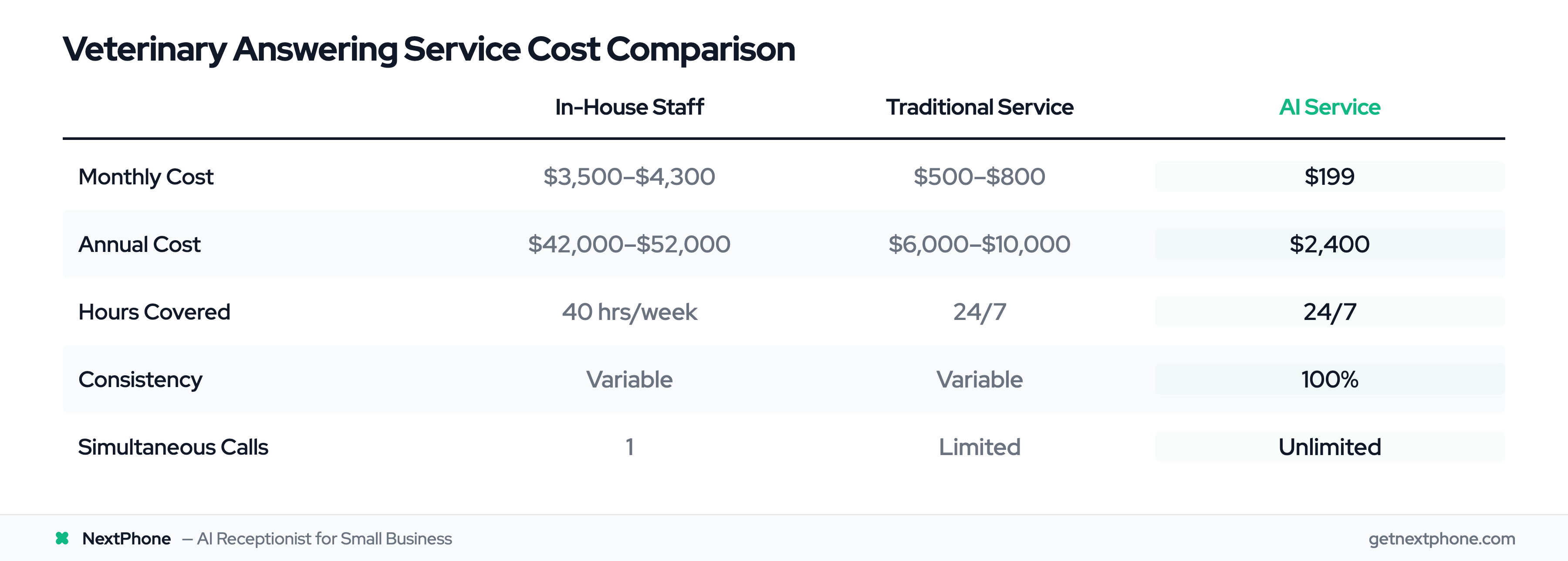
Let's get specific about pricing because vague "contact us for a quote" pages don't help you budget.
In-House Receptionist Costs
Hiring a dedicated phone person costs more than you might think:
- Salary: $33,000-$40,000/year for veterinary receptionists
- Benefits: Add 25-30% for healthcare, PTO, payroll taxes
- Training: Time and resources for initial and ongoing training
- Turnover: Average receptionist tenure is under 2 years
Total: $42,000-$52,000/year - and that only covers about 40 hours per week. No evenings, no weekends, no holidays.
Traditional Answering Service Pricing
Live agent services typically charge:
- Base fee: $500-800/month
- Per-call or per-minute overage: $0.75-$1.50 after included minutes
- Setup fees: Often $100-300
A busy clinic can easily spend $6,000-$10,000/year on traditional answering services, and costs spike during high-call-volume months.
AI Answering Service Pricing
AI-powered services offer a different model:
- Flat monthly fee: $99-299/month typically
- Unlimited calls: No overage charges
- 24/7 coverage included: No extra fees for nights or weekends
Total: $1,200-$3,600/year with predictable budgeting.
The Real ROI Calculation
Here's the math that matters:
-
If NextPhone costs $199/month and prevents just 2 lost clients per month
-
At $5,000 lifetime value per client
-
That's $10,000 in protected revenue per month
-
Versus $199 in cost
-
That's a 50x return on investment - and that's a conservative estimate assuming you only save two clients monthly from going to competitors.
| Factor | In-House Staff | Traditional Service | AI Service |
|---|---|---|---|
| Monthly Cost | $3,500-$4,300 | $500-800 | $199 |
| Annual Cost | $42,000-$52,000 | $6,000-$10,000 | $2,400 |
| Hours Covered | 40/week | 24/7 | 24/7 |
| Consistency | Variable | Variable | 100% |
| Simultaneous Calls | 1 | Limited | Unlimited |
How NextPhone Handles After-Hours Pet Emergencies
NextPhone provides AI-powered answering specifically designed for businesses that can't afford to miss calls - including veterinary practices where every call could be an emergency.
Always-On Pet Emergency Response
NextPhone answers every call in under 5 seconds, day or night. No hold music, no "press 1 for appointments, press 2 for emergencies" - just an intelligent AI that immediately engages with the caller.
When a pet owner calls at 2 AM panicking about their dog, NextPhone:
- Greets them calmly and professionally
- Quickly identifies the nature of the emergency
- Collects critical information (pet type, symptoms, severity)
- Routes true emergencies immediately to your on-call veterinarian
- Handles non-urgent matters appropriately (scheduling a next-day appointment, providing basic clinic information)
Intelligent Call Routing
Not every after-hours call is an emergency. NextPhone distinguishes between:
- True emergencies requiring immediate veterinarian contact
- Urgent but not critical situations that can wait until morning
- Routine questions about hours, directions, or services
- Appointment requests that can be scheduled automatically
Your on-call vet only gets woken up for genuine emergencies - not for someone asking about your holiday hours.
Integration with Your Workflow
NextPhone works with your existing phone system. Forward calls when you're busy or closed, and NextPhone handles them automatically. Every call generates:
- Email notifications with call summaries
- Full transcripts and recordings
- Optional SMS alerts for urgent matters
Setup takes hours, not weeks. Upload your clinic information, configure your preferences, and start receiving calls.
At $199/month with unlimited calls, NextPhone costs a fraction of traditional answering services - while providing more consistent, around-the-clock coverage.
Frequently Asked Questions About Veterinary Answering Services
Can an AI handle emotional pet owners in crisis?
Modern conversational AI is trained to respond with empathy and calm reassurance. When a caller is panicking about their pet, the AI maintains a steady, professional tone while quickly gathering the information needed to help. For true emergencies, the AI immediately routes to a human - your on-call veterinarian. Many pet owners report that the AI's calm demeanor actually helps reduce their anxiety in crisis moments.
How does emergency call routing work?
The AI identifies emergency situations through keyword recognition and symptom assessment. When it detects an emergency, it collects essential information (pet species, symptoms, duration, severity) while simultaneously initiating a transfer to your on-call veterinarian. The vet receives the call with context already gathered, allowing them to provide guidance immediately rather than spending time on intake questions.
Will the service know my clinic's specific protocols?
Absolutely. During setup, you configure your specific protocols - what constitutes an emergency at your practice, your on-call rotation, your services and pricing, your appointment availability. The AI learns this once and applies it consistently to every call. Unlike traditional services where you retrain new agents every few months, AI maintains perfect consistency.
What if the caller has a complex medical question?
AI excels at routine matters - hours, appointment scheduling, pricing, directions, basic FAQs. For complex medical questions that require professional judgment, smart forwarding routes appropriately - either to your on-call vet for emergencies, or logs the question for callback during business hours. This means callers get immediate help for simple matters and appropriate routing for complex ones.
How quickly can we get set up?
Most AI answering services can be operational within hours. You'll provide your clinic information (often by simply entering your website URL), configure your preferences, test with a few calls, and go live. Traditional services often take weeks for agent training; AI learns instantly from the information you provide.
What about existing clients - will the AI recognize them?
With practice management integration, the AI can recognize existing clients based on their phone number. This allows for personalized greetings ("Hi Mrs. Johnson, how is Max doing?") and access to relevant patient context. Approximately 86% of veterinary calls come from existing clients, so this recognition significantly improves the caller experience.
Never Miss Another Pet Emergency Call
Pet emergencies don't check your business hours before happening. The dog that ate chocolate at midnight, the cat seizing on Sunday morning, the bird that suddenly collapsed on Christmas - these situations demand immediate response.
Right now, veterinary practices are missing 25-30% of their calls. During busy periods, that number doubles. Every missed call potentially represents $4,000-$10,000 in lifetime client value walking out the door to a competitor who answered.
A veterinary answering service fixes this problem. Whether you choose traditional live agents, premium vet tech services, or AI-powered solutions, the goal is the same: ensure every worried pet owner reaches someone who can help.
For most practices, AI answering provides the best combination of cost, consistency, and coverage. At $199/month versus $500-800 for traditional services or $35,000+ for staff, the math is straightforward.
Your phone is ringing somewhere right now. A pet owner needs help.
The only question is whether someone will answer. See how NextPhone works for veterinary clinics.