
Why San Antonio Businesses Need a Local Answering Service
It's 2 PM on a July afternoon. The temperature just hit 98 degrees in San Antonio. Your phone rings - a homeowner's AC just died. But you're on a roof in Alamo Heights, hands full of equipment. The call goes to voicemail. They call the next contractor on Google. You just lost a $4,500 job.
This happens dozens of times every week to San Antonio contractors and service businesses. And in a city of 1.55 million people with a booming $192.8 billion economy, every missed call means a customer choosing your competitor.
San Antonio is the 7th largest city in the United States. It ranked #1 in Texas for job creation in 2024 and third nationally. According to McKinsey research, the region's economic output has grown 40% over the past decade - well above the national average of 28%.
That growth means more homeowners, more businesses, and more phone calls from people who need your services. The question is: who's answering when they call?
San Antonio's Booming Economy Means More Customer Calls
San Antonio by the Numbers
The San Antonio-New Braunfels metro area is home to 2.7 million people across eight counties. The city proper has 1.55 million residents, making it larger than Philadelphia, San Diego, or Dallas proper.
The numbers tell the story of a city on the rise:
- $192.8 billion GDP - expected to reach $210 billion by 2026
- 40% economic growth over the past decade versus 28% nationally
- $7.5 billion in capital investment since 2021
- 19,000 new jobs across advanced manufacturing, professional services, and tech
- #1 in Texas for job creation in 2024
Doing business in San Antonio costs about 10% less than in peer cities. That's good news for small business owners, but it also means more competition.
Key Industries Driving Growth
San Antonio's economy runs on healthcare, cybersecurity, manufacturing, and home services. The city is second only to Washington DC for federal and military cybersecurity work, with over 80 cybersecurity companies and 7,500+ employees in the sector.
For service businesses, the Texas climate drives year-round demand. Hot summers mean constant HVAC work. The state's HVAC market alone is worth $11.3 billion with over 9,200 businesses competing for customers.
Why Service Businesses Are Thriving
More people moving to San Antonio means more homes that need maintenance. More businesses opening means more commercial properties needing service. And when the summer heat hits 100 degrees, everyone needs their AC working.
The opportunity is massive. But with over 9,200 HVAC businesses competing in Texas alone, San Antonio contractors can't afford to miss a single call.
The 210 Area Code Advantage: Why Local Numbers Win More Business
How Customers Judge Businesses by Phone Number
When a San Antonio homeowner sees a phone number pop up on their screen, they make a split-second decision: answer or ignore?
That decision often comes down to one thing - the area code.
A 210 number tells the caller this is a local San Antonio business. Someone in the community. Someone who knows the area. Not a telemarketer calling from across the country.
The Spam Problem with Unknown Numbers
We all get spam calls. According to Hiya's State of the Call report, about 30% of all calls to mobile phones in the US are spam. That's made everyone cautious about answering unfamiliar numbers.
But here's what most business owners don't realize: the type of phone number dramatically affects whether customers answer.
| Number Type | Answer Rate | Spam Perception |
|---|---|---|
| Local (210) | 60-70%+ | 2-5% |
| Toll-Free (800, 888) | 40-50% | 20-30% |
| Unknown Mobile | 45-55% | 15-25% |
A local 210 number nearly doubles your chances of customers actually answering when you call back.
210 Signals "Local San Antonio Business"
San Antonio residents want to support local businesses. They want someone who understands the neighborhood, knows the climate challenges, and will show up when they say they will.
A 210 area code signals all of that before you even say hello.
When you call from an 800 number or an out-of-state area code, customers wonder if they're about to get a sales pitch. When they see 210, they know it's a local company calling them back.
How Many Calls Are San Antonio Contractors Missing?
The Brutal Statistics on Missed Calls
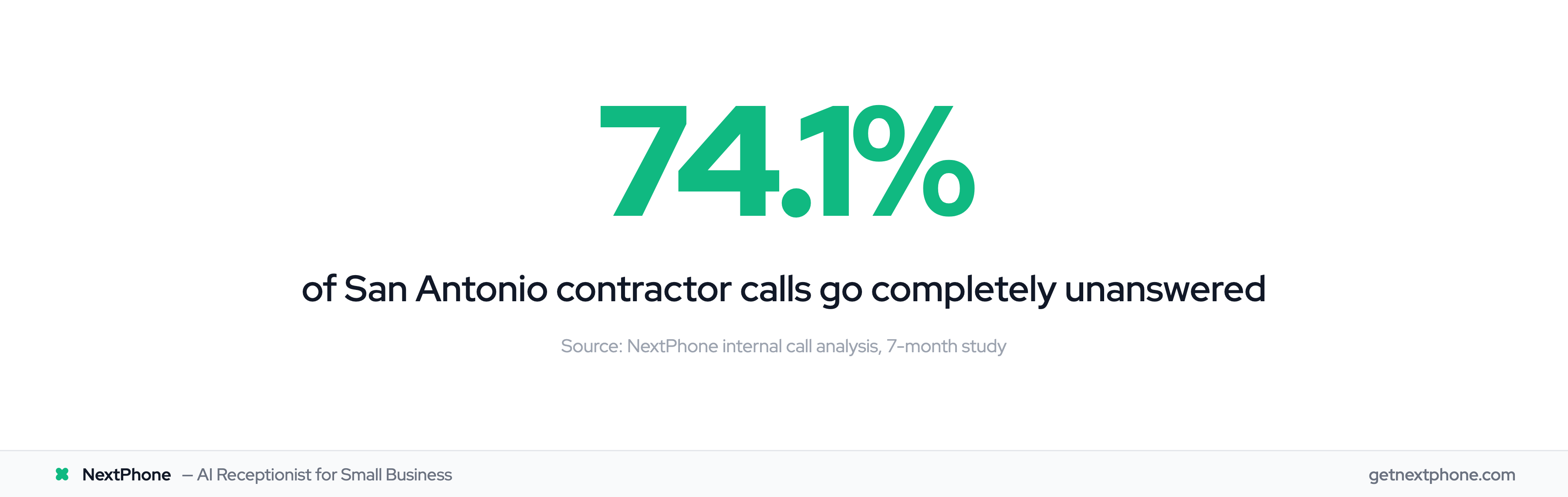
We've answered more than 1,446,980 business calls, and the industry data on home services contractors is brutal: research shows 74.1% of calls go completely unanswered. That's three out of every four potential customers calling someone else.
For a typical San Antonio contractor receiving 42 calls per month, that means 31 calls going to voicemail every month.
Here's what those calls look like:
- About one in four explicitly requests a callback - they want you to call back, but without a system to track these, most never get returned
- Urgency language ranks among the top reasons people call - words like emergency, urgent, or ASAP
- True emergencies are a recurring reason people call - pipe burst, no power, AC out in 95-degree heat
- Quote requests are among the top reasons people call - high-value leads ready to buy
- Booking or rescheduling is the single most common reason people call - customers trying to get on your calendar
What Happens When Callers Reach Voicemail
According to industry research, 85% of callers who don't reach someone won't call back. They don't leave a message. They don't wait. They call your competitor.
The few who do leave a voicemail? About 80% of those messages never get returned promptly. The callback request falls through the cracks, and by the time someone follows up, the customer has already hired someone else.
One plumber we work with discovered he had 76 missed calls in a single month. His reaction? "I didn't even know I was missing that many calls. I just thought business was slow."
The Real Cost of Missed Calls
Let's do the math for a typical San Antonio contractor:
- 42 calls per month (average for home services)
- 74.1% go unanswered = 31 missed calls
- 20% would have converted = 6 lost jobs
- $3,500 average job value = $21,000 lost per month
That's $252,000 per year in potential revenue walking out the door - or rather, calling your competitor.
For emergency calls, the numbers are even worse. Emergency jobs average $4,200 in revenue, significantly higher than routine work. Missing just one emergency call per week costs $16,800 per month in lost revenue.
Research shows 78% of customers hire whoever responds first. Not the cheapest. Not the best reviewed. The first one to pick up the phone.
Why Bilingual Answering Matters in San Antonio
San Antonio's Hispanic Majority Population
San Antonio is the largest majority-Hispanic city in the United States. According to Census data, 64.4% of residents identify as Hispanic or Latino.
That's not a niche market. That's the majority of your potential customers.
Business Advantage of Spanish Language Support
Many San Antonio residents prefer to conduct business in Spanish. For some, English is a second language. For others, Spanish simply feels more comfortable when discussing something as important as their home.
Businesses without Spanish-language capability are leaving money on the table. They're also sending a message - intentional or not - that they don't serve the whole community.
Think about it from the customer's perspective. A homeowner in the West Side calls about a water heater issue. Her English is limited. She reaches your voicemail - in English. She hangs up and calls the next company, hoping for better luck.
With a bilingual answering service, she gets help in Spanish. You get the job.
How AI Handles Bilingual Calls
Traditional answering services often charge extra for bilingual operators - if they offer it at all. Finding a receptionist who's fluent in both English and Spanish adds to hiring costs.
AI answering services handle multiple languages without additional cost. The AI detects the caller's language preference and responds accordingly. No premium fees. No scheduling complications. Just consistent service for every customer who calls.
San Antonio Answering Service Options: What Will It Cost?
Traditional Live Answering Services
Traditional answering services charge $500-800 per month for about 100 calls. Go over that limit and you pay overage fees - sometimes $1-2 per additional call.
Most are based out of state. They read from scripts and may not understand San Antonio neighborhoods or the urgency of a broken AC in Texas summer heat. Bilingual service? Usually an extra charge if available at all.
For a busy San Antonio contractor during summer, 100 calls per month isn't nearly enough.
Voicemail and Call Forwarding (DIY)
Voicemail is free. That's about the only positive thing to say about it.
As we've covered, 85% of callers who reach voicemail won't call back. Around 80% don't even leave a message. For high-intent callers - the ones with emergencies, ready to book, cash in hand - voicemail means you've already lost them.
Call forwarding helps when you can answer. But when you're on a roof, under a house, or driving between jobs, you're back to voicemail.
AI Answering Services
AI answering services represent a newer option that combines 24/7 availability with intelligent call handling.
The AI answers every call in under 5 seconds. It handles routine questions about hours, pricing, and scheduling. For emergencies or complex requests, it routes calls directly to your phone or takes a detailed message.
Cost? NextPhone offers unlimited calls for $199 per month. No per-call fees. No overage charges during your busy season.
Cost Comparison
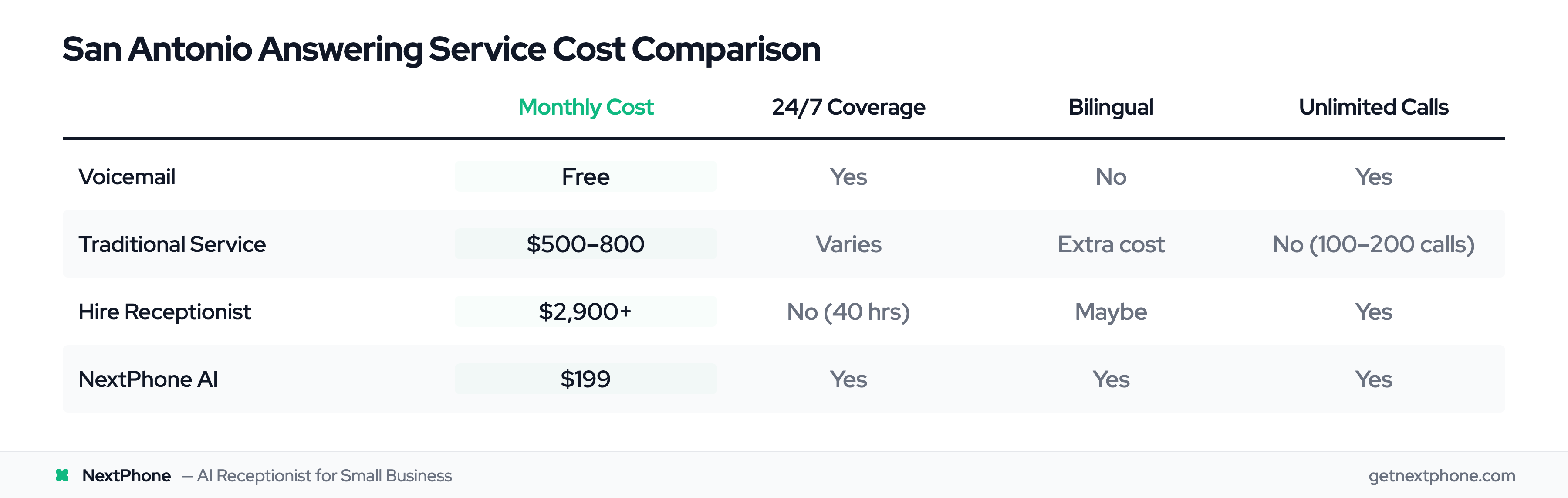
| Option | Monthly Cost | 24/7 Coverage | Bilingual | Unlimited Calls |
|---|---|---|---|---|
| Voicemail | Free | Yes | No | Yes |
| Traditional Service | $500-800 | Varies | Extra cost | No (100-200) |
| Hire Receptionist | $2,900+ | No (40 hrs) | Maybe | Yes |
| NextPhone AI | $199 | Yes | Yes | Yes |
The Bureau of Labor Statistics reports the median receptionist wage at $17.90 per hour. That's roughly $35,000 per year in salary alone - before benefits, taxes, and the cost of having someone who only works 40 hours per week.
For a detailed breakdown of AI receptionist costs, see our pricing guide.