
Your host is trying to seat a party of eight when the phone rings. Again.
She glances at the caller ID—could be a reservation for Saturday night, could be someone asking about your hours for the third time today. Either way, she has a choice: abandon the guests in front of her or let the call go to voicemail.
She chooses the guests. The caller never calls back.
This scenario plays out in restaurants across the country every single day. According to industry research from Hostie.ai, 43% of restaurant phone calls go completely unanswered. That adds up to anywhere from $52,000 to $292,000 in lost revenue per year, depending on your volume.
The good news? A restaurant answering service can capture those calls without adding stress to your staff. This guide breaks down what these services are, how much they cost, and whether the ROI makes sense for your operation.
The Hidden Cost of Unanswered Restaurant Calls
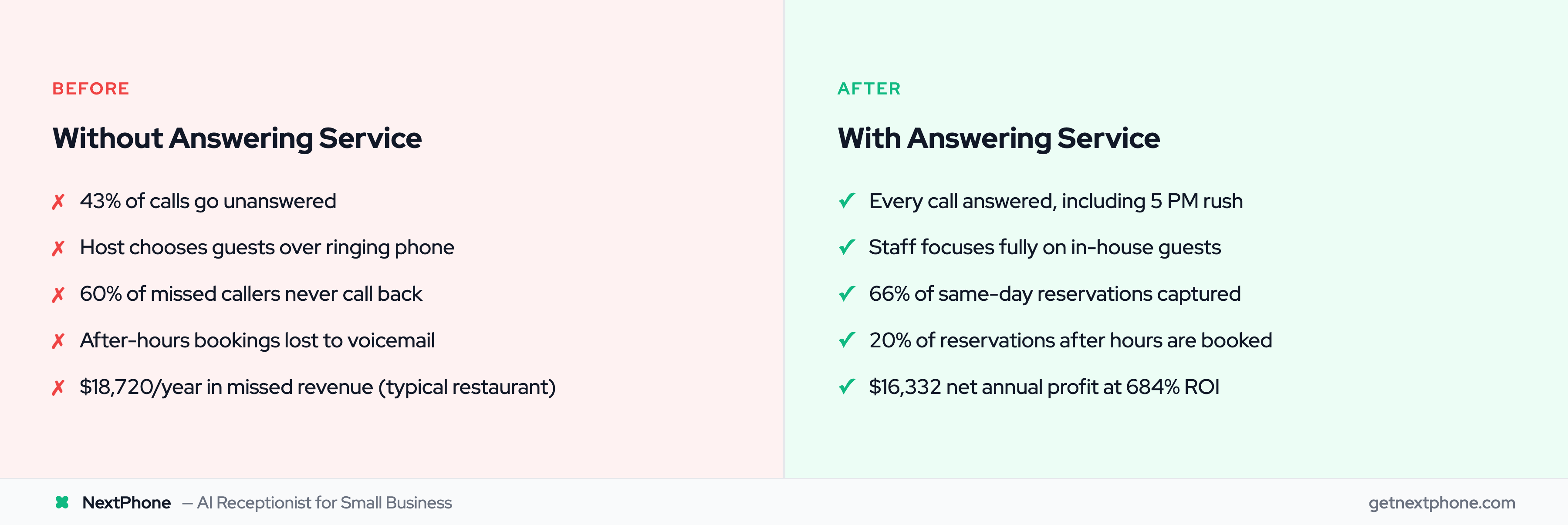
Most restaurant owners know they miss calls during the rush. What they often don't realize is how much those missed calls actually cost.
The Peak Hour Problem
Restaurant phones don't ring evenly throughout the day. They spike at the worst possible moments.
According to data from Slang AI, call volume peaks at 5 PM, 4 PM, and noon on weekdays—exactly when your team is managing the lunch rush, prepping for dinner service, or seating the first wave of evening guests. The phone is ringing when your staff physically cannot answer it.
During peak hours, a staggering 25% of calls to restaurants go unanswered. Some studies put the overall miss rate even higher at 43%. Either way, that represents thousands of dollars walking out the door each month.
What Happens When Calls Go Unanswered
Here's where it gets painful.
A HungerRush study found that 60% of customers who can't get through on the first try won't call back. They just book somewhere else. Even worse, 69% of Americans say they're likely to give up on a restaurant entirely if no one answers the phone.
These aren't window shoppers. These are people with their credit cards out, ready to spend money. And 80% of them won't even leave a voicemail—they'll simply move on to your competitor down the street.
The Math: How Missed Calls Add Up
Let's run the numbers for a typical mid-volume restaurant:
- Monthly call volume: 150 calls
- Miss rate: 43% = 65 missed calls
- Percentage who would have ordered: 60% = 39 missed opportunities
- Average order value: $40
- Monthly revenue lost: $1,560
- Annual revenue lost: $18,720
And that's conservative. High-volume restaurants or those in busy urban areas can see losses exceeding $100,000 annually. The Hostie.ai research puts the ceiling at $292,000 per year for restaurants with significant phone traffic.
Why Restaurant Staff Can't Keep Up
Before blaming your host or servers, understand the structural problem they're facing. This isn't about bad employees—it's about an impossible situation.
The Labor Shortage Reality
The restaurant industry is still recovering from a historic staffing crisis. According to the National Restaurant Association, 70% of restaurant operators report having job openings that are tough to fill. Meanwhile, 45% say they don't have enough employees to support existing customer demand.
You're not fully staffed. Your team is already stretched thin covering tables, running food, and managing the door. Adding "dedicated phone answerer" to someone's job description isn't realistic when you're short-handed to begin with.
Competing Priorities During Service
Picture the scenario: It's 6:30 PM on a Friday. Your host is managing a 45-minute wait list, greeting new arrivals, and coordinating with the floor manager about table turnover. The phone rings.
If she answers, the couple standing in front of her feels ignored. If she doesn't, the caller booking a birthday dinner for next week goes to voicemail—and probably books somewhere else.
As one restaurant technology executive put it: "You're gonna staff your cashiers, you're gonna staff your production... but you typically don't staff the phone." In an industry where 25-30% of revenue now comes from takeout and delivery, that gap becomes a serious problem.
Employees find themselves "held hostage on the phone" when they should be serving in-house guests. A server taking a phone order can't greet the family waiting to be seated. Every phone call creates a lose-lose situation for your team.
Phone Customers Are Your Most Valuable
Here's what makes missed calls even more frustrating: phone customers are worth more than online customers.
Research shows that phone orders average $48 compared to $41 for online orders—that's 18% more per transaction. Phone customers are also 2.3 times more likely to become repeat customers.
Why? Phone calls are high-intent interactions. Someone calling your restaurant is already engaged enough to pick up the phone, ask questions, and place a personalized order. They're not casually browsing. They're ready to buy.
Every time a phone call goes to voicemail, you're not just missing a sale. You're missing your best customer.
What Is a Restaurant Answering Service?
A restaurant answering service is exactly what it sounds like: a service—either human or AI-powered—that answers your phone when your staff can't.
How It Works
When a call comes in and your team is busy (or you're closed), the answering service picks up. The caller hears a professional greeting, gets their questions answered, and can often complete their reservation or order right there.
Depending on the service, this happens either through:
- Call forwarding: Calls roll to the answering service after a certain number of rings
- Direct routing: Calls go straight to the service 24/7, with urgent calls transferred to your team
- Overflow handling: Service only kicks in when your lines are busy
The experience should feel seamless. A caller making a reservation at 9 PM shouldn't be able to tell whether they're talking to someone at your restaurant or to your answering service.
What Calls It Can Handle
Modern restaurant answering services handle the full range of phone inquiries:
- Reservations: Party size, date, time, special requests
- Takeout and delivery orders: Full menu navigation with modifications
- Menu questions: Ingredients, allergens, preparation methods, specials
- Hours and directions: Including holiday schedules and parking
- General inquiries: Gift cards, dress code, private dining, catering
The best services can answer detailed questions like "Is the salmon gluten-free?" or "Do you have high chairs?" without needing to transfer to your staff.
Beyond Just Answering
This isn't your grandmother's answering machine. Today's services integrate with your existing tech stack:
- Reservations sync directly to OpenTable, Resy, or SevenRooms
- Orders push to your POS system (Toast, Square, Clover)
- Customers receive text or email confirmations automatically
- You get real-time notifications when calls come in
And here's a stat that matters: according to SevenRooms data, 66% of diners make same-day reservations, and 20% of reservations happen outside business hours. An answering service captures those bookings that would otherwise be lost.
Types of Restaurant Answering Services
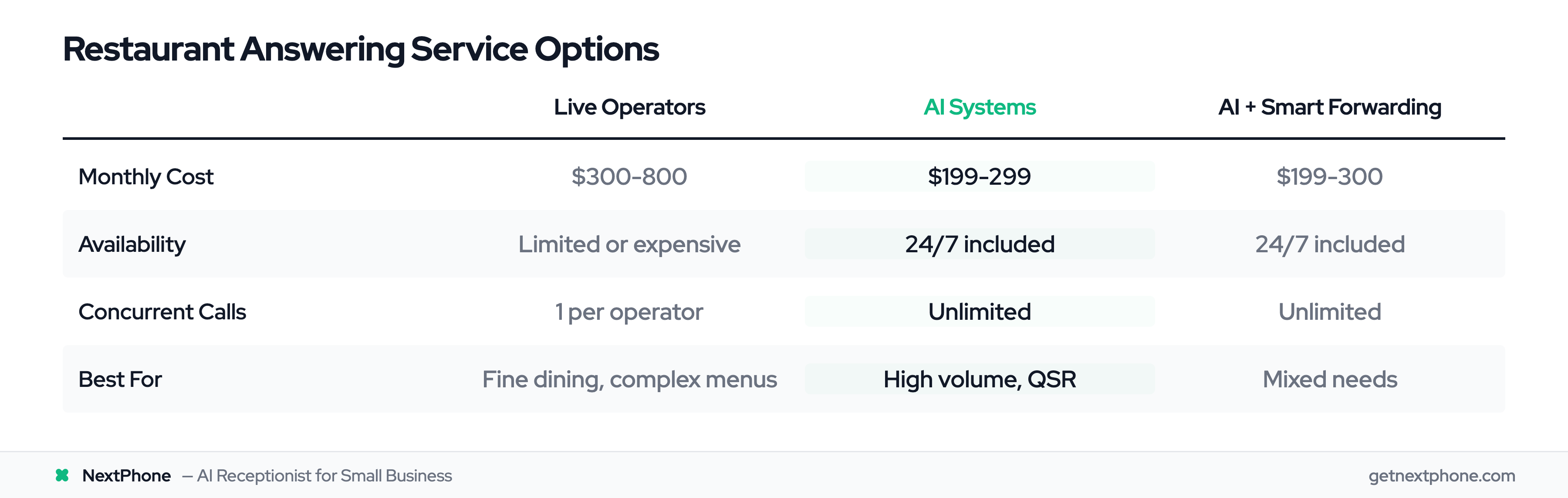
Not all answering services work the same way. Here's how the three main options compare.
Live Operator Services
Live operator services employ real humans who answer calls on your behalf. They follow scripts you provide and can handle nuanced conversations.
Pros:
- Human warmth and empathy
- Can handle complex or emotional situations
- Adapts to unexpected questions naturally
Cons:
- Per-minute pricing adds up quickly ($1-2 per minute)
- Limited hours unless you pay premium rates
- Quality varies by operator
- Cannot handle multiple calls simultaneously
Best for: Fine dining restaurants prioritizing white-glove service, or restaurants with complex menus that require human judgment.
Typical cost: $300-800/month for limited minutes, with overage fees.
AI-Powered Phone Systems
AI answering services use conversational artificial intelligence to handle calls. Modern systems sound natural and can hold full conversations—not the robotic "press 1 for reservations" of old IVR systems.
Pros:
- Available 24/7/365 without extra cost
- Handles unlimited concurrent calls (no busy signals)
- Consistent quality on every call
- Integrates with reservation and POS systems
- Gets smarter over time
Cons:
- Some callers still prefer humans
- Requires training on your specific menu and policies
- May struggle with heavy accents or unusual requests
Best for: High-volume restaurants, quick-service concepts, any restaurant wanting round-the-clock coverage without the premium price.
Typical cost: $199-599/month, often with unlimited calls.
According to SevenRooms research, 74% of consumers are now comfortable using AI in the restaurant booking experience. The perception gap is closing fast.
AI-First with Smart Forwarding
AI-first services handle reservations, hours questions, and standard orders, then smart forwarding routes unusual requests directly to your staff.
Pros:
- AI handles high volume, you handle exceptions
- Cost-effective while maintaining quality
- 24/7 coverage without staffing
Cons:
- Requires initial setup of forwarding rules
- Need to define which situations trigger forwarding
Best for: Restaurants wanting automation efficiency with smart forwarding for VIP guests or complaints.
Which Is Right for Your Restaurant?
| Factor | Live Operators | AI Systems | AI + Smart Forwarding |
|---|---|---|---|
| Monthly Cost | $300-800 | $199-299 | $199-300 |
| Availability | Limited (or expensive) | 24/7 included | 24/7 included |
| Concurrent Calls | 1 per operator | Unlimited | Unlimited |
| Best For | Fine dining, complex menus | High volume, QSR | Mixed needs |
7 Benefits of a Restaurant Answering Service
Why are restaurants increasingly turning to answering services? Here are the top benefits.
1. Never Miss a Revenue Opportunity
The most obvious benefit: calls get answered. If 43% of your calls currently go unanswered and each represents a $40 average order, an answering service pays for itself almost immediately.
Even recovering just 10 additional orders per month at $40 each equals $400 in revenue—more than many AI services cost.
2. 24/7 Availability for Same-Day Reservations
Dining habits have changed. According to SevenRooms, 66% of reservations are now same-day. People decide where to eat at 4 PM for a 7 PM dinner.
If your phone goes to voicemail at 4 PM because you're prepping for service, you lose that reservation. An answering service means someone is always available to capture that booking—even on holidays, even at midnight when someone is planning tomorrow's anniversary dinner.
3. Staff Can Focus on In-House Guests
When your host isn't constantly interrupted by phone calls, they can actually host. Your servers can focus on the tables in front of them instead of being pulled away to answer questions about your hours.
This improves service quality for everyone in your dining room. The family waiting to be seated gets acknowledged. The couple at table 12 gets their check faster. Your team isn't constantly context-switching.
4. Consistent Customer Experience
Human performance varies. Your host might be friendly and patient on Monday morning but frazzled and rushed on Friday night. A bad phone interaction—rushing a caller, putting them on hold too long, getting an order wrong—can cost you a customer permanently.
An answering service delivers the same quality on every call. No bad days, no rushed responses, no variation based on how busy the floor is.
5. Scale During Peak Hours Without Hiring
Friday night hits and suddenly you have three calls on hold. With your current setup, that means two frustrated callers waiting (or hanging up).
AI answering services handle unlimited concurrent calls. Whether you get 1 call or 100 calls at the same time, every caller gets answered immediately. No hiring extra staff, no overtime, no busy signals.
6. Capture After-Hours Business
Research consistently shows that 20% of restaurant reservations happen outside business hours. That's people booking at 10 PM for the next night, or calling Sunday morning to reserve a table for a birthday dinner.
If your phone goes to voicemail after close, you lose those bookings. Your competitors with answering services capture them.
7. Reduce Staff Burnout
Restaurant turnover averages nearly 80% annually, and burnout is a major driver. Staff who are constantly interrupted by phone calls while trying to serve guests experience more stress.
Taking that burden off your team isn't just good for efficiency—it's good for retention. When employees aren't "held hostage on the phone," they can do the job they signed up for.