
Key Takeaways
- In-house receptionist true cost: $52,000-$68,000/year (not the $37K base salary)
- Quick multiplier: Base salary x 1.35-1.5 = closer to actual cost
- Virtual human services: $300-$1,300+/month depending on volume and provider
- AI receptionist (NextPhone): $199/month flat, unlimited calls, 24/7 coverage
- Coverage reality: One hire covers 40 hrs/week (24% of the week); AI covers 168 hrs/week (100%)
- Turnover cost: 50-200% of annual salary to replace an employee who leaves
- Break-even: One captured $3,500 job pays for 17+ months of AI service
The True Cost of an In-House Receptionist
When most business owners think about hiring a receptionist, they look at the hourly rate on job postings. That number is where the real calculation begins, not where it ends.
Base Salary: The Starting Point
According to the Bureau of Labor Statistics, the median hourly wage for receptionists was $17.90 in May 2024. At 40 hours per week for 52 weeks, that translates to:
$17.90 x 2,080 hours = $37,232 annual salary
Depending on your market, wages range from $15.00 to $22.00 per hour, meaning actual salaries fall between $31,200 and $45,760.
Here's the problem: that salary represents roughly 74% of what you'll actually pay. The remaining 26% or more comes from mandatory costs most employers overlook until the bills arrive.
Employer Tax Burden: The 7.65% You Can't Avoid
The moment you hire an employee, you become responsible for your share of payroll taxes.
FICA Taxes (Federal Insurance Contributions Act):
- Social Security: 6.2% on wages up to $176,100 (2024)
- Medicare: 1.45% (no wage cap) Total employer FICA: 7.65%
On a $37,232 salary: $2,848 in FICA taxes
Unemployment Taxes:
- FUTA (Federal): 6% on first $7,000, typically reduced to 0.6% after state credits = ~$420
- SUTA (State): Varies from 0.1% to 12% depending on your state and claims history = $325-$1,080
Total unemployment estimate: $745-$1,500 annually
These taxes are non-negotiable. You pay them on top of every dollar of salary.
Benefits: The 31% That Comes Standard
The Bureau of Labor Statistics reports that benefits average 31% of total compensation for civilian workers. For a receptionist, expect:
Health Insurance:
- Employer contribution: $6,000-$12,000/year (depending on plan and family coverage)
- This is often the largest hidden cost after salary
Paid Time Off:
- Standard: 10-15 days of PTO plus sick leave
- At $17.90/hour for 10 days: $1,432 in paid non-working time
- At 15 days: $2,148
Workers' Compensation Insurance:
- Office worker rates: 1-3% of payroll
- Estimate for receptionist: $372-$1,117 annually
Training: The Invisible Investment
New receptionists don't arrive knowing your systems, customers, or protocols. They require training.
According to the 2024 Training Industry Report, organizations spend an average of $774 per learner annually, with employees receiving about 47 hours of training. For a receptionist learning your specific business:
First-year training cost: $1,000-$1,500 Ongoing annual training: $500-$774
This doesn't account for your time (or a manager's time) spent training, which has its own opportunity cost.
Equipment and Space: The Physical Requirements
Your receptionist needs somewhere to work and tools to do the job.
One-Time Equipment Costs:
| Item | Cost Range |
|---|---|
| Desk and chair | $500-$1,500 |
| Computer | $800-$1,500 |
| Phone system | $200-$500 |
| Office supplies | $100-$300 |
| Software licenses | $100-$200 |
| Total one-time | $1,700-$4,000 |
Ongoing Space Allocation:
- Dedicated workspace rent allocation: $200-$500/month
- Annual space cost: $2,400-$6,000
Even in a home office situation, you're likely adding square footage, upgrading phone systems, or making other accommodations.
The Complete Year-One Calculation
Let's add every component for a realistic first-year cost:
| Cost Category | Low Estimate | High Estimate |
|---|---|---|
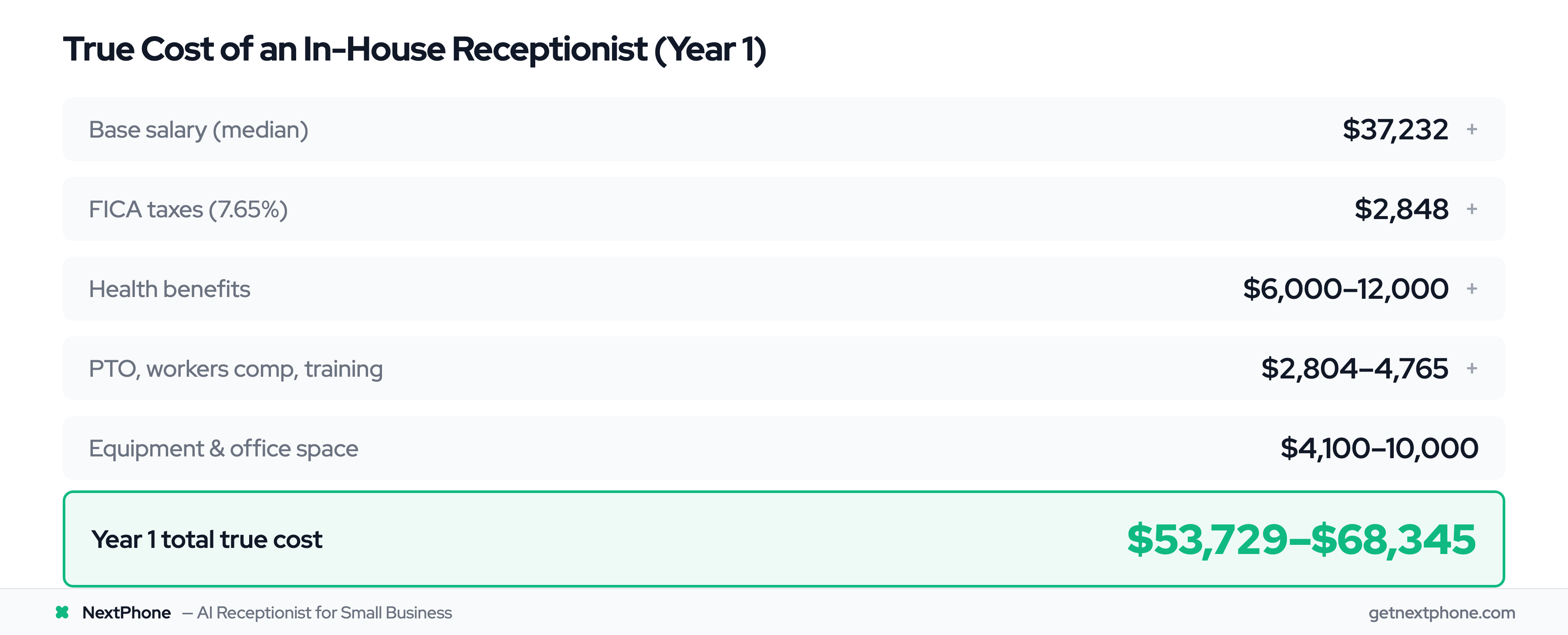
| Base Salary | $37,232 | $37,232 |
| FICA Taxes (7.65%) | $2,848 | $2,848 |
| Unemployment (FUTA/SUTA) | $745 | $1,500 |
| Health Benefits | $6,000 | $12,000 |
| PTO/Sick Days | $1,432 | $2,148 |
| Workers Compensation | $372 | $1,117 |
| Training | $1,000 | $1,500 |
| Equipment (one-time) | $1,700 | $4,000 |
| Office Space | $2,400 | $6,000 |
| Year 1 Total | $53,729 | $68,345 |
Monthly equivalent: $4,477-$5,695
Ongoing years (after equipment purchase) still run $52,000-$64,000 annually.
The Quick Multiplier Method
Don't have time for detailed calculations? Use this shortcut:
True Cost = Base Salary x 1.35 to 1.5
For a $37,232 salary:
- Conservative: $37,232 x 1.35 = $50,263
- Moderate: $37,232 x 1.40 = $52,125
- With premium benefits: $37,232 x 1.50 = $55,848
Then add Year 1 equipment and space costs separately.
The Turnover Time Bomb
There's one more cost that doesn't appear until it happens: what if they leave?
Replacement Cost Reality:
- SHRM average cost to hire: $4,683 (direct costs only)
- Full turnover cost: 50-200% of annual salary
- For a $37K receptionist: $18,500-$74,000 total replacement cost
The replacement cost includes:
- Job posting and recruitment
- Interview time (yours and others')
- Background checks
- Lost productivity during vacancy
- Training the replacement
- Reduced productivity during learning curve
Time-to-Hire:
- Average: 41 days
- That's 41 days with no receptionist or you answering phones
The Sobering Statistic:
- 34% of new hires quit within 90 days
You might go through this entire hiring process twice before finding someone who stays.
The Coverage Gap Problem
Even at $55,000+ per year, one receptionist provides limited coverage:
- Full-time hours: 40 per week
- Hours in a week: 168
- Coverage percentage: 23.8%
- Uncovered hours: 128 per week (76%)
Your receptionist covers business hours, Monday through Friday. Evenings, nights, weekends, and holidays? Voicemail.
When a customer calls at 6 PM with an emergency, your $55,000 investment can't help them.
Virtual Receptionist Costs: Human Services
Virtual receptionist services use remote human agents to answer your calls. They're a type of answering service that's been around for decades, but pricing structures vary dramatically—and the advertised price rarely reflects what you'll actually pay.
Understanding the Three Pricing Models
1. Per-Minute Pricing
You pay for every minute agents spend on your calls.
- Rate range: $0.65-$5.19 per minute
- How it works: Clock starts when agent answers, stops when call ends
- Watch for: Rounding increments (15-second, 30-second, or 60-second)
The rounding problem is significant. A 1-minute-5-second call billed at 60-second increments becomes 2 minutes. Over 50 calls monthly, rounding can add 20-40% to your actual cost.
Best for: Very low volume (under 25 calls/month) with short calls (under 2 minutes average).
2. Per-Call Pricing
Flat fee for each answered call, regardless of duration.
- Rate range: $0.80-$11.00 per call
- How it works: Every answered call costs the same amount
- Watch for: Counts hang-ups and wrong numbers
You pay the same for a 30-second wrong number as a 5-minute appointment booking.
Best for: Moderate volume with longer average calls (3+ minutes).
3. Flat-Rate/Monthly Pricing
Fixed monthly fee with included or unlimited calls.
- Rate range: $199-$500+ per month
- How it works: Predictable monthly bill regardless of volume
- Advantage: No overage anxiety
Best for: High volume, variable call patterns, anyone who values budget predictability.
Major Provider Pricing Breakdown
Here's what the major virtual receptionist services actually charge:
Ruby Receptionists (Premium Tier)
| Plan | Monthly Fee | Included | Overage Rate |
|---|---|---|---|
| Basic | $319 | 50 minutes | $5.19/min |
| Standard | $599 | 100 minutes | $5.19/min |
| Professional | $999 | 200 minutes | $5.19/min |
| Enterprise | $1,599 | 500 minutes | $5.19/min |
- AnswerConnect
- Base: ~$325/month (approximately 200 minutes included)
- Per-minute charges apply after included minutes
- 24/7 live answering available
Smith.ai (Per-Call Model)
| Plan | Monthly Fee | Included Calls | Overage Rate |
|---|---|---|---|
| Starter | $255 | 30 calls | $8.50/call |
| Basic | $675 | 90 calls | $8.50/call |
| Pro | $1,275 | 180 calls | $8.50/call |
- PATLive
- Base: $199/month for 75 minutes included
- Per-minute overages apply
- Various higher-tier plans available
Calculating Your Real Cost
The formula for per-minute services:
Monthly Cost = Base Fee + ((Calls x Avg Minutes) - Included Minutes) x Overage Rate
-
Example: Ruby at 50 calls/month (2.5 minute average)
-
Minutes used: 50 calls x 2.5 min = 125 minutes
-
Minutes included: 50
-
Overage minutes: 125 - 50 = 75 minutes
-
Overage cost: 75 x $5.19 = $389.25
-
Base fee: $319
-
Monthly total: $708.25
-
Example: Smith.ai at 50 calls/month
-
Calls included: 30
-
Overage calls: 50 - 30 = 20 calls
-
Overage cost: 20 x $8.50 = $170
-
Base fee: $255
-
Monthly total: $425
What You Actually Pay at Different Volumes
| Provider | 50 calls/mo | 100 calls/mo | 200 calls/mo |
|---|---|---|---|
| Ruby | $708 | $1,357 | $2,656 |
| AnswerConnect | $400 | $875 | $1,600+ |
| Smith.ai | $425 | $850 | $1,530 |
| PATLive | $299 | $549 | $1,000+ |
Hidden Fees That Inflate Your Bill
The base price and overage rates aren't the complete picture. Watch for:
| Fee Type | Typical Range |
|---|---|
| Setup/onboarding | $50-$500 |
| Integration fees | $50-$200 |
| Call recording | $10-$30/month |
| CRM integration | $25-$50/month |
| Bilingual support | 25-50% premium |
| Weekend/holiday surcharges | Up to 50% premium |
| Annual contract penalty | $100-$500 |
A "$319/month" plan can easily become $400-$500/month once you add necessary features.
Annual Cost at Typical Usage
For a business receiving 50 calls per month:
| Provider | Monthly (with overages) | Annual |
|---|---|---|
| Ruby | $708 | $8,496 |
| AnswerConnect | $400 | $4,800 |
| Smith.ai | $425 | $5,100 |
| PATLive | $299 | $3,588 |
At 100 calls per month, Ruby can exceed $16,000 annually.
AI Receptionist Costs: The Flat-Rate Alternative
AI-powered receptionists represent the newest option in the market. They use conversational AI to handle calls, eliminating the per-minute and per-call pricing that makes traditional services unpredictable.
The Flat-Rate Advantage
NextPhone charges $199/month flat. That's it.
- Per-call charges: None
- Per-minute charges: None
- Overage fees: None (unlimited calls)
- Setup fees: None
- Contract requirements: None (month-to-month)
Whether you receive 50 calls or 500 calls, the price stays the same.
What's Included at $199/Month
The flat rate includes everything you'd pay extra for with traditional services:
- 24/7/365 coverage (no after-hours surcharges)
- Unlimited call volume (no overage anxiety)
- Appointment scheduling with calendar integration
- CRM integration for lead capture
- Voicemail transcription included
- Call recording included
- Spam filtering (blocks 7%+ of junk calls automatically)
- Emergency detection and routing
- Custom greeting and business training
No hidden fees. No add-on charges. No surprises.
Annual Cost Calculation
The math is simple:
$199/month x 12 months = $2,388/year
Same price at 50 calls. Same price at 100 calls. Same price at 500 calls.
Cost Per Call Analysis
As call volume increases, effective cost per call decreases:
| Monthly Volume | Annual Cost | Cost Per Call |
|---|---|---|
| 30 calls | $2,388 | $6.63 |
| 50 calls | $2,388 | $3.98 |
| 100 calls | $2,388 | $1.99 |
| 200 calls | $2,388 | $1.00 |
| 500 calls | $2,388 | $0.40 |
With per-call services, more calls mean higher bills. With flat-rate, more calls mean lower effective cost.
AI vs Human: The Trade-offs
AI Receptionist Advantages:
- 95% cost reduction vs in-house hiring
- True 24/7 coverage without premium charges
- Zero turnover risk
- Instant scalability (same price at any volume)
- Consistent quality on every call
- No staffing limitations or hold times
Considerations:
- Very complex or unusual inquiries may need escalation
- Some callers have strong preference for human interaction
- Works best for defined call types (scheduling, inquiries, messages, routing)
For the vast majority of incoming calls—appointment scheduling, basic inquiries, message taking, emergency routing—AI handles them effectively. The 95% cost savings make it worth trying for most businesses. Businesses implementing automation see 30-200% ROI in the first year.
The Complete Cost Comparison
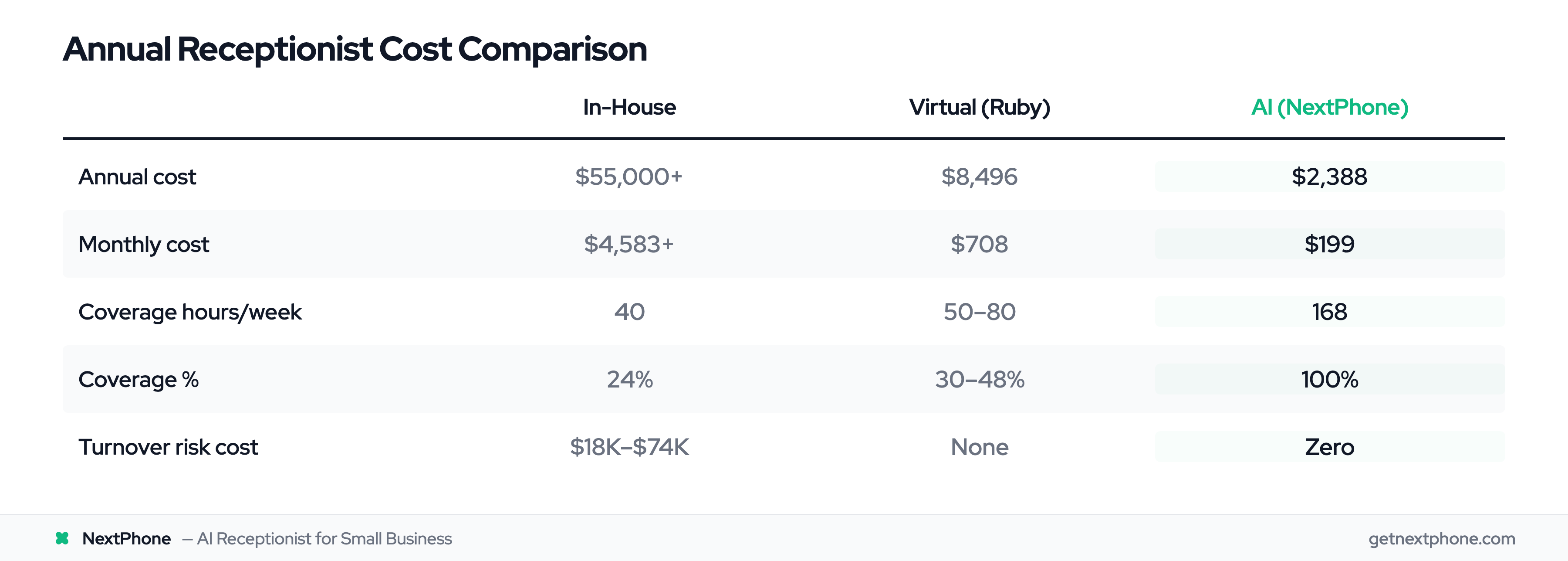
Let's put all three options side by side with actual numbers.
Annual Cost Comparison
| Factor | In-House | Virtual (Ruby) | AI (NextPhone) |
|---|---|---|---|
| Annual Cost | $55,000+ | $8,496 | $2,388 |
| Monthly Cost | $4,583+ | $708 | $199 |
| Coverage Hours/Week | 40 | 50-80 | 168 |
| Coverage Percentage | 24% | 30-48% | 100% |
| Setup Time | 8-16 weeks | 1-2 weeks | 2-5 days |
| Turnover Risk Cost | $18K-$74K | Provider handles | Zero |
| Overtime/After-Hours | Not covered | Surcharges | Included |
| Scalability | Hire more | Pay more | Same price |
Coverage Hours Reality
The coverage gap matters more than many realize:
| Option | Hours/Week | % of Week | Uncovered Hours |
|---|---|---|---|
| In-house (1 FTE) | 40 | 24% | 128 |
| Virtual (business hours) | 50 | 30% | 118 |
| Virtual (extended) | 80 | 48% | 88 |
| AI (24/7) | 168 | 100% | 0 |
Industry data shows 6.2% of calls are emergencies that happen outside business hours. Those are often the highest-value calls—premium pricing, urgent need, customer will hire whoever answers first.
5-Year Cost Projection
The differences compound dramatically over time:
In-House Receptionist (5 Years):
| Year | Cost |
|---|---|
| Year 1 (with equipment) | $59,000 |
| Year 2 | $52,000 |
| Year 3 | $53,000 |
| Year 4 | $54,000 |
| Year 5 | $55,000 |
| One turnover event | $30,000 |
| 5-Year Total | $303,000 |
Ruby Receptionists (5 Years):
| Year | Cost |
|---|---|
| Years 1-5 ($708/mo x 60) | $42,480 |
| 5-Year Total | $42,480 |
NextPhone AI (5 Years):
| Year | Cost |
|---|---|
| Years 1-5 ($199/mo x 60) | $11,940 |
| 5-Year Total | $11,940 |
5-Year Savings:
- NextPhone vs In-House: $291,060
- NextPhone vs Ruby: $30,540
Cost Calculator Worksheets
Use these worksheets to calculate your specific costs.
Worksheet 1: In-House Receptionist Calculator
YOUR IN-HOUSE RECEPTIONIST COST CALCULATION

STEP 1: BASE SALARY
Target hourly rate:            $________/hour
Annual hours (2,080 standard): ________
Annual base salary:            $________ (A)

STEP 2: QUICK MULTIPLIER METHOD
Base salary (A):               $________
Multiplier (use 1.35-1.5):     x ________
Loaded salary cost:            $________ (B)

STEP 3: YEAR-ONE ADDITIONS
Equipment (one-time):          $________ (C)
Annual space/rent allocation:  $________ (D)

STEP 4: TOTAL YEAR-ONE COST
Loaded salary (B):             $________
Equipment (C):                 $________
Space (D):                     $________
YEAR 1 TOTAL:                  $________

STEP 5: ONGOING ANNUAL COST
Loaded salary (B):             $________
Space (D):                     $________
ONGOING ANNUAL:                $________
Example filled in:
- Base salary: $37,232
- Multiplier: 1.40
- Loaded cost: $52,125
- Equipment: $2,500
- Space: $4,000
- Year 1: $58,625
- Ongoing: $56,125
Worksheet 2: Virtual Receptionist Calculator
YOUR VIRTUAL RECEPTIONIST COST CALCULATION

STEP 1: ESTIMATE YOUR VOLUME
Monthly calls (estimate):       ________ calls
Average call duration:          ________ minutes
Total minutes needed:           ________ min/month

STEP 2: PROVIDER COSTS
Provider name:                  ________________
Monthly base fee:               $________
Included minutes or calls:      ________
Overage rate:                   $________/min or /call

STEP 3: CALCULATE OVERAGES
Total minutes/calls needed:     ________
Minus included:                 ________
Overage quantity:               ________
x Overage rate:                 $________
Monthly overage cost:           $________

STEP 4: MONTHLY TOTAL
Base fee:                       $________
+ Overage cost:                 $________
+ Add-on features:              $________
MONTHLY TOTAL:                  $________

STEP 5: ANNUAL TOTAL
Monthly total:                  $________
x 12 months:                    $________
+ One-time setup fees:          $________
ANNUAL TOTAL:                   $________
Example (Ruby at 50 calls):
- Monthly calls: 50
- Average duration: 2.5 min
- Total minutes: 125
- Base fee: $319
- Included: 50 min
- Overage: 75 min x $5.19 = $389
- Monthly: $708
- Annual: $8,496
Worksheet 3: AI Receptionist Calculator
YOUR AI RECEPTIONIST COST CALCULATION

STEP 1: FIXED COSTS
Monthly flat rate (NextPhone):  $199
x 12 months:                    $2,388
+ Setup fees:                   $0
+ Add-on features:              $0
ANNUAL TOTAL:                   $2,388

STEP 2: YOUR EFFECTIVE COST PER CALL
Your estimated monthly calls:   ________ calls
Annual calls (x 12):            ________ calls
Annual cost:                    $2,388
Cost per call:                  $________
(Formula: $2,388 / annual calls)

EXAMPLE CALCULATIONS:
At 50 calls/month (600/year):   $3.98 per call
At 100 calls/month (1,200/year): $1.99 per call
At 200 calls/month (2,400/year): $1.00 per call
Worksheet 4: Side-by-Side Comparison
YOUR RECEPTIONIST COST COMPARISON

OPTION A: IN-HOUSE
Year 1 cost:                    $________
Ongoing annual:                 $________
5-year total:                   $________
Coverage: 40 hrs/week (24%)

OPTION B: VIRTUAL HUMAN
Annual cost (with overages):    $________
5-year total:                   $________
Coverage: ______ hrs/week (____%)

OPTION C: AI (NEXTPHONE)
Annual cost:                    $2,388
5-year total:                   $11,940
Coverage: 168 hrs/week (100%)

SAVINGS ANALYSIS:
A vs C (annual):                $________
A vs C (5-year):                $________
B vs C (annual):                $________
B vs C (5-year):                $________
ROI and Break-Even Analysis
Cost is only half the equation. The other half is what you get back.
The Missed Call Revenue Problem
Industry research reveals a critical gap:
- 74.1% of business calls go unanswered
- 85% of callers who can't reach you won't call back
- Each missed call is a potential customer hiring your competitor
When someone calls five businesses and yours goes to voicemail, they're not leaving a message. They're calling the sixth business on their list. Research shows a single missed call costs an average of $12.15, with SMBs losing $26,000+ per year from missed calls.
ROI Calculation Formula
Here's how to calculate return on investment for any receptionist option:
Monthly Revenue Captured = Missed Calls x % Revenue Opportunities x Avg Job Value x Close Rate

Monthly Profit = Revenue Captured - Service Cost

ROI = (Monthly Profit / Service Cost) x 100
Sample ROI Calculation
Your current situation:
- Calls currently missed: 30/month
- Industry data: 7% are quote/estimate requests
- Quote requests missed: 2.1/month
- Average job value: $3,500
- Close rate on answered quotes: 20%
The math:
- Monthly revenue potential: 2.1 x $3,500 x 20% = $1,470
- NextPhone cost: $199
- Monthly profit: $1,271
- ROI: 639%
Every dollar spent returns $6.39. Use Nextiva's AI receptionist ROI calculator to project your own savings.
Break-Even Formula
How many additional jobs do you need to capture for the service to pay for itself?
Annual Jobs Needed = Annual Service Cost / (Average Job Value x Close Rate)
NextPhone break-even:
- Annual cost: $2,388
- Average job: $3,500
- Close rate: 20%
- Revenue per closed job: $700
- Jobs needed: $2,388 / $700 = 3.4 jobs per year
That's less than one additional closed job per quarter.
Ruby break-even (at $8,496/year):
- Jobs needed: $8,496 / $700 = 12.1 jobs per year
One additional closed job per month.
In-house break-even (at $55,000/year):
- Jobs needed: $55,000 / $700 = 78.6 jobs per year
Nearly 7 additional closed jobs per month.
ROI by Business Type
| Business Type | Avg Job Value | Break-Even (NextPhone) |
|---|---|---|
| Plumber | $800 | 15 jobs/year |
| Electrician | $1,200 | 10 jobs/year |
| HVAC | $2,000 | 6 jobs/year |
| General Contractor | $3,500 | 3.4 jobs/year |
| Roofer | $15,000 | 0.8 jobs/year |
Consider the lead acquisition costs: home services leads cost $150+ to acquire, while HVAC leads range from $25-$300+ with an average of $105. Missing a call means losing both the acquisition cost and the revenue potential.
For a roofer, capturing one additional roof that would have gone to voicemail pays for nearly two years of service.
Decision Framework: Which Option Is Right?
The numbers overwhelmingly favor virtual and AI options for most businesses. But circumstances vary.
Choose In-House Receptionist When:
- You have walk-in visitors who need in-person greeting
- Your budget comfortably supports $60,000+/year for reception
- You need multi-tasking beyond phones (filing, admin, office management)
- Building team culture is a priority and you're scaling to 10+ employees
- Complex specialized knowledge is required on every call
Choose Virtual Human Receptionist When:
- Premium human touch is essential for your brand
- Complex legal or medical intake requires human judgment
- Call volume is very low (under 30 calls/month) making flat-rate less efficient
- You already have some phone coverage and just need overflow support
Choose AI Receptionist When:
- Cost is a primary concern (95% savings vs in-house)
- 24/7 coverage is needed without paying premium after-hours rates
- You work in the field and can't answer during jobs
- Call volume fluctuates seasonally (same price at any volume)
- You're a solo operator or small team where $55K is a massive overhead percentage
- Budget predictability matters (no surprise overage bills)
- Turnover risk concerns you (AI has zero turnover)
Quick Decision Flowchart
-
Do you have walk-in visitors requiring in-person greeting?
- YES: Consider in-house or hybrid
- NO: Virtual or AI handles everything
-
Is your total reception budget under $25,000/year?
- YES: AI is your primary option
- NO: All options on the table
-
Do you need true 24/7 coverage?
- YES: AI ($199/mo) or 3+ FTEs ($150K+/year)
- NO: Single hire could work
-
Is your call volume over 50/month or unpredictable?
- YES: Flat-rate makes financial sense
- NO: Per-call might work
-
Can you justify $50,000+/year for reception?
- YES: Consider in-house if other factors align
- NO: Virtual or AI is more sustainable
Frequently Asked Questions
How much does a full-time receptionist cost per year?
The true cost of a full-time receptionist is $52,000-$68,000 annually, not the $37,000 base salary you see on job postings. This includes mandatory employer taxes (FICA at 7.65%), unemployment taxes, health benefits (typically $6,000-$12,000), paid time off, workers' compensation, training ($1,000+ first year), equipment ($1,700-$4,000), and allocated office space ($2,400-$6,000/year). Use the multiplier shortcut: base salary x 1.35 to 1.5 gets you close to true cost.
What is the true cost multiplier for hiring a receptionist?
Multiply the base salary by 1.35 for a conservative estimate or 1.5 for a comprehensive estimate that includes premium benefits. A $37,232 salary becomes approximately $50,263 (at 1.35x) to $55,848 (at 1.5x) in true annual cost. Add Year 1 equipment ($1,700-$4,000) and annual space costs ($2,400-$6,000) separately.
How does virtual receptionist cost compare to hiring?
Virtual receptionist services typically cost $3,600-$16,000 per year depending on provider and call volume, compared to $52,000-$68,000 for an in-house hire. That represents 70-93% savings. AI-powered options like NextPhone cost $2,388/year ($199/month flat) with unlimited calls and 24/7 coverage, representing 95%+ savings versus hiring.
What's the cheapest receptionist option for small business?
AI receptionist at $199/month flat ($2,388/year) is typically the most cost-effective option for small businesses. This includes unlimited calls, 24/7 coverage, appointment scheduling, and CRM integration with no overages or hidden fees. For very low volume businesses (under 20 calls/month), basic per-call services might come in slightly lower, but lose the 24/7 coverage and predictability benefits.
How do I calculate receptionist ROI?
Use this formula: ROI = (Revenue Captured - Service Cost) / Service Cost x 100. First calculate Revenue Captured: Missed Calls x % Revenue Opportunities x Average Job Value x Close Rate. Example: If you miss 30 calls monthly and 7% are quote requests for $3,500 jobs with 20% close rate, that's $1,470/month in captured revenue. Subtract the $199 NextPhone cost for $1,271 monthly profit, or 639% ROI.
What hidden costs should I include in receptionist calculations?
For in-house: FICA taxes (7.65% of salary), FUTA/SUTA unemployment taxes, health insurance contributions, PTO/sick day costs, workers' compensation insurance, training expenses, equipment (computer, phone, desk, chair), and allocated office space. For virtual services: setup fees, integration fees, call recording, CRM integration, weekend/holiday surcharges, and overage charges. For AI (NextPhone): there are no hidden costs—$199/month includes everything.
Making Your Decision
The math is clear. A full-time receptionist costs $52,000-$68,000 per year for 40 hours of weekly coverage (24% of the week). A virtual human service runs $4,000-$16,000 annually depending on volume. An AI receptionist costs $2,388 per year for 168 hours of weekly coverage (100% of the week).
The salary you see on job postings is 74% of what you'll actually pay. Benefits, taxes, training, equipment, and space add 26-50% to the real cost. Turnover can add another $18,000-$74,000 when it happens.
For most small businesses—especially service businesses, contractors, and solo operators—the calculation is overwhelming:
- 95% cost reduction (AI vs in-house)
- 4x the coverage hours (168 vs 40 hours/week)
- Zero turnover risk (no hiring, training, or replacement costs)
- Predictable monthly cost (no overages, no surprises)
The question isn't whether you can afford a receptionist service. It's whether you can afford to keep paying 20x more for 24% coverage.
Ready to calculate your exact savings? NextPhone provides unlimited 24/7 answering for $199/month flat—no setup fees, no contracts, no hidden costs.