It's 11 PM on a Tuesday. Your phone buzzes. You're watching a movie with your family, finally relaxed after a 12-hour day of showings, maintenance calls, and tenant complaints.
The caller ID shows a tenant from Building C.
Is it a burst pipe flooding the unit below? Or someone asking—for the third time this month—whether they can have a second parking spot?
You answer anyway. Because what if it's a real emergency?
This is the daily reality for property managers. Over 70% identify communication as their biggest operational challenge, according to a National Association of Residential Property Managers survey. You're caught between two impossible options: sacrifice your personal life to answer every call, or miss the ones that actually matter.
A property telephone answering service solves this problem. Whether powered by human agents or AI, these services handle tenant calls 24/7 so you don't have to—while ensuring emergencies reach you immediately.
This guide covers what property management answering services do, what they cost, how to choose between traditional and AI options, and why the math makes this an easy decision.
What Is a Property Management Answering Service?
A property management answering service is a dedicated phone service that answers calls from tenants, prospective renters, and vendors on your behalf. Think of it as a 24/7 front desk that never calls in sick, never takes lunch, and never forwards a routine question to your personal phone at midnight.
How It Works
When a tenant calls your office line, the answering service picks up—typically within seconds. The agent or AI system greets callers with your company name, handles their inquiry based on your instructions, and takes appropriate action.
For routine questions ("What's the pet policy?"), they provide answers directly. For maintenance requests, they create tickets or schedule callbacks. For emergencies, they escalate immediately to your on-call number.
The best services integrate with property management software like Buildium, AppFolio, or Rent Manager. When someone calls about a clogged drain, a work order can be created automatically in your system before you even see the notification.
Who Uses These Services
Property management companies of all sizes rely on answering services. A solo landlord with 10 units might need after-hours coverage. A management company with 500 doors might need overflow support during peak leasing season. According to property management industry statistics, the average property management firm handles 25-50 calls per day for every 100 units managed—that's a lot of ringing phones.
Over 1,500 property management companies use just one major answering service provider. This isn't a niche solution; it's how the industry handles the volume.
Why Property Managers Need 24/7 Call Coverage
The expectation of instant communication has fundamentally changed how tenants interact with their property managers. And the data shows that meeting—or failing to meet—those expectations directly impacts your bottom line.
The After-Hours Reality
Property managers average about 62 after-hours calls per year, according to industry reporting. That's more than one call per week outside business hours. These range from genuine emergencies (floods, fires, lockouts) to questions that could easily wait until morning.
Here's the problem: you can't know which is which until you answer.
Many property managers solve this by forwarding the office line to their personal cell after hours. The result? Staff getting "woken up at all hours of the night only to find the call was not an emergency," as one property management company reported. You sacrifice sleep and family time for calls about whether the pool opens at 9 or 10 AM.
Tenant Expectations Have Changed
Your tenants live in a world where Amazon delivers in hours, Uber arrives in minutes, and customer service chatbots respond instantly. They expect the same from their landlord.
Research shows that 85% of tenants highlight the need for effective communication when choosing where to live. They're not just paying rent—they're paying for the experience of living in your property. When they can't reach anyone with a question or concern, frustration builds.
The Retention Connection
Here's where it gets expensive. Communication quality has nearly a 70% correlation with overall tenant satisfaction—far outweighing amenities like fitness centers or package lockers.
Satisfied tenants are 32% more likely to renew their lease than those dissatisfied with communication. They're also 4 times more likely to recommend your property to friends and family.
When a tenant doesn't renew, it costs you. The National Apartment Association estimates tenant turnover costs between $1,000 and $5,000 per unit, with the average around $1,750. That includes lost rent during vacancy, cleaning, repairs, marketing, and leasing costs.
Properties with professional answering services report tenant retention rates 23% higher than those without. The service pays for itself in avoided turnover alone.
Types of Calls an Answering Service Handles
A property telephone answering service manages four main categories of calls. Understanding these helps you configure the service to match your needs—and see why trying to handle everything yourself becomes unsustainable.
Leasing and Prospect Inquiries
These are your highest-value calls. A prospective tenant wants to know if Unit 4B is available, what the pet deposit is, or when they can schedule a showing.
Here's the problem: 75% of prospects won't leave a voicemail if you don't answer. They call your competitor instead. Research from the lead response management field shows that 78% of customers buy from whichever company responds first—not the cheapest, not the best-reviewed, but the first one to pick up.
Each missed leasing call costs property managers an average of $1,000 in lost rental income, according to RentManager research. For a property with $1,500 monthly rent, a single missed prospect could mean $18,000 in annual lost revenue from that extended vacancy.
An answering service captures every lead, every time.
Maintenance Requests
"My garbage disposal isn't working." "There's a crack in the bathroom tile." "The hallway light is out again."
These calls make up the bulk of tenant contact. They're not emergencies, but they need to be logged, tracked, and addressed. An answering service creates maintenance tickets, confirms the details, and either schedules a callback or dispatches based on your protocols.
Without this system, requests fall through cracks. Tenants feel ignored. Small problems become expensive problems.
Emergency Calls
Water pouring through ceilings. Gas smell in the building. Heating system failed in January. Lockout at 2 AM with a baby inside.
True emergencies require immediate action. A proper answering service is trained to identify these situations and escalate instantly to your on-call person—no delays, no missed handoffs.
Tenant Questions and Complaints
"When is rent due?" "Can I paint my bedroom?" "My neighbor is playing loud music at midnight."
These calls don't require urgent action, but they do require a response. An answering service provides immediate answers for common questions and logs everything else for your review in the morning.
The Real Cost of Missed Tenant Calls
Property managers often underestimate how much unanswered calls actually cost. When you see the math, the case for an answering service becomes obvious.
Missed Leasing Calls = Lost Revenue
Across the 1,446,980+ inbound calls our AI receptionist has answered, the pattern is unambiguous: small businesses routinely miss 60–80% of incoming customer calls (Invoca data corroborates). That's three out of every four potential customers calling someone else.
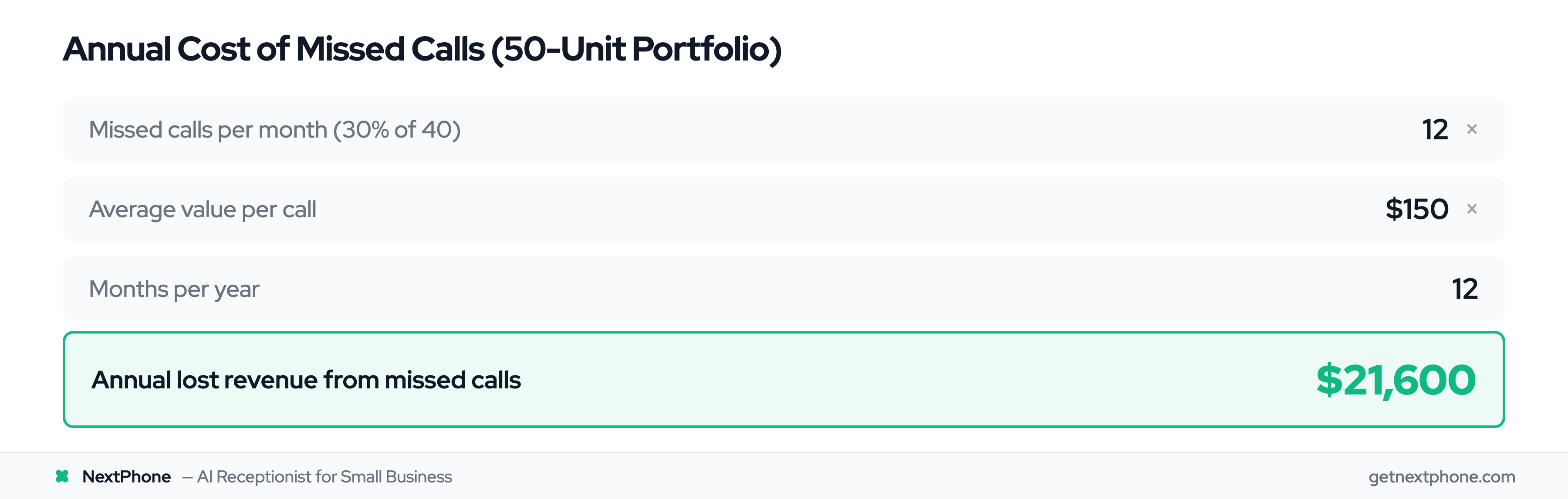
Property management shows similar patterns. A typical small property management company with 50 units receives about 40 calls per month. If you're missing even 30% of those calls (12 calls monthly), and each represents potential revenue of $150 in fees or rent, you're losing $1,800 every month.
That's $21,600 in lost revenue annually—just from unanswered calls.
The leasing calls hurt most. Each missed prospect represents not just this month's showing, but potentially years of rent payments. Industry research from RentManager suggests each missed leasing call costs an average of $1,000 in lost rental income when you factor in extended vacancy time.
Missed Maintenance Calls = Bigger Problems
When a tenant reports a small leak and nobody responds, that leak becomes water damage. A $50 repair turns into a $500 remediation project.
Properties with 24/7 emergency response capabilities experience 60% fewer escalated maintenance issues and significantly lower repair costs, according to Property Management Association statistics. Catching problems early—which requires answering the phone—saves money.
The Annual Impact
Let's do the full calculation for a 50-unit property management company:
- Monthly calls: 40
- Missed at 30%: 12 calls
- Average value per call: $150
- Monthly lost revenue: $1,800
- Annual lost revenue: $21,600
Plus:
- Additional tenant turnover from poor communication: 2 units/year
- Turnover cost per unit: $1,750
- Annual turnover cost: $3,500
Total annual cost of missed calls: $25,100+
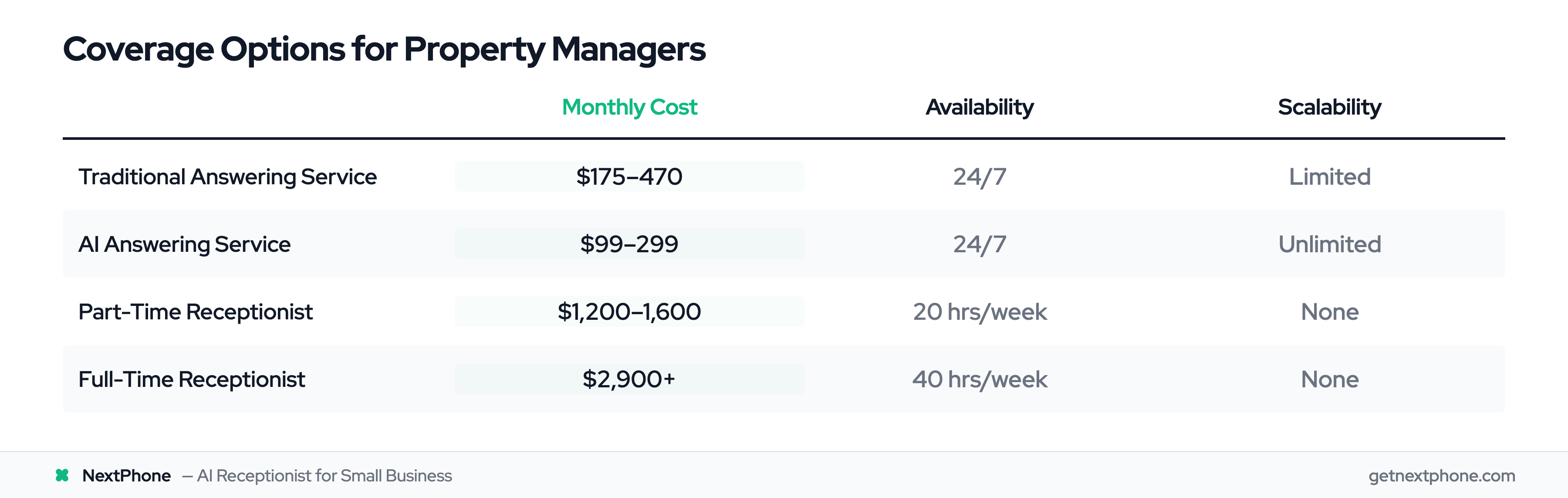
A property management answering service costs $175-470/month—roughly $2,100-5,640/year. The ROI calculation is straightforward.
How Emergency Triage Works
Not every after-hours call deserves a 2 AM wake-up. The value of an answering service lies partly in its ability to sort what's urgent from what can wait.
Not Every Call Is an Emergency
Across the 1,446,980+ inbound calls our AI receptionist answers, emergencies rank among the least common call types — well behind scheduling questions, service inquiries, and status checks. Most after-hours tenant calls are routine matters that feel urgent to the caller but aren't: pool hours, parking questions, pet policy reminders.
This matches what property managers experience firsthand. You're getting woken up for genuine emergencies maybe once or twice a month. The rest are calls that didn't need to interrupt your evening — but you had no way to know that without answering.
A production after-hours call — the AI greets, captures the issue and contact details, flags urgency level, and routes emergencies to your phone. This is the call a voicemail box loses.
The Triage Process
A properly configured answering service uses scripted questions to determine severity:
- "Is anyone in immediate danger?"
- "Is water actively flowing?"
- "Is this a complete loss of heat in winter or AC in extreme heat?"
- "Is there a security breach or intruder?"
If yes to any critical question, the call gets escalated immediately. If no, the service takes a detailed message, reassures the tenant that someone will follow up during business hours, and logs everything for your review.
Escalation Protocols
You control the escalation rules. Typical configurations include:
- Immediate escalation: Water emergencies, no heat/AC in extreme weather, security issues, gas leaks
- Next business day: Appliance failures, noise complaints, general maintenance requests
- Informational only: Policy questions, payment inquiries, parking questions
The service follows your playbook. You sleep through the 10 PM pool hours question but get the 2 AM burst pipe call immediately.