
A patient calls at 7 PM with concerning symptoms. Your office closed two hours ago. The call goes to voicemail. They wait. No callback. So they search for another practice that answers.
You just lost a patient. Maybe for years. Maybe permanently.
This scenario plays out thousands of times daily across medical practices. According to industry research, practices miss between 23% and 42% of incoming calls during business hours alone. Each missed call costs $125-$200 on average. New patient inquiries? Those run $300-$500 each.
And here's what makes it worse: 67% of patients still prefer calling over patient portals, apps, or email. Your phone isn't just a communication tool. It's your practice's lifeline.
This guide covers everything you need to know about medical answering services - from pricing models to cost comparisons and modern AI alternatives that handle unlimited calls for a fraction of traditional pricing.
Why Medical Practices Need Professional Answering Services
Your front desk handles a lot. Checking in patients. Processing paperwork. Managing schedules. Answering insurance questions. And somewhere in between, the phone keeps ringing.
The math simply doesn't work. One receptionist can only handle one call at a time while managing everything else. Meanwhile, 41% of patient calls occur outside standard 8 AM - 5 PM hours. That includes early mornings, evenings, and weekends.
Patient expectations have shifted too. 55% now expect 24/7 access to basic services like appointment scheduling and prescription refill requests. That expectation has increased 23% since 2020. Patients want answers when they have questions - not just when your office happens to be open.
The Real Cost of Missed Patient Calls

Let's talk numbers. Research from Talkdesk found that medical practices miss an average of 23% of incoming calls. Other studies put that figure closer to 34% or even 42% during peak hours.
What happens when patients can't reach you? 62% hang up when reaching voicemail. They don't leave a message. They don't wait for a callback. They call someone else.
Even more concerning: 85% won't try calling back after an unanswered call. One missed call often means one lost patient.
The financial impact adds up fast:
- Average missed call: $125-$200 in lost revenue
- New patient inquiry: $300-$500 in lost revenue
- One 12-provider practice in Ohio: $950,000 annually from just 20 missed calls per day
For context, if your practice misses 10 calls per day at an average value of $150, that's $1,500 daily. Over a year? $390,000 walking out the door.
Patient Retention and Phone Accessibility
Missed calls don't just cost immediate revenue. They cost relationships.
Practices with excellent phone accessibility maintain 85-95% annual patient retention rates. Those with poor phone service? They see 70-80% retention. That 10-15% gap compounds over time.
Consider what losing a patient family actually costs. According to Patient10x research, a lost family represents $15,000-$25,000 in immediate lifetime value. Add referrals they would have sent - typically 5-10 people - and you're looking at $50,000-$100,000 in extended network value.
Patients who experience multiple poor phone interactions are 4x more likely to switch providers. Your phone experience directly shapes whether patients stay or leave.
Traditional Medical Answering Service Costs
Most traditional medical answering services use per-minute billing. This is industry standard, but costs add up faster than most practices expect.
Per-Minute Pricing Breakdown
According to industry pricing guides, here's what traditional services typically charge:
- Basic message-taking: $0.75-$1.00 per minute
- Standard medical services: $0.90-$1.50 per minute
- Complex services (triage, intake): $1.75-$3.00 per minute
- RN triage: $1.50-$4.00 per minute
The average call lasts about 1.25 minutes. At $1.50 per minute, that's roughly $1.88 per call.
Sounds reasonable until you do the math. A practice handling 400 calls per month at $1.88 each spends $752 - assuming no overages, after-hours premiums, or complex calls.
Monthly Plan Estimates
| Practice Size | Monthly Calls | Estimated Cost |
|---|---|---|
| Solo practice | 100-300 | $200-$400/month |
| Small group (2-4 physicians) | 300-600 | $400-$800/month |
| Busy clinic (5+ physicians) | 600-1,000+ | $1,000-$2,000+/month |
| Multi-location | 2,000+ | $3,000+/month |
These estimates assume average call complexity. Specialty practices typically pay 20-30% more than general practices.
Hidden Costs to Watch For
Per-minute pricing creates unpredictable bills. Watch for these additional charges:
- After-hours premiums: Evening and weekend rates often run 25-50% higher
- Bilingual support: Adds 10-20% to standard rates
- Setup and training fees: $100-$300 upfront for custom scripts
- Per-call minimums: Some services charge for at least 30-60 seconds regardless of actual duration
- Overage charges: Exceeding plan limits triggers higher per-minute rates
A quoted rate of "$200/month" can easily become $400+ once these factors kick in.
What to Look for in a Medical Answering Service
Not all answering services are built for medical practices. Some offer healthcare features as an add-on; others lack the workflow entirely. Knowing what to require protects your practice and your patients.
Essential Features Checklist
Any medical answering service should provide:
- Trained staff or well-configured AI systems
- 24/7/365 availability including holidays
- Bilingual support if serving diverse populations
- EHR/EMR integration capabilities
- Appointment scheduling functionality
- Urgent call escalation protocols
- Prescription refill request handling
- Detailed call logs and audit trails
If a service can't confirm these features, keep looking.
Questions to Ask Before Signing
Get specific answers before committing:
- What encryption protocols do you use for voice and data?
- How do you handle urgent calls after hours?
- What's your average answer time?
- Can you integrate with our EHR system?
- What happens if we exceed plan limits?
- What's your process if a security incident occurs?
The answers reveal whether the service actually fits medical workflows or just markets to them.
AI-Powered Medical Answering: The Modern Alternative
Traditional answering services have served healthcare for decades. But AI technology has matured to the point where it outperforms human operators on many metrics - at a fraction of the cost.
This isn't science fiction. AI medical receptionists handle millions of healthcare calls today, with leading platforms processing over 4 million calls across thousands of providers.
How AI Medical Receptionists Work
AI receptionists use natural language processing to understand patient requests in real time. They can:
- Answer common questions about office hours, locations, and services
- Schedule appointments directly or send booking links
- Collect information for prescription refill requests
- Triage calls based on urgency
- Transfer emergencies to on-call staff immediately
- Send SMS confirmations and reminders
- Integrate with practice management and EHR systems
Unlike traditional services that charge per minute, most AI solutions offer flat monthly pricing for unlimited calls.
Performance Advantages
AI systems often exceed human performance on key metrics:
- 99.7% data accuracy vs 90-95% for human operators (no typos, no mishearing)
- 30% faster call handling than human operators
- <5 second answer time vs 30+ seconds for live services
- Zero abandonment rate - no hold times means no hangups
One practice that switched to AI-powered answering reported going from significant call abandonment to "zero-percent abandonment rate" after implementation.
The consistency matters too. AI delivers the same quality at 3 AM as it does at 3 PM. No bad days. No sick calls. No training gaps.
Cost Comparison: Traditional vs AI
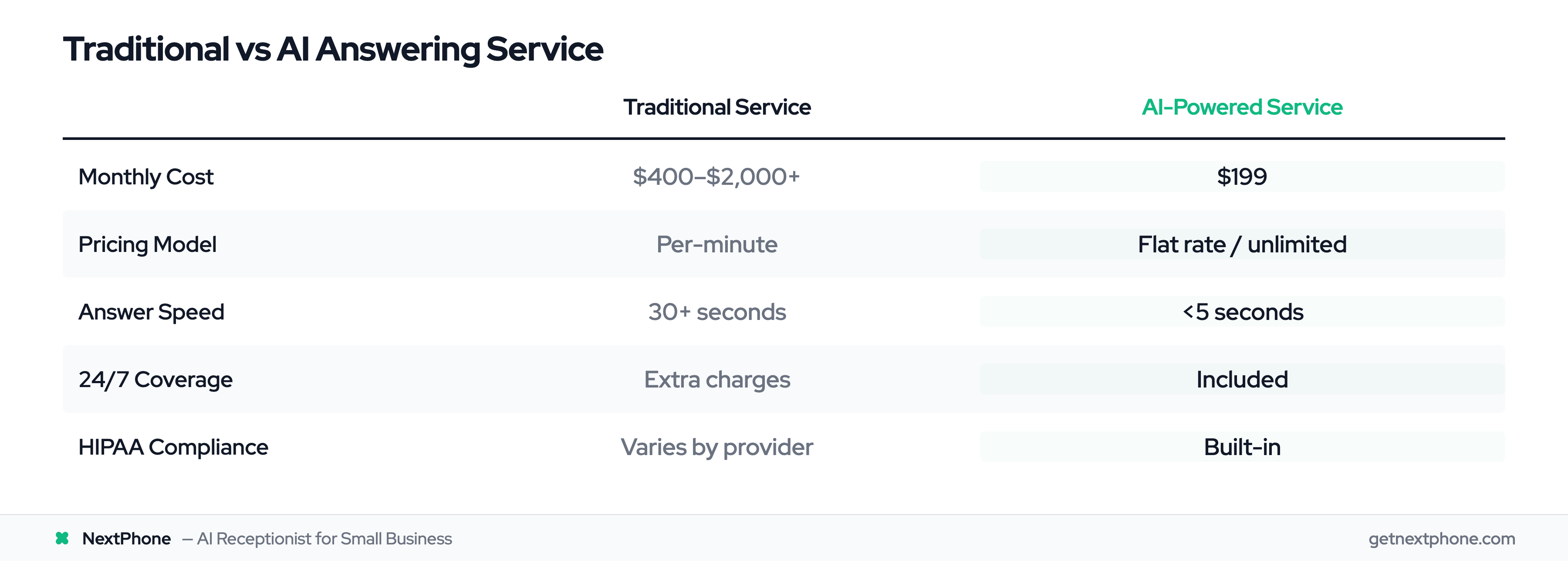
| Feature | Traditional Service | AI-Powered Service |
|---|---|---|
| Monthly Cost | $400-$2,000+ | $199-$400 |
| Pricing Model | Per-minute | Flat rate/unlimited |
| Answer Speed | 30+ seconds | <5 seconds |
| 24/7 Coverage | Extra charges | Included |
| EHR Integration | Limited/extra cost | Often included |
| Scalability | Per-call fees | Unlimited |
| Security | Varies by provider | Secure data handling |
For most practices, AI answering delivers better service at 50-75% lower cost than traditional alternatives.
How NextPhone Supports Medical Practices
NextPhone provides AI-powered receptionist services built specifically for businesses that can't afford to miss calls. For medical practices, that means reliable call handling without the complexity or cost of traditional services.
Features That Matter for Healthcare
24/7 coverage: NextPhone answers every call, including the 41% that come outside business hours. Patients get immediate response at 3 AM the same as 3 PM.
Urgent call routing: Emergency protocols transfer critical calls to on-call staff instantly. You define what qualifies as urgent - the AI follows your rules.
Appointment scheduling: Patients can book directly during the call or receive scheduling links via SMS. No more "call back during business hours."
Prescription refill triage: The AI collects medication details, pharmacy information, and patient identifiers for efficient callback.
SMS confirmations: Encrypted appointment reminders reduce no-shows without manual staff effort.
Integration via webhooks: Connect to your existing EHR, CRM, or practice management system. Data flows where you need it.
Transparent Pricing
NextPhone costs $199/month for unlimited calls. That's it.
- No per-minute charges
- No after-hours premiums
- No setup fees
- No overage penalties
Compare that to $400-$2,000+ monthly for traditional services that charge by the minute. For most practices, NextPhone delivers significant savings while providing faster, more consistent service.
Frequently Asked Questions
How much does a medical answering service cost?
Traditional services typically charge $1-2 per minute, with monthly costs ranging from $200-$2,000+ depending on call volume and complexity. After-hours and bilingual services cost extra. AI-powered alternatives like NextPhone offer flat-rate pricing around $199/month for unlimited calls - eliminating surprise bills.
Can an answering service handle appointment scheduling?
Yes. Most medical answering services offer appointment scheduling, either by directly booking in your system via integration or by collecting patient information and providing scheduling links. AI services often integrate directly with practice management software for real-time availability.
What happens with urgent calls after hours?
Quality medical answering services triage urgent calls based on protocols you establish. True emergencies transfer immediately to on-call physicians. Urgent but non-emergency matters get flagged for priority callback. Routine questions wait until the next business day. You define the criteria - the service executes consistently.
Are AI medical receptionists as good as human operators?
For routine calls, AI often outperforms humans. AI achieves 99.7% data accuracy (vs 90-95% for humans), handles calls 30% faster, and answers in under 5 seconds with zero hold time. AI also delivers consistent quality 24/7 without sick days or training gaps. Complex situations that need human judgment transfer to staff smoothly.
How do I switch from my current answering service?
Most transitions take 1-2 weeks. You'll provide your new service with practice information, call handling protocols, and integration details. Test the system with staff calls before going fully live. Once confirmed working, update your call forwarding. Many practices run both services briefly in parallel during transition.
Protect Your Practice and Your Patients
Your phone is your practice's front door. With 67% of patients preferring to call and 41% of those calls coming after hours, professional answering services aren't optional - they're essential for both patient care and practice revenue.
The stakes are clear. Practices miss 23-42% of calls, losing $150,000-$500,000+ annually. Patients who can't reach you call someone else.
Traditional answering services work, but per-minute pricing creates unpredictable costs that scale poorly. AI-powered alternatives now deliver secure, encrypted coverage at a fraction of the cost - with faster answer times and no surprise bills.