
It's the first warm Saturday in April. Your phone buzzes while you're running the zero-turn across a client's backyard. By the time you finish the row and check, there's a voicemail notification. You play it back: "Hi, I'm looking for someone to redo our entire backyard. Probably a $6,000 project. Give me a call back when you can."
You call back two hours later. No answer. You try again the next day. Nothing. They've already hired someone else.
This scenario plays out thousands of times every day across the $167.4 billion landscaping industry. With over 632,800 landscaping companies in the US competing for the same customers, the business often goes to whoever answers first.
Industry research on home services businesses reveals a brutal truth: 74.1% of calls go completely unanswered. That's three out of every four potential customers calling someone else.
This guide breaks down how a landscaping answering service can help you capture every lead during your busiest season, what different options cost, and how to choose the right solution for your crew size and budget.
Why Landscapers Lose Thousands to Missed Calls
The math on missed calls hurts. Let's look at what the data actually shows.
The Numbers Behind Missed Calls

A typical home services contractor receives about 42 calls per month. With a 74.1% miss rate, that means 31 calls going straight to voicemail. If just 20% of those callers would have converted at an average landscaping project value of $3,500, you're looking at $21,700 in lost revenue every single month.
That adds up to $260,400 per year walking out your door.
"I didn't even know I was missing that many calls until I saw the data," one plumber admitted after discovering he'd missed 76 calls in a single month. "I just thought business was slow."
What Happens When Callers Hit Voicemail
Here's where it gets worse. According to research from Invoca, less than 3% of callers who get pushed to voicemail actually leave a message. The other 97%? They hang up and dial the next landscaper on their list.
BrightLocal found that 48% of consumers immediately search for a competitor when they can't reach a business on the first try. Your voicemail isn't a safety net. It's a leak in your revenue bucket.
The First Responder Advantage
The MIT Lead Response Management Study found something that should keep every landscaper up at night: 78% of customers buy from whichever company responds first. Not the cheapest. Not the one with the best reviews. The first one to pick up the phone.
When you're running equipment and can't answer, you're not just missing a call. You're handing that customer to your competitor.
The Spring Rush Problem: 70% of Your Year in 90 Days
Landscaping isn't like running a restaurant where customers come in at a steady pace year-round. Your business faces a compressed window that makes call management exponentially harder.
When Call Volume Triples Overnight
Industry data from LMC Landscape Partners shows that nearly 70% of annual landscaping requests occur between March and May. That means your normal 10 calls per week suddenly becomes 30 or more. Every homeowner who spent winter looking at their sad backyard finally picks up the phone when the first warm weekend hits.
Your schedule fills up 2-3 months in advance during this window. Project start dates can face 6-8 week delays. Material costs spike 15-25% because everyone's ordering mulch and pavers at the same time.
The Scheduling Domino Effect
Missing calls during spring creates a cascade of problems. You're not just losing that one job. You're losing the referral they would have given you. You're losing their fall cleanup business. You're losing their neighbor who would have seen your truck in the driveway.
Meanwhile, you're physically unable to answer every call because you're out doing the work. You can't operate a hedge trimmer and have a phone conversation at the same time. You can't answer calls while you're driving between job sites.
Why Traditional Solutions Fail
Some landscapers try to solve this by having their spouse or a family member answer calls. That works until it doesn't. People have their own jobs and commitments.
Hiring a dedicated receptionist sounds great until you calculate the cost: $33,000-$40,000 per year plus benefits. For a small crew doing $200,000-$300,000 in annual revenue, that's 15-20% of your gross just to answer phones. And they only work 40 hours a week while calls come in evenings and weekends.
What Is a Landscaping Answering Service?
A landscaping answering service handles your incoming calls when you can't. But the options have evolved significantly from the old-school call centers your parents might have used.
How Answering Services Work
The basic concept is simple: A call comes in to your business line. Instead of hitting voicemail, it gets routed to someone (or something) else that answers professionally, captures the caller's information, and either schedules an appointment or routes the call to you if it's urgent.
You get notified immediately via text, email, or app notification with all the details. The caller gets a professional experience instead of a frustrating voicemail box.
Types of Landscaping Answering Services
Traditional Call Centers: Human operators work from scripts you provide. They answer calls, take messages, and forward information to you. Pricing typically runs $0.79-$1.50 per minute or $150-$400 per month for a limited number of calls. Overage fees add up fast during spring rush.
Virtual Receptionists: A step up from basic call centers. These services use trained receptionists who can handle more complex conversations, schedule appointments, and qualify leads. Higher touch, but higher cost, often $500-$800 per month for meaningful volume.
AI-Powered Answering: The newest category uses conversational AI to handle calls 24/7. No per-minute charges, no overage fees, instant scaling during busy periods. The AI can answer questions, book appointments directly on your calendar, and route urgent calls to your phone.
AI vs Human Receptionists: An Honest Comparison
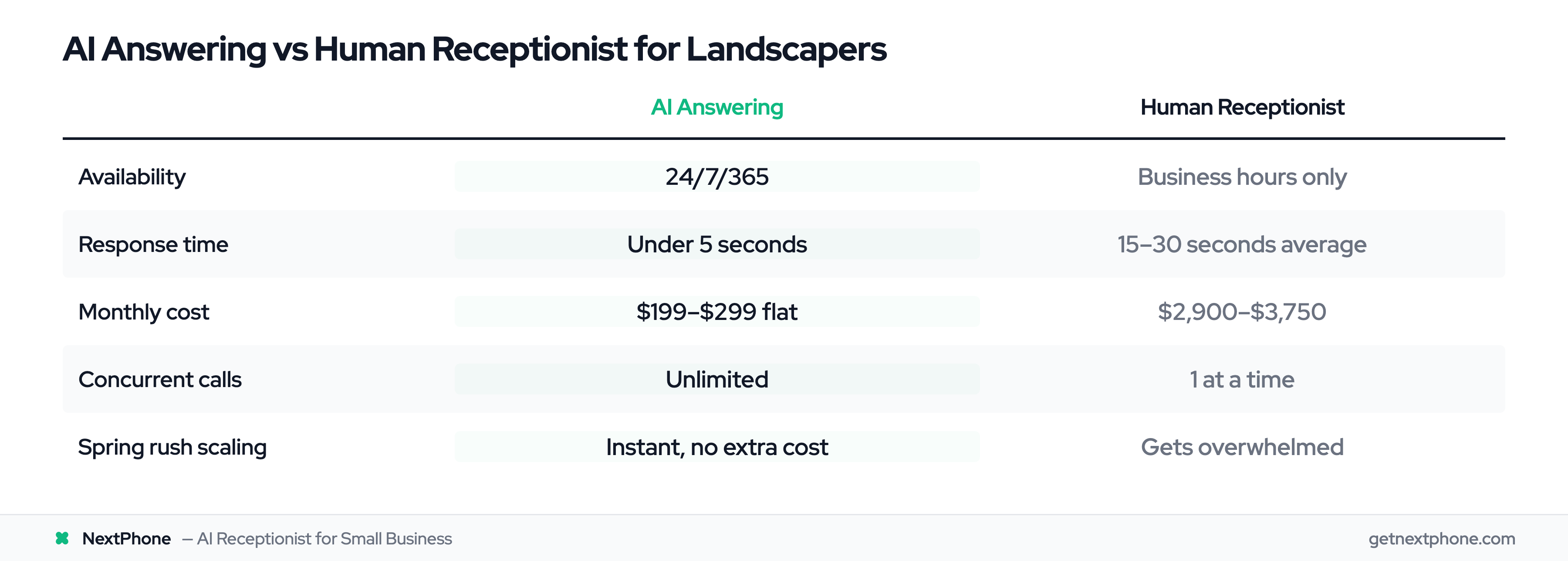
Let's be straight about what each option does well.
| Factor | AI Answering | Human Receptionist |
|---|---|---|
| Availability | 24/7/365 | Business hours only |
| Response time | Under 5 seconds | 15-30 seconds average |
| Cost | $199-$299/month flat | $35,000+/year |
| Concurrent calls | Unlimited | 1 at a time |
| Consistency | Same quality every call | Varies by person, mood |
| Complex empathy | Limited | Strong |
| Unusual requests | May need transfer | Can improvise |
AI excels at the 80% of calls that follow predictable patterns: scheduling, pricing questions, service area inquiries, basic job details. Humans excel at the 20% that require genuine empathy or creative problem-solving.
The research backs this up. Gartner found that 60-70% of customers are now comfortable interacting with AI for simple tasks like scheduling. The key is having a seamless transfer option when someone genuinely needs a human touch.
6 Ways an Answering Service Helps Landscapers Book More Jobs
Beyond just answering the phone, here's what a good landscaping answering service actually does for your business.
Never Miss a Call (Even While Operating Equipment)
The core value proposition. When you're running a mower, operating a chainsaw, or driving between sites, calls still get answered. Your 74.1% miss rate drops to near zero.
Every call gets a professional greeting instead of a robotic voicemail message. Callers feel like they're dealing with a real business, not a solo operator who might not show up.
Capture After-Hours Leads
A large share of calls to home services businesses come outside traditional 9-5 hours. Saturday afternoon when a homeowner is planning their spring project? You're probably on another job. Sunday morning when they're drinking coffee and researching contractors? You're at church or sleeping in.
An answering service captures these high-intent leads when they're ready to buy, not when you're ready to answer.
Book Appointments Directly on Your Calendar
The best services integrate with your calendar (Google Calendar, Outlook, and the like) and can actually book estimate appointments during the call. If you run on Jobber, the estimate request lands there instead, with everything the caller told you on it. No phone tag. No back-and-forth texts. The customer hangs up with a confirmed time slot.
This alone can save you hours every week and reduce the friction that causes potential customers to go elsewhere.
Qualify Leads Before You Call Back
Not every call deserves the same response. A service can collect key information up front:
- What type of work do they need?
- What's the property size?
- What's their timeline?
- Do they have a budget in mind?
- Is this urgent or can it wait?
When you call back, you already know if this is a $500 mulch job or a $15,000 hardscape project. You can prioritize accordingly.
Track Callback Requests Automatically
Our analysis found that approximately one in four callers explicitly asks for a callback. That's a lot of people saying "please call me back." Without a system, most of these fall through the cracks. You think you'll remember, but three jobs later, you've forgotten.
A good answering service logs every callback request with contact info and context, then reminds you until it's done.
Scale Instantly for Spring Rush
Here's where AI answering really shines. When your normal 10 calls per week jumps to 30+, a human receptionist gets overwhelmed. A call center charges you triple for the extra volume.
AI handles one call or 100 simultaneous calls for the same flat rate. Your spring rush doesn't cost you more. It just works.