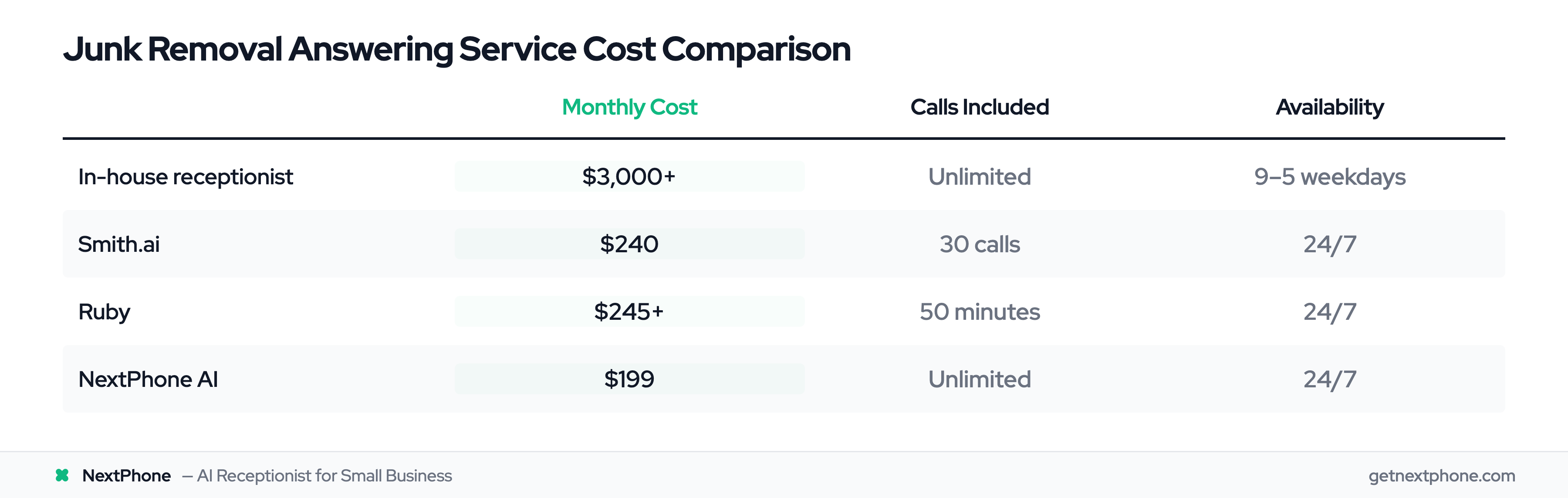
The Call You Missed While Loading That Couch
You're halfway up a driveway, a sectional sofa balanced between you and your helper, sweat dripping down your back. Your phone buzzes in your pocket. By the time you set the couch down, catch your breath, and check the missed call, ten minutes have passed.
You call back. No answer. They already booked someone else.
This happens more often than most junk removal operators want to admit. According to junk removal industry statistics, 65% of junk removal business owners don't consistently answer their phones. And the data backs that up: industry research shows 74.1% of calls to home services businesses go completely unanswered.
That's not a phone problem. That's a revenue problem.
This guide breaks down exactly how much missed calls cost your junk removal business, what a junk removal answering service actually does, and how to capture every lead—even when you're elbow-deep in a basement cleanout.
Why Junk Removal Businesses Miss So Many Calls
The Fieldwork Reality
Junk removal isn't a desk job. You're loading trucks, driving between appointments, navigating narrow staircases with heavy furniture, and dealing with the physical demands of hauling other people's stuff. Answering every call the moment it comes in isn't just difficult—it's often impossible.
Consider a typical day: You're at a residential cleanout, truck half-loaded, when a call comes in. Your hands are full. Maybe you're operating equipment where answering would be a safety issue. Maybe you're in the middle of explaining pricing to the customer in front of you.
By the time you're free, that caller has moved on.
For one-truck operators, this hits hardest. There's no office staff to handle incoming calls. It's just you, your truck, and a phone that rings at the worst possible moments.
The Numbers Don't Lie
The industry research on home services businesses is stark: 74.1% of calls go completely unanswered. That's nearly three out of every four potential customers reaching voicemail—or worse, an endless ring.
The junk removal industry faces the same challenges. Maybe worse, given how much time crews spend physically handling items where they simply can't reach their phones.
What Happens When You Miss That Call
Here's what callers do when you don't pick up:
- 85% won't call back after reaching voicemail, according to research from BIA/Kelsey
- 48% immediately search for a competitor, per BrightLocal data
- 75% hang up without leaving a message
The caller doesn't know you're mid-haul. They don't know you'll call back in 20 minutes. They just know they called and nobody answered. So they call the next name on the list.
"I didn't even know I was missing that many calls until I saw the data. I just thought business was slow."
That quote came from a plumber we work with, but junk removal operators say the same thing. The calls are coming in. You're just not there to answer them.
The Real Cost of Missed Calls to Your Junk Removal Business
The Math: What Every Missed Call Costs
Let's put real numbers to this problem.
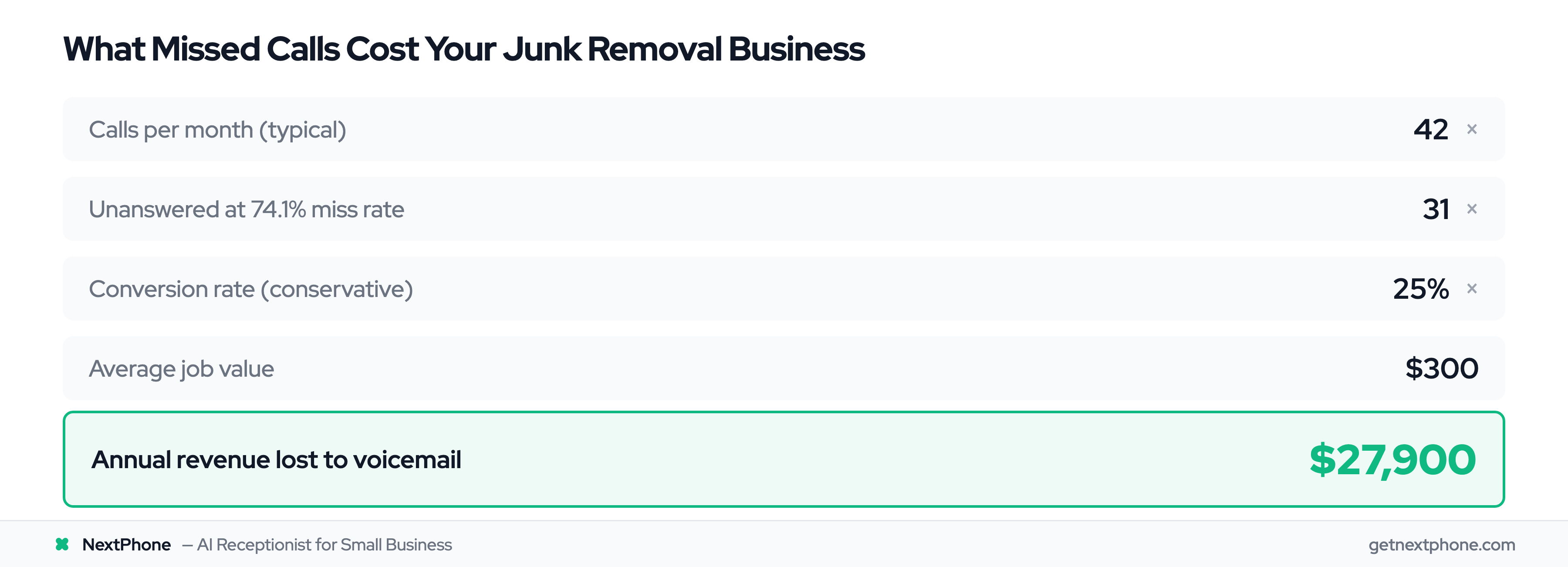
The average junk removal job runs between $150 and $350, with full truckloads commanding $400 to $800. For this calculation, we'll use a conservative $300 average job value.
A typical junk removal business receives around 42 calls per month. If 74.1% go unanswered, that's 31 missed calls every month.
Not every call converts—some are price shoppers, some aren't ready to book. But if even 25% of those missed callers would have become customers, here's what you're losing:
- 31 missed calls x 25% conversion = 7.75 lost jobs per month
- 7.75 jobs x $300 average = $2,325 per month in lost revenue
- $2,325 x 12 months = $27,900 per year
For operators with higher call volume or higher average job values, those numbers climb fast. A company averaging $450 per job loses over $40,000 annually to missed calls.
Speed-to-Lead: Why First Response Wins
The timing of your callback matters enormously. Research from MIT and InsideSales found that calling a lead back within five minutes makes you 100 times more likely to reach them compared to waiting 30 minutes.
Five minutes versus 30 minutes. A hundred-fold difference in contact rate. The speed-to-lead research is unambiguous on this point.
But here's the kicker: 78% of customers buy from whichever company responds first. Not the cheapest. Not the one with the best reviews. The first one to pick up the phone.
When you're loading a truck and can't call back for an hour, you're not competing on price or quality anymore. You're just losing to whoever answered first.
Your Annual Revenue Leak
During peak season—spring cleaning and summer moves—call volume spikes roughly 50% above winter levels. That 31 missed calls per month becomes 45 or more. HomeAdvisor found that 42% of homeowners tackle home improvement projects in spring, and clearing out junk is often part of those projects.
So you're missing the most calls during the exact months when demand is highest and every job counts most.
How a Junk Removal Answering Service Works
What Happens When a Customer Calls
A junk removal answering service does exactly what the name suggests: it answers your phone when you can't.
When a potential customer calls your business number, the service picks up within seconds—typically under five seconds for AI-powered systems, compared to the 30-plus seconds many callers wait on hold with traditional services.
The caller hears a professional greeting customized to your business name. No generic "please hold" messages. No robotic menus asking them to press 1 for this or 2 for that.
Information Collection for Junk Jobs
A good junk removal answering service collects the details you need to price and schedule the job:
- Customer name and phone number
- Service address
- What they need removed (furniture, appliances, yard waste, general household items)
- Rough volume estimate (single item, partial load, full truckload)
- Access details (stairs, narrow hallways, elevator available)
- Timeline (flexible, specific date needed, urgent)
- Any special circumstances (hoarding situation, estate cleanout, construction debris)
By the time you call back—or by the time the service texts you the lead details—you know exactly what you're walking into. No more arriving at a "small job" to find three floors of furniture with no elevator.
Getting Leads to Your Phone
Most answering services offer multiple ways to get lead information to you instantly:
- Text notifications with caller details and job summary
- Email summaries with full conversation transcripts
- App notifications you can check between jobs
- Direct transfers for urgent calls that need your immediate attention
You're loading a truck, your phone buzzes with a text: "New lead - Sarah Miller - 1847 Oak Street - full basement cleanout - needs done by Friday - has elevator - call back." You finish the current job, call Sarah with full context, and book the appointment.
That's the difference between losing a lead and capturing it.
Features That Matter for Junk Removal Businesses
Industry-Specific Question Handling
Generic answering services ask generic questions. A junk removal answering service should understand your business well enough to collect useful information.
Does the caller have appliances with freon that require special handling? Is this a hoarding situation that might take longer than a standard cleanout? Are there stairs involved, and how many flights?
These details affect your pricing and scheduling. An answering service that doesn't collect them creates more callback work for you.
Urgent Job Detection and Routing
Not all junk removal calls are created equal. Some callers have flexible timelines. Others need help immediately.
Estate cleanouts with a closing date in three days. Eviction cleanups with a court-ordered deadline. Customers moving out this weekend who just realized they can't take everything.
In our call data, urgent calls rank among the top reasons people call, using language like "emergency," "urgent," or "ASAP." For junk removal, these callers often represent higher-value jobs—they'll pay a premium for fast service.
A good answering service detects this urgency and can route those calls directly to your phone while handling routine inquiries via message.
Scheduling and Quote Collection
The best junk removal answering services go beyond message-taking. They can check your calendar availability and book appointments directly, or at minimum, collect enough information for you to provide an accurate quote on the callback.
Some services integrate with scheduling software like Workiz or Jobber, dropping leads directly into your system with no manual entry required.
After-Hours Coverage
Here's something that surprises many business owners: a large share of calls to home services businesses come outside traditional 9-to-5 hours.
Weekends are prime time for junk removal inquiries. People clean out garages on Saturdays. They clear basements on Sunday afternoons. They scroll through their phones Sunday night, see that pile of stuff in the spare room, and decide tomorrow they're finally dealing with it.
If your phone goes to voicemail at 7 PM or all day Sunday, you're missing the majority of your potential customers. An after-hours answering service closes that gap completely.