It's 7:15 PM on a Tuesday. You're at your daughter's volleyball game when your phone buzzes—a prospective client calling about auto insurance after their teenager just got a license. You can't take the call. It goes to voicemail.
They hang up without leaving a message. Two minutes later, they're on the phone with the agency down the street that actually picked up.
This scenario plays out constantly across insurance agencies. According to Invoca's insurance marketing research, insurance companies miss 39% of inbound calls. That's four out of every ten potential clients calling someone else. And 65% of insurance customers will consider switching providers after just one poor communication experience.
An insurance answering service solves this problem—ensuring every quote request, claim notification, and policy question gets answered, 24 hours a day. This guide breaks down what these services do, what they cost, and how to choose the right one for your agency.
The Real Cost of Missed Calls for Insurance Agencies
Before discussing solutions, you need to understand the problem. Most agency owners dramatically underestimate how many calls they miss and what those misses actually cost.
How Many Calls Does Your Agency Actually Miss?
The industry average is sobering: insurance companies miss 39% of inbound calls. But that number gets worse when you look at small agencies without dedicated reception staff.
Industry research puts the missed-call rate for small businesses at 74.1%. That's three out of every four potential customers reaching voicemail instead of a person.
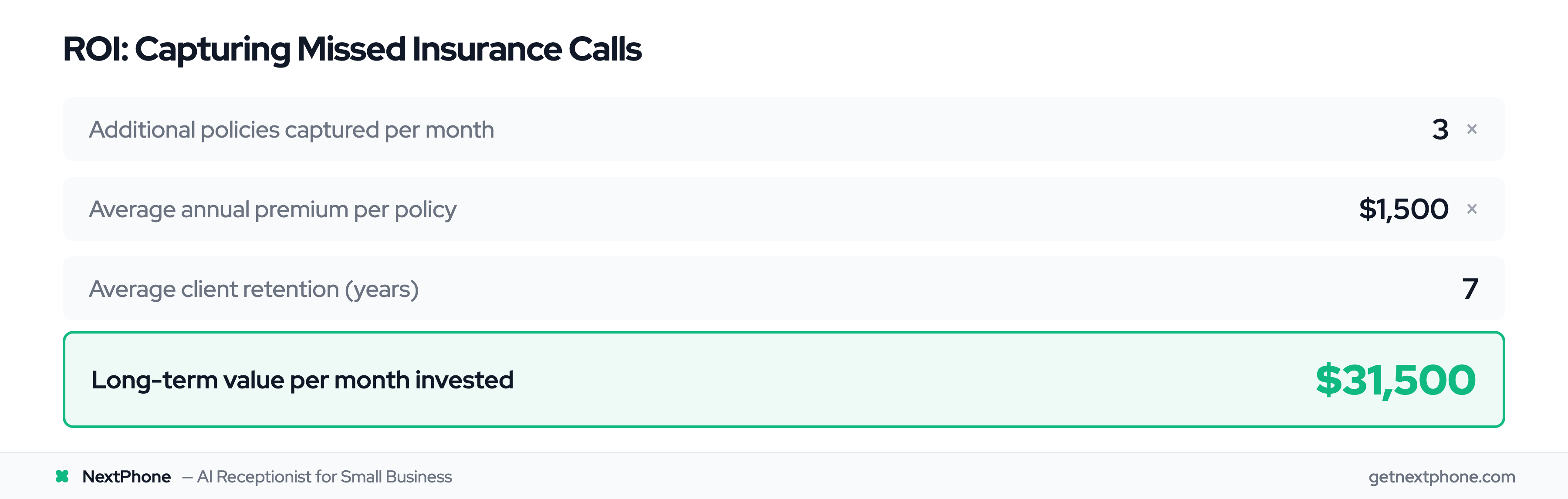
Here's where it gets painful: 30% of those calls are leads, and 22% of leads convert. So every 100 calls your agency receives, roughly 39 go unanswered, 12 of those were potential new clients, and 2-3 would have actually bought a policy.
Miss those calls consistently, and you're bleeding business without even knowing it.
What a Missed Call Really Costs
The average auto insurance policy runs $1,500-2,000 per year. Homeowners policies average $1,200-1,800. Bundle them together, and you're looking at $2,700-3,800 annually per household.
But here's the real math: insurance clients stick around. The average retention period is 7+ years. That means a single client relationship is worth $18,000-26,000 in lifetime premium revenue.
Industry benchmark data puts the average small business loss at $450 per missed call. For insurance agencies specifically, industry estimates suggest $300-500 in immediate lost premium revenue per unanswered call—not counting the lifetime value walking out the door.
Let's make this concrete. Say your agency fields 100 calls per month:
- 39 go unanswered (industry average)
- 12 of those were leads (30%)
- 3 would have converted (22% of leads)
- 3 lost clients × $20,000 average LTV = $60,000 in long-term revenue lost monthly
Even if you're more conservative—say 2 lost clients per month—that's $480,000 in lifetime value evaporating every year.
The Speed-to-Lead Problem
Here's what makes this worse: insurance shoppers move fast.
According to the landmark MIT lead response study, 78% of customers buy from whichever company responds first. Not the cheapest. Not the one with the best reviews. The first one to pick up the phone.
And 85% of callers won't try again if their first attempt goes unanswered. They don't leave voicemails. They call your competitor.
Insurance shopping happens at inconvenient times. Parents research coverage after the kids go to bed. Business owners call during their lunch break. Accident victims need to report claims at 2 AM. If you're not answering, someone else is.
"I didn't even know I was missing that many calls until I saw the data. I just thought business was slow." — Small business owner after reviewing call analytics
What an Insurance Answering Service Actually Handles
An insurance answering service isn't just someone picking up and taking messages. Modern services—especially AI-powered ones—handle the full spectrum of calls your agency receives.
Quote Requests and New Business Calls
When a prospect calls asking about coverage, the answering service captures everything you need:
- Caller's name and contact information
- Type of coverage they're shopping for (auto, home, life, business)
- Current coverage status and renewal timeline
- Property or vehicle details
- Preferred callback time or appointment slot
The best services go beyond intake. They can qualify leads by asking about budget range and coverage needs, then schedule appointments directly in your calendar. Some even send an SMS follow-up with a link to your online quote form, keeping the momentum going.
Claims Notifications and Emergencies
Claims don't wait for business hours. A fender bender at 10 PM, a kitchen fire on Sunday morning, a break-in at 3 AM—your clients need to report these immediately.
An answering service takes the initial claim intake:
- Date, time, and location of the incident
- Description of what happened
- Other parties involved
- Whether anyone was injured
- Photos or documentation the caller can provide
For urgent claims—accidents with injuries, major property damage, incidents requiring immediate response—the service routes the call to your cell phone. You decide what counts as urgent. Everything else gets documented and queued for your review the next morning.
Policy Questions and Renewals
Existing clients call with questions: What's my deductible? When does my policy renew? Can I add my new car to my coverage? Do you offer umbrella policies?
Your answering service can handle frequently asked questions directly, pulling from the information you provide during setup. For questions requiring policy-specific details, they collect the client's information and schedule a callback.
Renewal season gets hectic. An answering service ensures every renewal inquiry gets captured and scheduled for review, rather than lost in a voicemail pile you'll never clear.
After-Hours Coverage
Here's something that surprises most agency owners: most customer calls to service businesses happen outside traditional 9-5 hours. Insurance follows a similar pattern.
Why? Because the moments that trigger insurance needs happen on their own schedule:
- A teenager backs into the garage door on a Saturday
- A pipe bursts on Thanksgiving
- Someone shopping for insurance finally has time to call after putting the kids to bed
Without after-hours coverage, you're invisible during the majority of buying moments. An answering service makes you available 24/7/365 without requiring you to be on-call personally.
AI vs Traditional Answering Services
Not all answering services work the same way. Understanding the differences helps you choose the right fit for your agency.
Traditional Live Answering Services
Traditional services employ human operators who answer calls on your behalf, following scripts you provide.
How they work: Your calls forward to a call center. A live person answers with your agency name, follows your script, takes messages, and handles basic intake. Pricing typically runs $325-800/month based on minutes used.
Pros:
- Human touch for sensitive conversations
- Can handle complex, nuanced situations
- Callers know they're talking to a person
Cons:
- Per-minute billing adds up fast (insurance calls can run long)
- Quality varies by operator
- Limited or expensive after-hours coverage
- Setup fees ($200-300), porting fees ($300+), overage charges
- Minimal technology integration
Services like Ruby Receptionists, AnswerConnect, and AnswerFirst fall into this category. They work well but cost significantly more than newer alternatives.
AI-Powered Answering Services
Modern AI answering services use conversational AI—not the frustrating "press 1 for sales" systems from a decade ago. These sound natural, understand context, and handle real conversations.
How they work: Calls route to an AI that engages naturally with callers, asks relevant questions, captures information, schedules appointments, and even sends follow-up texts. Pricing is typically flat-rate: $199/month for unlimited calls.
Pros:
- 60-75% cheaper than traditional services
- Truly 24/7 without overtime costs
- Perfect consistency—never has a bad day
- Handles unlimited concurrent calls (no busy signals during claim spikes)
- Deep integrations with CRM, calendar, and communication tools
- Answers in under 5 seconds, every time
Cons:
- Some callers prefer speaking with humans
- Complex emotional situations may need human handoff
The key innovation: modern AI can transfer calls to you seamlessly when needed. A caller requesting a human or discussing a complex claim gets routed to your phone mid-conversation.
The Hybrid Approach
The smartest agencies use AI for what it does best while keeping humans in the loop for what requires human judgment.
AI handles:
- Quote request intake
- Claims documentation
- Appointment scheduling
- FAQ responses
- After-hours coverage
- Lead qualification
You handle:
- Complex claims discussions
- Upset or frustrated clients
- VIP clients who expect your personal attention
- Coverage explanations requiring expertise
This lets you focus on selling policies and servicing clients—not answering every phone call personally.
Cost Comparison at a Glance
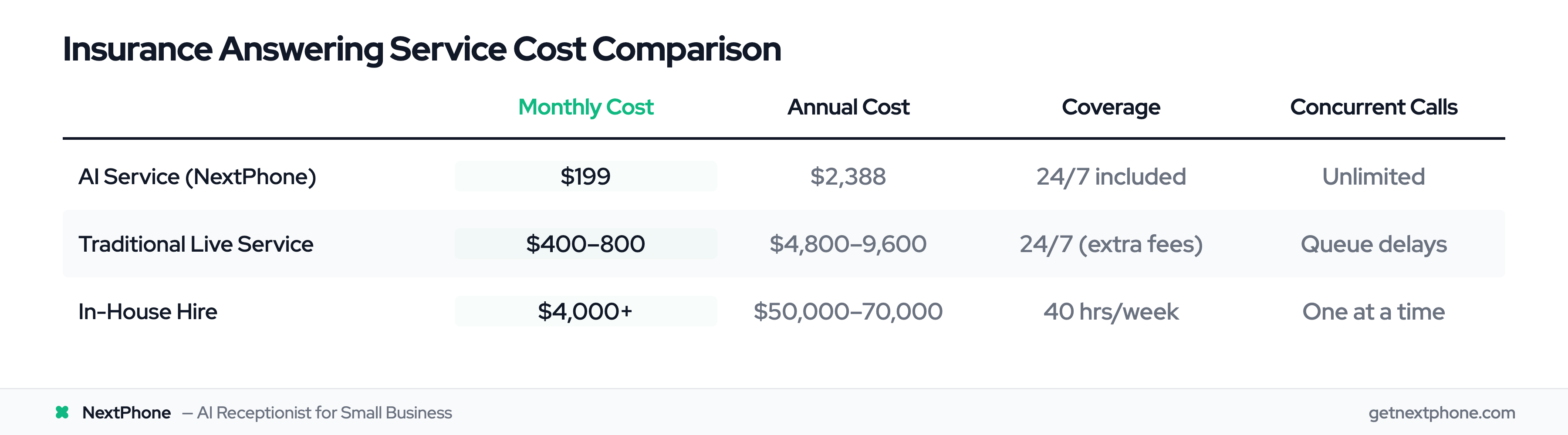
| Factor | Traditional Service | AI Service | In-House Hire |
|---|---|---|---|
| Monthly Cost | $400-800 | $199 | $4,000+ |
| Annual Cost | $4,800-9,600 | $2,388 | $48,000+ |
| Coverage Hours | 24/7 (extra fees) | 24/7 included | 40 hrs/week |
| Consistency | Varies by operator | Perfect every call | Varies by day |
| CRM Integration | Limited or none | Built-in | Manual entry |
| Setup Time | Days to weeks | Hours | Weeks to months |
| Concurrent Call Limit | Queue delays | Unlimited | One call at a time |