Understanding Inbound and Outbound Calls
Your phone rings. A homeowner needs emergency AC repair - their system died in 95-degree heat. You're on a job site with drywall mud on your hands. The call goes to voicemail. They call the next contractor on Google. You just lost a $4,200 job.
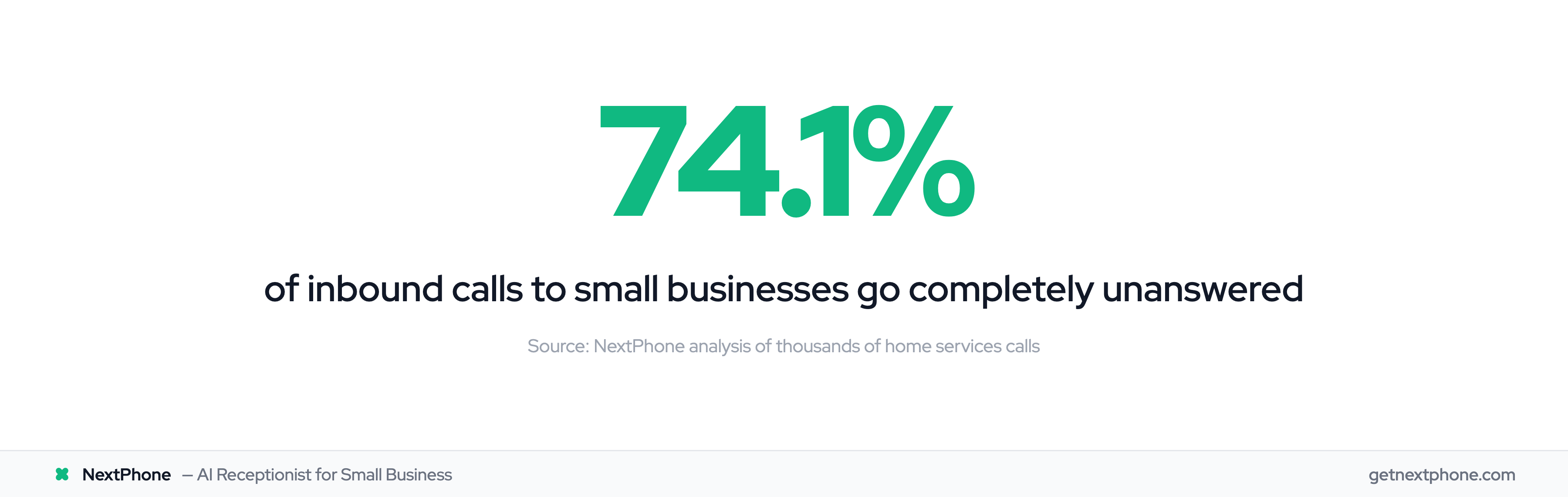
This scenario plays out constantly for small businesses. Industry research on calls to home services businesses found that 74.1% go completely unanswered. That's three out of every four potential customers calling someone else.
Most small business owners don't fully understand the difference between inbound and outbound calls - or why only one of them is actually costing you money. This guide breaks down everything you need to know about both call types, plus practical solutions for handling inbound calls without building a traditional call center.
What is an Inbound Call? Definition and Examples
Inbound Call Definition
An inbound call is any phone call initiated by a customer or prospect to your business. The customer makes the call. You receive it. The call comes IN to your business.
This is the opposite of outbound calling, where your business reaches out to customers. With inbound calls, someone has already found you and decided you might be worth their money. They've done the hard work of discovering your business - now they just need you to answer.
Looking for just the definition? See our focused guide to inbound call meaning.
Common Types of Inbound Calls
The calls coming into your business typically fall into these categories:
- New customer inquiries and quote requests - People who found you online and want to learn more
- Existing customer support - Current clients with questions or issues
- Appointment scheduling - Booking service calls, consultations, or meetings
- Order tracking and status checks - Customers following up on previous work
- Emergency service requests - Urgent situations requiring immediate attention
- Billing and payment questions - Inquiries about invoices, payment options, or disputes
In our call data, quote or estimate requests are among the top reasons people call, and scheduling is the single most common reason of all. These represent immediate revenue opportunities.
Examples by Industry
Here's what inbound calls sound like across different businesses:
Home services: "My AC stopped working and it's 95 degrees. Can someone come out today?"
Healthcare: "I need to schedule a follow-up appointment with Dr. Smith."
Legal: "I was in a car accident last week. Can you help me with my case?"
Real estate: "Is the house on Oak Street still available? I'd like to schedule a showing."
Each of these callers has intent. They're not browsing - they're ready to take action. That's why inbound call handling matters so much for business growth.
What is an Outbound Call? Definition and Examples
Outbound Call Definition
An outbound call is any phone call your business initiates to a customer or prospect. You make the call. They receive it. The call goes OUT from your business.
Outbound calling is typically associated with sales, marketing, and follow-up activities. You're reaching out to people who haven't contacted you first.
Common Types of Outbound Calls
Businesses make outbound calls for various reasons:
- Cold calling and lead generation - Reaching out to prospects who haven't expressed interest
- Following up on leads or quotes - Checking in after someone requested information
- Customer satisfaction surveys - Gathering feedback on recent service
- Payment reminders and collections - Following up on overdue invoices
- Appointment confirmations - Verifying upcoming scheduled services
- Upselling and cross-selling - Offering additional services to existing customers
When Small Businesses Make Outbound Calls
If you run a small service business, your outbound calling probably looks like this:
- Calling back someone who requested a quote
- Confirming tomorrow's appointments
- Following up after completing a job
- Asking satisfied customers for reviews
Notice something? Most of these are reactive, not proactive. You're not running cold call campaigns. You're following up on inbound interest.
For service businesses, inbound calls represent much higher value. When someone calls you, they've already decided they might need your help. When you call them out of the blue, you're interrupting their day and hoping they'll listen.
Inbound vs Outbound Calls: Key Differences
Understanding these differences helps you prioritize where to focus your resources.
| Factor | Inbound Calls | Outbound Calls |
|---|---|---|
| Who initiates | Customer | Business |
| Customer intent | High (they called you) | Low (you called them) |
| Urgency level | Often immediate need | Scheduled or planned |
| Conversion rate | Higher (30-50% for phone leads) | Lower (cold calls ~2%) |
| Revenue impact | Direct - missed call = lost sale | Indirect - builds pipeline |
| Skills needed | Problem-solving, empathy | Persuasion, resilience |
Why This Matters for Small Businesses
Here's the reality for most small business owners:
You receive inbound calls. Customers find you through Google, referrals, or your advertising. They call because they have a need. Every ring represents someone ready to spend money with you - or your competitor.
You rarely make outbound sales calls. You're not running a telemarketing operation. You don't have a team of salespeople dialing through lead lists.
This means inbound call handling directly impacts your bottom line. Missing an inbound call doesn't just lose that customer - it hands them to whoever answers next.
The Technology Difference
Call centers use different tools depending on their focus:
Inbound call technology:
- IVR (Interactive Voice Response) systems for call routing
- Automatic Call Distribution (ACD)
- Voicemail and answering services
- CRM integration for customer lookup
Outbound call technology:
- Auto-dialers and predictive dialers
- Lead management software
- Call scripting tools
- Performance tracking dashboards
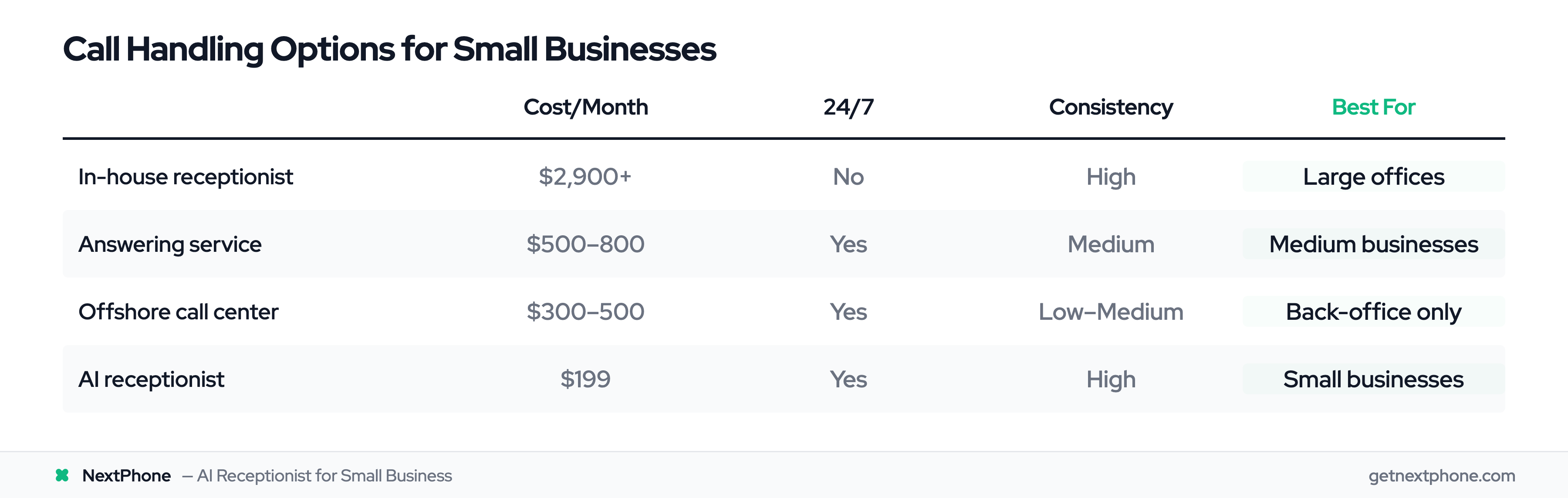
For small businesses, the inbound technology matters most. You need something that answers when you can't - not software for cold calling campaigns you're not running.
According to Google research, phone leads convert at 30-50% higher rates than form submissions. Every unanswered call is a high-value opportunity lost.
Why Inbound Calls Matter More for Small Businesses
The Reality of Small Business Phone Calls
Let's be honest about how your business actually works.
You're probably not running cold call campaigns. You don't have a sales floor of agents dialing through lead lists. Customers find you - through search, through referrals, through the sign on your truck - and they call.
Every inbound call represents someone who has already decided you might be worth their money. They searched, they compared, they picked up the phone. That's a warm lead by any definition.
Research from Lead Connect found that 78% of customers buy from whichever company responds first. Not the cheapest. Not the best reviewed. The first one to pick up the phone.
The Shocking Truth About Missed Inbound Calls
Here's where the data gets uncomfortable.
Industry research on calls to home services businesses found that 74.1% go completely unanswered. That's not a typo. Three out of every four potential customers reached voicemail.
What happens when callers get voicemail? According to industry research, 85% of callers who reach voicemail never call back. They don't leave a message and try again later. They call your competitor.
Think about what this means. If you receive 42 calls per month (typical for a home services contractor), 31 of those calls are going unanswered. Most of those callers will never attempt to reach you again.
Revenue Impact Calculator
Let's do the math for that typical contractor:
- 42 inbound calls per month
- 74.1% go unanswered = 31 missed calls
- If 20% would have converted = 6 lost customers
- Average job value of $3,500 = $21,700 per month lost
- Annual impact: $260,400 in lost revenue
Even if your numbers are more conservative, the pattern holds. Missed inbound calls directly translate to missed revenue.
Mobile Call Handling Challenges
Modern business owners work from their phones. That creates problems.
Your Android phone call notification comes while you're under a sink or on a ladder. By the time you can safely reach your phone, the caller has given up. Your carrier voicemail kicks in after 4-5 rings - about 20 seconds.
If you're already on another call, the second caller goes straight to voicemail. There's no "please hold" option. Just silence, then a beep.
Some carrier plans don't even include visual voicemail. You have to dial in to check messages - assuming you remember to check at all.
The Hidden Cost of Carrier Voicemail
What is Carrier Voicemail?
Carrier voicemail is the default voicemail service provided by your mobile phone carrier - AT&T, Verizon, T-Mobile, or whoever handles your cell plan.
When someone calls and you don't answer, the call forwards to your carrier's voicemail server. The caller hears a greeting (either generic or one you recorded) and can leave a message. That message is stored on your carrier's servers until you retrieve it.
Carrier voicemail meaning differs from visual voicemail apps or third-party services. It's the basic, built-in option that comes with your phone plan. Some carriers charge extra for enhanced features like transcription.
Why Carrier Voicemail is Killing Your Business
The problem isn't the technology. The problem is what happens when callers reach it.
Callers don't leave messages. Modern customers expect instant answers. Voicemail feels like talking to a wall. They hang up and try somewhere else.
No transcription on basic plans. You have to dial in, listen to the full message, and manually write down the callback number. By the time you do this, hours have passed.
Generic greetings feel impersonal. "You have reached the voicemail of 555-1234. Please leave a message." That's not a customer experience. That's a dead end.
No notification if you're unreachable. If your phone is off, in airplane mode, or out of service, you might not know someone called until much later.
The Psychology of Voicemail
Here's why 85% of callers never call back after reaching voicemail:
Immediate needs require immediate answers. When your AC is broken in July, you don't want to wait for a callback. You want someone to say "we can be there today."
Leaving a message feels like shouting into the void. Will anyone actually listen? Will they call back? When? Customers have no idea. So they call someone who answers.
Voicemail signals unavailability. Rightly or wrongly, customers interpret voicemail as "this business is too busy for me" or "this business doesn't prioritize customers."
Your carrier voicemail is the last thing a customer hears before calling your competitor. Make sure that thought sinks in.
How to Handle Inbound Calls Professionally
Answer Quickly (The 80/20 Rule)
The industry standard for professional call handling is the 80/20 rule: 80% of calls should be answered within 20 seconds. That's about 3-4 rings.
But here's what research shows about answer speed:
| Rings | Time | Conversion Impact |
|---|---|---|
| 1-2 rings | 0-8 seconds | Optimal zone |
| 3 rings | 9-15 seconds | Still professional |
| 4 rings | 16-20 seconds | Decline begins |
| 5+ rings | 20+ seconds | 10-25% lower conversion |
According to the InsideSales Lead Response Study, conversion rates are 8x greater when you respond within 5 minutes. After 30 minutes, you're 10x less likely to make contact.
The ideal? Answer by the second ring. It signals attentiveness without feeling desperate. AI receptionists answer in under 5 seconds - faster and more consistent than any human.
Start With the Right Greeting
How you open a call matters more than you might think.
The exploratory approach (recommended): "Thanks for calling [Your Business], how can I help you today?"
This feels welcoming. It puts the customer in control. They lead with their need, and you respond helpfully.
The qualifying approach (avoid): "Are you a new customer or existing customer?"
This feels bureaucratic. You're sorting them into a queue before you've provided any value. It creates friction before the conversation even starts.
Start by helping. Qualify naturally through conversation.
Collect the Right Information
Every inbound call should capture:
- Caller name and contact information
- Nature of their request or problem
- Urgency level (routine, soon, emergency)
- Preferred callback time if you can't help immediately
- Any relevant details about the job or situation
Don't interrogate callers. Gather this information conversationally. "And the best number to reach you?" works better than "What is your telephone number?"
Close the Loop
Never end a call without clear next steps.
- If you can help now: Schedule the appointment, provide the quote, answer the question
- If you need to follow up: Set a specific callback time and stick to it
- Always: Send a follow-up text with the details you discussed
Calls that end with "I'll get back to you" and no timeline are calls that disappear into the void. Be specific.