The phone rings. You're at the front desk, processing a credit card for a family of four while explaining the breakfast hours. Two guests wait behind them. The phone rings again. And again.
By the fourth ring, it goes to voicemail. The caller wanted to book a three-night stay for their anniversary.
They call the hotel down the street instead.
This scenario plays out at hotels everywhere, every single day. According to the American Hotel & Lodging Association, 67% of hotels are currently dealing with staffing shortages. That means fewer people answering more calls while handling more in-person guests.
A hotel answering service solves this problem by ensuring every call gets answered, every booking opportunity gets captured, and your front desk team can focus on the guests standing in front of them.
This guide breaks down how hotel answering services work, what they cost, and how to pick the right one for your property.
The Hidden Cost of Missed Booking Calls
Why Hotels Miss More Calls Than They Realize
Most hotel managers underestimate how many calls slip through the cracks. Industry data shows businesses only answer about 38% of incoming calls on average. The rest hit voicemail, ring endlessly, or get abandoned by frustrated callers.
Hotels face an even tougher challenge because of the nature of the business. Your busiest phone times often coincide with your busiest in-person times. When guests need help at the desk, someone calling to make a reservation waits.
The Revenue Math: What Each Missed Call Costs

Let's do the math for a typical boutique hotel.
Average nightly rate: $200. A guest calling to book typically stays 2-3 nights. That's $400-600 per booking.
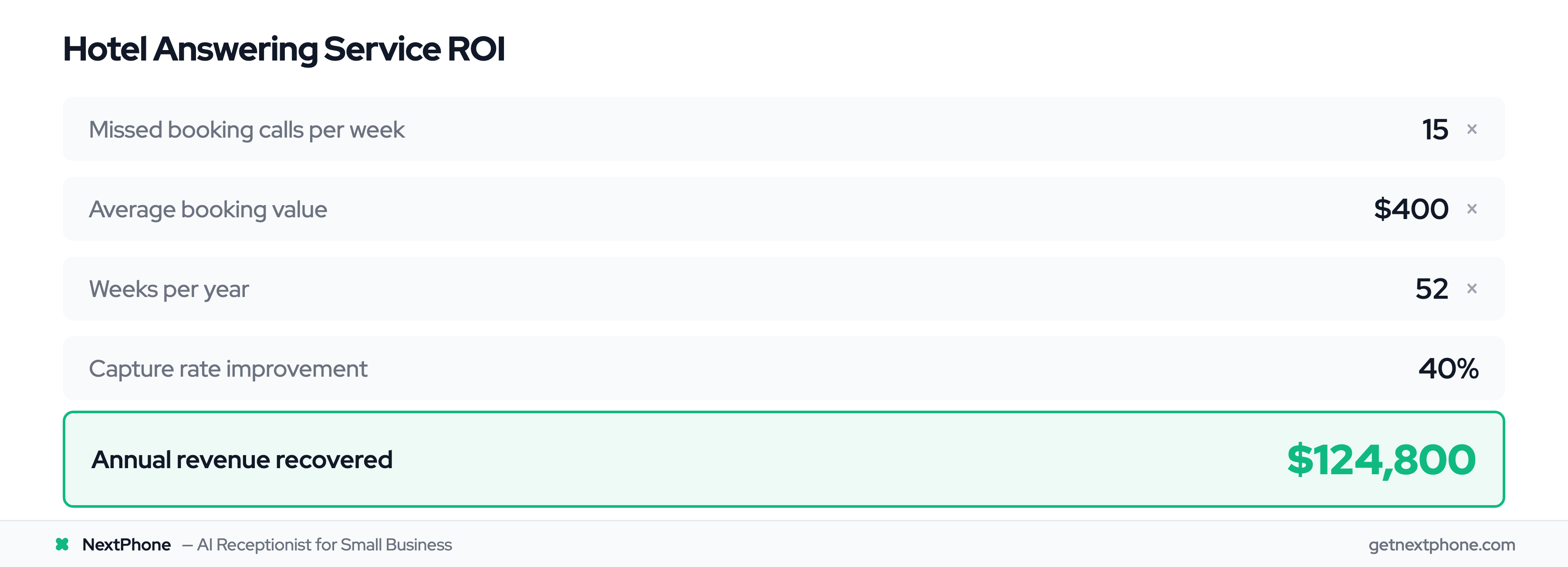
If your hotel misses just 10 booking calls per week (a conservative estimate during busy season), here's what you're losing:
- 10 missed calls × $500 average booking × 52 weeks = $260,000 per year in potential revenue
Even capturing 30% of those missed calls adds $78,000 to your annual revenue.
First Impressions Start on the Phone
Here's what makes missed calls especially costly: research on caller behavior shows that 80% of people who reach voicemail won't call back. They'll just call your competitor.
And according to the MIT Lead Response Management Study, 78% of customers book with whichever company responds first. Not the cheapest. Not the one with the best reviews. The one that picks up the phone.
When a potential guest calls your hotel, that call represents a make-or-break moment. Answer quickly and professionally, and you've just earned their trust before they've even seen their room.
What a Hotel Answering Service Actually Does
More Than Just Answering Phones
A hotel answering service acts as an extension of your front desk. When your staff can't pick up, the service answers using your hotel's name and follows scripts tailored to your property.
But modern services do far more than take messages. They can:
- Answer questions about rates, amenities, and availability
- Capture reservation requests with full guest details
- Handle common inquiries (check-in times, parking, pet policies)
- Route urgent calls immediately to on-duty staff
- Send confirmation texts and emails to guests
Reservation Handling and Booking Management
The best hotel answering services integrate with property management systems. When a guest calls at 2 AM wanting to book for the following weekend, the service can check actual availability, capture payment information, and send a booking confirmation.
No sticky notes. No "we'll call you back in the morning." Just a completed booking while you sleep.
After-Hours Coverage That Never Sleeps
According to the HotelTechReport's 2025 State of Guest Tech Report, 70% of guests find automated assistance helpful for simple inquiries. That number jumps higher for after-hours calls when the alternative is voicemail.
A hotel answering service ensures someone always picks up at 11 PM when a traveler's flight gets delayed and they need to adjust their reservation. Or at 6 AM when an early riser wants to book a last-minute room before driving into town.
The 3-6 PM Crisis Window
Why Check-In Hours Create Phone Chaos
Every hotel manager knows the afternoon rush. Guests arrive in waves starting around 3 PM. The front desk transforms into a juggling act of check-ins, credit card authorizations, room explanations, and complaint handling.
This is also when prospective guests are calling to book rooms.
Research from hospitality analytics firm FundMate identified the 3-6 PM window as the most critical revenue leak period for hotels. During these hours, front desk staff face an impossible choice: help the guest in front of you or answer the phone.
Most choose the guest in front of them. The phone goes to voicemail. A booking walks out the door.
The Impossible Choice: Guest at Desk vs. Phone Ringing
Picture this afternoon scenario:
A guest is asking about late checkout. Another couple wants restaurant recommendations. The phone has rung three times in the last five minutes. You're the only person at the desk.
Do you excuse yourself from the guests to answer? Let the phone ring? Rush through the conversation and risk seeming dismissive?
None of these options create great guest experiences. The phone caller feels ignored. The in-person guests feel rushed. Your stress level climbs.
Peak Season Multiplies the Problem
Summer travel season brings the highest booking volatility. More people calling to book means more people calling at inconvenient times. According to travel industry data from Skift, June through September sees the highest rates of both bookings and cancellations.
This is exactly when you can least afford to miss calls. A hotel answering service provides overflow capacity precisely when you need it most.
The Staff Shortage Connection
67% of Hotels Are Running Short-Staffed
The hospitality labor crisis didn't end with the pandemic. The American Hotel & Lodging Association reports that 67% of hotels still struggle to fill positions. More than half of hoteliers are operating at 25-74% of their pre-pandemic workforce.
That means fewer people covering more shifts with less backup when someone calls in sick.
The Burnout Cycle: Phone Stress Drives Turnover
Hotels have responded by raising wages to record highs. The average hourly wage hit $23.91 in late 2023, according to AHLA data. Yet positions remain unfilled.
Here's what many managers miss: phone duty is a major burnout factor. Front desk staff constantly interrupted by ringing phones while handling complex in-person requests report higher stress and lower job satisfaction.
Industry research puts it bluntly: "Forcing front desk teams to perform an impossible balancing act day after day leads to stress, frustration, and eventual turnover."
High turnover is expensive. Recruiting and training a single front desk employee costs thousands. The cycle continues.
Technology as the Staffing Solution
Rather than fighting a losing battle for limited workers, many hotels are solving the phone coverage problem with technology.
AI-powered answering services handle unlimited simultaneous calls without adding headcount. Your existing staff can focus on in-person hospitality while the service handles phone inquiries.
Marriott reportedly saw a 67% decrease in abandoned calls after implementing AI-based answering solutions. That's not replacing staff. That's giving them backup.
Key Features to Look for in a Hotel Answering Service
24/7 Availability (Non-Negotiable)
Hotels never close. Your phone coverage shouldn't either. Any service you consider must provide true 24/7/365 availability, including holidays.
Test this before signing up. Call at 2 AM on a Sunday. See how long it takes to get an answer and how professional the response sounds.
Hospitality Training and Brand Representation
Generic call center scripts won't cut it. Your answering service needs to understand hospitality terminology, guest expectations, and your specific property.
Questions to ask:
- Can agents describe your room types accurately?
- Do they know your amenities and policies?
- Can they pronounce your hotel name correctly?
- Do they sound welcoming rather than robotic?
Booking System Integration
The most valuable hotel answering services connect directly to your property management system or booking platform. This allows real-time availability checks and actual reservation creation.
Properties with integrated guest messaging report 42% higher satisfaction with communication, according to hospitality technology research.
Multilingual Support
If your hotel welcomes international guests, language support matters. Look for services offering at least Spanish and the primary languages of your international visitor demographics.
AI-powered services often handle multiple languages automatically, while live services may charge extra for multilingual agents.
Call Routing and Emergency Escalation
Not every call should stay with the answering service. Urgent matters, maintenance emergencies, and VIP guests need immediate escalation to on-duty staff.
The best services learn your escalation rules and follow them consistently. A guest locked out of their room at midnight needs to reach someone who can physically help, not get a voicemail.