You're standing on a ladder, 10 feet up, aligning track brackets on a garage door. Your hands grip the bracket while you tighten bolts with your other hand. Or worse - you're winding a torsion spring. Industry veterans call these things "literal tension bombs." One wrong move, one distraction, and you're dealing with a serious injury.
That's when your phone rings.
A potential customer needs an emergency spring replacement. Their car is stuck in the garage. They need someone today. But you can't answer. You can't even check who's calling. The phone goes to voicemail. And that $400+ emergency repair job? It goes to whoever answers next.
This scenario plays out thousands of times daily across the garage door industry. The work demands your full attention - often for safety reasons - while the phone keeps ringing with jobs you're losing.
Here's how a garage door answering service with same-day booking capability changes that math entirely.
Why Garage Door Technicians Can't Answer the Phone
The Reality of Garage Door Work
Garage door installation and repair isn't office work. You're dealing with heavy equipment, dangerous components, and situations where stopping mid-task isn't just inconvenient - it's potentially catastrophic.
A standard residential garage door weighs between 150 and 400 pounds. Commercial doors can weigh significantly more. When you're guiding a section into place, you can't let go to grab your phone. The door doesn't care about your incoming calls.
Torsion springs present an even bigger challenge. These springs store enormous amounts of energy. Winding or unwinding them requires your complete focus. As one industry forum put it: "You can't pause while tensioning springs." The consequences of getting distracted during spring work can be severe - hospital-level severe.
When Every Second Matters
Then there's the environment itself. You're often working on ladders, in tight spaces, or in positions where your phone isn't even reachable. Power tools create noise that drowns out ringtones. And even if you hear the phone, reaching for it while your hands are full of sharp metal components or heavy door sections isn't safe or practical.
Some jurisdictions even have regulations about who can perform certain garage door repairs. Following proper procedures means staying focused on the task - not juggling phone calls.
The Phone Rings at the Worst Time
Here's what makes this especially painful: calls tend to cluster during working hours. You're most likely to get new customer calls precisely when you're most likely to be hands-deep in a job.
The result? Phones ring. Voicemails fill up. And customers move on.
The Real Cost of Missed Garage Door Calls
How Many Calls Are You Actually Missing?
The numbers are worse than most garage door company owners realize.
Industry research on home services contractors shows that 74.1% of calls go completely unanswered. That's nearly three out of every four potential customers hearing voicemail instead of a person.
A typical garage door repair business receives around 50 calls per month. At a 74.1% miss rate, that's 37 missed calls - 37 potential customers who wanted to give you money.
According to Invoca research, home services businesses miss around 27% of their inbound calls industry-wide. Garage door companies often perform worse because of the physical nature of the work.
The Voicemail Death Spiral
"But they'll leave a voicemail and I'll call them back."
No, they won't. And no, you probably won't.
Research from BIA/Kelsey shows that 80% of callers who reach voicemail never call back. They don't leave a message - they call the next name on the list. Your competitor.
It gets worse. BrightLocal found that 48% of consumers immediately search for an alternative business when they can't reach you on the first try. Nearly half your missed callers are actively looking for your competition before your voicemail beep even finishes.
Our own data shows approximately one in four callers explicitly asks for a callback. But without a tracking system, 80% of those requested callbacks never happen. The callback request goes in one ear and out the other while you're wrestling with a bent track.
Garage Door Revenue Math
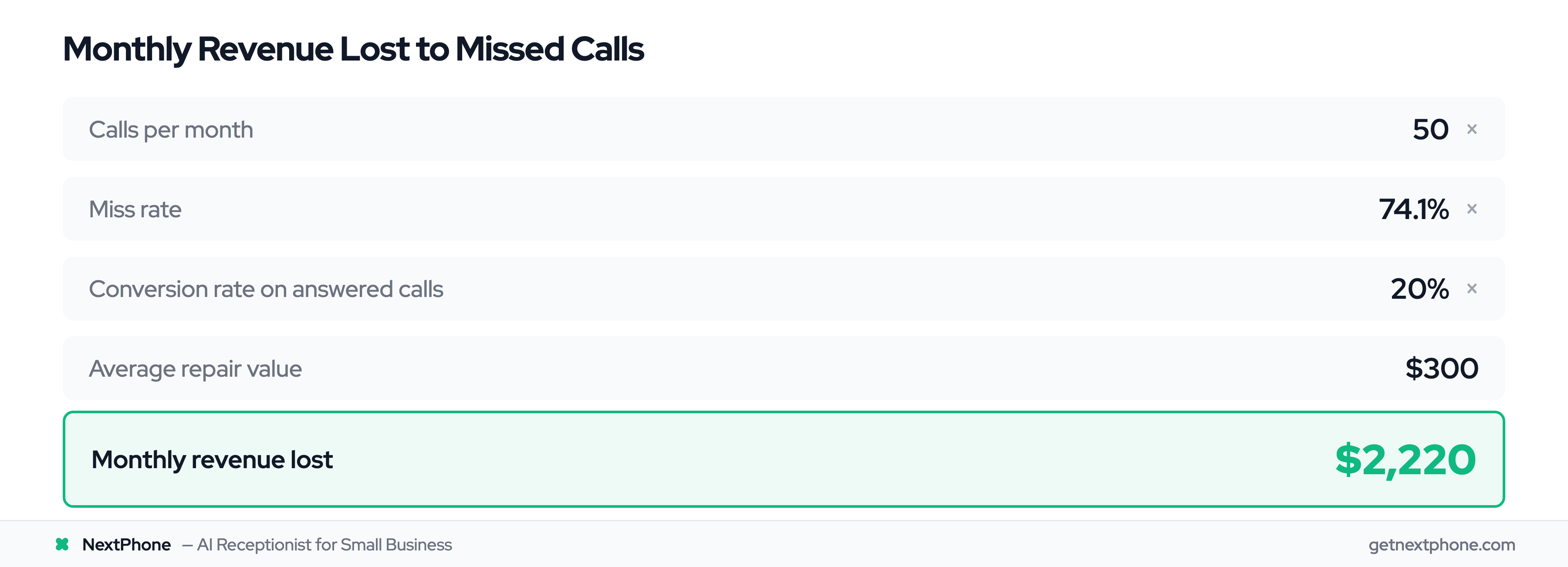
Let's make this concrete with actual garage door numbers.
The average repair ticket for garage door services runs around $300 for repairs, with emergency spring replacements in the $300-$600 range and opener repairs at $150-$300. Full door replacements can run $1,200-$4,500+.
For a typical garage door business:
- 50 calls per month
- 74.1% missed = 37 missed opportunities
- If 20% would have converted = 7.4 lost jobs
- At $300 average repair value = $2,220 per month lost
- That's $26,640 per year in missed revenue
And that's the conservative calculation. Emergency calls - which rank among the top reasons people call - often command premium prices. Missing a single emergency spring replacement per week at $450 costs you $1,800 per month, or $21,600 annually, from emergency work alone.
One Brampton, Ontario garage door company discovered their technicians were missing 50% of emergency calls while performing spring replacements. They estimated $4,000 in lost monthly revenue from emergency services they never had a chance to quote.
Emergency vs. Routine Calls: Why Both Need Answers
The Emergency Call Premium
Not all missed calls cost the same. Emergency calls hurt the most.
Across the 1,446,980+ business calls we've answered, urgency language - words like "emergency," "urgent," or "ASAP" - ranks among the top reasons people call. For garage door companies, emergency calls are where the money is.
Think about the scenarios:
- "My garage door won't close and my car is stuck inside"
- "The spring just snapped - I heard the bang from inside the house"
- "The door fell off the track and I can't get it down"
These customers need help now. They're not price shopping. They're calling whoever answers first. And they're willing to pay premium rates for immediate service.
Emergency spring replacements run $300-$600. After-hours emergency calls often command 1.5x to 2x the normal rate. Missing one emergency call per day at an average of $400 costs you $12,000 per month.
After-Hours: When Most Emergencies Happen
Here's the kicker: most of these calls don't come during business hours.
Most calls to home services businesses arrive outside standard 9-to-5 hours. Garage door emergencies don't wait for Monday morning. Springs break on Saturday night. Doors get stuck at 10 PM.
If you're only answering calls when you're not on a job - and you're probably on jobs during normal business hours - you're missing the entire after-hours emergency segment.
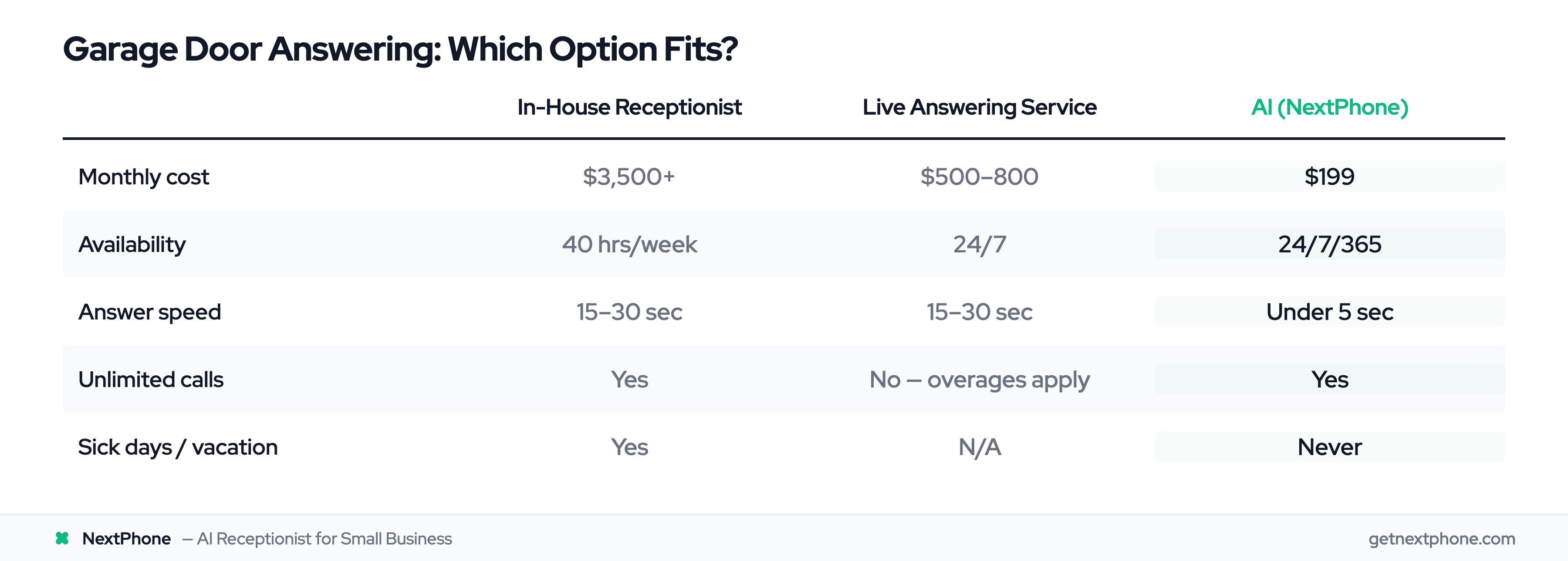
Traditional receptionists cost $35,000+ per year and only work 40 hours per week. That leaves the bulk of your potential emergency calls going to voicemail.
Routine Calls Still Convert
Emergency calls get the attention because of their urgency and higher ticket values. But routine calls matter too.
Quote requests, scheduling inquiries, questions about services - these calls represent your future pipeline. A customer calling for a spring replacement quote today might need a full door replacement next year. Missing that first call means losing the relationship entirely.
The Lead Response Management Study found that 78% of customers buy from whichever company responds first. Not the cheapest. Not the best reviewed. The first one to pick up the phone.
How Same-Day Booking Actually Works
The Old Way vs. The New Way
The Old Way:
- Phone rings while you're on a ladder
- Call goes to voicemail
- You check voicemail 3 hours later
- You call back, customer doesn't answer (they're at work)
- Phone tag continues
- Customer gives up and calls someone else
The New Way:
- Phone rings
- AI answers in under 5 seconds
- AI qualifies the lead, identifies urgency
- AI checks your calendar for same-day availability
- AI books the appointment and sends confirmation
- You finish your current job and head to the next one
The difference isn't just convenience. It's the difference between capturing the job and losing it to whoever answered first.
Instant Response, Immediate Booking
Modern answering services don't just take messages. They complete the booking workflow while the customer is still on the phone.
Here's how a same-day booking typically flows:
Customer: "My garage door spring broke this morning. I need someone to come fix it."
AI: "I'm sorry to hear that. A broken spring can definitely be urgent - is your car stuck in the garage, or are you able to get in and out safely?"
Customer: "My car's stuck inside. I need to get to work."
AI: "I understand. Let me check our availability for today. We have a technician who can be there between 11 AM and 1 PM. Would that work for you?"
Customer: "Yes, that's perfect."
AI: "Great. I've scheduled your appointment. You'll receive a text confirmation with the details. The technician will call when they're on their way."
The customer hangs up with a confirmed appointment. They're not calling anyone else. You captured the job.
What Happens After the Call
The booking is just the start. A good answering service also:
- Sends an SMS confirmation to the customer with appointment details
- Pushes a notification to the assigned technician
- Logs the call details in your CRM or scheduling system
- Captures customer information for follow-up
- Records the call for quality and training purposes
By the time you finish your current job, you have a complete briefing on the next one.