Key Takeaways
- Industry data shows contractors miss 60-80% of incoming calls - if you can't answer while working, you're likely in this bucket
- The 7 key signs you need help: missing calls, voicemail not working, callbacks falling through, urgent calls going unanswered, quote requests slipping away, spam wasting time, DIY system breaking down
- Quick self-test: If you answer "yes" to 3+ of the assessment questions below, an answering service will likely pay for itself
- At $199/month for AI answering, you only need to capture ONE additional $500+ job to break even - the math usually works in your favor
- Not everyone needs an answering service - if you can answer 80%+ of calls yourself, you might be fine for now
Introduction
Ready to Stop Missing Customer Calls?
Try NextPhone's AI receptionist free for 7 days. See how other small businesses are capturing more leads 24/7.
Get Started"I can answer my own phone."
That's what most small business owners tell themselves - right up until they realize how many calls they're actually missing.
Here's the uncomfortable truth: industry research shows contractors and home services businesses miss 60-80% of incoming calls. While you're on a job site, up on a roof, or meeting with a customer, your phone is ringing. And most of those callers don't leave voicemails - they call your competitor instead.
This guide will help you figure out if you actually need an answering service - or if you're handling things just fine. We'll walk through 7 clear warning signs, give you a self-assessment, and show you the honest math on whether it pays off.
No sales pitch. Just the data and a framework for making the right decision.
The 7 Signs You Need an Answering Service
Not every business needs phone answering help. But if any of these signs sound familiar, you should seriously evaluate your options.
Sign #1: You're Missing Most of Your Calls
This is the big one. Industry data shows contractors miss 60-80% of their incoming calls. Not some calls - most calls.
Think about it: you can't answer when you're on a job. You can't answer when you're driving. You can't answer when you're talking to another customer. That's most of your workday.
If you're getting 40 calls per month and missing 60% of them, that's 24 missed opportunities. Each one of those callers is now dialing your competitor.
The question isn't whether you're missing calls. It's how many, and whether you've been honest with yourself about the number.
Sign #2: Voicemail Isn't Cutting It
Here's a stat that should concern you: 80% of callers won't leave a voicemail. They hang up and call the next business instead.
Voicemail was designed for a world where people were patient. That world doesn't exist anymore. When someone needs a plumber, they need a plumber now. If your voicemail picks up, they're gone.
Some warning signs your voicemail strategy is failing:
- Voicemail box fills up and you don't notice
- Days pass before you check messages
- Customers mention they "left a few messages"
- You're returning calls to numbers you don't recognize
If voicemail is your primary backup plan, it's not working as well as you think.
Sign #3: Callback Requests Are Falling Through the Cracks
Here's a number from real call data: 25.4% of customer calls are explicit callback requests. "Can you have someone call me back?" One in four calls.
And here's the uncomfortable follow-up: research shows 42% of callback requests never get returned.
You write the number on a piece of paper. You put it in your pocket. You get busy. By the end of the day, you forgot. Or you remember at 9 PM and decide it's too late to call.
Each unreturned callback is a damaged customer relationship. Even if they eventually hire you, they're starting with a negative impression.
If you're being honest with yourself, how many callback requests did you drop this week?
Sign #4: Urgent and Emergency Calls Go Unanswered
Not all calls are equal. Some are emergencies.
Data shows 6.2% of calls are true emergencies - situations requiring immediate response. Another 15.9% contain urgency language: "ASAP," "today," "urgent," "as soon as possible."
That's over 22% of your calls that are time-sensitive.
Real examples from call transcripts:
- "Needs you to come look at and repair a leak around a chimney. It's urgent due to ongoing rain."
- "Emergency pipe burst, needs plumber immediately."
- "Needs emergency AC repair, no cooling in 95 degree weather."
These callers aren't leaving voicemails and waiting patiently. They're calling the next contractor on their list. Emergency jobs often pay $1,200 or more - and they go to whoever answers first.
Sign #5: Quote Requests Are Slipping Away
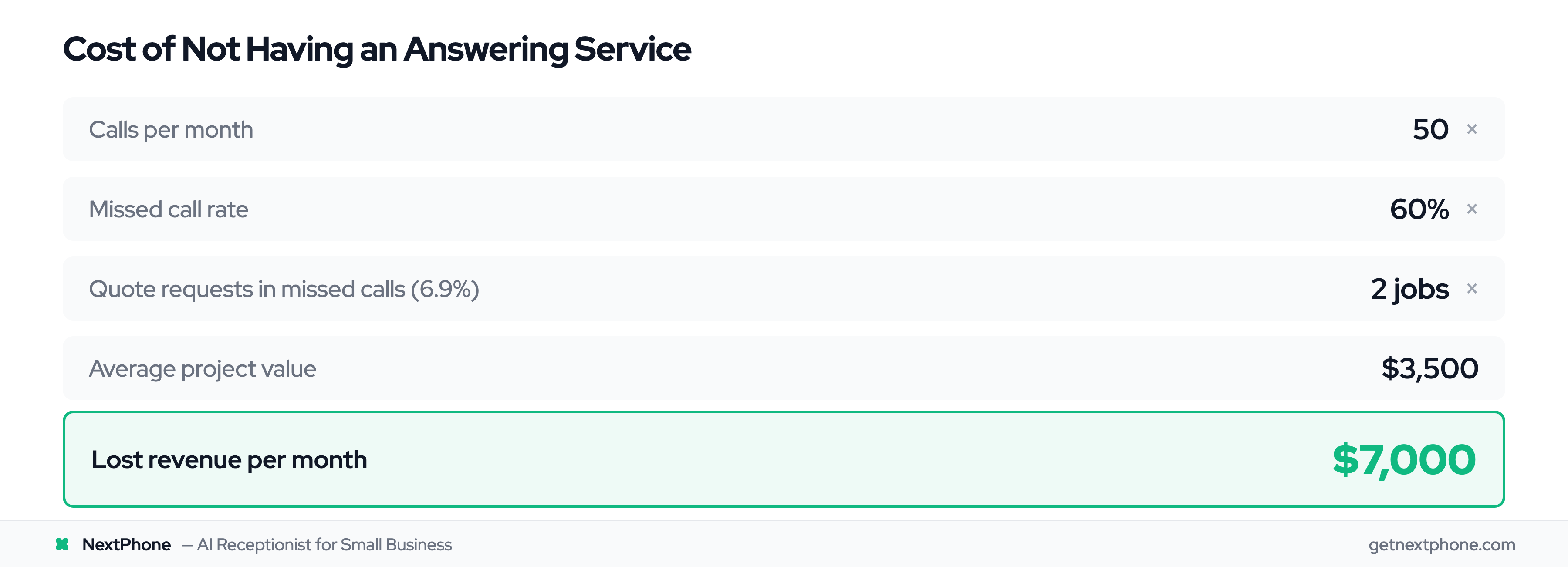
Quote and estimate requests represent 6.9% of incoming calls. These are your highest-intent callers - people actively looking to hire someone.
Average project value? $3,500 for contractors. Some much higher.
Here's what happens when a quote request goes to voicemail: the caller moves on to the next company. Industry research shows customers typically contact 3-5 businesses when requesting quotes. The first business to respond wins the job 78% of the time.
If you're missing quote requests while working, you're literally handing revenue to competitors. They're not winning because they're better. They're winning because they answered the phone.
Sign #6: Spam Calls Are Wasting Your Time
This one's a hidden tax on your productivity.
About 7% of incoming calls to small businesses are spam or robocalls. At 40 calls per month, that's nearly 3 interruptions for zero value - every single month.
Every spam call that reaches you:
- Pulls you away from work
- Costs 10-15 seconds minimum
- Breaks your concentration
- Sometimes costs much longer when you answer
It's not just the time. It's the mental overhead of constant interruptions that aren't even real customers.
Sign #7: Your DIY System Is Breaking Down
Maybe you've been managing calls through a patchwork system. Your spouse helps. Your staff takes turns on "phone duty." You check voicemail during lunch and again at night.
Here are signs that system is failing:
Your helper is burning out. Your spouse didn't sign up to be a full-time receptionist. Your office manager resents stopping their real work to answer calls. Whoever's covering you is getting tired of it.
Your personal time is disappearing. You're checking voicemails at 10 PM. You're returning calls on Saturday morning. The boundary between work and life has evaporated.
Things are slipping through. Messages aren't getting relayed. Callbacks are forgotten. You're playing whack-a-mole with customer communications.
You're always "on." That constant low-level stress of knowing your phone might ring with something important - and you might miss it.
If your DIY phone coverage is causing friction in your life or business, that's a clear sign the system needs to change.
Self-Assessment: Answer These 5 Questions
Let's make this practical. Answer these questions honestly:
Question 1: Do I miss more than half of my incoming calls while working?
Question 2: When was the last time I returned every callback request within 24 hours? (If you can't remember, the answer is probably "too long ago.")
Question 3: Do customers ever say "I called but couldn't reach you" or "I left a message"?
Question 4: Am I or my family feeling stressed about business phone coverage?
Question 5: Have I lost a job - or probably lost a job - because someone else answered first?
How to Score Your Answers
0-1 "yes" answers: You might genuinely be fine. Your phone coverage is working, or your business model doesn't depend on inbound calls. See the section below on when DIY is okay.
2-3 "yes" answers: Yellow flag. You're feeling strain, and opportunities are probably slipping through. Worth seriously evaluating your options.
4-5 "yes" answers: Red flag. Your current system isn't working, and an answering service will almost certainly pay for itself. The question isn't "should I get help?" - it's "how soon can I start?"
Be honest with yourself. That customer who said "I tried calling a few times" - how many others didn't bother to mention it?
When DIY Phone Handling Is Actually Fine
Here's something most answering service articles won't tell you: not everyone needs professional phone help. Some businesses genuinely manage just fine.
You're probably okay handling calls yourself if:
- You can answer 80%+ of calls during business hours. Maybe you work at a desk, or your job allows phone access. If you're picking up most calls, you're in decent shape.
- Your call volume is under 20 per month. Lower volume means fewer missed opportunities even if you miss some.
- You have a reliable same-day callback system. If you truly return every call within a few hours and track them rigorously, voicemail can work.
- Customers aren't complaining. If nobody's mentioning that they couldn't reach you, maybe it's not a problem.
Tips for Better DIY Phone Management
If you're not ready for an answering service, here are ways to improve your current setup:
1. Set specific call-return windows. Block 15 minutes at noon and 5 PM exclusively for returning calls. Treat it like an appointment.
2. Use text templates. When you can't call back immediately, send a quick text: "Got your message. I'll call you back by 5 PM today."
3. Fix your voicemail greeting. Set expectations: "I'm working on a job right now but I return all calls within 2 hours."
4. Train anyone who answers. If your spouse or staff sometimes picks up, make sure they know to get callback number, name, and reason for call.
5. Actually check voicemail. Multiple times daily. Not just when you remember.
The honest question: are you actually doing these things consistently? Or just intending to?
When It's Time to Get Professional Help
Here are clear threshold indicators. If several of these apply, you've crossed into "need help" territory:
- Missing more than 40% of calls consistently
- Getting 30+ calls per month
- Can't answer during significant work hours (most contractors)
- Customers mentioning they couldn't reach you
- DIY helper (spouse, staff) showing burnout
- Checking voicemails at night has become routine
- Any known lost job due to missed call
Why Waiting Costs More Than Acting
Every month you delay, you're losing opportunities. The math is simple:
At 40 calls/month with 60% missed = 24 missed opportunities If 20% would have become customers = 4.8 lost jobs At $500 average service call = $2,400/month you're not capturing
Even if those numbers are half right, waiting is expensive.
The good news: the investment required is small. AI answering services start at $199/month with no contract. That's less than a single service call. You can try it, see if it helps, and cancel if it doesn't.
The question isn't whether you can afford an answering service. It's whether you can afford to keep missing calls while your competitors answer theirs.
The Hidden Cost of Doing Nothing
Here's what most business owners don't see: the cost of missed calls is invisible. You never know about the opportunities you lost.
You don't get a notification saying "Customer called at 2:47 PM, you didn't answer, they hired Joe's Plumbing instead." It just happens silently. The job that could have been yours goes to someone else.
Let's make the invisible visible.
What Missed Calls Are Actually Costing You
The math for a typical contractor:
- 40 calls per month
- 60% missed = 24 missed calls
- 20% of those would have become customers = 4.8 lost jobs
- Average job value: $3,500
- Lost revenue: $16,800 per month
Even if we're conservative and cut that in half, that's $8,400/month in missed opportunities. $100,000+ per year.
The first responder problem:
Studies show 78% of customers hire the first business that responds to their inquiry. Not the best business. Not the cheapest business. The first one.
Your competitors aren't winning jobs because they're better. They're winning because they answered the phone when you couldn't.
The ROI Math: When Answering Service Pays for Itself
Let's do the break-even calculation:
NextPhone cost: $199/month = $2,388/year
Average job value: $3,500
Break-even: $2,388 / $3,500 = 0.68 jobs per year
Translation: If having 24/7 call answering helps you capture just one additional $3,500 job per year, the service has paid for itself 17 times over.
Even with a more modest $500 service call average, you only need 4.8 additional jobs per year to break even. That's less than one every two months.
The ultra-conservative case:
Even if an answering service only captures 5% of your previously missed opportunities:
- 24 missed calls × 5% = 1.2 additional connections
- 1.2 × $500 job = $600/month recovered
- Vs. $199/month cost = 301% ROI
The numbers work even with extremely conservative assumptions.
You're Already Paying This Tax
Here's the uncomfortable reality: you're already paying a "missed call tax." You just can't see the invoice.
Every caller who hangs up on voicemail is money leaving your business. Every quote request that goes to a competitor is revenue you could have had. Every emergency call that rings through to no answer is a high-margin job going elsewhere.
The question isn't whether to pay for phone coverage. It's whether to pay $199/month for a solution - or pay thousands in invisible lost opportunities.
How NextPhone Makes the Decision Easy
If you've recognized yourself in the signs above, here's the practical solution.
Why AI Answering Is the Smart Starting Point
Traditional options for phone coverage are expensive: Full-time receptionist: $35,000-50,000/year, covers 40 hours/week only Live answering service: $400-800/month with per-minute overages
AI answering services changed the math: NextPhone: $199/month flat rate, 24/7 coverage, unlimited calls
For most contractors and small businesses, AI is the obvious entry point. Try it at low cost, see if it works, upgrade later if needed.
What You Get for $199/Month
Everything included, nothing extra:
- AI-powered call answering 24/7/365
- Unlimited calls - no per-minute charges
- Custom greeting in your business name
- Message taking with details sent to your phone
- Emergency call routing to reach you immediately
- Spam filtering (7% of junk calls blocked automatically)
- Appointment scheduling with calendar integration
- No setup fee
- No annual contract
That's complete phone coverage for less than the cost of a typical service call.
No Risk to Try
Month-to-month service means you can cancel anytime. No penalty, no hassle.
Setup takes 1-2 hours. Most contractors are handling calls the same day.
If it doesn't work for your business, you're out $199 and you cancel. If it does work - and for most businesses it does - you've solved a problem that was costing you thousands.
The risk of trying is low. The risk of continuing to miss calls is high.
Frequently Asked Questions
How do I know if I need an answering service?
If you're missing more than 40% of incoming calls, have callbacks falling through the cracks, or customers are mentioning they couldn't reach you - those are clear signs. Take the 5-question self-assessment above. If you score 3+ "yes" answers, an answering service will likely pay for itself quickly.
Is an answering service worth it for a small business?
For most small businesses that can't answer calls while working - yes. At $199/month for AI answering, you only need to capture one additional $500+ job to break even. Industry data shows small businesses miss 60-80% of calls, so the opportunity for improvement is usually significant.
Can voicemail replace an answering service?
Not effectively. Research shows 80% of callers won't leave a voicemail - they hang up and call the next business. Voicemail creates friction, while an answering service creates connection. Every caller who hangs up on voicemail is a potential customer going to your competitor.
Should I hire a receptionist or use an answering service?
For most small businesses, an answering service makes more sense. A full-time receptionist costs $35,000-50,000/year and only covers 40 hours per week. An AI answering service costs $199/month, covers 24/7, and handles unlimited calls. Unless you need someone physically present to greet visitors, the math heavily favors answering services.
What if I only miss a few calls per day?
"A few calls per day" adds up fast. That's 60-90 missed calls per month. If even 10% of those would have become customers at $500 average job value, you're losing $3,000-4,500 monthly. Compare that to $199/month for 24/7 coverage, and the decision becomes clear.
Can I use an answering service just part-time or after hours?
You can, but with AI answering services like NextPhone at $199/month for unlimited 24/7 coverage, it often makes more sense to have full-time protection. There's no extra charge for after-hours with NextPhone, so limiting coverage just means limiting protection without saving money.
Conclusion
The 7 signs are clear: missing most of your calls, voicemail not working, callbacks falling through the cracks, urgent calls going unanswered, quote requests slipping away, spam wasting your time, and your DIY system breaking down.
If you scored 3+ on the self-assessment, you're almost certainly leaving money on the table. And at $199/month for AI answering, the investment pays for itself with a single captured job.
You're already paying a "missed call tax" every month - you just can't see the bill. Every day without proper call coverage is another day your competitors are answering calls that could have been yours.
The customers are calling. The question is whether you'll be there to answer.
Stop missing calls. Start your NextPhone trial today - $199/month, unlimited calls, no contract.
Ready to Stop Missing Customer Calls?
Try NextPhone's AI receptionist free for 7 days. See how other small businesses are capturing more leads 24/7.
Get StartedLast updated: November 2025