Key Takeaways
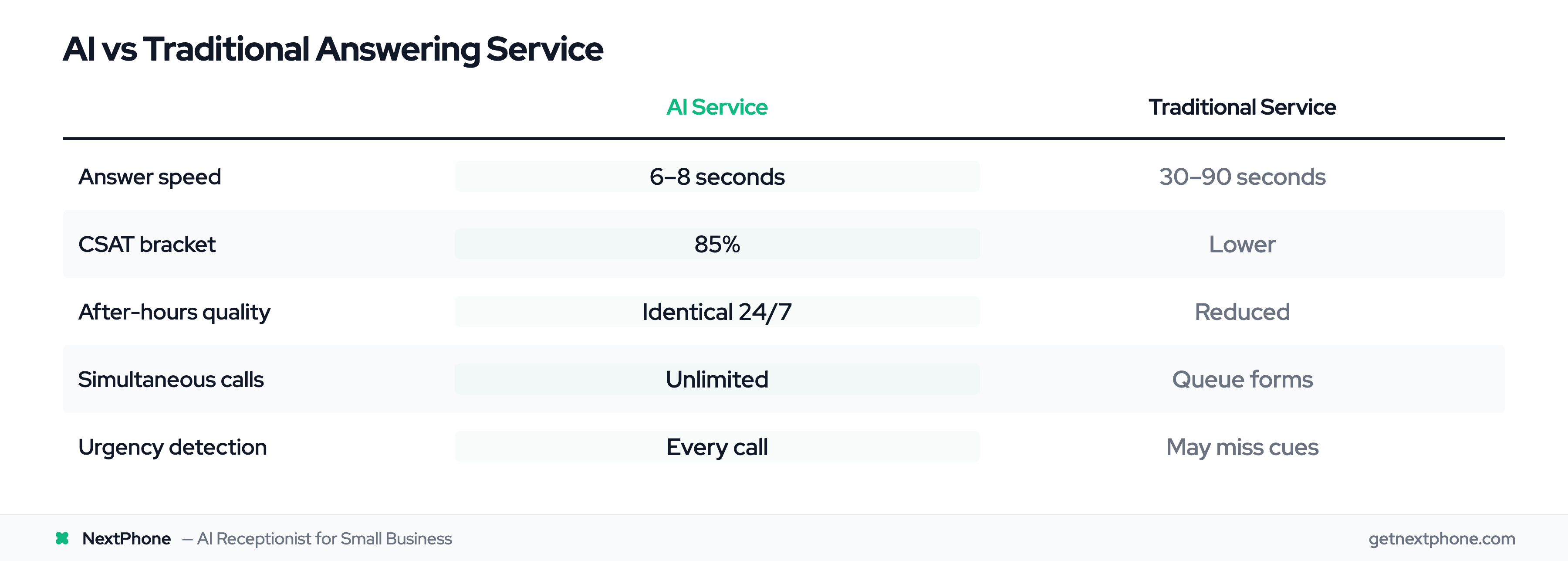
- Response time directly impacts satisfaction: 5-second response = 85% CSAT vs 2+ minutes = 60% CSAT
- First call resolution is the top satisfaction driver: every 1% FCR improvement equals 1% CSAT improvement
- 93% of customers expect their issue resolved on the first call
- Contractors miss 60-80% of incoming calls, making satisfaction impossible before any conversation begins
- Approximately one in four callers asks for a callback, making proper follow-through essential for maintaining satisfaction
- AI answering in 2 rings (6-8 seconds) outperforms traditional services (30-90 seconds) on the metric that matters most
Here's the thing about customer satisfaction: it starts before the conversation does.
You can have the best product, the friendliest team, and the most competitive prices. None of that matters if the phone rings six times and goes to voicemail. The customer who can't reach you is already dissatisfied, and they're probably dialing your competitor.
Industry data shows contractors and service businesses miss 60-80% of incoming calls. That's not a service problem. That's a satisfaction catastrophe happening silently, call by call.
Research from the CMO Council found that response time is the single most significant attribute that leads to customer satisfaction. Not product quality. Not pricing. How quickly you respond when someone reaches out.
And here's what the data shows: 52% of customers stop purchasing from companies with slow response times. Half your potential business, gone, because you couldn't pick up fast enough.
This is where a customer satisfaction answering service becomes not just helpful but essential. Salesforce's State of Service Report shows AI is transforming customer service delivery. The link between professional call handling and customer satisfaction isn't theoretical. It's measurable, documented, and backed by decades of research.
Let's break down exactly how answering services impact satisfaction and what you can do to maximize that effect.
The Science of Customer Satisfaction and Phone Response
Customer satisfaction isn't some mysterious quality. Researchers have studied it extensively, and the drivers are remarkably consistent across industries.
Response Time: The Primary Satisfaction Driver

When customers call your business, a timer starts. Every second matters.
Studies show a direct, measurable relationship between how quickly you answer and how satisfied the caller ends up. When a customer receives a response within five seconds, the average customer satisfaction score hits 85%. When it takes more than two minutes, that score drops to 60%.
That's a 25-percentage-point gap based purely on speed.
The expectations are clear. HubSpot research shows 82% of customers expect an immediate response:
- 90% of consumers expect an immediate response to their inquiry
- 77% of customers say quick response is the best service a company can provide
- 89% of consumers report that quick response to an initial inquiry influences their purchase decision
Call abandonment increases 5% for every 30 seconds of delay. Let that sink in. Every half-minute you make someone wait, you lose 5% more callers. By the time you hit two minutes, you've lost significant portions of your potential customer base to frustration. Desk365's analysis of 117 customer service statistics reinforces these patterns across industries.
The message from the research is unambiguous: speed wins.
First Call Resolution: The Satisfaction Multiplier
Beyond answering quickly, the next question becomes: can you actually solve the caller's problem?
First Call Resolution (FCR) measures how often you handle a customer's issue in a single interaction. SQM Group's comprehensive FCR research shows 70% as the average benchmark, with top performers reaching 90%. The research here is equally striking.
According to SQM Group's extensive call center research, every 1% improvement in first call resolution produces a 1% improvement in customer satisfaction. The relationship is linear and predictable. Enthu.ai's research on call center statistics shows 85% of call center managers are implementing conversation intelligence, with customer satisfaction improving 64% when agents receive real-time assistance.
But it gets more dramatic when resolution fails. Customer satisfaction drops an average of 15% with each callback a customer must make. If someone needs to call four times to resolve an issue, there's a 47% satisfaction gap compared to resolving it the first time.
93% of customers expect their call to be resolved on the first attempt. That's not a preference. That's an expectation. Fall short, and you've already disappointed nearly everyone calling.
Research from Accenture showed that 67% of customers would stay with a company that addressed a service issue in a single interaction. Conversely, 23% are likely to discontinue business after an unresolved call.
The Effort Factor
There's another dimension to satisfaction that often gets overlooked: customer effort.
Studies reveal that low-effort customer experiences produce a 96% satisfaction rate. When customer effort is high, satisfaction crashes to 9%.
Think about what high effort looks like: calling multiple times, getting transferred, repeating information, waiting on hold, leaving voicemails that never get returned. Each friction point adds effort and destroys satisfaction.
A professional answering service eliminates most of these friction points. One call. Immediate answer. Issue handled. Minimal effort, maximum satisfaction.
How Missed Calls Destroy Customer Satisfaction
You cannot satisfy a customer you never talk to.
The Missed Call Epidemic
The numbers are staggering. Industry data shows that contractors and service businesses miss 60-80% of incoming calls. Plumbers are under sinks. Electricians are on job sites. Lawyers are in court. The phone rings, and nobody's there to answer.
Each missed call represents a potential customer who:
- Needed your services
- Made the effort to call
- Got voicemail or endless ringing
- Called your competitor instead
Research shows 89% of consumers say quick initial response influences their purchase decision. When your initial response is no response at all, you've lost before the race began. McKinsey reports AI can enhance customer satisfaction by 15-20% and revenue by 5-8%.
What Happens When Customers Can't Reach You
The consequences of poor phone accessibility compound quickly.
According to Zendesk's 2025 CX Trends Report, 73% of consumers will switch to a competitor after multiple bad experiences. But here's the alarming part: more than 50% will switch after just one bad experience.
The statistics get worse:
- 86% would leave a brand after two or more poor service experiences
- 61% of customers switch to competitors specifically due to poor customer service
- 75.5% of consumers switch due to poor customer service, with 77% of SMB owners using call forwarding to ensure availability
Missed calls are poor customer service. There's no other way to interpret a phone that rings and rings without answer. The caller concludes that you don't care about their business, and they act accordingly. Forrester reports the US CX Index is at its lowest since 2016—a warning sign for businesses not prioritizing customer contact.
The Hidden Cost of "I'll Call Them Back"
Even when you do reach voicemail messages, the callback problem creates its own satisfaction challenges.
Analysis of real business calls shows that approximately one in four callers explicitly asks for a callback. That's a quarter of your call volume asking for follow-up.
Here's what typically happens: someone writes down the callback request on a sticky note. They get busy with other tasks. The note gets buried. Hours pass, then a day, then two days. The callback either never happens or happens so late that the customer has already solved their problem elsewhere.
Delayed callbacks drop satisfaction just as effectively as delayed answers. A promise of "we'll call you back" followed by silence is arguably worse than no promise at all. You've made a commitment and broken it.
Systematic callback management isn't optional for customer satisfaction. It's fundamental. HubSpot's State of Service report, based on surveys of 1,500+ customer service leaders, confirms callback follow-through is a key satisfaction driver.
How Professional Answering Services Improve Satisfaction
A well-run answering service addresses every satisfaction driver we've discussed: speed, resolution, consistency, and effort reduction.
Guaranteed Answer Equals Guaranteed First Impression
Phone answering services often represent the first human interaction customers have with a business. That initial touchpoint shapes everything that follows.
Research from AnswerUnited shows that 73% of customers report higher satisfaction when they receive personalized responses. A Sprinklr study found that 80% of customers are more likely to engage with companies offering tailored, personalized interactions.
When someone calls and immediately reaches a professional voice who knows your business, the tone is set. Compare that to ringing into voicemail or an obviously unprepared receptionist scrambling for information.
First impressions compound. A positive start creates goodwill that carries through the entire customer relationship. A negative start creates skepticism that's hard to overcome even with excellent subsequent service. Nextiva's 2026 customer service statistics confirm these patterns continue to hold across modern communication channels.
24/7 Availability Meets Modern Expectations
Your customers don't work 9-to-5, and their needs don't wait for business hours.
The homeowner with a burst pipe at 2 AM needs help now. The prospect researching services on Sunday evening wants to schedule an appointment. The patient with questions after their procedure closes wants answers.
Analysis shows true emergencies requiring immediate response regardless of when they occur are a recurring reason people call. These aren't calls that can wait until morning. Missing them means losing the customer and potentially facing serious consequences depending on your industry. A Housecall Pro report found 72% of homeowners are willing to pay 10% more for contractors with better customer service reputations.
Being available when competitors aren't creates an immediate satisfaction advantage. The customer who calls at 10 PM and reaches a professional answering service remembers that. The customer who gets voicemail at 10 PM remembers that too, but differently. Deloitte's Customer Service Excellence 2025 report highlights availability as a key differentiator.
Consistency Eliminates Variable Experiences
Human receptionists have good days and bad days. They get tired, distracted, stressed, and frustrated. The caller at 9 AM might get a warm, helpful response. The caller at 4:45 PM might get someone rushing to finish their shift.
Same business. Wildly different experiences.
This inconsistency erodes trust. Customers never know what version of your business they're going to encounter. That uncertainty itself reduces satisfaction because it adds mental effort to every interaction.
Professional answering services, particularly AI-powered ones, deliver identical quality on every call. Same greeting. Same professionalism. Same accurate information. Call number one or call number one thousand, the experience remains consistent.
Research shows 83% of customers feel more loyal to brands that respond to and resolve their complaints consistently. Consistency builds the reliability that underlies long-term satisfaction. Five9's contact center statistics for 2025 show 32% YoY enterprise AI revenue growth as businesses invest in consistent customer experiences. Zendesk's research shows first contact resolution is critical for building customer loyalty.
Proper Urgency Detection and Prioritization
Not every call carries the same weight. Some callers need immediate action. Others can wait.
Analysis of business calls reveals that urgent calls rank among the top reasons people call. These are time-sensitive situations requiring faster-than-normal response. Phrases like "as soon as possible," "today if you can," or "it's getting worse" signal callers who need prioritization.
A good answering service recognizes these signals and acts appropriately. Urgent callers get escalated. Routine inquiries get handled normally. True emergencies, a recurring reason people call, get flagged for immediate attention.
Missing urgency signals creates frustrated customers. Someone calling about a genuine emergency who gets treated like a routine inquiry feels dismissed. That frustration converts directly into dissatisfaction and often into lost business.
Key Metrics That Prove Answering Service Impact
If answering services improve satisfaction, you should be able to measure the effect. You can.
Customer Satisfaction Score (CSAT) Correlation
The relationship between answer speed and satisfaction is direct and documented.
The 5-second response producing 85% CSAT versus 2+ minute response producing 60% CSAT isn't theoretical. These are measured outcomes from real customer interactions.
Live chat benchmarks show similar patterns: 48-second response times produce 87% satisfaction rates. The principle applies across communication channels. Speed wins.
For phone answering specifically, the 5% abandonment increase per 30-second delay provides a clear metric. Track your average speed of answer and watch what happens to abandonment rates. The correlation is reliable.
Net Promoter Score (NPS) Improvements
Beyond satisfaction, answering quality impacts whether customers recommend your business.
Research shows every 1% improvement in first call resolution corresponds to a 1.4-point increase in Net Promoter Score. Happy customers recommend. Frustrated customers warn their networks.
Word-of-mouth drives significant business for most companies. An answering service that consistently delivers satisfying experiences creates promoters. One that delivers inconsistent or poor experiences creates detractors.
The NPS impact compounds over time as recommendations accumulate or warnings spread.
Customer Retention and Lifetime Value
Satisfied customers stay. Dissatisfied customers leave.
Accenture's research found that 67% of customers would stay with a company that resolves issues in a single interaction. The flip side: 23% are likely to discontinue business after an unresolved call.
The financial impact of retention is substantial. Research consistently shows that a 5% increase in customer retention can produce 25-95% revenue growth. Every satisfied customer you keep represents protected and growing revenue. Zendesk's CX Trends 2025 report, based on 10,000+ consumer surveys, confirms human-centric AI drives loyalty.
Conversely, poor service causes estimated revenue losses of $62 billion annually in the U.S. alone. Businesses that prioritize service excellence grow revenues 4-8% above market averages.