
The AI Skeptic's Guide to Business Phones
If you roll your eyes every time you hear "AI-powered" slapped onto another product, you're not alone. The term has become marketing shorthand for "we added some automation" - often without delivering anything meaningfully intelligent.
But here's the thing: when it comes to business phone systems, AI actually delivers something practical. Research shows consumers and businesses prefer voice over text or email for important communications. Not science fiction, not chatbots pretending to be human, but measurable capabilities that solve real problems.
Consider the data from actual business call patterns. Analysis of calls to small businesses reveals that 25.4% request callbacks - callers who simply want to schedule a conversation rather than wait on hold. Another 15.9% of calls contain urgency language, indicating time-sensitive matters that deserve priority handling. And 6.2% of calls are genuine emergencies - burst pipes, medical situations, security issues - that need immediate routing regardless of the hour.
Traditional phone systems treat all these calls identically. Someone answers, or they don't. AI integration changes that equation fundamentally. The callback request gets scheduled automatically. The urgent call gets prioritized. The emergency reaches someone immediately. And the spam call? It never rings at all.
This isn't about robots answering your phone. It's about your phone becoming smart enough to handle the predictable so you can focus on the important. Let's examine what that actually looks like in practice.
What "AI" Actually Means for Your Business Phone
Strip away the marketing language and business phone AI comes down to a few core technologies working together.
Automatic Speech Recognition (ASR) converts spoken words to text in real-time. When a caller says something, the system understands what they said - not just that they pressed a button. This happens in milliseconds, fast enough that the caller never perceives any delay.
Natural Language Understanding (NLU) goes beyond transcription to determine intent. When someone says "I need to talk to someone about my leaking faucet right now," NLU recognizes the urgency ("right now"), the topic (plumbing issue), and the implied emergency (active leak). This is fundamentally different from traditional phone menus that force callers to navigate rigid options.
Machine Learning enables the system to improve continuously. Every call teaches the system something. Over time, it learns your business patterns: which callers are VIPs, what "urgent" sounds like in your industry, which types of inquiries can be handled automatically versus which need human attention.
Intelligent Routing puts all this understanding into action. Based on what the AI learned about the caller and their needs, it makes decisions: answer and handle the call, route to voicemail, forward to your mobile, or block entirely. These decisions happen automatically, in real-time, without requiring human attention.
The contrast with traditional phone systems is stark. Old systems gave you voicemail, maybe an IVR menu ("press 1 for sales, press 2 for support"), and basic call forwarding. You controlled the rules manually, and the system followed them rigidly. The UCaaS market has reached $21.7 billion in 2024 with 6.5% YoY growth as AI capabilities reshape what's possible. Modern business phone AI—essentially a voice AI receptionist—makes contextual decisions. It understands that the same caller at 3 PM on Tuesday might warrant different handling than 3 AM on Saturday.
For small businesses without dedicated receptionists or IT departments, this matters enormously. The business phone service market is projected to grow from $91.11 billion in 2023 to $144.1 billion by 2031. You get capabilities that previously required staff and infrastructure - delivered through software that runs on your existing phone.
The Four Pillars of Business Phone AI

Practical AI phone integration delivers value through four distinct capabilities. Each addresses a specific challenge that small businesses face daily.
Pillar One: Callback Automation (25.4% of Calls)
Here's a number that might surprise you: more than one in four business calls are simply requests for callbacks. Callers don't necessarily want to talk right now - they want to schedule a conversation. With traditional systems, this creates phone tag: caller leaves message, business calls back, caller is unavailable, and the cycle repeats.
AI handles this differently. When a caller requests a callback, the AI can manage the entire process: take the caller's preferred times, check your calendar availability, schedule the callback, and send confirmation to both parties. No human intervention required for a routine transaction.
The benefit compounds over time. Instead of scattered voicemails requiring individual attention, you get an organized queue of scheduled callbacks. Your phone time becomes intentional rather than reactive. And callers get what they actually wanted - a confirmed time to talk - rather than uncertainty about when (or if) they'll hear back.
Pillar Two: Urgency Detection (15.9% of Calls)
Not every call deserves the same priority. The challenge is distinguishing genuine urgency from routine matters - and from sales calls masquerading as urgent.
AI analyzes language patterns to make this determination. Keywords like "emergency," "urgent," "immediately," and "right now" trigger closer analysis. But it goes deeper than keyword matching. The system considers context: a caller's history with your business, the time of day, the combination of phrases used, and patterns that indicate genuine time-sensitivity versus manufactured pressure.
Data shows that 15.9% of calls to businesses contain urgency language. Not all of these are genuine emergencies, but they represent callers who perceive their needs as time-sensitive. AI routes these calls for priority handling - interrupting when warranted, ensuring they don't get lost in a voicemail queue.
The distinction between urgency detection and emergency routing matters. An urgent call might be a customer needing quick answers before making a purchase decision. Important, but not necessarily requiring immediate interruption of your work. True emergencies are different.
Pillar Three: Emergency Routing (6.2% of Calls)
Some calls genuinely cannot wait. A burst pipe at 2 AM. A security alarm activation. A medical situation requiring immediate response. For service businesses especially, the ability to receive these calls immediately - regardless of hour or circumstances - can make the difference between a manageable situation and a disaster.
AI identifies genuine emergencies through multiple signals: specific language ("flooding," "fire," "broken into"), caller urgency patterns, known emergency contacts, and time-of-day context. When these signals align, the system breaks through normal routing rules. Do-not-disturb gets bypassed. Calls forward to on-call staff. The priority is getting a human on the line immediately.
The 6.2% figure represents the proportion of business calls that warrant this emergency treatment. It might seem small, but these calls carry outsized importance. Miss a routine inquiry and you might lose a sale. Miss an emergency and you might lose a customer permanently - or face serious property damage, safety issues, or liability exposure.
Pillar Four: Spam Filtering (7% of Calls)
The least glamorous but perhaps most appreciated capability: making unwanted calls disappear before they interrupt you.
Analysis shows that 7% of calls to businesses are spam or robocalls - automated marketing, scam attempts, or simply misdials. Some industries face much higher rates; electricians, for example, experience 15.5% spam rates, meaning roughly one in six calls is unwanted noise.
AI filtering happens invisibly. Pattern recognition identifies spam campaigns - often from the calling pattern itself, before anyone even speaks. Known spam databases get checked automatically. Suspicious calls get blocked or routed to voicemail without ever ringing your phone.
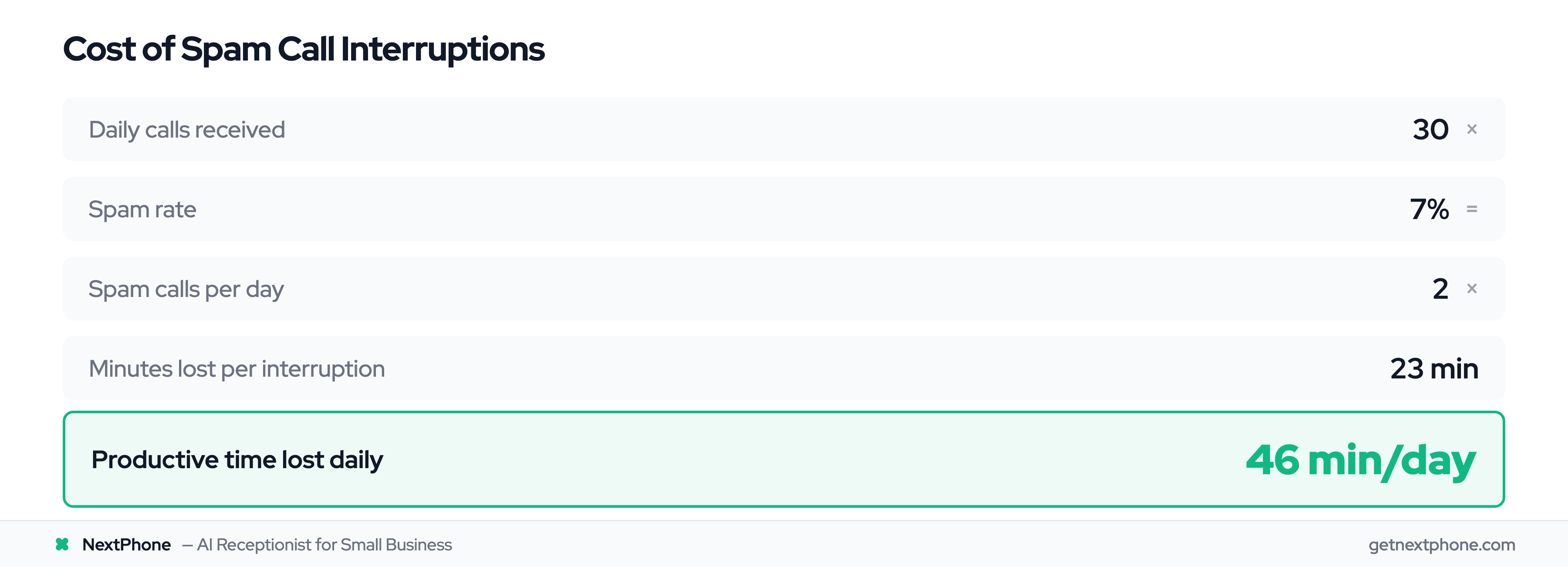
The productivity impact here is straightforward. Every avoided interruption saves the 23 minutes of refocus time that workplace research has documented. For a business receiving 30 calls daily with 7% spam, that's two prevented interruptions - 46 minutes of productive time protected, automatically, every day.
How AI Phone Integration Actually Works
Understanding the technology flow helps demystify what happens when your AI-integrated phone receives a call.
Call Arrival: The moment a call comes in, analysis begins. Caller ID information gets captured and cross-referenced against spam databases, known contacts, and previous interaction history.
Intent Recognition: If the caller speaks (or if AI answers), natural language processing determines purpose. Is this a scheduling request? A complaint? An emergency? A sales pitch? The system classifies intent in real-time.
Priority Assessment: Based on caller identity, stated intent, and contextual signals (time of day, urgency language, caller history), the system assigns priority. Emergency, urgent, routine, or spam - each category triggers different handling.
Routing Decision: The priority assessment drives action. Emergencies route immediately to designated recipients. Urgent calls get priority queuing. Routine calls follow normal patterns. Spam gets blocked.
Conversation Handling: Depending on configuration, AI either handles the conversation directly (taking messages, scheduling callbacks, answering routine questions) or connects the caller to a human. Many calls never need human attention at all.
Post-Call Processing: After the call, AI generates transcripts, extracts action items, and updates connected systems (calendars, CRM, task lists). Information from the call becomes available for follow-up without requiring someone to listen to recordings or transcribe voicemails.
The entire process happens in milliseconds. Callers don't perceive delays. The experience feels natural - more natural, often, than navigating traditional IVR menus or waiting on hold.
What makes this different from older phone automation is the adaptive intelligence. Traditional systems followed rigid rules: if X, then Y. AI systems understand context and nuance. They learn from every interaction. They handle situations that rule-based systems can't anticipate.
Real-World Applications by Business Type
Abstract capabilities become meaningful when mapped to specific business situations. Here's how AI phone integration applies across different business types.
Service Professionals (Plumbers, HVAC, Electricians)
Trades workers face a constant challenge: you can't answer the phone while on a ladder or elbow-deep in a repair. Traditional voicemail means returning calls hours later - by which time customers may have called a competitor.
AI integration changes this. Spam calls (15.5% for electricians) never interrupt. Scheduling inquiries get handled automatically. Urgent calls get flagged for quick attention. And true emergencies break through immediately - the burst pipe, the gas smell - routed directly to your phone.
Solo Operators and Consultants
Running a one-person business means wearing every hat, including receptionist. AI provides professional front-office functionality: calls answered promptly, callback requests (25.4% of calls) scheduled without phone tag, urgent matters flagged, routine questions queued.
The result: appearing larger and more established than a solo operation typically manages.
Small Retail and Hospitality
When staff are busy with in-person customers, phone calls create impossible prioritization. AI handles standard inquiries - hours, directions, basic availability - while staff focus on customers present in the space. Complex calls route appropriately, but routine traffic gets filtered.
Home Services and Property Management
The challenge is distinguishing true emergencies from matters that can wait. AI screening means the 6.2% of genuine emergencies reach on-call staff immediately. Everything else routes to voicemail. Residents get appropriate response; staff get protected personal time.
The Productivity Argument for Phone AI
Beyond customer experience, AI phone integration makes a compelling productivity case.
Research from UC Irvine found that every workplace interruption requires an average of 23 minutes to fully recover focus. Studies show knowledge workers face interruptions roughly 15 times per hour. Basex calculated that interruptions cost the U.S. economy $588 billion annually.
Apply this to business phone calls. If 7% of your calls are spam, those unwanted interruptions steal productive time at 23 minutes each.
For a business receiving 30 calls daily:
- 7% spam rate = 2 spam calls daily
- 2 interruptions x 23 minutes = 46 minutes lost daily
- Annually = 200+ hours of productive time
AI filtering eliminates those spam interruptions automatically. Priority detection ensures that when you are interrupted, it's worth stopping your work. Callback scheduling converts reactive phone time into organized communication. After-hours routing protects personal time for non-emergencies.
Getting Started with Business Phone AI
One barrier that prevented small business adoption of advanced phone technology has largely disappeared: complexity. Modern AI phone systems require no special hardware, no IT infrastructure, and no technical expertise to configure.
Setup typically takes minutes. Most solutions work through mobile apps. AT&T ranked #1 in small business wireless customer satisfaction, and solutions work across all major carriers. You keep your existing phone number. The AI layer adds on top of whatever phone you already use. There's no equipment to install, no phone lines to rewire, no servers to configure.
The learning period is measured in days, not months. AI systems begin learning your business patterns immediately upon activation. Within the first week or two, the system has typically learned your regular callers, your busy periods, and your routing preferences. Accuracy improves continuously from there.
Key features to evaluate:
- Callback scheduling: Can the system take caller availability and book appointments without human intervention?
- Urgency detection: How does the system identify and prioritize time-sensitive calls?
- Emergency routing: What happens when a genuine emergency comes in after hours?
- Spam filtering: What's the accuracy rate, and how quickly does it adapt to new spam campaigns?
- Integration capabilities: Does the system connect to your calendar, CRM, or other business tools?
- Reporting: Can you see analytics on call patterns, response times, and outcomes?
Common concerns addressed:
"Will it sound robotic?" Modern AI uses natural-sounding voice synthesis. Conversations flow normally. Most callers can't distinguish AI handling from a human receptionist for routine interactions.
"Will customers hate it?" Research shows 62% prefer chatbots over waiting for human agents for simple queries. For complex matters, AI provides smooth handoff to humans. The key is handling simple things simply - not forcing every interaction through AI.
"Is it complicated to manage?" If you can use a smartphone app, you can manage AI phone integration. Configuration happens through simple interfaces. You don't need to program anything.
How NextPhone Approaches Business Phone AI
NextPhone built its AI capabilities specifically for small businesses and service professionals who need enterprise-grade phone management without enterprise-grade complexity or budgets.
The system automatically handles the 25.4% of calls requesting callbacks - taking caller preferences, checking your availability, scheduling and confirming appointments without requiring your attention. Urgency detection identifies the 15.9% of calls containing time-sensitive language, ensuring these callers get priority treatment.
For the 6.2% of calls that are genuine emergencies, AI routing bypasses normal screening rules. These calls reach you (or your designated on-call person) immediately, regardless of do-not-disturb settings or time of day. The system understands that some calls simply cannot wait.
Spam filtering handles the background noise - that 7% of calls that are robocalls, scams, or unwanted solicitations. These never ring through. You never waste attention on them. The filtering happens automatically, continuously improving as new spam patterns emerge.
What distinguishes this approach is the underlying data. The 25.4%, 15.9%, 6.2%, and 7% figures come from analysis of actual calls to real businesses - not laboratory simulations or theoretical projections. The system understands patterns that matter in practice, including industry-specific challenges like the 15.5% spam rate that electrical contractors face.
Setup works on existing phone numbers and mobile devices. No hardware installation. No IT department required. At $199/month, the pricing puts enterprise AI phone capabilities within reach of businesses that previously couldn't access this technology.
The Future of Business Phone AI
AI phone integration is moving from innovative advantage to standard expectation. Understanding the trajectory helps contextualize where the technology is heading.
Industry research shows 90% of telecom companies are already using AI in some capacity, with 41% actively deploying solutions and 48% in pilot phases. T-Mobile generated $66.2B in service revenue in 2024 with 6.1M net customer adds—showing the scale of mobile business. On the small business side, 91% of SMBs with AI report it boosts revenue.
Consumer platform integration is accelerating adoption. Both iOS and Android are adding native AI call screening capabilities. Google's on-device scam detection rolled out broadly in 2024. T-Mobile leads with 54% 5G coverage and fastest download speeds, making AI features more responsive. Apple's upcoming call intelligence features signal that AI-powered phone management is becoming standard phone functionality, not optional add-on software.
Regulatory environment increasingly supports AI in phone communications. The FCC's 2024 ruling made AI-generated voices in robocalls explicitly illegal, expanding enforcement against scammers. The FTC's robocall enforcement actions have demonstrated measurable reductions in spam call volume from targeted providers.
For businesses, the competitive implications are straightforward. Early adopters build advantages now: better customer response, better productivity, better data about their call patterns. As AI phone features become standard expectations, businesses without these capabilities will increasingly appear outdated or unresponsive.
The technology capabilities continue expanding: deeper CRM integration, predictive call handling, sentiment analysis, multi-language support. But the core value proposition - intelligent filtering, prioritization, and routing - is mature and practical today.
Frequently Asked Questions
Does business phone AI actually answer calls, or just route them?
Both, depending on how you configure it. AI can handle entire conversations for routine matters: taking messages, scheduling callbacks, answering common questions about hours or location. For more complex calls, AI gathers initial information and routes to humans with context already captured. The most common use is intelligent filtering and routing - ensuring calls reach the right destination efficiently - but automated answering capabilities continue improving.
How does AI know which calls are urgent versus routine?
The system analyzes multiple signals. Language patterns matter: words like "emergency," "urgent," "immediately," and "right now" trigger priority assessment. But context matters equally. A caller's history with your business, the time of day, the combination of phrases used, and patterns that distinguish genuine urgency from sales pressure tactics. The system also learns from your corrections - if you flag a call as urgent that wasn't detected automatically, that pattern gets incorporated.
Will customers know they're talking to AI?
Modern AI voice technology is remarkably natural - many callers don't distinguish AI from human handling for routine interactions. Transparency options exist if you prefer disclosure. Research shows most customers care more about getting their issue resolved efficiently than about who (or what) handles it. For complex matters requiring human nuance, AI provides seamless handoff to staff.
What happens if the AI makes a mistake?
Override options ensure important contacts always reach you regardless of other signals. Whitelists guarantee VIP callers bypass screening. If a legitimate call gets incorrectly filtered, the system learns from your correction and adjusts its model. False positive rates for well-calibrated systems run below 1%. Human escalation paths remain available for any situation where AI handling proves insufficient.
Do I need technical skills to set up AI phone integration?
No. Modern solutions work through mobile apps, using your existing phone number, requiring no hardware installation. If you can navigate smartphone apps, you can configure AI phone integration. Setup typically takes minutes. Support is available for more complex configuration needs, but most businesses handle initial setup without assistance.
How much does business phone AI cost?
Pricing ranges from free basic features to several hundred dollars monthly for comprehensive solutions. NextPhone offers full AI capabilities at $199/month. Business phone system statistics show accelerating adoption across industries. The ROI calculation typically favors adoption: productivity savings from eliminated spam calls, improved customer response from priority routing, and reduced staffing needs for phone handling often exceed the monthly cost within the first billing cycle.
Can AI handle industry-specific calls (medical, legal, etc.)?
AI can be customized for industry-specific terminology and workflows. Compliance considerations matter for regulated industries - healthcare, legal, and financial services have specific requirements for call handling and information disclosure. Emergency handling (the 6.2% of calls requiring immediate routing) applies across all industries. Many solutions offer industry-specific configurations addressing common vertical requirements.
Conclusion: Practical Phone AI for Real Businesses
Business phone AI integration isn't about futuristic technology or replacing human connection. It's about practical automation of predictable work so you can focus on what actually matters.
The numbers tell the story: 25.4% of calls are callback requests that AI can schedule automatically. 15.9% contain urgency language that AI can detect and prioritize. 6.2% are genuine emergencies that AI can route immediately. And 7% are spam that AI can eliminate before it ever interrupts you.
These aren't theoretical capabilities. They're measurable improvements available today, running on existing phones, requiring no IT infrastructure. At $199/month, the technology that once required enterprise resources and budgets now fits small business economics.
Your phone should capture opportunities, not create interruptions. It should connect you with customers who need you, not telemarketers who waste your time. It should handle the routine automatically, so human attention focuses on the genuinely important.
That's what business phone AI actually delivers. Not science fiction - just a smarter phone.
Ready to experience business phone AI that handles the 25.4% of callbacks, detects the 15.9% of urgent calls, and routes the 6.2% of emergencies automatically? See how NextPhone brings enterprise phone intelligence to small business.
Sources: University of California, Irvine (Dr. Gloria Mark); Stanford University; Basex Research; Michigan State University; Gartner; McKinsey & Company; Deloitte AI Institute; Federal Communications Commission; Federal Trade Commission; NextPhone proprietary data analysis.