
It's February in Boston. You're finishing a job in Brookline, hands numb from the cold, racing to wrap up before the next storm rolls in. Your phone buzzes in your pocket - a homeowner in Cambridge has burst pipes and needs help now. But you can't answer. You're up on a ladder, the wind's howling, and by the time you check your phone an hour later, they've already hired someone else.
This happens every day to contractors and service businesses across Greater Boston. Massachusetts has over 700,000 small businesses, and they're all competing for the same customers. The ones who answer their phones win. The ones who don't watch revenue walk out the door.
Here's what most Boston business owners don't realize: having a local 617 number isn't just convenient - it's a competitive advantage. And when you pair that local presence with professional call answering, you stop losing the customers you're already paying to attract.
Why Your Boston Business Needs a 617 Number
The 617 Area Code: Boston's Original
The 617 area code is Boston history. It's one of the original 86 area codes created in 1947 when the North American Numbering Plan first launched. For nearly 80 years, 617 has meant one thing: Boston.
Today, 617 covers the heart of Greater Boston - the city itself plus Cambridge, Brookline, Newton, Quincy, Somerville, and other inner suburbs. When someone sees a 617 number on their caller ID, they know it's local. They know it's a real Boston business.
The 857 area code was added as an overlay in 2001 when 617 numbers started running out. Both codes cover the exact same geography, so whether you have 617 or 857, customers know you're local. But 617 carries that extra recognition - it's the original, the one people associate most strongly with Boston.
Why Local Numbers Build Trust
When your phone shows a local area code, people are far more likely to answer. Research shows that local numbers achieve 65% higher answer rates compared to unknown or out-of-area numbers. That's not a small difference - that's the gap between connecting with customers and going straight to voicemail.
There's a practical reason for this. In an era of constant spam calls, an unfamiliar area code is a red flag. People assume it's a scam and ignore it. But when they see 617 or 857, they think: "That could be the plumber I called," or "Maybe that's the electrician getting back to me."
The trust factor goes deeper than answer rates. Studies indicate that 83% of consumers prefer supporting local businesses over national chains. A local number signals that you're part of their community, not some faceless call center in another state.
617 vs 857: What's the Difference?
Nothing, geographically. Both area codes serve the same region - Boston and its immediate suburbs. The only difference is timing: 617 came first in 1947, and 857 was overlaid on top in 2001 because 617 numbers were running out.
For your business, either code works. Customers recognize both as local Boston numbers. If you already have a 617 number, keep it - that original code still carries prestige. If you're getting a new number and 857 is what's available, that's perfectly fine too.
What Missed Calls Actually Cost Your Boston Business
The 74.1% Problem
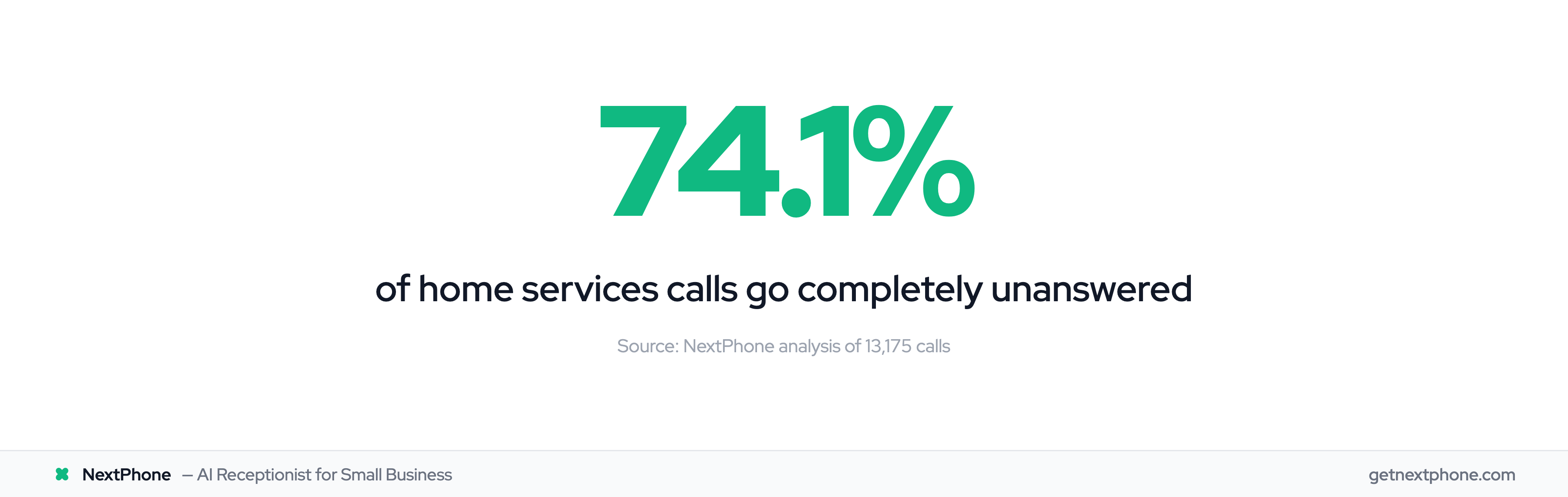
Here's a number that should worry you: 74.1% of calls to home services businesses go completely unanswered.
We know this from industry research on calls placed to home services contractors. Three out of every four calls never reached a human. They went to voicemail - or worse, just rang and rang until the caller gave up.
These aren't spam calls. Our data shows urgent calls rank among the top reasons people call, using words like "emergency," "urgent," or "ASAP." True emergencies are a recurring reason too - burst pipes, power outages, furnaces that died in the middle of a cold snap. These callers needed help immediately, and they didn't get it.
What happens next? According to industry research, 85% of callers who don't reach someone won't call back. They don't leave voicemails. They don't try again later. They call your competitor.
The Math: Lost Revenue for Boston Contractors
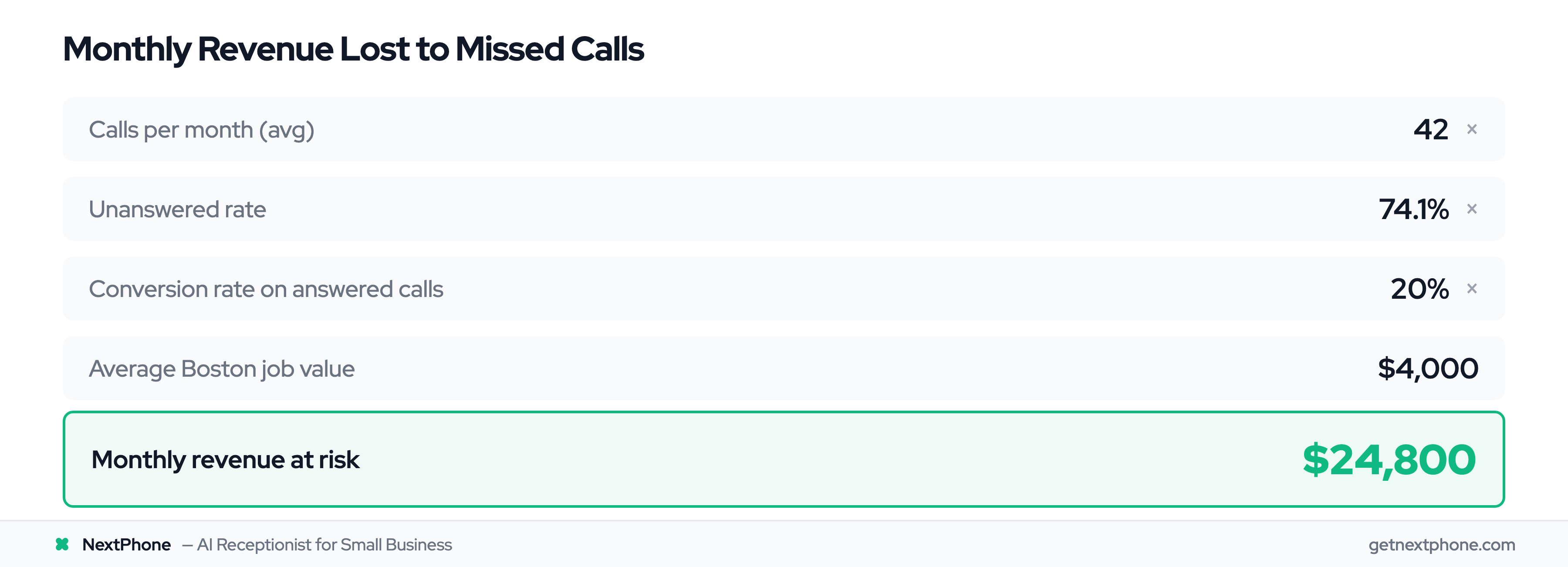
Let's do the calculation for a typical Boston-area contractor:
- You receive about 42 calls per month (average for home services)
- 74.1% go unanswered = 31 missed calls
- Maybe 20% of those would have converted to paying jobs
- Average job value in Greater Boston: $4,000
That's 6 jobs lost per month at $4,000 each = $24,800 per month in missed revenue.
Over a year? $297,600 gone. And that's using conservative estimates.
The real number could be higher. Boston's cost of living means service prices run above national averages. A heating system replacement that costs $4,000 elsewhere might be $5,500 here. Emergency plumbing in Cambridge or Newton commands premium rates. Every missed call potentially costs more in this market.
Winter Emergencies: High-Value Calls You're Missing
Boston winters create a constant stream of high-value emergency calls. Frozen pipes burst. Furnaces fail. Boilers quit at 2 AM when it's 15 degrees outside.
These emergency calls are worth significantly more than routine work. Emergency jobs average $4,200 in our data - higher than standard service calls because customers pay premiums for immediate help. Miss one emergency call per week and you're losing $16,800 per month just in emergency work.
Here's the scenario that plays out constantly in Boston: A Quincy homeowner wakes up to no heat on a January morning. The house is 52 degrees and dropping. They call the first HVAC company they find on Google. No answer. They call the second. No answer. The third company picks up, schedules a visit for that morning, and earns $4,500 for a furnace repair.
Companies one and two? They check their voicemails that afternoon and see the missed call. By then, the job is done and paid for - just not by them.
"I didn't even know I was missing that many calls until I saw the data. I just thought business was slow." - Plumber who discovered 76 missed calls in one month
How Boston Answering Services Actually Work
Traditional Live Answering Services
Live answering services employ real people to answer your calls. When customers dial your 617 number, the call forwards to a call center where a human receptionist picks up. They follow scripts you provide, take messages, and forward urgent calls.
The advantage is obvious: human interaction feels personal. Callers can ask complex questions and get nuanced responses. For high-touch businesses where relationships matter, live answering has real value.
The downsides? Cost and consistency. Live services charge per minute or per call, and those charges add up fast. You might pay $500-800 per month for basic coverage, with overages during busy periods. Quality also varies - the person answering at 3 PM might be great, while the 11 PM night shift person is just reading scripts without understanding your business.
AI-Powered Answering Services
AI answering has matured rapidly. Modern AI receptionists hold natural conversations, understand context, and handle the vast majority of caller needs without sounding robotic.
When someone calls your business, the AI picks up immediately - typically in under 5 seconds. It greets them professionally, asks how it can help, and guides the conversation from there. Common scenarios:
- "What are your hours?" - AI provides business hours instantly
- "Do you service Brookline?" - AI confirms service area
- "I need to schedule an appointment" - AI checks availability and books
- "I have an emergency - my pipes burst" - AI detects urgency and routes call to you immediately
The AI handles routine inquiries that make up 60-80% of calls. For complex situations or emergencies, it transfers to you in real-time. You're not replacing human interaction entirely - you're handling the predictable stuff automatically so you can focus on what requires your expertise.
AI-First with Smart Forwarding
The best answering service is AI-first with smart forwarding. AI handles routine calls 24/7 without per-minute charges. When something requires your judgment - a complex technical question, an upset customer, or a situation the AI isn't trained for - smart forwarding transfers to you without dropping the connection.
This gives small businesses enterprise-level phone coverage without enterprise budgets. Your customers get immediate attention at any hour. You get qualified leads and urgent calls routed properly, not lost to voicemail.