Avvo for Lawyers: How the Rating Works and Whether a Paid Profile Is Worth It

Updated
16 min read
Industries
Avvo for Lawyers: How the Rating Works and Whether a Paid Profile Is Worth It

NextPhone AI Receptionist

Answer every call, book appointments, 24/7.

Get Started Free

Avvo calls coming in while you're in court? See how NextPhone answers every lead instantly.

The Moment That Matters

A potential client searches "criminal defense attorney Chicago." Your Avvo profile appears. They see your 9.1 rating, read through two client reviews, and decide you're worth calling.

They tap your phone number.

What happens in the next ten seconds determines whether that person becomes your client or walks to the next result on the page.

That's the thing about Avvo that most attorneys don't fully reckon with. The directory part -- the rating, the profile optimization, the decision about whether to pay for sponsorship -- all of that gets them to your phone number. The phone call is where you either convert or don't.

This guide covers both sides. How the rating works, what moves it, when the paid upgrade makes sense, and what you need in place so that when an Avvo lead calls, you actually win the case.

What Avvo Actually Is

Avvo launched in 2007 as a directory covering essentially every lawyer licensed in the United States. The company built its profile database from state bar records, which means you likely have a profile already -- whether you've claimed it or not.

An unclaimed profile shows basic bar information: name, license status, practice areas, years licensed, and any disciplinary history on record. It's not flattering, and you have no control over it.

Claimed profiles let you add your photo, biography, detailed practice area descriptions, past case results, publications, speaking engagements, awards, and -- most importantly -- client and peer reviews. The platform's rating algorithm reads all of it.

Avvo serves two different audiences at once: consumers searching for an attorney, and attorneys building their online presence. The consumer-facing side is a directory with a search interface. The attorney-facing side is a combination of organic profile optimization and optional paid advertising.

Understanding that split matters because it changes how you think about value. The free profile is about organic search placement and conversion. The paid options are about getting in front of more people. Both are useless if no one picks up.

How the Avvo Rating Actually Works

The Avvo Rating is scored on a 1-10 scale. Avvo groups the inputs into three categories — experience, recognition, and disciplinary history — and deliberately does not publish the weight it gives each one, so that nobody can reverse-engineer it. Treat any guide that claims exact weightings as guessing.
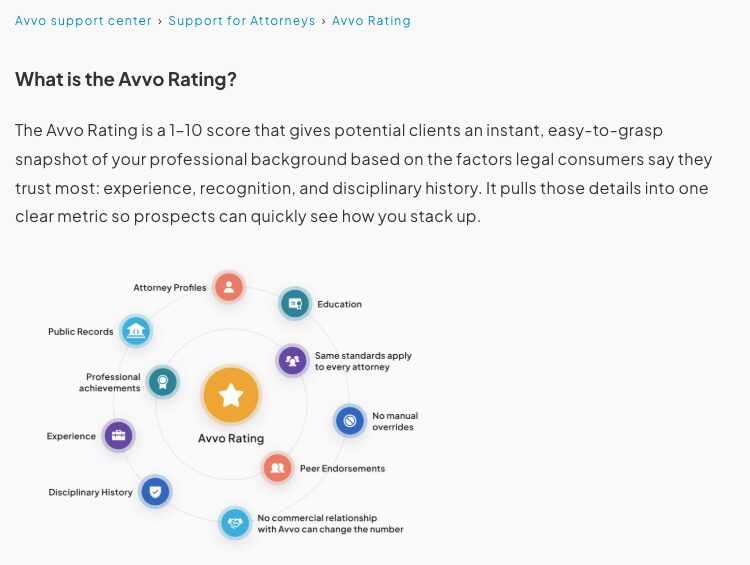
Avvo's own diagram of the Avvo Rating inputs: attorney profiles, education, experience, professional achievements, public records, disciplinary history, and peer endorsements — with no client-review input

Avvo's own breakdown of what feeds the rating. Note what isn't in the diagram: client reviews. Captured from Avvo's support center, August 2026.

Years licensed. This one is mechanical -- the longer you've been licensed, the higher the baseline score. A first-year attorney starts lower than a 20-year practitioner, all else equal. You can't shortcut it.

Credentials and background. Law school attended, law review or journal participation, clerkships, publications, speaking engagements, bar leadership positions. The more you fill in, the higher this component scores. Many attorneys leave entire sections blank and wonder why their rating is a 7.3 instead of a 9.

Industry recognition. Awards, honors, Super Lawyers listings, Best Lawyers designations, AV Preeminent Martindale-Hubbell ratings. These signal peer validation and they move the score.

Peer endorsements. Other attorneys -- not clients -- endorsing your legal ability. These sit under "recognition" and do move the rating.

Client reviews: not a rating input. This is the most common misconception about Avvo, and getting it wrong will waste your effort. Avvo states that client reviews are not a direct input into the numerical rating — they are displayed separately on your profile, and they matter enormously for whether a reader calls you, but a wall of five-star reviews will not move a 7.3 to a 9.0. Peer endorsements will. Pursue both, for different reasons.

Disciplinary history. Any public record of disciplinary action appears on your profile and pulls the score down. This data comes directly from state bar records.

One thing the rating does NOT measure: whether you advertise on Avvo. The company is explicit that the rating cannot be bought -- the algorithm is independent of paid placement. A 6.2 attorney who pays for sponsorship doesn't become a 9.6. The two systems run in parallel.

The practical implication: a fully completed profile with documented credentials, recognition, and peer endorsements can reach 9.0+ without a dollar spent on advertising. Many attorneys neglect the profile and then wonder why paid placement isn't converting.

Optimizing the Free Profile First

Before considering any paid options, fill in everything.

Biography. Write in first person. Describe your practice focus, your typical client, and what you bring to that client's case. Concrete specifics outperform generic language.

Practice area details. Avvo gives you space to describe each practice area. Use it. "I represent individuals charged with DUI, drug offenses, and assault cases in Cook County" is more useful to a searching consumer than "criminal defense."

Client reviews. You can't write them yourself, but you can ask satisfied clients to leave a review. The timing matters -- ask while the matter is still fresh. A simple follow-up message after closing a case works better than waiting a year and then reaching out cold.

Peer endorsements. Other attorneys in your network can endorse your legal ability directly on Avvo. Ask the colleagues you've co-counseled with, referred cases to, or worked alongside in bar association committees.

Credentials. Every award, every publication, every speaking engagement belongs on the profile. Avvo's algorithm reads them. Consumers read them too. There's no downside to completeness.

Photo. Profiles with a professional headshot convert materially better than those without. This isn't unique to Avvo -- it's true across every professional directory. Use the same photo you use on your firm's website.

A fully optimized free profile consistently outperforms an incomplete paid listing. The sequence should always be: complete the profile first, then evaluate whether paid placement makes sense.

Free Profile vs. Avvo Sponsorship: The Economics

Avvo offers paid sponsorship options that place participating attorneys above organic search results when a consumer searches a specific practice area in a specific city or zip code.

The mechanics are straightforward: you pay for preferential placement. A sponsored attorney appears at the top of a practice area/location search regardless of their organic rating position. Multiple attorneys can sponsor for the same search -- the exact order among sponsors varies.

When sponsorship makes sense:

The math works when two conditions are true: the typical case value is high enough to justify lead cost, and you actually convert the leads you receive.

Personal injury (contingency), criminal defense, estate planning, and family law tend to have case economics that support paid directory placement. The potential fee on a single retained client often exceeds months of directory fees.

Lower-ticket practice areas or high-volume commodity work (simple wills, uncontested divorces) require a tighter conversion analysis -- the per-client economics don't always justify aggressive paid placement.

The conversion variable that breaks the math:

Here's what the sponsorship sales conversation doesn't emphasize. If a potential client sees your sponsored listing, clicks to your profile, decides to call, and reaches voicemail -- the lead is gone. They don't leave a message and wait. They scroll down and call the next attorney.

Sponsored placement drives more calls to your profile. Whether those calls convert is entirely a function of whether you answer. The ROI on Avvo sponsorship correlates more with answer rate than with anything else Avvo controls.

What Avvo Lead Volume Actually Looks Like

Attorneys new to paid directory placement often have unrealistic expectations in both directions.

On one end: expecting guaranteed high volume. Avvo isn't Google -- it's a directory competing for attention alongside FindLaw, Martindale, Justia, Super Lawyers, and general organic search. In many markets, a well-optimized Avvo profile in a competitive practice area generates a handful of inbound contacts per month, not dozens.

On the other end: dismissing directories entirely because a colleague in a different market or practice area had a bad experience. The results vary significantly by market size, practice area, and -- again -- conversion infrastructure.

The honest benchmark: track every call, track every conversion, calculate cost per retained client, and compare it against your other acquisition channels. A directory that costs $400/month and produces one retained client worth $8,000 in fees is returning 20x. The same $400 producing zero retained clients is a waste. You can't evaluate it without measuring it.

Which brings us to the tracking problem.

Why Your Personal Cell Is the Wrong Number for Avvo

Most attorneys set their Avvo profile contact number to their personal cell or their main office line. This creates two compounding problems.

No call attribution. When a call comes in on your personal cell, you have no way to know it came from Avvo versus a referral, a Google search, or an old client. You can't measure the platform's performance because you can't separate Avvo calls from everything else.

No coverage when you're unavailable. You're in depositions, in court, in client meetings. The same hours when potential clients are researching attorneys are often the hours you're least available to answer. A call to your personal cell while you're cross-examining a witness goes to voicemail. The lead calls the next name on the page.

The standard fix -- used across every platform that generates calls -- is a dedicated tracking number pointed at your actual phone (or answering infrastructure). The tracking number goes on your Avvo profile. Every call that comes through that number is traceable back to Avvo. You get source attribution. You know exactly what the platform is delivering.

The secondary benefit: you can point that tracking number at an answering system that picks up when you can't. No more missed leads during depositions.

NextPhone AI Receptionist

Answer every call, book appointments, 24/7.

Get Started Free

Setting Up NextPhone as Your Avvo Contact Number

Hear it: AI handling an inbound legal intake inquiry in real time
0:00
0:00

The setup that works for law firms using Avvo: point your Avvo contact number at NextPhone.

When a potential client calls your Avvo number, NextPhone answers in under 5 seconds. The AI handles the initial intake -- name, nature of the matter, contact information, how they found you, urgency level. If the call needs immediate attention, it transfers to your phone with a summary. If you're unavailable, it captures the lead completely and sends you the details immediately.

The potential client never reaches voicemail. You never miss an Avvo lead because you were in court.

This matters especially for the practice areas where Avvo performs well. A personal injury call from someone injured in a car accident last week is time-sensitive -- they're likely calling multiple firms in the same afternoon. A criminal defense call from someone who was just arrested has enormous urgency. Estate planning calls from someone dealing with a recent family death require immediate, sensitive handling.

Across 1,446,980+ business calls answered, NextPhone resolves 90-95% of calls without needing to route to a human, picks up in under 5 seconds, and maintains 99% positive caller sentiment.

The tracking number setup also gives you the call attribution data you need to measure Avvo's ROI. Every call through that number is an Avvo lead. You can see volume, conversion rate, and cost per retained client -- not just cost per lead.

NextPhone does not bill per minute at all: flat monthly plans from $199 with unlimited inbound calls, so a month full of Avvo leads costs the same as a quiet one. For a firm paying for Avvo sponsorship to drive more calls, the answering infrastructure costs a fraction of the directory spend.

What Happens When a Potential Client Calls

Here's the scenario most attorneys don't think through carefully enough.

A potential client has their phone in hand. They've opened three attorney profiles in separate tabs. They're going to call all three and see who they like. The first one to answer gets the first conversation. The attorney who makes a good impression in that first call usually gets the retained client.

This isn't unique to Avvo -- it's how consumers evaluate professional services. The directory narrows the field. The phone call is the qualifying event.

For law firm answering service purposes, the relevant question is: what does a potential client experience when they call your number at 7pm on a Thursday, or at 9am on a Saturday? Personal injury and criminal defense calls don't respect business hours. Neither do after-hours inquiries from someone just served divorce papers.

A voicemail message that says "call back during business hours" communicates the opposite of what a retained client experience should feel like. Every answer matters -- not just the ones that come in during the hours you happen to be at your desk.

Hear it: AI handling an after-hours legal inquiry and capturing intake details
0:00
0:00

Avvo, Martindale-Hubbell, FindLaw, Justia, and Super Lawyers all compete for the same space -- attorneys trying to be found online by potential clients. They approach it differently.

Martindale-Hubbell is the oldest of the group, with the AV Preeminent rating system based entirely on peer review. It carries weight in certain professional contexts (bar leadership, general counsel evaluations) but has less consumer traffic than Avvo. The demographic skews older.

FindLaw (Thomson Reuters) focuses heavily on local search traffic. Their directory integrates with a broader content network. Paid placement costs are typically higher than Avvo. The lead quality tends to skew toward informational research rather than immediate-action calls.

Justia operates a free directory with significant Google indexing. The platform doesn't charge for profiles but offers paid upgrades for enhanced visibility. A well-maintained Justia profile generates some organic traffic on its own.

Super Lawyers and Best Lawyers are selection-based designation services -- attorneys are nominated and evaluated by peers. They carry credibility signals for high-value practices but aren't primarily lead generation platforms.

Where Avvo distinguishes itself: the consumer-facing rating system that actually gets used. Consumers trust the 10.0 scale in a way they don't engage with other directories' rating systems. For attorneys building an online profile from scratch, Avvo's consumer recognition and the volume it generates in most major markets make it the first directory to prioritize.

None of them matters without conversion infrastructure on the receiving end.

Frequently Asked Questions

What is a good Avvo rating for a lawyer?

Avvo rates attorneys on a 1-10 scale. Ratings of 7.0-8.0 are "Excellent," 8.0-8.9 are "Superb," and 9.0-10.0 are "Superb" at the top of the scale. Anything below 5.0 raises concerns for potential clients. Most attorneys with several years of practice and a claimed, fully completed profile can reach 7.5-8.5 without paid advertising. Reaching 9.0+ typically requires documented industry recognition — awards, peer endorsements, publications — on top of experience. Client reviews are not part of that calculation, though they heavily influence whether someone who sees your rating actually calls.

Is Avvo worth it for lawyers?

It depends on practice area, market, and your conversion infrastructure. Personal injury, criminal defense, family law, and estate planning attorneys in competitive markets often find Avvo sponsorship cost-effective when they're actually answering the calls. Practice areas with lower per-client economics require a tighter ROI analysis. The free profile is worth claiming and optimizing regardless -- the cost is only your time, and the profile shows up in branded search results whether you pay or not.

How do I improve my Avvo rating?

The highest-impact actions (Avvo's own guidance): complete every section of your profile (credentials, publications, awards, practice area descriptions), get peer endorsements from attorneys in your network, and document any industry recognition. Collecting client reviews is worth doing for conversion, but it will not raise the rating itself. Years of experience is the one factor you can't accelerate. Disciplinary history is reflected directly from bar records and can pull the score down -- there's no way to remove legitimate disciplinary information.

What is Avvo sponsorship?

Avvo's paid advertising option -- sometimes called sponsorship or Avvo Pro, depending on current product naming -- places your profile in a featured position above organic search results for specific practice areas and cities. You pay for the preferential placement, not for leads directly. Your profile appears more prominently when a consumer searches your practice area in your market. The organic rating remains independent of paid placement.

Does Avvo actually generate leads for lawyers?

Avvo generates inbound calls and contact form submissions for attorneys who are actively listed. Volume varies significantly by practice area and market. In larger markets and for high-search-volume practice areas (personal injury, DUI, family law), attorneys with optimized profiles and paid placement can receive several leads per month. In smaller markets or less-searched practice areas, volume is lower. The key variable is that you have to answer the calls to convert them into clients.

Should I use my personal cell phone on my Avvo profile?

No. Using your personal cell makes it impossible to track which calls came from Avvo versus other sources, and calls go to voicemail whenever you're unavailable. Use a dedicated tracking number pointed at your phone or answering infrastructure. The tracking number lets you measure Avvo's performance accurately and ensures coverage when you're in court or depositions.

Most attorneys with a meaningful online presence maintain profiles on multiple directories: Avvo, Martindale, Justia, FindLaw, and Super Lawyers where applicable. Each draws different traffic and different types of searchers. Avvo's consumer recognition and the 10.0 rating scale give it distinctive value in markets where consumers actively use it to evaluate attorneys. The strategy isn't Avvo versus the others -- it's understanding which platforms generate the calls in your specific market, then having answering infrastructure that converts those calls.

The Directory Is Only Half the Work

Avvo does what it's designed to do: it lists you, rates you, and puts your contact information in front of potential clients actively searching for an attorney. The platform's job ends the moment someone decides to call.

Your job starts there.

The attorneys making directory investment pay off -- on Avvo, on Martindale, on any platform -- are the ones who treat the phone call as seriously as the profile. A 9.3 rating and a sponsored listing generate more calls. An answering setup that picks up in under 5 seconds converts more of those calls into consultations. A tracking number tells you which platform is actually delivering.

The gap between attorneys who get ROI from directories and those who don't isn't usually the rating or the placement. It's what happens when the call comes in.

Set up NextPhone as your Avvo contact number and start converting every lead.

Try NextPhone AI answering service

AI answering service that answers, qualifies, and books — 24/7.

Get Started Free

Related Articles

Yanis Mellata

About NextPhone

NextPhone helps small businesses implement AI-powered phone answering so they never miss another customer call. NextPhone captures leads, qualifies prospects, books meetings, and syncs with your CRM — automatically.

Try NextPhone

Get Started Free