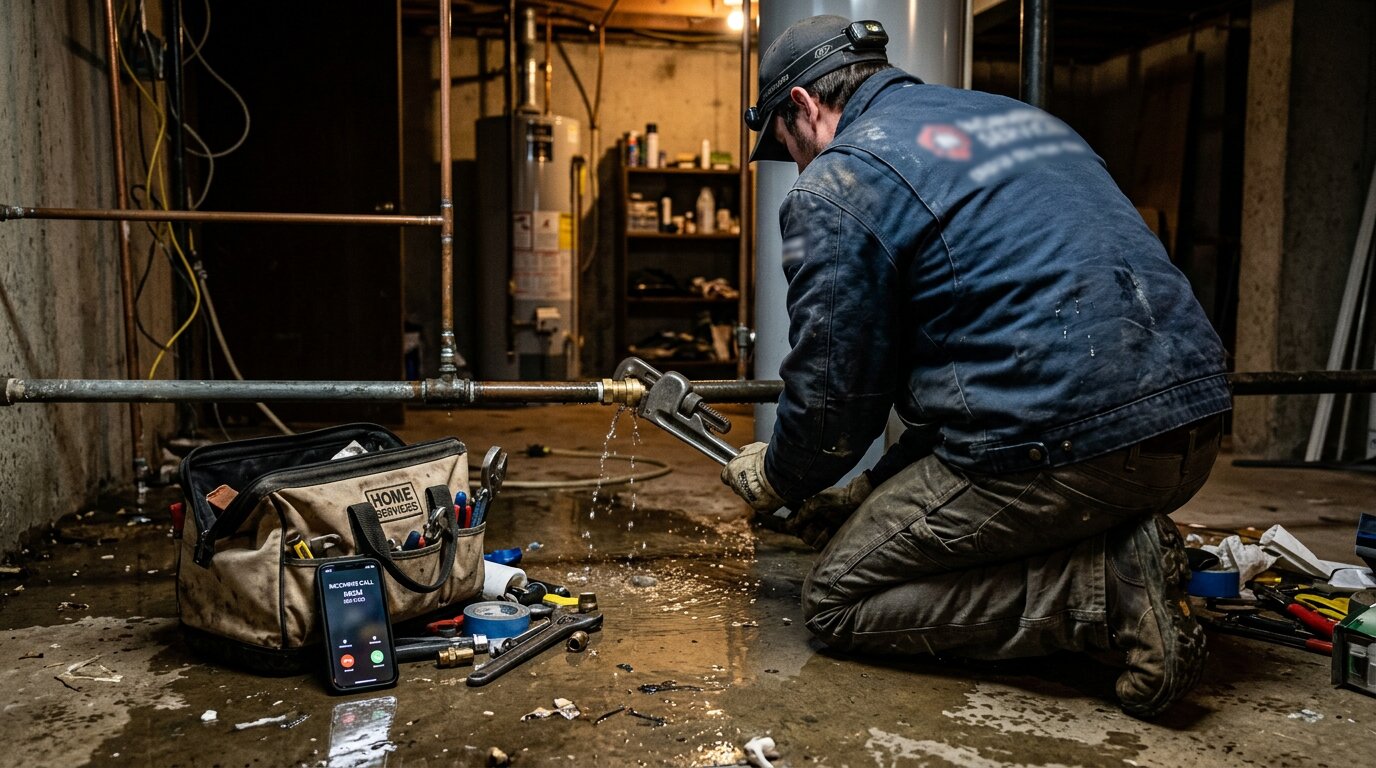
It's 2 AM on a Sunday. A homeowner's basement is flooding from a burst pipe. They Google "emergency plumber near me" and start calling. Your competitor answers on the first ring with an AI receptionist. You? Voicemail.
They book the $3,500 emergency job. You wake up Monday morning to a missed call notification worth nothing.
This scenario plays out thousands of times per day across home services businesses. Most calls to contractors arrive outside standard business hours. That means if you're only available 9-5, you're literally unreachable for a large share of your potential customers.
The solution isn't hiring a night shift receptionist at $35,000/year. It's implementing 24/7 answering coverage that costs a fraction of staff, answers instantly, and never takes a day off. See how AI after-hours answering works in practice.
The After-Hours Coverage Gap Costing You Customers

Let's start with the uncomfortable truth: Customer expectations have changed. 85% of customer service leaders will pilot conversational GenAI in 2025, because they know customers won't wait.
According to Salesforce's State of the Connected Customer report, 77% of customers now expect to reach someone immediately when they contact a company. HubSpot's research shows 82% expect an immediate response to sales or marketing questions. Not tomorrow morning. Not during business hours. Right now. And 21% expect instant resolution of their issue.
For service businesses (plumbers, HVAC contractors, electricians, roofing companies), after-hours emergencies are your highest-value calls. A homeowner with no AC in 95-degree heat isn't comparison shopping on price. They need help immediately and will pay premium rates to whoever answers first.
Across the 1,446,980 business calls in our analysis, the pattern breaks down like this:
- Urgent calls rank among the top reasons people call ("emergency," "urgent," "ASAP," "right away")
- Emergencies are a recurring reason people call (pipe burst, no power, heating/cooling failure, roof leak)
- Emergency jobs average $4,200 in revenue, significantly higher than routine work
- Missing one emergency per week = $16,800/month in lost revenue
Here's the math: If you're a typical contractor averaging 42 calls per month and industry research shows 74.1% go unanswered because they occur after hours or while you're on a job, that's 31 missed calls monthly. 42% of small businesses lose $500 or more every month from missed calls. If just 20% would have converted at an average $3,500 project value, you're losing $21,700 per month, or $260,400 per year.
Traditional solutions don't solve this:
Voicemail: By the time you check messages Monday morning, the customer already hired someone else. Research from Invoca shows the average business loses $1,200 per missed customer call.
On-call forwarding: You're at dinner, at your kid's soccer game, asleep at 2 AM. Even if you answer, you're not prepared to professionally handle intake, you can't capture data for your CRM, and you can't filter spam from real emergencies.
Part-time staff: Hiring evening/weekend staff costs $15-25/hour plus payroll taxes, training, management overhead, and you still have gaps in coverage.
There's a better way.
What Is a 24/7 Answering Service?
A 24/7 answering service picks up your phone calls around the clock (nights, weekends, holidays) when you're unavailable. Instead of calls going to voicemail or ringing endlessly, every caller reaches a professional voice that can help them immediately.
How it works:
- Call forwarding setup: Your business line forwards unanswered calls (or all calls during specific hours) to the answering service
- Custom greeting: The service answers with your business name and custom script
- Information collection: Caller details are captured (name, phone, reason for call, urgency level)
- Routing & escalation: Routine inquiries are logged for follow-up; emergencies are routed to your on-call phone immediately
- Integration: Call data flows to your CRM, email, SMS, or dispatch system automatically
The after-hours answering service market continues to grow as businesses recognize the cost of missed calls. There are three main types of 24/7 answering services:
Live Human Answering Services
Real people answer your calls from a call center. Pros: Warm, conversational, can handle complex questions. Cons: Expensive ($500-800/month for 100 calls with overage fees), slower response times (30+ seconds to pick up during peak hours), inconsistent quality depending on who answers.
AI Receptionist Systems
Voice AI receptionist technology answers calls using natural language processing. Pros: Instant response (NextPhone picks up in under 2 seconds), consistent quality, unlimited calls on flat monthly plans from $199, never tired or stressed. Cons: Best for structured inquiries (appointments, quotes, emergencies) rather than open-ended conversations.
Hybrid Models
AI handles routine calls, escalates complex situations to humans or directly to you. Pros: Best of both worlds. Cons: More complex setup, slightly higher cost.
For most small businesses, AI answering services offer the best value: professional coverage 24/7 at a fraction of the cost of live services or staff. The virtual receptionist market has grown to $6.26 billion, reflecting this shift in how businesses handle calls.
24/7 Coverage Options Compared
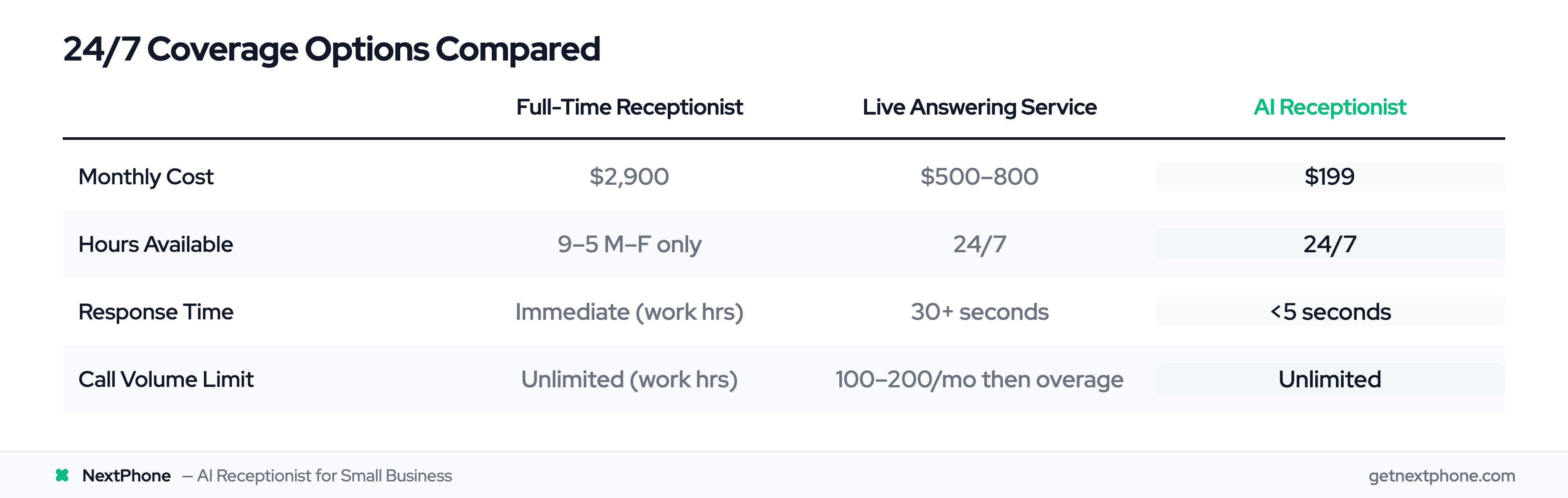
Let's break down what each option actually costs and what you get.
| Option | Monthly Cost | Hours Available | Response Time | Call Volume Limit | Pros | Cons |
|---|---|---|---|---|---|---|
| Full-Time Receptionist | $2,900 (salary + benefits) | 9-5 M-F only (40 hrs/week) | Immediate during work hours | Unlimited during work hours | Personal touch, company knowledge | Only 24% time coverage, misses every after-hours call, expensive |
| Live Answering Service | $500-800 | 24/7 (168 hrs/week) | 30+ seconds | 100-200 calls/mo, then overage fees | Human interaction | Expensive at scale, inconsistent quality, slower pickup |
| AI Receptionist (NextPhone) | $199 | 24/7 (168 hrs/week) | <2 seconds | Unlimited | Instant, consistent, affordable, scales infinitely | Less "human" warmth (though modern AI is very natural) |
Cost savings breakdown:
If you're currently using a full-time receptionist at $35,000/year ($2,900/month) who only works business hours, you're paying for 24% time coverage (40 hours out of 168 hours per week). That means every call that arrives outside those hours still goes unanswered.
Switching to an AI receptionist:
- Saves $2,700/month ($32,400/year) compared to receptionist
- Provides 100% time coverage instead of 24%
- Answers instantly vs potential hold times
If you're using a traditional live answering service at $600/month for 100 calls:
- You pay $6 per call
- Overage fees add up quickly (many contractors get 150-200 calls/month)
- At 200 calls/month, you're paying $1,200+ with overages
AI answering at $199/month unlimited:
- $0.99 per call at 200 calls/month
- No overage fees ever
- 83% cost savings
Benefits of Always-On Phone Coverage
Beyond cost savings, 24/7 coverage delivers measurable business advantages.
Never Miss Emergency Calls
Urgent calls rank among the top reasons people call. For trades, after-hours emergencies are your most profitable work. A homeowner with a burst pipe at midnight will pay $500-800 for immediate response. An HVAC emergency in summer heat? $800-1,500.
With 24/7 AI answering:
- Emergency keywords trigger instant routing to your on-call phone
- You decide what counts as "urgent" (flooding, no power, safety hazards)
- Spam calls are filtered out before they ever ring you
- You only get woken up for real emergencies worth responding to
Capture After-Hours Leads
Most estimate requests come when people have time to think about their projects: evenings and weekends. If you're unavailable, they call the next contractor.
Approximately one in four callers explicitly asks for a callback. An AI receptionist can also:
- Collect detailed project information while the customer is engaged
- Schedule a callback appointment automatically
- Send confirmation via SMS or email
- Push lead details to your CRM immediately
By Monday morning, you have fully-qualified leads with next steps scheduled, not a list of names to cold-call.
Professional Image 24/7
"Hi, you've reached ABC Plumbing. We're unable to take your call right now..."
Voicemail greetings sound amateur. They signal you're too small or too busy to handle new customers.
A professional answering service, live or AI, answers with: "Thank you for calling ABC Plumbing. How can I help you today?"
Instant professionalism. Customers can't tell (and don't care) whether it's a receptionist, a call center, or AI. They care that someone answered and can help them.
Reduce Stress & Improve Work-Life Balance
When you're the business owner, you're always "on." You answer your cell at dinner, during family time, at 11 PM. It's exhausting and unsustainable. For property managers, 39% spend 20+ hours per month just on maintenance requests, and 61% of landlords say maintenance is the worst aspect of the job.
With 24/7 answering:
- Routine inquiries are handled without interrupting you
- You set escalation rules (only route emergencies, let everything else queue)
- Your personal time is protected
- You can actually take a vacation without losing business