
Introduction
The answering services industry is now worth $8.4 billion globally, with the virtual receptionist market projected to grow from $3.85B to $9B by 2033. Yet every service claims to be "reliable." It's the most overused word in the industry. Browse any provider's website and you'll see it plastered everywhere—reliable service, reliable operators, reliable technology.
But here's what nobody talks about: what happens when that reliability fails?
Industry research on calls to home services contractors found that 74.1% go unanswered. That's the reality for businesses without truly dependable call coverage. Three out of four callers - potential customers with real problems and real money to spend - never reached a human.
The challenge isn't finding a service that calls itself reliable. It's figuring out which ones actually deliver. How do you verify reliability claims before signing a contract? What specific factors separate dependable services from the ones that drop balls?
That's what this guide is for. We'll define what reliability actually means, show you how to evaluate any service's claims, and recommend specific options that have earned trust. No vague promises - just criteria you can apply and services you can count on.
What "Reliable" Actually Means for Answering Services
Before we compare services, we need to agree on what "reliable" actually means. It's not just about answering calls - it's about answering them correctly, consistently, every single time.
The Three Pillars of Reliability
Availability: The service actually picks up when calls come in. This means 24/7/365 coverage that doesn't depend on whether someone showed up for their shift. It means having backup systems when primary ones fail. It means answering at 2 AM on a holiday the same as 2 PM on a Tuesday.
Accuracy: Calls get handled correctly. Messages are taken accurately. Urgent calls get escalated. Appointments get scheduled in the right time slots. Information gets captured without errors. One wrong message can cost you a job.
Consistency: The same quality every time. Not great service during business hours and sloppy handling overnight. Not excellent week one and declining quality by month three. Every caller gets the same professional experience regardless of when they call or how busy things are.
Why Reliability Matters More Than Features
Feature lists are meaningless if the service isn't there when you need it.
Urgency language—phrases like "as soon as possible," "need help today," or "emergency"—ranks among the top reasons people call. True emergencies are a recurring reason too: burst pipes, no heat in winter, electrical failures. The field service management market is growing from $5.1B to $9.17B by 2030, reflecting how critical responsive service has become.
Miss one of those calls because your "reliable" service wasn't actually reliable, and you've lost more than a lead. You've abandoned someone who needed help.
All the fancy features in the world don't matter if the phone rings and nobody answers.
The Real Cost of Unreliable Answering Services
Let's put numbers to this problem. Because "missed calls are bad" doesn't capture the actual damage unreliable services cause.
What Happens When Calls Are Missed
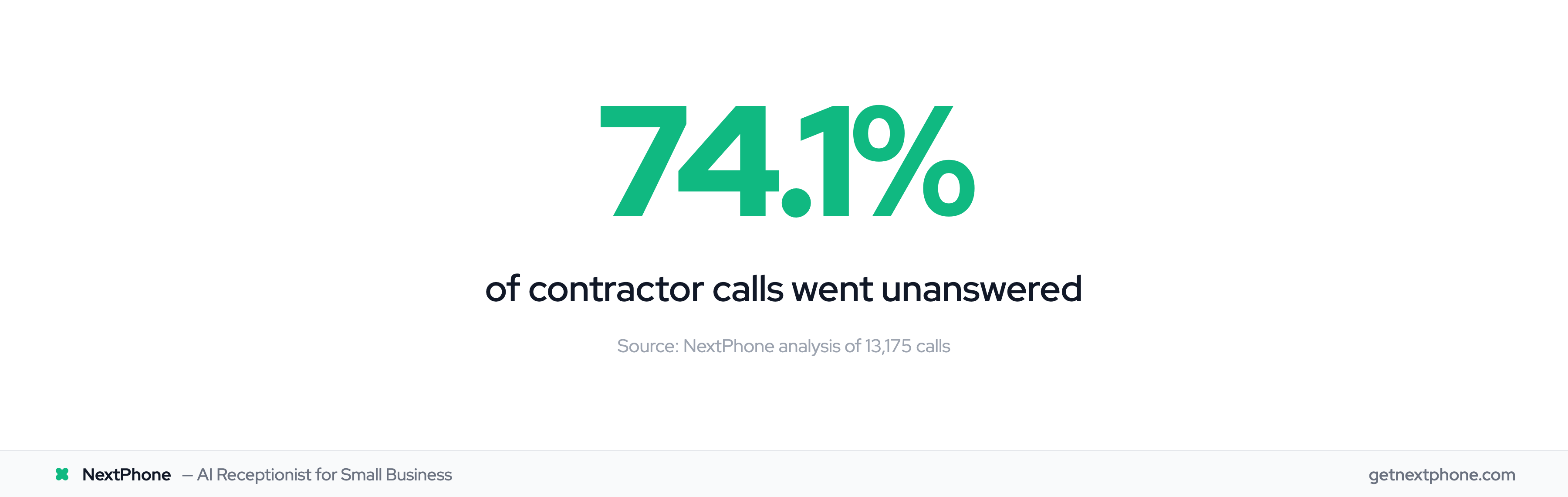
We've answered more than 1,446,980 business calls, and the industry research on contractors should make every business owner uncomfortable:
74.1% of calls go unanswered. Not just after hours. Not just during lunch. Throughout the day, most calls never connected with a human. They rang out, hit voicemail, or got dropped.
Only about one in four callers left a message or tried again. The "I'll call them back" strategy fails because three out of four callers won't give you that chance. They've already moved on to your competitor. The lead capture software market is growing from $2.69B to $4.55B by 2029, reflecting how critical capturing those initial inquiries has become.
Callers don't wait. When someone needs a plumber, electrician, or HVAC tech, they're not patient. They'll call three companies in five minutes and hire whoever answers first.
The Financial Impact
When we calculated the full cost of these missed calls - factoring in conversion rates and average job values - the average contractor lost an estimated $189,068 per year.
That's not aspirational revenue they could have grown into. That's money that called their phone and went elsewhere.
Here's the uncomfortable truth: an unreliable answering service might be worse than no service at all. At least without a service, you know you're missing calls. An unreliable service gives you false confidence while still dropping the ball.
If reliability costs you an extra $50 or $100 per month, that's noise compared to what unreliability costs you.
How We Evaluated These Services
Marketing materials won't tell you if a service is actually reliable. You need to dig deeper. Here's a framework for evaluating any answering service's dependability.
Reliability Checklist
Uptime guarantees: What specific uptime percentage do they promise? 99.9%? 99.99%? What happens if they miss it - do you get credits, refunds, or just apologies? A service confident in their reliability will put it in writing.
Redundancy systems: What happens if their primary system fails? Do they have backup servers? Multiple call centers? Failover routing? Ask specifically: "If your main system goes down, what happens to my calls?"
Staffing model: For live services, do they overstaff to handle surges or run lean to cut costs? What's their operator-to-call ratio? How do they handle holidays and sick days?
Technology infrastructure: Is it cloud-based with geographic distribution, or a single server in one location? Modern reliable services spread risk across multiple systems and locations. The UCaaS market is projected to grow from $56B to $176B by 2030, driven by businesses demanding better communication infrastructure.
Review patterns: Don't just look at star ratings. Read reviews specifically mentioning reliability, uptime, and consistency. One complaint about dropped calls is a data point. Multiple complaints are a pattern.
Response to problems: How do they handle issues when they occur? A service that acknowledges problems and fixes them quickly is more trustworthy than one that claims problems never happen.
Red Flags That Signal Unreliable Services
Watch out for these warning signs:
- Vague uptime claims without specific numbers
- No Service Level Agreement (SLA) or weak commitments
- Reviews mentioning dropped calls, long hold times, or inconsistent quality
- Complicated cancellation policies - unreliable services trap dissatisfied customers
- Outsourced support with no clear escalation path
- No backup system mentioned or explained
- Reluctance to provide references
Questions to Ask Before Signing Up
Before committing to any service, ask these directly:
"What's your uptime percentage over the past 12 months?" Real numbers, not marketing claims.
"What redundancy do you have if your primary system goes down?" They should have a clear answer.
"How do you handle unexpected call volume spikes?" Reliable services plan for busy periods.
"Can I speak with current clients in my industry?" Willingness to provide references signals confidence.
"What's your process when something goes wrong?" Everyone has issues - how they handle them matters.
If they can't answer these questions clearly and specifically, that tells you something about their reliability.
Virtual Answering Service Reviews: 6 Providers Compared
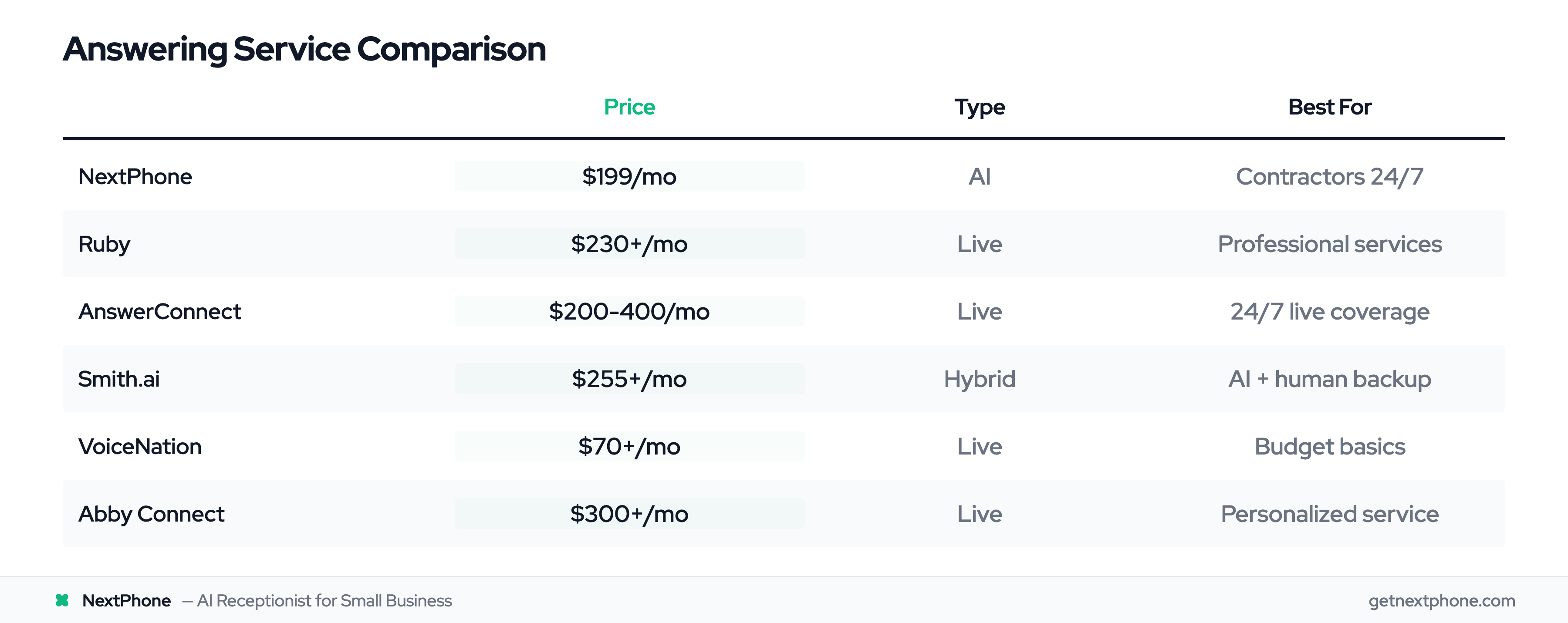
Based on our research and the reliability criteria above, here are the answering services that consistently deliver dependable performance.
1. NextPhone - Most Reliable AI Answering for Contractors
NextPhone was built specifically for contractors and service businesses, using data from the 1,446,980+ real business calls we've answered. The AI-powered service provides 24/7 coverage with the consistency that only automation can deliver.
Why It's Reliable: The AI doesn't get sick, take breaks, or have bad days. Every call gets the same quality handling whether it's the first call of the day or the hundredth. The cloud infrastructure eliminates single points of failure, and the system scales instantly for high-volume periods.
- AI trained on actual contractor call patterns
- 24/7/365 availability with no staffing dependencies
- Appointment scheduling with calendar integration
- Emergency call escalation
- CRM and dispatch software integrations (the CRM market is projected to grow from $112.9B to $262.7B by 2032)
Pricing: $199/month flat rate - no per-minute fees, no surprises
Pros:
- Predictable, consistent performance every call
- Instant scalability without quality drops
- No human staffing variability
- Same-day setup
Cons:
- AI-only (no human operator option)
- Complex or unusual requests may need escalation
Best For: Contractors, HVAC companies (an industry with specific data needs), plumbers, and electricians wanting reliable 24/7 coverage at predictable cost.
Try NextPhone free for 7 days
AI answering service that answers, qualifies, and books — 24/7.
2. Ruby - Most Reliable Premium Live Service
Ruby has built a strong reputation for live answering reliability. Their US-based receptionists receive extensive training, and the company invests heavily in maintaining consistent quality.
Why It's Reliable: Ruby's rigorous training programs and quality monitoring create consistency across their receptionist team. They've been operating for years with a track record that shows in their reviews. The mobile app gives you visibility into calls in real time.
Key Features:
- Live US-based receptionists
- Quality monitoring and training programs
- Mobile app for call management
- Warm transfers
- Bilingual options
Pricing: Starting at $250/month for 50 receptionist minutes
Pros:
- Consistent quality across operators
- Strong training and monitoring
- Established track record
- Professional handling
Cons:
- Per-minute pricing adds up
- Human variability still possible
- Premium pricing
Best For: Professional services including law firms where 70% of lawyers prefer remote work with cloud practice management, and businesses needing reliable human operators and willing to pay for quality.
3. AnswerConnect - Reliable 24/7 Live Coverage
AnswerConnect delivers round-the-clock live answering with genuine 24/7 staffing. Their multiple call centers provide redundancy that smaller services can't match. They're part of a call center outsourcing market worth $97B and growing to $163B by 2030.
Why It's Reliable: True 24/7/365 coverage backed by multiple call centers means calls get answered even if one location has issues. They've been in business long enough to work out staffing and technology problems.
Key Features:
- 24/7/365 live operators
- Multiple call centers for redundancy
- Bilingual English/Spanish
- Lead capture and qualification
- Custom scripting
Pricing: Custom quotes, typically $200-400/month
Pros:
- Genuine 24/7 live coverage
- Redundant operations
- Experienced with service businesses
Cons:
- Quality varies between operators
- Pricing requires sales conversation
- Longer setup time
Best For: Businesses needing reliable live coverage around the clock with redundancy built in.
4. Smith.ai - Reliable Hybrid Solution
Smith.ai combines AI and human operators for redundant reliability. The AI handles routine calls with perfect consistency, while humans step in for complex situations.
Why It's Reliable: The hybrid approach provides two layers of reliability. AI ensures consistent handling for most calls, while trained humans handle anything unusual. If one system has issues, the other provides backup.
Key Features:
- AI for routine calls, humans for complex
- Smart routing between AI and human
- Lead screening and intake
- CRM integrations
Pricing: Starts around $255/month for 30 calls
Pros:
- Double redundancy (AI + human)
- Consistent AI handling for routine calls
- Human backup for edge cases
Cons:
- Per-call pricing requires monitoring
- More complex setup
- Premium pricing
Best For: Businesses wanting reliability redundancy and willing to pay for both AI and human capabilities.
5. VoiceNation - Reliable Budget Option
VoiceNation offers straightforward live answering at budget-friendly prices. They're not fancy, but they're established and dependable for basic needs.
Why It's Reliable: VoiceNation has been around long enough to work out operational issues. Their simple service model reduces complexity and potential failure points. What they do, they do consistently.
Key Features:
- 24/7 live answering
- US-based operators
- Message taking and call patching
- Basic appointment scheduling
Pricing: Plans starting around $70/month
Pros:
- Affordable and straightforward
- Established company
- No long-term contracts
- Simple, dependable service
Cons:
- Fewer features
- Basic reliability only
- Limited integrations
Best For: Budget-conscious businesses needing basic reliable coverage without bells and whistles.
6. Abby Connect - Reliable Personalized Service
Abby Connect assigns dedicated receptionist teams to your account. The same people answer your calls, learning your business over time for increasingly personalized service.
Why It's Reliable: The dedicated team model creates reliability through familiarity. Your receptionists know your business, recognize repeat callers, and handle calls with context that pooled services can't match.
Key Features:
- Dedicated receptionist teams
- Personalized call handling
- Learning your business over time
- Custom call flows
Pricing: Starting around $300/month
Pros:
- Consistency through dedicated staff
- Receptionists truly learn your business
- Personalized handling
Cons:
- Premium pricing
- Longer onboarding
- Less flexibility than pooled services
Best For: Businesses valuing relationship-based reliability and consistent personal service.