Alert Communications is a legal intake call center built for volume: mass tort, personal injury, high-call-count firms. They're good at that, and this isn't an argument that they aren't.
Credit where it's due: Alert publishes its plan prices, which most of this category won't. The problem firms run into is what happens past the plan: the overage rate isn't published, and the contract defines billable time unusually broadly. If you want a bill you can predict, NextPhone runs flat monthly plans from $199 with no per-minute component at all.
All contract language quoted verbatim from Alert's published terms and conditions. Verify current pricing and terms before signing.
What Alert publishes
Prices checked against each provider's own pricing page on October 5, 2026.
| Plan | Price | Includes |
|---|---|---|
| Tier 1: Basic | $240/month for 100 minutes | Message taking |
| Tier 2: Advanced | $590/month for 250 minutes | Message taking + intake |
| Tier 3: Premier | $550 or $575/month for 250 minutes, plus $75 a retainer (both prices appear on Alert's plans page) | Intake + retainers |
| Alert Go | $2.50 a minute, pay as you go | $100 a retainer, no monthly minimum |
Every tier includes 24/7 coverage, free message delivery, client portal access and HIPAA compliance.
Two things worth noticing. The pay-as-you-go rate is published at $2.50 a minute. That's real transparency, and more than Answering Legal offers. And Tier 3 costs less per month than Tier 2 for the same 250 minutes, because the retainer fee is where the difference sits.
What Alert doesn't publish: the overage rate
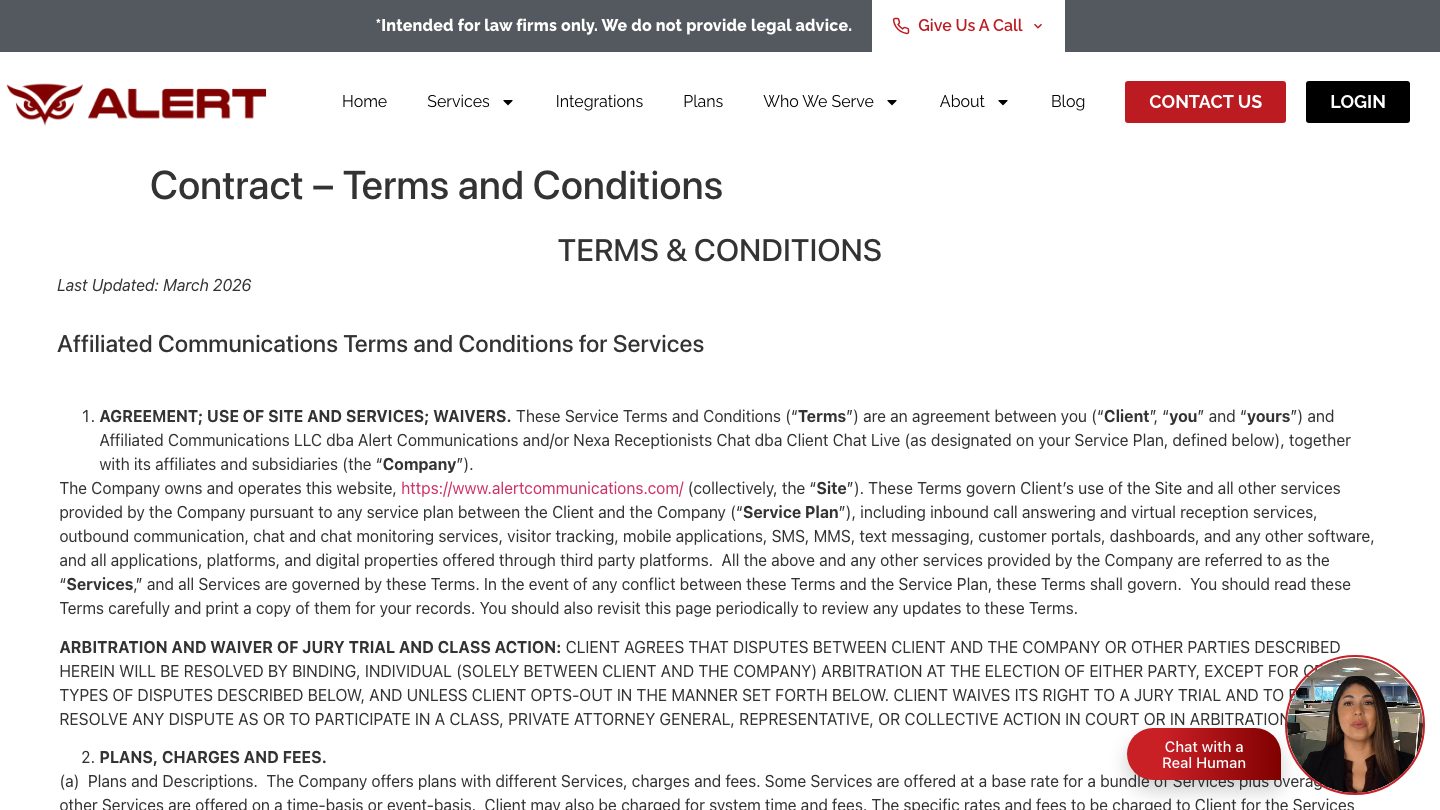
The published plans tell you what the bucket costs. They don't tell you what happens when you empty it, and for a firm running intake volume that's the number that decides the bill. The quotes below are from Alert's own published terms, which anyone can read.
Rates are defined by the invoice, not the plan page.
"The specific rates and fees to be charged to Client for the Services provided by the Company to the Client are identified on invoices issued to Client."
Read against the published tiers, that clause is about everything the tiers don't cover, the overage rate chief among it.
Partial minutes round up.
"All time (including overage measured in time) will be billed in whole minute increments and that any partial minutes will be rounded up to the nearest whole minute."
Hold time, ringing time and after-call work are billable. This is the clause that matters most, and it's the longest:
"For calls, time is calculated starting from the time a receptionist receives or initiates the call and ending when the call is transferred through to someone, or to voicemail, or otherwise disconnects because the call is over (and includes time when callers are on hold waiting to be transferred and outbound ringing time), as well as any time a receptionist spends completing information about the call after the caller has hung up or that the Company spends performing other work on your account."
Read that carefully. Billable time includes the caller sitting on hold, the phone ringing at your office while nobody picks up, the wrap-up notes after the caller hangs up, and unspecified "other work on your account."
A percentage fee stacks on the invoice.
"A Service Fee contributing to the recovery of certain expenses related to provision of the Services based on a percentage of the Client's monthly invoice and determined by the Service Plan and features selected by the Client. The Company reserves the right, upon notice to Client, to increase or change any component of the Service Fee."
Setup fee: non-refundable, amount not stated.
"A one-time Set Up Fee as outlined on the Services Plan, which Set Up Fee will be non-refundable."
They can reprice at will.
"The Company reserves the right to change its rates, charges, fees or pricing plans or adjust pricing for Services or any components thereof, in any manner and at any time."
Plus: a 3% credit card surcharge, 1.5% monthly interest on late payments, and collection agency plus attorney fees if it goes that far.
Cancellation takes one month's written notice before your next invoice date, and the plan auto-renews monthly otherwise. Note the clause opens with "Unless otherwise stated in a Service Plan," so their "no long-term contracts" marketing describes the default, and an individually negotiated plan can carry different terms.
Why that combination is hard to budget
Take the pieces together. You know what the plan costs, but not what the minute past it costs. Every partial minute rounds up. Hold time and ringing time count. Wrap-up work counts. A percentage fee sits on top. And the rate can change at any time, in any manner.
A customer review from April 2023 describes what that feels like in practice. Keri, one star on Trustpilot:
"Their staff turnover makes it hard for any of the operators to learn anything about the companies they are answering calls for or care about doing a good job. They mispronounce our business name, regularly fail to 'push 1 to accept the call' leading it to voicemail, and follow the script so strictly the conversation makes no sense and it's clear they aren't listening and just going through the motions. The support staff are even worse, they don't respond to calls, take forever to answer emails, and then only answer a portion of the outstanding questions. They keep raising the prices with no notice and while it is becoming more expensive, the service is drastically decreasing."
That last sentence maps directly onto the repricing clause above. She's describing the contract working as written.
The pattern across customers and staff
Two groups who don't know about each other describe the same decline over the same period.
Customers on Google review: "We have used alert for years and they keep getting worse." And: "Was a good company for years but no longer reliable."
Employees, independently. On Indeed, Alert holds 3.3 out of 5 across 108 reviews; on Glassdoor, 2.5 out of 5 across 103 reviews with 27% saying they'd recommend the company, which Glassdoor notes is well below its industry average. A former intake specialist, June 2022:
"This used to be an amazing company until it was sold. They got rid of everything that made it a great place to work. Now you're just a body to answer a phone. The turn over is terrible now."
Another, August 2022:
"Lack of stability at this job, it seems every week there's a different approach to rectify poor performance. Training is lackluster so when you speak to new agents they make a ton of errors. I feel embarrassed for the clients."
The mechanism behind it is public: Alert is now owned by Nexa, the Phoenix answering service backed by private equity firm Sunstone Partners. Nexa's own about page lists the acquisition, and Alert's contract terms name Nexa Receptionists as a contracting party and match Nexa's terms clause for clause. Customers describing a service getting worse and employees describing a workplace getting worse after an acquisition is the same story told from both ends.
Both sets of reviews are public and both are their own audiences, which is why the pattern is worth taking seriously rather than treating either group as disgruntled.