Why Your San Francisco Business Can't Afford to Miss Another Call
You're in a client meeting in the Financial District. Your phone buzzes. A potential customer needs a quote. The call goes to voicemail. They call the next business on their list.
Sound familiar?
We've answered more than 1,446,980 business calls. And the industry research is brutal: 74.1% of calls to home services businesses go completely unanswered. That's three out of every four potential customers calling someone else.
In a city with 90,000 small businesses competing for the same customers, that kind of miss rate is a death sentence for growth. And here's what makes it worse: research from MIT and InsideSales.com found that 78% of customers buy from whichever company responds first.
Not the cheapest. Not the best reviewed. The first one to answer the phone.
This guide walks you through everything you need to know about San Francisco answering services - from getting a 415 business number to choosing between live and AI options with smart forwarding. You'll learn exactly what missed calls cost you, how to evaluate your options, and how to stop losing customers to voicemail.
What Missed Calls Really Cost Bay Area Businesses
"I didn't even know I was missing that many calls until I saw the data. I just thought business was slow."
That's what one San Francisco plumber told us after discovering he'd missed 76 calls in a single month. He's not alone.
The Data: How Many Calls SF Businesses Miss
The data on home services businesses reveals some uncomfortable truths:
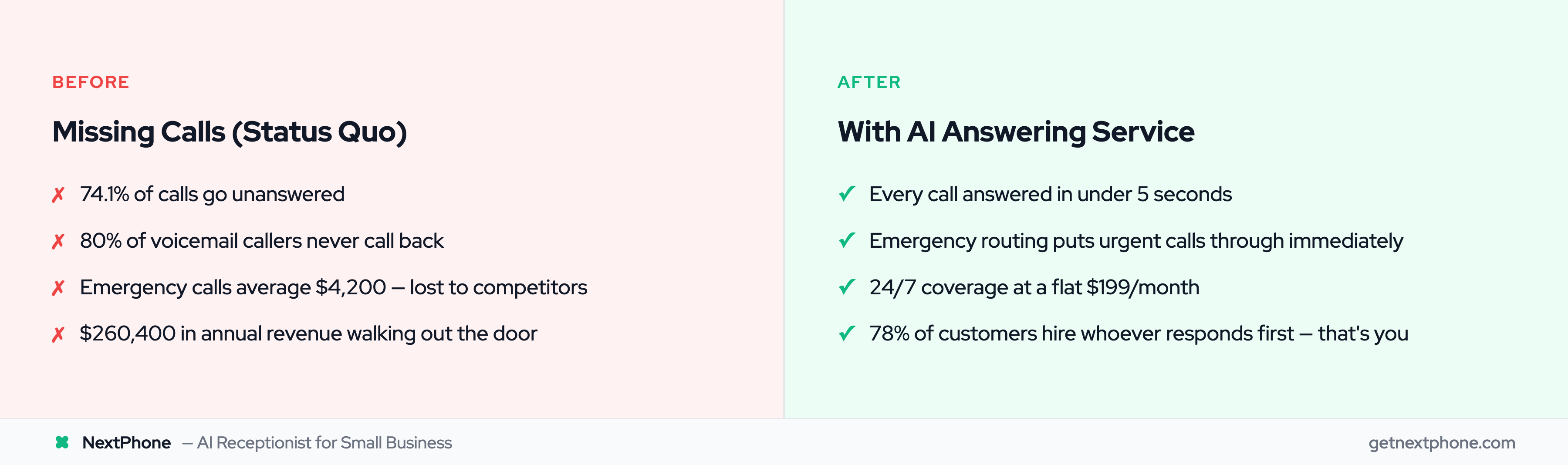
- Industry research shows 74.1% of calls go unanswered
- For a typical business receiving 42 calls per month, that means 31 missed opportunities
- Approximately one in four callers explicitly asks for a callback (which rarely happens without a tracking system)
- Spam and robocalls get filtered out before they ever ring you - the rest are real customers
Picture this: You're a contractor on a roof in Pacific Heights. Your phone buzzes. An $8,000 kitchen remodel inquiry goes to voicemail. The homeowner, frustrated, searches "kitchen contractor San Francisco" and calls the next name on the list.
The Math: Revenue Lost Per Missed Call
Let's break down the actual cost:
- 42 calls per month (average for small service businesses)
- 74.1% missed = 31 unanswered calls
- If just 20% would have converted (conservative estimate)
- At an average project value of $3,500
That's $21,700 per month in lost revenue. $260,400 per year.
And according to BIA/Kelsey research, 80% of callers who reach voicemail never call back. They don't leave a message - they call your competitor.
Emergency Calls: The Highest-Stakes Misses
Our data shows that urgent calls with language like "emergency," "urgent," or "ASAP" rank among the top reasons people call. True emergencies are a recurring reason too - burst pipes, power outages, AC failures during heat waves.
These emergency calls average $4,200 in revenue - significantly higher than routine jobs. Miss just one emergency call per week, and you're losing $16,800 per month.
For San Francisco businesses, where competition is fierce and customers expect immediate responses, every missed call is a customer handed to someone else.
Why a 415 Number Matters for Bay Area Credibility
When a San Francisco customer sees an incoming call from a 415 number, something clicks. It's local. It's trusted. It's one of us.
Local Numbers Build Trust
The 415 area code was established in 1947 as one of the original 86 area codes in North America. It covers San Francisco and Marin County - about 873,965 residents who recognize it instantly.
When you call a potential customer back from a 415 number, you're signaling that you're a Bay Area business. You're not a telemarketer calling from who-knows-where. You're a neighbor.
Answer Rates: Local vs Toll-Free
The numbers tell the story. According to Hiya and Truecaller spam research:
| Number Type | Answer Rate | Spam Perception |
|---|---|---|
| Local (415) | 60-70% | 2-5% |
| Toll-Free (800, 888) | 40-50% | 20-30% |
That's a massive difference. A local 415 number can nearly double your contact rate compared to a generic toll-free number.
The San Francisco Identity Factor
Bay Area customers are savvy. They know that tech-forward, trusted businesses have local numbers. A 415 caller ID instantly associates you with San Francisco's identity - whether you're a law firm in the Financial District, a contractor in the Sunset, or a tech startup in SoMa.
Your answering service should give you a genuine 415 number, not route calls through some random area code. When you call customers back, they should see that local presence.
Three Types of Answering Services for San Francisco Businesses
Not all answering services work the same way. Here's what you need to know about your options.
Traditional Live Answering Services
Real humans answer your calls 24/7, following scripts you provide.
How it works: When a call comes in, it routes to a call center where a live agent answers in your business name, takes messages, and either delivers them to you or transfers urgent calls.
Pros:
- Human touch for complex or emotional situations
- Can handle unexpected questions flexibly
- Some customers prefer talking to people
Cons:
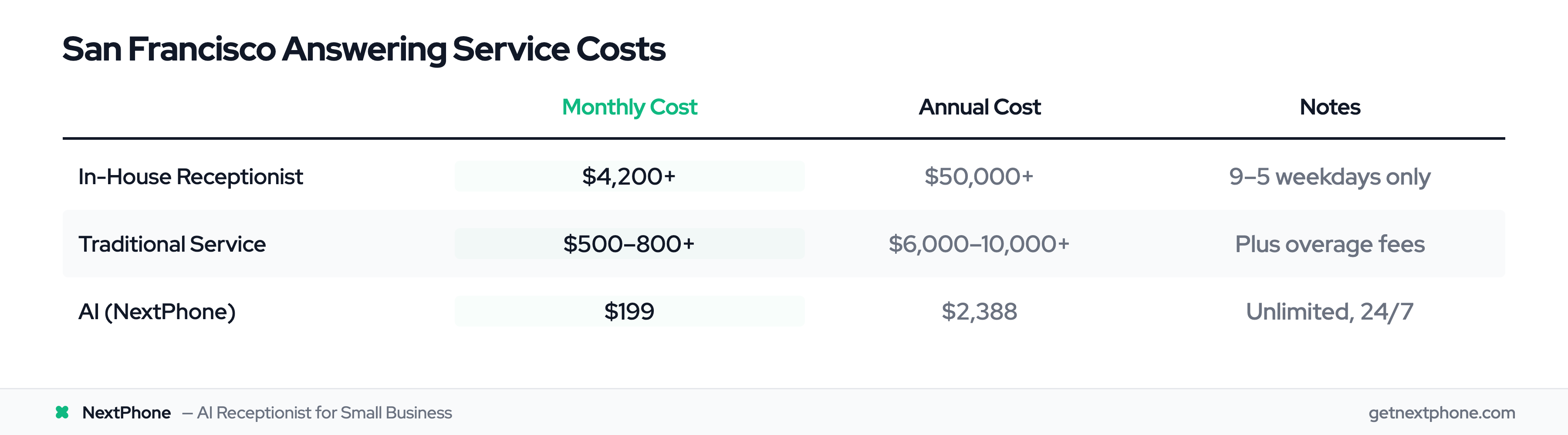
- $500-800/month for just 100 calls (with overage fees)
- Quality varies by agent and time of day
- Setup takes 3-5 business days
- Limited scalability during busy periods
Examples: Smith.ai, AnswerConnect, MAP Communications
AI-Powered Answering Services
Artificial intelligence handles calls using natural conversation.
How it works: AI answers calls, understands what the caller needs, and either handles it directly (scheduling, answering FAQs, taking messages) or routes to you based on urgency.
Pros:
- $99-299/month with unlimited calls
- Answers in under 5 seconds, every time
- 24/7/365 without quality dips at 3 AM
- Consistent experience for every caller
- Scales infinitely - handles one call or 100 simultaneously
Cons:
- May struggle with highly complex or emotional situations
- Some callers still prefer humans (though this is declining)
Examples: NextPhone, Goodcall
AI-First with Smart Forwarding
AI handles routine calls; smart forwarding routes exceptions to you.
This is increasingly the smart choice. AI answers in under 5 seconds, handles the 80% of calls that are routine (hours, pricing, scheduling), and seamlessly forwards to you when complexity demands it.
Research shows 60-70% of customers are comfortable with AI for simple tasks. But 80%+ still want the option to reach a human if needed. Smart forwarding gives them that path.
Essential Features for a San Francisco Answering Service
When evaluating options, these features separate the good from the great.
24/7 Availability (Non-Negotiable)
San Francisco never sleeps - and neither should your answering service.
Our data shows that 30-35% of calls come outside standard business hours, and for service businesses the share runs higher still. The startup culture here means customers research and call at all hours.
After-hours callers often have the highest intent. Someone calling at 9 PM about a broken water heater isn't browsing - they need help now.
Appointment Scheduling and Calendar Integration
The best answering services don't just take messages - they book appointments directly into your calendar.
Look for services that:
- Integrate with Google Calendar, Calendly, or your scheduling system
- Send automatic confirmation texts or emails to callers
- Reduce the back-and-forth that loses leads
Emergency Call Detection and Routing
Remember that urgent calls rank among the top reasons people call. Your answering service needs to recognize "emergency," "urgent," "flooding," "no power" - and route those calls to your cell immediately.
For San Francisco contractors, medical practices, and professional services, this feature is critical. A burst pipe in Russian Hill at 2 AM can't wait until morning. An emergency that's caught becomes a $4,200+ job. One that's missed goes to your competitor.
CRM and Business Tool Integration
The best services automatically log calls to your CRM - HubSpot, Salesforce, Zoho, whatever you use.
Why this matters: Without integration, you're relying on manual data entry. Businesses with CRM integration capture more of their leads because information gets logged within seconds, not hours later when "someone gets around to it."
Bilingual Support for Bay Area Diversity
San Francisco is one of the most diverse cities in America. Many answering services offer Spanish support at no extra charge - and some offer additional languages.
If your customer base includes Spanish speakers (or Mandarin, Cantonese, or other languages), make sure your service can accommodate them.