It's 2 AM on a January night. The temperature outside is -5 degrees. A family's propane tank just ran dry, and their furnace has stopped working.
They call your company. The phone rings. And rings. And eventually goes to voicemail.
They don't leave a message. Instead, they pull up Google and call your competitor. That competitor answers. Within two hours, a driver is there with an emergency delivery. That family is now their customer - probably for years.
This scenario plays out thousands of times every winter across propane delivery companies. Industry research shows 74.1% of calls to home services businesses go completely unanswered. And research from BIA/Kelsey shows that 80% of callers who reach voicemail never call back.
For propane companies, missed calls aren't just lost revenue. They can be safety emergencies. This guide covers everything you need to know about propane answering services: what they do, how emergency dispatch works, how to handle winter surges, and what it actually costs.
The Hidden Problem: Why Propane Companies Miss So Many Calls
The Reality of Missed Calls in Propane Delivery

Most propane company owners don't realize how many calls they're missing. When you're out making deliveries, you can't answer the phone. When your office staff is helping a walk-in customer, they can't pick up. When it's 7 PM and your office closed at 5, nobody's there at all.
The propane industry serves approximately 6.6 million U.S. households that use propane as their primary heating fuel, according to the U.S. Energy Information Administration. That's a lot of potential customers calling - and a lot of calls going straight to voicemail. Like contractors and other field service businesses, propane companies face the same structural challenge: you can't answer when you're on the road.
This is an industry-wide pattern. It isn't just that 74.1% of calls go unanswered. Approximately one in four callers explicitly asks for a callback - callbacks that often never happen without a tracking system.
Why Propane Businesses Struggle to Answer Every Call
Propane delivery is a field-heavy business. Your drivers are on the road. Your service technicians are at customer homes. Even your office staff might be out doing tank inspections or quotes.
Unlike a retail store where someone's always at the counter, propane companies operate with lean teams spread across large service areas. When a call comes in, there's often nobody available to pick up.
This is especially true for smaller operations. A two-truck company can't afford a dedicated receptionist at $35,000 per year plus benefits. So the phone rings, goes to voicemail, and customers move on.
The Seasonal Factor: Winter Makes It Worse
Propane demand is heavily seasonal. The EIA reports that January 2025 saw 946 heating degree days and propane consumption hit an 18-year record. During that cold snap, propane inventories drew down by 22 million barrels - the most since January 2017.
When temperatures drop, your phones start ringing off the hook. Customers who let their tanks get low suddenly need emergency deliveries. Routine scheduling calls flood in. And your team is already stretched thin making deliveries.
The result? Even more missed calls, right when customers need you most.
The True Cost of Missed Propane Calls
Lost Deliveries and Revenue
Let's do the math for a typical propane delivery company.
Say you receive around 42 calls per month during a normal season. With a 74.1% miss rate, that's 31 calls going unanswered. Not all of those would have converted to deliveries, but let's be conservative and say 20% would have.
That's 6 lost deliveries per month. At an average residential tank fill of $400, you're losing $2,400 monthly - or $28,800 per year - just from calls that nobody answered.
During winter peak season, when call volume might triple, those losses multiply too.
Emergency Calls: When Missing a Call Is Dangerous
Here's where propane differs from most businesses. When someone runs out of propane in winter, it's not just an inconvenience. It's a potential safety crisis.
No heat means frozen pipes, which can burst and cause thousands in water damage. Elderly customers or families with young children face genuine health risks. And propane customers often live in rural areas where getting to a neighbor or hotel isn't easy.
Our data shows urgent calls rank among the top reasons people call service businesses, using language like "emergency," "urgent," or "ASAP." For propane companies in winter, that share is likely even higher.
When someone calls with a true emergency and gets voicemail, 90% will immediately call the next company on the list. They don't have time to wait for a callback.
Customer Churn and Lifetime Value Loss
Beyond the immediate lost delivery, there's a bigger cost: losing the customer entirely.
Research from BrightLocal found that 48% of consumers immediately search for a competitor if they can't reach a business on the first try. That's not just one delivery lost - it's years of future business.
A residential propane customer might fill their tank 4-6 times per year. At $400 per fill, that's $1,600-$2,400 annually. Over a 10-year customer relationship, you're looking at $16,000-$24,000 in lifetime value.
Miss one call, lose one customer, forfeit tens of thousands in future revenue. The math is brutal. The same dynamic plays out across every contractor answering service vertical.
What a Propane Answering Service Actually Does
24/7 Call Answering and Message Taking
A propane answering service ensures every call gets answered, every time - whether it's 2 PM on a Tuesday or 2 AM on Christmas morning.
When a customer calls, a real person (or in the case of AI services, a conversational AI) picks up within seconds. They answer in your company name, so callers feel like they're reaching your business directly.
For routine calls, the service takes detailed messages: who called, what they need, how to reach them, and any relevant details about their service history or account.
For home services businesses, the bulk of calls land outside standard 9-5 business hours. For propane companies, especially during heating season, that after-hours window is when many urgent calls come in.
Appointment Scheduling and Delivery Coordination
Beyond just taking messages, good answering services can actually schedule deliveries. They have access to your calendar and can book customers into available slots.
This means a customer calling at 8 PM to schedule a delivery doesn't have to wait until tomorrow to get on the books. They get immediate confirmation, and you wake up to a full delivery schedule.
Some services can also coordinate with your dispatch system, automatically adding new deliveries to your route optimization software.
Customer Information Collection
Propane customers need to provide specific information for efficient service. A trained answering service collects:
- Customer name and contact information
- Service address (critical for rural deliveries)
- Tank size and current level if known
- Type of request: routine delivery, emergency, service call, or question
- Preferred delivery window
- New customer or existing account
This information gathering means you're not playing phone tag later trying to get details. Everything you need is captured on the first call.
Multiple Communication Channels
When the answering service takes a call, how do you find out about it? Modern services offer multiple notification options:
- Immediate phone calls for emergencies - they call your on-call driver's cell directly
- Text messages for urgent-but-not-emergency calls
- Email summaries for routine messages you can address during business hours
- Dashboard access where you can see all calls and messages in one place
This flexibility means you can stay informed without being overwhelmed, with the most critical calls getting immediate attention.
Emergency Delivery Dispatch: The Critical Difference
What Counts as a Propane Emergency
Not every call is an emergency, but the ones that are need immediate action. True propane emergencies include:
- Empty tank in freezing weather - customer has no heat, pipes at risk of freezing
- Suspected gas leak - safety hazard requiring immediate response
- System malfunction - furnace or appliances not working despite having propane
- Commercial critical need - restaurant or business that can't operate without propane
The key is distinguishing these from routine calls. Someone wanting to schedule a delivery for next week isn't an emergency. Someone whose tank ran dry at 10 PM in January absolutely is.
How Emergency Dispatch Protocols Work
This is where a good answering service earns its keep. When an emergency call comes in, they don't just take a message and email it to you the next morning. They trigger immediate escalation.
Here's how it typically works:
- Caller identifies as emergency - either by stating urgency or answering screening questions that reveal a safety issue
- Service immediately contacts on-call personnel - usually by calling and texting simultaneously
- Confirmation required - the service keeps trying until someone acknowledges the emergency
- Information relay - all relevant details (address, situation, customer info) are provided so dispatch can happen fast
- Follow-up - some services call the customer back to confirm help is on the way
This protocol ensures emergencies never sit in an inbox overnight while a family shivers without heat.
Immediate Escalation vs. Message Taking
The distinction matters enormously. Consider two calls:
Call A: "Hi, I'd like to schedule a propane delivery sometime next week. Our tank is at about 40%."
Call B: "We just noticed our tank is empty and it's 15 degrees outside. Our furnace stopped running an hour ago."
Call A gets a message taken and added to tomorrow's callback list. Call B triggers immediate escalation to your emergency driver.
Without clear protocols, some answering services treat every after-hours call the same - either all emergencies or all messages. Good services know the difference and act accordingly.
On-Call Technician and Driver Coordination
For emergency dispatch to work, the answering service needs current on-call contact information. This means:
- Maintaining a list of on-call drivers and technicians
- Knowing the rotation schedule (who's on call tonight?)
- Having multiple contact methods (cell phone, home phone, spouse's phone as backup)
- Understanding geographic coverage (which driver handles which area?)
Many propane companies rotate on-call duties weekly. The answering service needs to be updated when that rotation changes, or emergencies might go to the wrong person.
Handling the Winter Surge: Seasonal Demand Management
The Winter Call Volume Reality
Propane demand doesn't stay flat throughout the year. The EIA notes that propane inventories typically build from April through September when demand is low, then draw down from October through March when heating kicks in.
For your phones, this means a potentially dramatic spike in call volume. A company that handles 40 calls per month in summer might see 120-200 calls monthly during a cold January.
This creates a capacity problem. Your normal staffing handles summer volume fine. But when a polar vortex hits and everyone's calling about deliveries, you're suddenly drowning.
How Traditional Services Handle (or Fail) Surges
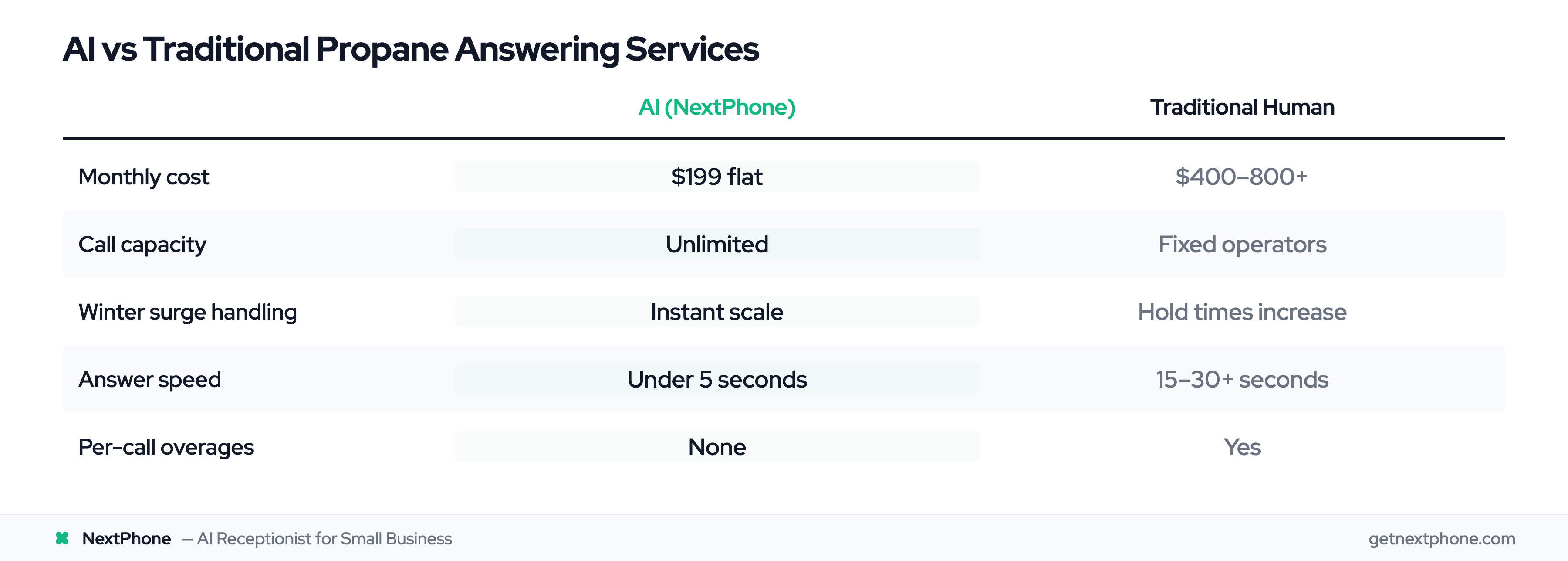
Traditional human answering services have a fixed number of operators. When call volume spikes, callers experience longer hold times, rushed interactions, or overflow to voicemail.
Many traditional services also charge per call or per minute. During a winter surge, those charges can balloon unexpectedly. A bill that's normally $400/month might hit $1,200 or more during a cold snap.
Some services cap the number of calls they'll handle, meaning once you hit your limit, calls go unanswered anyway.
AI Advantages: Instant Scalability
This is where AI answering services show their strength. An AI doesn't have capacity limits the way human operators do. Whether 1 call comes in or 100 calls come in simultaneously, every call gets answered in under 5 seconds.
There's no hold time, no degraded service quality, no overflow to voicemail. The twentieth concurrent caller gets the same experience as the first.
For propane companies, this means reliable service exactly when you need it most - during the winter peaks that drive your business. You're not paying for capacity that sits idle in summer or scrambling for coverage when temperatures drop.