
Your service department is bleeding revenue through the phone lines—and you might not even realize it.
Industry research shows dealership service departments miss an average of 158 calls per month. High-volume stores miss up to 216. At an average repair order value of $450, that translates to anywhere from $71,000 to over $97,000 in lost revenue every single month. Annually? Up to $1.17 million walking out the door.
Meanwhile, your service advisors are trapped in a loop. They're checking in walk-ins, authorizing repairs, updating customers—and the phone keeps ringing. Something has to give, and usually it's the caller.
This is where automotive answering services come in. Whether AI-powered or staffed with live agents, these services answer every call your team can't. They book appointments, route emergencies, and capture customers who would otherwise dial your competitor.
Let's break down how the smartest dealerships are capturing every call.
The Service Department Call Crisis: How Many Calls Are You Missing?
The numbers are worse than most dealers realize.
The Shocking Missed Call Statistics
Research from CallSource shows that 60% of service calls go unanswered during peak hours. Industry-wide, the automotive sector has a 23% unanswered call rate—meaning nearly one in four potential customers can't reach your dealership when they call.
But that 23% is an average. During the morning rush, it gets much uglier. When advisors are juggling walk-ins, techs are asking questions, and the drive is packed, those unanswered calls pile up fast.
Here's what the data shows:
- Service departments miss 158-216 calls per month on average
- 31.8% of callers hang up while on hold
- Average hold time at dealerships: 3 minutes and 5 seconds
- For service appointments specifically, hold times can stretch past 9 minutes
Peak Hours: When Calls Slip Through the Cracks
The busiest call window? 8:00 AM to 11:30 AM. That's also when your service drive is slammed with morning check-ins, early bird oil changes, and customers grabbing loaners before work.
Mondays and Tuesdays see the highest call volumes as customers try to lock in service slots early in the week. July and August peak for total volume. These patterns are predictable—which means they're also solvable.
Why Service Advisors Can't Keep Up
It's not that your advisors don't care. They're simply stretched too thin.
According to Digital Dealer, service advisors can spend up to 33% of their workday answering phones. Add outbound calls—authorizations, status updates, repair approvals—and phone time can eat up half the day.
Picture this: It's 9:30 AM on a Monday. Three customers wait in the service drive. Two technicians need authorization for add-on repairs. And the phone has been ringing for 45 seconds. The advisor glances at the phone, then back at the customer in front of them.
That caller? They're already dialing your competitor.
The Real Cost of Every Missed Service Call
Missing calls isn't just an inconvenience. It's a direct hit to your bottom line.
Revenue Per Missed Call
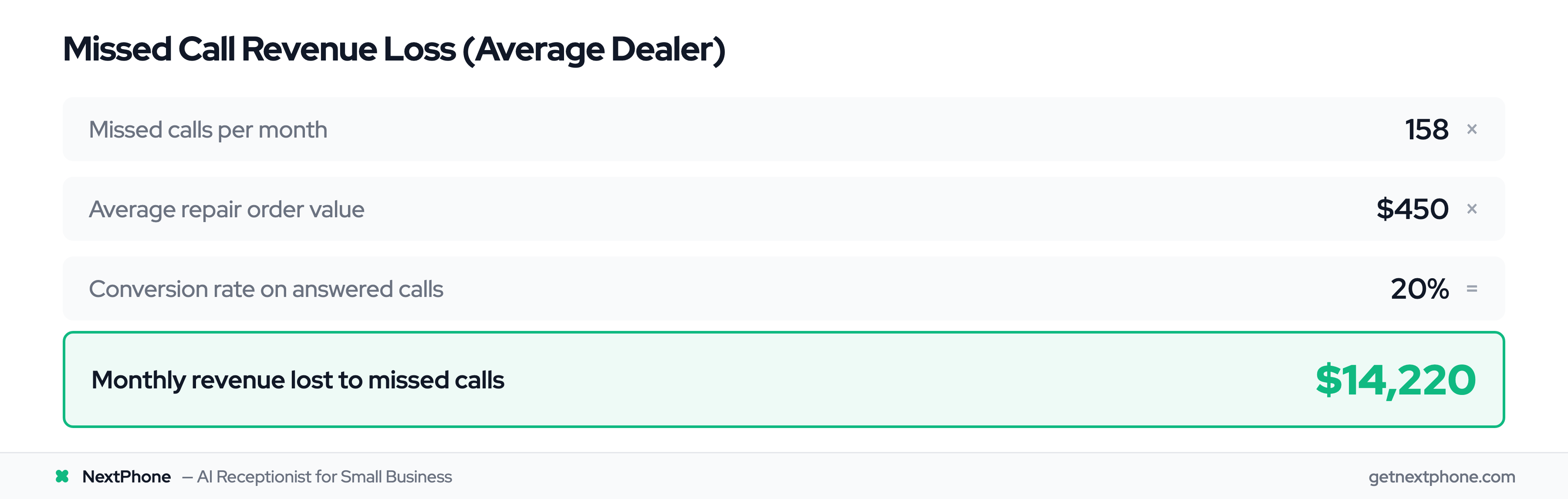
The average repair order (RO) at a dealership service department runs about $450. Some estimates put it higher depending on your mix of maintenance vs. repair work.
Let's do the math:
- 158 missed calls/month × $450 average RO × 20% conversion rate = $14,220 in monthly lost revenue
That's $170,640 per year—from a single service department at average volume. High-volume stores losing 216 calls monthly? They're leaving over $19,000 on the table every month.
The $1.17 Million Annual Problem
Analysis from DealershipGuy puts the annual impact at a staggering figure: dealerships with high missed-call rates could be losing up to $1.17 million in service revenue per year.
And that's just direct revenue. It doesn't count:
- Lost customer lifetime value (a service customer might buy their next car from you)
- Negative word-of-mouth from frustrated callers
- Lower CSI scores affecting manufacturer bonuses
The First-Responder Advantage
Here's the stat that should keep every service manager awake at night: according to the Lead Response Management Study, 78% of customers buy from whichever company responds first.
Not the cheapest. Not the one with the best reviews. The first one to pick up the phone.
And if you don't answer at all? Industry research shows 85% of callers who don't get through the first time will take their business elsewhere. They're not leaving voicemails. They're not calling back. They're Googling the next dealership.
What Is an Automotive Answering Service?
An automotive answering service is exactly what it sounds like: a service that answers calls on behalf of your dealership when your team can't.
How It Works
When a customer calls your service department and nobody picks up, the call routes to the answering service. The service answers with your dealership's greeting, handles the call, and takes the appropriate action—whether that's booking an appointment, taking a message, or routing an urgent call to an advisor.
There are three main types:
- Traditional live answering services: Real humans answer calls, often from a call center. They follow scripts you provide.
- AI-powered answering services: Artificial intelligence handles the conversation using natural language processing. Modern AI can book appointments, answer FAQs, and sound remarkably human.
- AI + smart forwarding: AI handles the bulk of routine calls, with smart forwarding to you for complex situations.
What Happens on a Typical Call
Here's a typical flow with an AI answering service:
- Customer calls about an oil change
- AI answers: "Thanks for calling [Dealership] Service Department, how can I help you today?"
- Customer explains they need to schedule service
- AI asks what service is needed, captures vehicle info
- AI checks availability and offers appointment times
- Customer selects a time
- AI confirms the booking and sends a text with the details
The whole interaction takes less than two minutes. No hold time. No phone tag. No lost customer.
AI vs. Traditional Answering Services: Which Fits Your Dealership?
Not all answering services work the same way. Here's how the options compare.
Traditional Live Answering Services
Live answering services employ real people—typically in call centers—who answer your phone using scripts you provide. They can take messages, book appointments, and answer basic questions.
Pros:
- Human touch for every call
- Can handle complex or emotional conversations
- Established industry with proven track record
Cons:
- Higher cost ($500-800/month for ~100 calls)
- Limited capacity—busy periods mean hold times
- Quality varies by agent
- Limited hours (most aren't truly 24/7)
AI-Powered Answering Services
AI answering services use conversational AI to handle calls. Modern AI has advanced dramatically—callers often don't realize they're talking to a machine.
Pros:
- Answers in under 5 seconds (no hold time)
- Unlimited concurrent calls (handles volume spikes)
- 24/7/365 availability—no sick days, breaks, or holidays
- Consistent quality on every call
- Lower cost ($199/month for unlimited calls with some services)
Cons:
- May struggle with unusual requests
- Some callers prefer human interaction
- Requires initial setup and training
AI-First with Smart Forwarding
The smartest approach is AI-first with smart forwarding. AI handles the 80% of calls that are routine—scheduling, hours, directions—while smart forwarding routes complex issues, complaints, or VIP customers to you.
This gives you:
- Speed and availability of AI
- Direct access to you when it matters
- Cost efficiency without compromising service
Head-to-Head Comparison
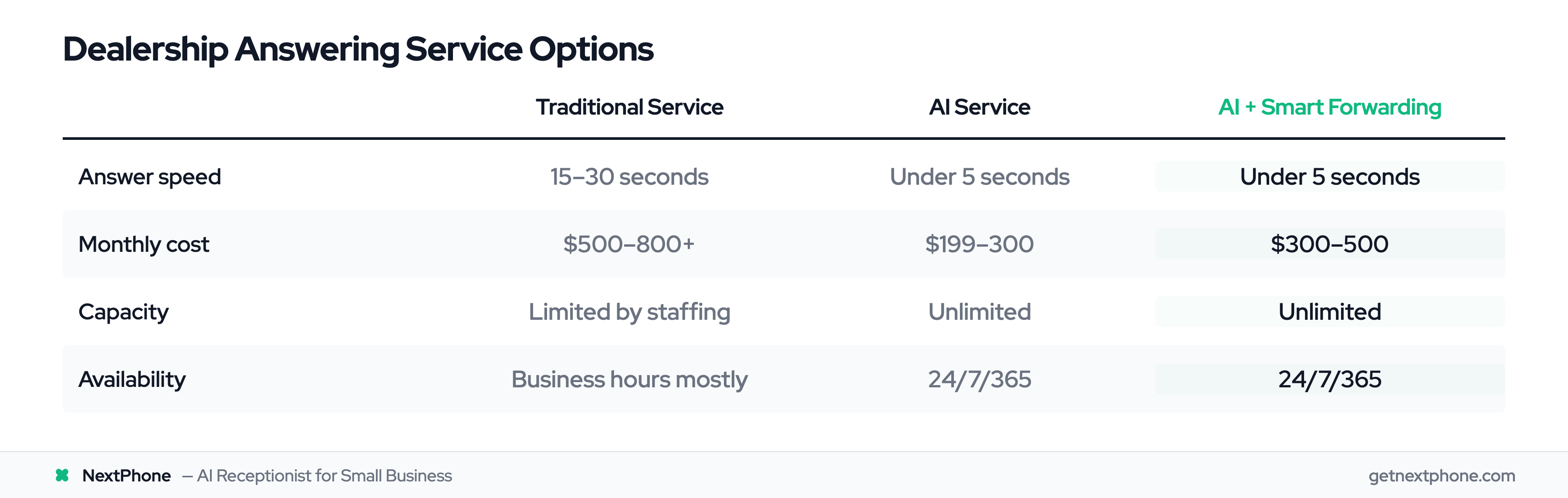
| Factor | Traditional Service | AI Service | AI + Smart Forwarding |
|---|---|---|---|
| Answer speed | 15-30 seconds | Under 5 seconds | Under 5 seconds |
| Monthly cost | $500-800+ | $199-300 | $300-500 |
| Capacity | Limited by staffing | Unlimited | Unlimited |
| Availability | Business hours (mostly) | 24/7/365 | 24/7/365 |
| Call limits | Often per-call pricing | Typically unlimited | Varies |
| Complex calls | Good | Adequate (can transfer) | Excellent |