You searched for a cheap business phone line because you're tired of feeling like professional phone systems are only for companies with real budgets. The quotes you've gotten - $200/month, $300/month, per-user fees that multiply with every hire - don't match your revenue reality.
Most phone service guides compare expensive options to slightly less expensive options. They're written for businesses with 20 employees and IT departments, not contractors working solo or small business teams hustling to grow.
This guide is different. We'll break down every cheap and affordable option from free to $200/month and help you pick the right one for your business stage - whether you need a business phone number or a full answering solution. Plus, we'll address the problem nobody talks about: what happens to the calls you can't answer.
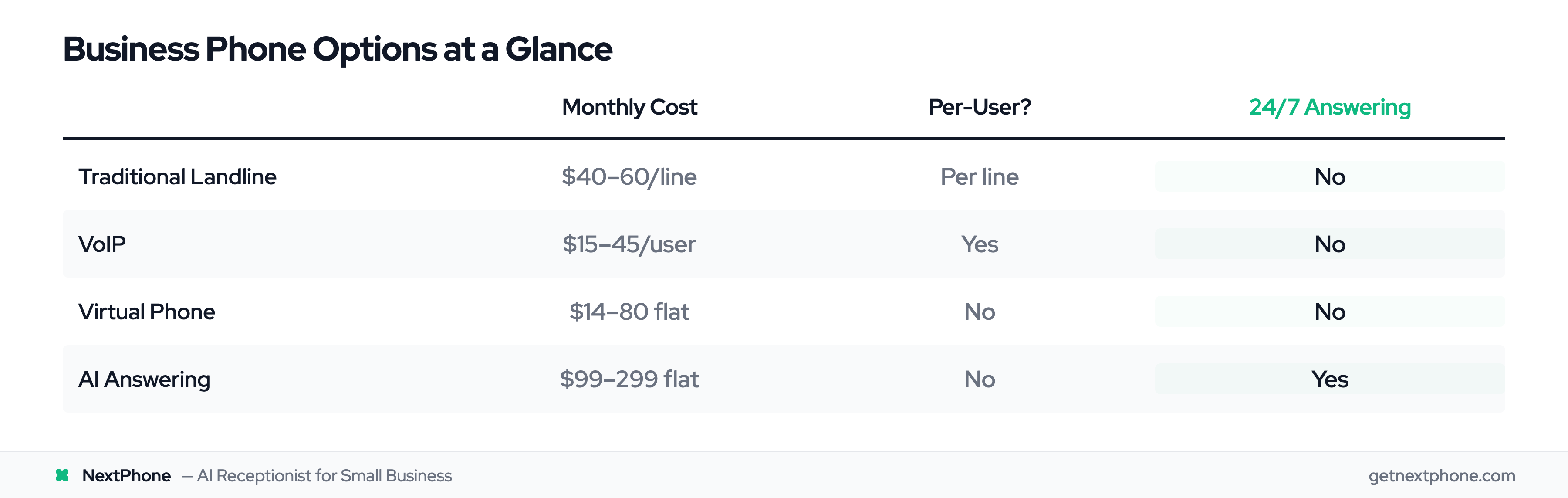
Cheap Business Phone Line Options at a Glance
Before diving into details, here's the landscape of what's available and what you'll pay for an affordable phone service.
The Four Categories of Business Phone Service
Small businesses have four main options for phone service, each with different strengths:
Traditional landlines ($40-60/line/month): The old-school option. Reliable but expensive, limited features, requires physical hardware. Still exists but increasingly obsolete for small businesses.
VoIP phone service ($15-45/user/month): The modern standard. Uses internet for calls, packed with features, works on any device. Per-user pricing means costs scale with your team. Check our VoIP guide for small business for a deeper breakdown. The global VoIP market is projected to grow from $132B to $326B, reflecting widespread adoption.
Virtual phone systems ($14-80/month flat): Lightweight solution for solopreneurs. Gives you a professional business number that forwards to your cell. No hardware needed.
AI phone answering ($99-299/month flat): The new category. This type of answering service doesn't just route calls - it actually answers them 24/7 when you can't. Takes messages, books appointments, routes emergencies. See our full AI receptionist pricing breakdown.
Quick Price Comparison by Type
For a solo operator, all options look affordable. The real differences show up as you scale or consider what happens when you can't answer:
| Service Type | Monthly Cost | Per-User? | 24/7 Answering |
|---|---|---|---|
| Traditional Landline | $40-60/line | Per line | No |
| VoIP | $15-45/user | Yes | No |
| Virtual Phone | $14-80 | Flat rate | No |
| AI Answering | $99-299 | Flat rate | Yes |
The cheapest option isn't always the best value. A cheap $15/month VoIP service that rings while you're on a job site doesn't help if nobody answers.
Traditional Business Phone Lines - The Baseline
Traditional business phone service from carriers like AT&T, Verizon, and CenturyLink still exists. Here's what you need to know.
What Traditional Service Costs
A basic business phone line runs $40-60/month per line from major carriers. That's just the line itself - add-on features cost extra:
- Call forwarding: +$5-10/month
- Voicemail: +$5-15/month
- Call waiting: +$5-10/month
- Three-way calling: +$5-10/month
Total for a "featured" line: $60-100/month.
Installation typically costs $100-200, and most carriers require 12-24 month contracts. You'll also need compatible desk phones ($50-200 each).
When Traditional Still Makes Sense
Traditional landlines have one advantage: they work during internet outages. If your business has a physical location with a reception desk and existing phone infrastructure, traditional service can work.
But for most small businesses in 2025? You're paying for 1980s technology. No mobile access, no video conferencing, no modern integrations. Unless you're running a storefront with a dedicated receptionist, traditional phone service is usually the worst value.
VoIP Phone Service - The Modern Standard
Voice over Internet Protocol (VoIP) is what most businesses mean when they say "business phone service" today. It uses your internet connection instead of phone lines. The UCaaS market is projected to grow from $56B to $176B by 2030, showing how quickly businesses are adopting these solutions.
How VoIP Pricing Works (Per-User Model)
VoIP providers charge per user per month. Each user gets a phone number (or extension), access to the mobile app, and all included features.
The per-user model is affordable for small teams but scales up quickly:
| Team Size | At $20/user | At $30/user | At $45/user |
|---|---|---|---|
| 1 person | $20/month | $30/month | $45/month |
| 3 people | $60/month | $90/month | $135/month |
| 5 people | $100/month | $150/month | $225/month |
| 10 people | $200/month | $300/month | $450/month |
Popular VoIP Providers and Their Costs
Here's what the major VoIP providers charge as of 2025:
RingCentral: $20-45/user/month (see RingCentral alternative options)
- Core: $20/user (100 toll-free minutes)
- Advanced: $25/user (1,000 minutes, advanced analytics)
- Ultra: $35-45/user (unlimited, AI features)
Nextiva: $18.95-32.95/user/month (see Nextiva alternative options)
- Essential: $18.95/user (voice, voicemail, fax)
- Professional: $22.95/user (video, SMS, integrations)
- Enterprise: $32.95/user (call recording, advanced analytics)
- Nextiva serves 100,000+ businesses with 99.999% uptime, claiming cloud VoIP saves companies up to 60% on communications
Ooma Office: $19.95-29.95/user/month
- Essentials: $19.95/user (50+ features)
- Pro: $24.95/user (call recording, enhanced features)
- Pro Plus: $29.95/user (CRM integration, advanced routing)
- Ooma claims customers save an average of 50% vs traditional phone, with 40-60% savings compared to current providers
Google Voice: $10-30/user/month (see Google Voice alternatives)
- Starter: $10/user (10 users max, basic features)
- Standard: $20/user (unlimited users, auto-attendant)
- Premier: $30/user (advanced reporting)
8x8: $15-44/user/month
- Express: $15/user (voice only)
- X2: $24/user (voice + video)
- X4: $44/user (contact center features)
Industry research shows VoIP saves businesses 30-50% compared to traditional phone service, and 31% of businesses use VoIP, with 45% of SMEs having adopted it.
The Real Cost: When Per-User Adds Up
For a 5-person plumbing company choosing mid-tier VoIP:
5 users x $25/month = $125/month = $1,500/year
That's affordable. But add a few more team members, and costs climb fast. A 10-person team at the same rate hits $250/month or $3,000/year.
What VoIP Doesn't Solve
Here's what VoIP marketing won't tell you: VoIP gives you a better phone system with more features. But you still need to answer the phone.
If you're a contractor on a roof, a consultant in a meeting, or a solo operator who can't pick up during work hours, VoIP doesn't help. The phone rings. Nobody answers. The caller moves on to your competitor.
VoIP solves the "I need a modern phone system" problem. It doesn't solve the "I miss calls while working" problem.
Virtual Phone Systems - Budget-Friendly Basics
Virtual phone systems are a lighter-weight option for solopreneurs and micro-businesses who need professional presence without full VoIP features.
What Virtual Phone Systems Offer
Virtual phone systems give you:
- A dedicated business phone number
- Call forwarding to your cell phone
- Professional voicemail and greetings
- Basic auto-attendant ("Press 1 for sales...")
- Voicemail-to-text transcription
- Mobile app for managing calls
What you don't get: multiple desk phones, advanced call routing, video conferencing, full PBX features.
Virtual systems are essentially "professional wrapper" for your existing cell phone. Customers call your business number, and it forwards to your cell - they don't know the difference.
Pricing: Flat Rate vs Per-User
Most virtual systems charge flat monthly rates rather than per-user:
Grasshopper (see Grasshopper alternative with AI):
- Solo: $14/month (1 number, 1 extension)
- Partner: $26/month (3 numbers, 3 extensions)
- Small Business: $80/month (5 numbers, unlimited extensions)
OpenPhone:
- Starter: $15/user/month (1 number per user)
- Business: $25/user/month (advanced features)
Google Voice (Free Tier):
- $0 for personal use with basic features
- Business tier: $10-30/user (see VoIP section)
- Note: Google Voice business actually costs $17/month minimum when you include required Workspace subscription ($10 Voice + $7 Workspace)
Who Virtual Systems Work Best For
Virtual phone systems are ideal for:
- Solopreneurs who want to separate business and personal calls
- Freelancers who need professional image without infrastructure
- Home-based businesses wanting a dedicated business number
- Contractors in early stages before they need full answering coverage
The value proposition is simple: for $14-26/month, you get a real virtual business phone number that doesn't expose your personal cell to customers and spam.
AI Phone Answering - The Game-Changer Nobody's Talking About
There's a category of phone service that most comparison guides ignore: AI phone answering. It solves a fundamentally different problem than VoIP or virtual phone systems.
What AI Phone Answering Actually Does
AI phone answering services don't just route calls - they answer them. When you can't pick up, an AI receptionist:
- Picks up in under 5 seconds, every time
- Greets callers professionally using your business name
- Understands what callers need through natural conversation
- Takes detailed messages and sends instant notifications
- Books appointments directly on your calendar
- Routes emergency calls to your phone immediately
- Filters spam so you never deal with robocalls
It's the difference between "here's a better phone" (VoIP) and "here's someone who answers your phone" (AI answering).
How AI Answering Differs from VoIP
With VoIP, you have a great phone system. When a call comes in, your phone rings on your desk, laptop, and mobile app simultaneously. But if you're:
- On a job site with a customer
- In a meeting
- Driving between appointments
- Sleeping at 2 AM when an emergency happens
- On another call
...the phone just rings. Maybe it goes to voicemail. Maybe the caller hangs up and calls your competitor instead.
With AI answering, every call gets answered by a professional-sounding AI that handles routine inquiries, captures leads, and escalates emergencies. You get off the job site and your messages are waiting - organized, transcribed, with urgent calls already handled.
AI Answering Service Pricing
AI phone answering typically costs $99-299/month with flat-rate, unlimited call pricing:
- Budget tier ($99-149/month): Basic AI answering, message taking, notifications
- Mid-range ($149-199/month): Full features including appointment booking, integrations
- Premium ($200-299/month): Advanced customization, smart forwarding, priority support
NextPhone charges $199/month flat for unlimited calls. No per-user fees, no per-minute charges, no overages. Whether you get 20 calls or 200, the price stays the same. See our guide to affordable AI answering services for a full breakdown of what's on the market at every price point.
Who Benefits Most from AI Answering
AI answering is particularly valuable for:
- Contractors and tradespeople who can't answer while on job sites
- Solo professionals who handle everything themselves
- Small teams without a receptionist who need AI receptionist coverage for small business
- Any business with after-hours calls that can't afford missed opportunities
If the phone rings while you're working and you can't answer it, AI answering solves that problem in a way VoIP never can.
See NextPhone's AI answering in action
Budget Guide - What Startups vs Established Businesses Should Choose
The right phone service depends on your business stage. Here's guidance based on where you are.
Startup/Solopreneur ($0-50/month budget)
Your situation: Just starting out, watching every dollar, working solo or with one partner.
Priority: Professional image without big investment.
Recommendations:
- Google Voice Free: $0/month for basic call forwarding and voicemail
- Grasshopper Solo: $14/month for dedicated business number
- Grasshopper Partner: $26/month if you have a business partner
The reality: At this stage, you can probably answer most calls yourself. A virtual phone system is enough to look professional without paying for features you don't need.
Growing Business (2-5 people, $50-150/month budget)
Your situation: Growing team, need coordination, starting to miss calls.
Priority: Team features, multiple lines, call management.
Recommendations:
- Google Voice Standard: $20/user x 3-5 = $60-100/month
- RingCentral Core: $20/user x 3-5 = $60-100/month
- Nextiva Essential: $19/user x 3-5 = $57-95/month
The reality: VoIP makes sense here. You need multiple lines, team messaging, and call routing. Per-user pricing is manageable at this size.
Established SMB (5+ people, $150-400/month budget)
Your situation: Established operations, consistent call volume, need reliability.
Priority: Full features, after-hours coverage, professional image.
Recommendations:
- VoIP for internal: RingCentral or Nextiva for team communication
- AI answering for external: NextPhone to answer customer calls 24/7
The reality: Many established businesses use hybrid approaches - VoIP for internal team communication, AI answering to handle incoming customer calls professionally.
The Special Case: Contractors and Field Service
Your situation: You work on job sites and literally cannot answer the phone during work hours.
Priority: Calls answered while you work.
Recommendation: AI answering (NextPhone at $199/month) regardless of business size. An after-hours phone system with AI answering means no call slips through, even at 10 PM.
The reality: VoIP doesn't solve your problem. You need something that answers the phone when you can't. One missed emergency call costs more than the monthly service fee.