You're showing a $500,000 listing to a serious buyer. Your phone vibrates in your pocket. Another potential client calling about the home they saw on Zillow last night. You can't answer - you're mid-tour, pointing out the upgraded kitchen and explaining the neighborhood.
The caller gets your voicemail. They listen for three seconds, hang up, and call the next agent on the listing.
You just lost a potential $15,000 commission and didn't even know it happened.
According to the National Association of Realtors, 78% of home buyers work with the first agent who responds to their inquiry. Not the best-reviewed agent. Not the agent with the most experience. The first one to pick up the phone.
The average real estate agent takes over 15 hours to respond to new leads, according to Inman's 2025 survey. That's not a typo. A dedicated answering service for real estate eliminates this delay entirely. Fifteen hours. Meanwhile, research shows your odds of connecting with a lead drop by 10x after just 30 minutes.
Your voicemail greeting is the first thing a potential client hears when you can't answer. This guide gives you six professional scripts that work, plus the data that explains why your voicemail script alone won't save you from losing leads.
What Makes a Great Realtor Voicemail Greeting
Before we get to specific scripts, let's cover what separates a professional voicemail from one that makes callers hang up.
Keep It Under 30 Seconds
Research on conversational speech shows people speak at 120-150 words per minute. That means your 30-second greeting should contain 60-75 words maximum. Go longer, and callers check out. Most won't even listen past the first 20 seconds before deciding whether to leave a message or move on.
Include the Essential Elements
Every realtor voicemail needs four components:
- Your name and brokerage (so they know they reached the right person)
- Brief acknowledgment that you're unavailable (showing or helping another client)
- Clear callback timeframe (and make sure you can keep that promise)
- What information they should leave (name, number, what they're looking for)
Always Offer a Text Option
Here's something most agents miss: 89% of consumers prefer text over phone calls for business communication. Many of your callers want to text you but called because that's the number they found. Explicitly giving them permission to text dramatically increases your capture rate.
Add something like: "For a faster response, feel free to text me at this number."
Sound Confident, Not Rushed
Smile while you record. Listeners can actually hear the difference in your voice. Record in a quiet room - a closet full of clothes works surprisingly well for sound dampening. Never record your voicemail while driving. Poor audio quality signals an unprofessional business, even if your script is perfect.
6 Professional Voicemail Scripts for Real Estate Agents
Here are six proven scripts you can adapt for your business. Each serves a different purpose - pick the one that matches your market and style.
Script 1: The Classic Professional Greeting
Best for: General use, balanced buyer/seller business
"Hi, you've reached [Your Name] with [Agency]. I'm either showing a property or helping another client right now. Leave your name, number, and a brief message about how I can help, and I'll call you back within [2 hours/end of day]. For a faster response, feel free to text me at this number. Thanks for calling!"
Why it works: Professional, sets expectations, offers the text alternative. Works for any situation.
Script 2: The Buyer-Focused Greeting
Best for: Agents who primarily work with buyers
"Thanks for calling [Your Name], your [City/Area] real estate expert. I'm probably out showing homes right now - which means I might be finding your perfect place! Leave your name and tell me what you're looking for - number of bedrooms, neighborhood, budget - and I'll call you back today. You can also text me for a quicker reply."
Why it works: Frames your absence positively (you're busy helping buyers like them), asks for specific qualifying information upfront.
Script 3: The Seller-Focused Greeting
Best for: Listing agents, agents targeting sellers
"Hi, this is [Your Name] with [Agency]. If you're thinking about selling your home, you've called the right agent. Leave me a message with your property address and the best time to reach you, and I'll call you back to discuss your home's value and what's happening in your market."
Why it works: Immediately qualifies the caller as a potential seller, asks for the key information you need (property address) to prepare for the callback.
Script 4: The After-Hours Greeting
Best for: Nights and weekends when you're off the clock
"Thanks for calling [Your Name]. I'm away from the office right now, but your call is important. Leave your name, number, and details about what you're looking for, and I'll return your call first thing tomorrow morning. For urgent matters, text me and I'll respond as soon as I can."
Why it works: Sets realistic expectations for after-hours calls while still offering a faster channel for urgent inquiries.
Script 5: The Urgency-Acknowledging Greeting
Best for: Hot markets where speed matters
"Hi, you've reached [Your Name]. I know the [City] market moves fast and finding the right home is time-sensitive. I'm with another client right now but will return your call within the hour. Leave your details, or text me for the fastest response - I can often reply to texts even when I can't take calls."
Why it works: Acknowledges the caller's urgency, promises a specific (fast) callback window, emphasizes the text option.
Script 6: The Tech-Forward Greeting
Best for: Younger demographics, tech-savvy markets
"Hey, it's [Your Name] with [Agency]. I'm away from my phone but want to help you fast. Honestly, your best bet is to text me at this number with what you're looking for - I can usually respond to texts even during showings. Otherwise, leave a voicemail and I'll call you back within a couple hours."
Why it works: Casual but professional, leads with the text option that younger buyers prefer, acknowledges modern communication preferences.
Speed to Lead: Why Response Time Decides Who Gets the Client

You have your voicemail script dialed in. Great. Now here's the data that should keep you up at night.
The 5-Minute Window
According to research from MIT and InsideSales.com, responding to a lead within 5 minutes makes you 21 times more likely to qualify them compared to waiting 30 minutes. Read that again: 21 times more likely.
The same study found you're 100 times more likely to actually connect with a lead at 5 minutes versus 30 minutes. The difference isn't marginal. It's the difference between winning and losing.
What Happens After 30 Minutes
Contact rates drop by 10x between the 5-minute mark and 30 minutes. After an hour, your odds drop another 7x. By the time most agents respond - remember, the average is 15+ hours - those leads are essentially dead.
A study by Roof AI tested the top 74 real estate brokerages in the United States. Only 9% responded within 5 minutes. Half took more than 3 days. The bar for standing out isn't high - you just have to actually answer.
Why the First Responder Wins
This brings us back to that 78% statistic. NAR data shows that 78% of buyers work with the first agent who responds. Another finding: 71% of buyers only interviewed one agent. They called, someone answered (or called back fast), and that was it.
If you're not the first to respond, there's a 78% chance you're not getting that client. Period.
The Hard Truth: Why Your Voicemail Script Alone Won't Save You
Here's where we need to talk about what voicemail can't do for you.
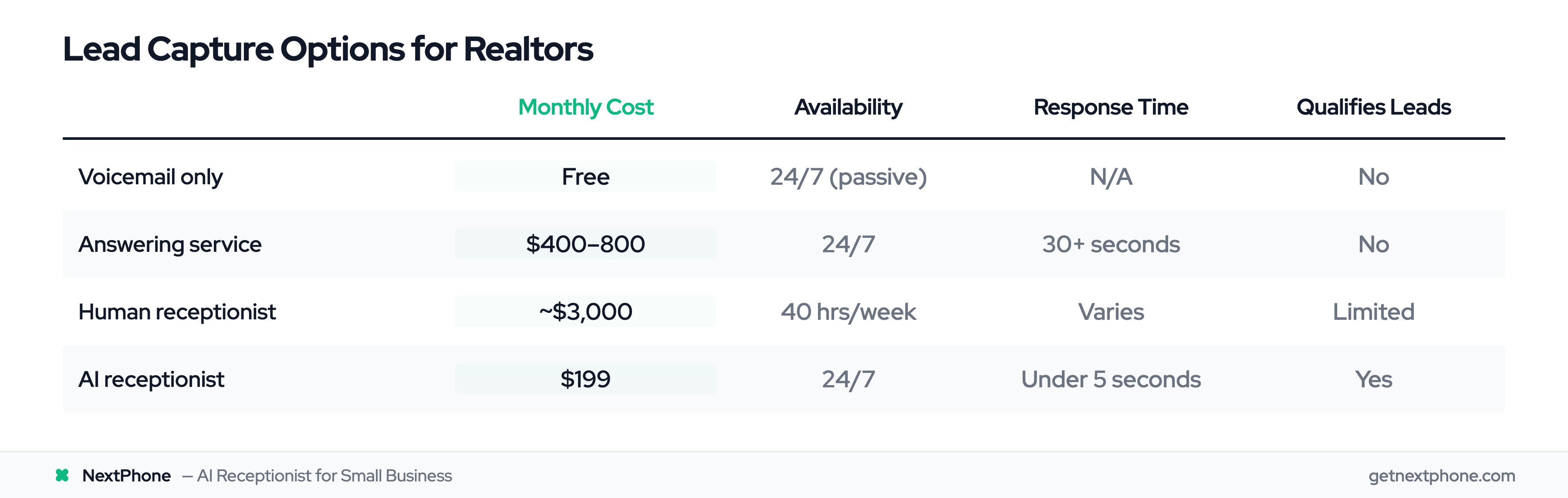
85% of Callers Won't Leave a Message
According to BIA/Kelsey research, 85% of callers who reach voicemail will never call back. They won't leave a message. They won't try again later. They'll call the next agent on their list.
Separate research shows 75% of callers hang up without leaving any message at all. Your carefully crafted voicemail script? Three-quarters of your callers will never hear more than the first few seconds before they're gone.
The After-Hours Challenge
Industry data shows 62% of real estate inquiries come outside traditional business hours. Evenings. Weekends. Holidays. That's when serious buyers are actively searching - scrolling through Zillow after dinner, touring neighborhoods on Saturday afternoons.
These aren't casual browsers. After-hours callers are often your highest-intent leads. They're ready to act. And if they reach your voicemail at 8 PM on a Sunday, they're not waiting until Monday morning for you to call back. They're calling the next agent.
What Happens When You Miss the Call
Let's trace a typical scenario:
Sunday, 7 PM. A pre-approved buyer sees your listing on Realtor.com. They love it. They want to see it before the open house next weekend. They call your number.
Voicemail.
They wait three seconds, hoping you might pick up. You don't. They consider leaving a message but decide they want to talk to someone now. They tap the back button and call the listing agent whose number is right below yours.
That agent answers. They schedule a showing for Tuesday. By Wednesday, the buyer is writing an offer.
You call back Monday morning, 15 hours later. The buyer is polite but already working with another agent.