The Hidden Cost of Poor Call Routing for Franchises
Here's what happens dozens of times per week at franchises without territory-based call routing:
A customer in Denver needs emergency HVAC service. They Google your franchise brand and call the number. Your system routes them to the Phoenix location because that's where corporate headquarters is located. The Phoenix receptionist says "We don't service Denver." The customer hangs up and calls a competitor. A $4,200 emergency job just walked out the door.
Now multiply this scenario across your franchise network.
Industry research shows 74.1% of calls to home services contractors go completely unanswered; research confirms 62% of calls to home services businesses go unanswered. For franchises, this problem multiplies fast. If each of your 5 franchise locations receives an average of 42 calls per month, that's 210 total calls. Without proper routing, 155 of those calls go unanswered or get routed to the wrong location.
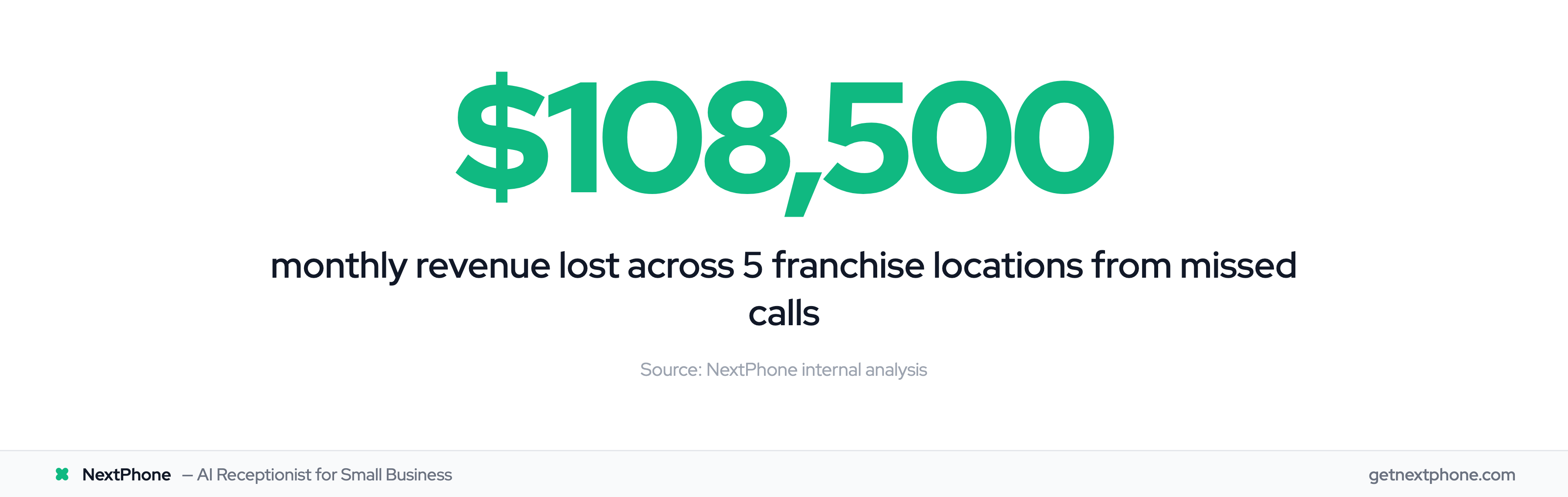
At a 20% conversion rate and $3,500 average job value, those 155 missed calls represent $108,500 in lost monthly revenue across your franchise network.
The core issue: Customers shouldn't need to figure out which franchise location serves their area. Your phone system should handle that automatically.
This guide shows you how to set up territory-based call routing that aligns with your franchise boundaries, maintains brand consistency, and stops revenue from slipping through the cracks. 42% of SMBs lose $500+ per month to missed calls. For multi-location franchises, this multiplies across every territory.
85% of customer service leaders plan to pilot conversational GenAI in 2025. The technology is ready. The question is whether your routing infrastructure can support it.
What is Multi-Location Call Routing? (And Why Franchises Need It)
Multi-Location Call Routing Defined
Multi-location call routing is an intelligent phone system that automatically directs incoming calls to the correct franchise location based on the caller's geography, time of day, or manual input. A voice AI receptionist handles this routing automatically through natural conversation.
Instead of managing separate phone numbers for each franchise location, you use one branded number for your entire network. When customers call, the system figures out which franchisee should handle the call and routes it there automatically.
Why Franchises Can't Use Single-Location Systems
The franchise industry is growing rapidly, with 851,000 franchise units expected by 2025 and franchise output exceeding $936.4 billion. As franchise networks expand, single-location phone systems create chaos.
Customers call the first number they find online. Without geographic routing, you end up with:
- The wrong location answering calls outside their territory
- Frustrated customers getting transferred multiple times
- Inter-franchisee conflicts over who "owns" the customer
- Lost revenue when customers give up and call competitors
According to research on multi-location customer experience challenges, creating a consistent online experience is easy, but monitoring the phone experience is challenging due to distributed locations and management.
The Territory Alignment Challenge
Your franchise agreements define territories by ZIP codes, counties, or geographic boundaries. Your call routing must respect these same boundaries.
When a Denver franchisee's territory includes ZIP codes 80201-80299, all calls from those ZIPs should route to Denver, not to Colorado Springs, not to Phoenix, not to corporate headquarters.
Territory-aligned call routing prevents the "that's not my customer" scenario between franchisees while ensuring every caller reaches the franchisee who's authorized and equipped to serve their area.
Think of it as turning your franchise territory map into an intelligent phone routing system.
Geographic Routing Methods: ZIP Code, Area Code, and Caller ID
Your multi-location routing system needs a way to determine the caller's location. Here are the four main methods, ranked by accuracy:
ZIP Code Routing (Most Accurate)
ZIP code routing prompts callers to enter their 5-digit ZIP code, then routes the call to the franchise serving that territory.
How it works: Caller dials your franchise number. System prompts: "To connect you with your local [Franchise Brand] location, please enter your 5-digit ZIP code." Caller enters 80203. System routes to Denver franchise (assigned ZIP codes 80201-80299).
According to FluentStream's research on ZIP code routing, this approach allows one unified number for your business rather than different numbers for each branch.
Accuracy: Highest. ZIP codes precisely match franchise territories. Customer friction: Moderate. Adds 5-10 seconds to call. Best for: Franchises with clearly defined ZIP-based territories.
Area Code Routing (Automatic)
Area code routing uses the caller's phone number area code to automatically determine location without prompting.
How it works: Caller dials from a 303 number (Denver area code). System silently detects area code and routes to Denver franchise without any customer action needed.
Accuracy: Moderate. Area codes cover large regions and cross territory boundaries. Customer friction: None. Routing is invisible to caller. Best for: Franchises in markets where area codes align well with territories.
Caller ID Routing (Silent)
Caller ID routing is similar to area code routing but can use more sophisticated geolocation based on the full phone number.
How it works: System analyzes the caller's full phone number and uses telecom databases to determine approximate location, then routes to nearest franchise.
Accuracy: Moderate to high, depending on database quality. Customer friction: None. Best for: Supplementing other routing methods.
IVR Menu Selection (Manual Backup)
IVR menu selection gives callers a list of locations to choose from manually.
How it works: "Which location would you like to reach? Press 1 for Denver, Press 2 for Colorado Springs, Press 3 for Phoenix."
Accuracy: Depends on customer knowing correct location. Customer friction: High. Customer must listen to full menu and decide. Best for: Backup option when automatic routing can't determine location, or for customers who want to bypass automatic routing.
Most franchise systems use a hybrid approach: Area code routing as the default with ZIP code verification for boundary cases, and an IVR menu as the final fallback.
Aligning Call Routing with Franchise Territory Boundaries
Getting geographic routing working is one thing. Aligning it perfectly with your franchise territory agreements is another.
Understanding Franchise Territory Boundaries
Your franchise agreement spells out each franchisee's exclusive or protected territory. These are typically defined by:
- ZIP codes: "Franchisee A receives ZIP codes 80201-80299"
- Counties: "Franchisee B receives Boulder and Larimer counties"
- Geographic boundaries: "Franchisee C receives all areas within 15 miles of downtown location"
According to franchise territory planning best practices, territory sizes vary significantly based on population density. Urban markets support 1-2 mile radius territories, suburban areas need 3-5 miles, and rural markets often require 10+ mile territories.
Your call routing must mirror these territory definitions exactly.
Mapping ZIP Codes to Territories
The most precise method is creating a master ZIP code assignment list:
Denver Franchise Territory:
- ZIP codes: 80201-80212, 80214-80239, 80246-80249, 80260-80266
- Routes to: 303-555-0100 (Denver franchisee's number)
Colorado Springs Franchise Territory:
- ZIP codes: 80901-80951
- Routes to: 719-555-0200 (Colorado Springs franchisee's number)
Boulder Franchise Territory:
- ZIP codes: 80301-80310
- Routes to: 303-555-0300 (Boulder franchisee's number)
Load this list into your phone system's routing configuration. When a caller enters their ZIP code, the system looks up which franchisee owns that territory and routes accordingly.
Handling Territory Boundary Edge Cases
What happens when a caller lives on the boundary between two franchise territories?
Option 1: Nearest location by distance Route to whichever franchisee is physically closer to the caller's ZIP code centroid.
Option 2: Assignment priority If ZIP 80301 is on the boundary between Denver and Boulder territories, assign it to one franchisee in your master list. First come, first served, or assign to the franchisee who opened first.
Option 3: Overflow to both Route to the primary franchisee (Denver), but if they don't answer within 4 rings, overflow to the secondary franchisee (Boulder).
The key is documenting these rules clearly in your franchise agreements and routing configuration to prevent conflicts.
Territory Conflict Resolution Rules
Even with clear routing rules, conflicts can occur:
- Franchisee A claims caller was in their territory
- Caller's address is in Territory A but they entered wrong ZIP code during IVR
- Mobile caller with area code from another state temporarily in your area
Best practices:
- Primary rule: ZIP code entered by caller takes precedence over phone number area code
- Mobile exception: If caller's area code doesn't match any franchise territory, default to ZIP code routing
- Wrong routing: If caller reaches wrong franchise, that franchisee should warm-transfer (not cold-transfer) to correct location with context
- Revenue allocation: Document in franchise agreement how jobs are credited when routing errors occur
Clear territory routing rules create fewer conflicts and happier franchisees.
Location-Specific Greetings: Brand Consistency + Local Flexibility
Your franchise phone system needs to sound like one brand while acknowledging local differences.
Corporate Brand Requirements
Corporate sets the foundational brand elements that must appear in every location's greeting:
- Official company name and tagline
- Brand promise or quality statement
- Professional tone and language standards
- Required disclaimers or compliance language
These elements are locked at the corporate level. Franchisees cannot edit them.
Franchisee Local Customization
Each franchise location needs to communicate location-specific information:
- Location name (e.g., "Denver location," "North Phoenix location")
- Service area (e.g., "serving Metro Denver and surrounding areas")
- Business hours (e.g., "Monday-Friday 7am-7pm, Saturday 8am-5pm")
- Local phone number for direct callbacks
- Franchisee owner name (optional)
These elements are customizable at the franchisee level within corporate-approved structure.
Greeting Script Templates
Here's how the template approach works in practice:
Corporate-Controlled (Locked) Sections:
"Thank you for calling [Franchise Brand Name], your trusted [service type] experts."
Franchisee-Customizable Sections:
"You've reached our [Denver] location serving [Metro Denver and surrounding areas]. We're open [Monday-Friday 7am-7pm, Saturday 8am-5pm]."
Corporate-Controlled (Locked) Sections:
"How can we help you today?"
In your centralized phone system dashboard, corporate literally locks the first and third sections. Franchisees can only edit the middle section, and only the bracketed portions.
This maintains brand consistency (every caller hears the same brand intro and closing) while providing local relevance (every caller knows which location they've reached and when that location is available).
According to research on franchise answering services, franchises that implement professional answering services see a 27% improvement in customer satisfaction scores. Much of this improvement comes from reducing the "wait, did I call the right location?" confusion that inconsistent greetings create.
Centralized Approval Process
Your phone system should include a corporate approval workflow:
- Franchisee edits their location's customizable greeting sections
- System saves as "pending approval"
- Corporate admin receives notification to review
- Corporate approves (greeting goes live) or rejects (with feedback to franchisee)
- Franchisee revises and resubmits
This prevents a rogue franchisee from changing their greeting to "What do ya want?" while still allowing genuine local customization.
Centralized Management Dashboard: Corporate Oversight + Franchisee Autonomy
The eternal franchise tension: corporate needs control, franchisees need flexibility.
Your multi-location phone system needs to balance both.
What Corporate Controls (Brand Standards)
Corporate administrators have full system access and control:
- Brand greetings: Corporate-approved greeting templates and locked sections
- IVR menus: Standardized menu options (Press 1 for service, Press 2 for billing)
- Routing templates: Master ZIP code assignments and territory boundaries
- System-wide settings: Hold music, call recording policies, compliance features
- User permissions: Who can access which settings at each location
- Reporting access: View call analytics across all franchise locations
Corporate can see everything and edit anything. This ensures brand consistency and catches problems early.
What Franchisees Control (Local Operations)
Franchisee managers have limited access to their location only:
- Local business hours: When their location is open/closed
- After-hours routing: Where calls should route when location is closed (voicemail, answering service, owner's cell)
- Forwarding numbers: Which phone numbers should ring when location receives a call
- Staff extensions: Add/remove employees and assign extension numbers
- Location-specific greeting customizations: Edit unlocked greeting sections only
- Local call recordings and transcripts: Access recordings from calls to their location
Franchisees can manage day-to-day operations without bothering corporate for every small change.
Permission Levels and User Roles
A typical permission structure:
| Setting | Corporate Admin | Franchisee Manager | Location Staff |
|---|---|---|---|
| Edit brand greetings | ✓ | ✗ | ✗ |
| Edit local greetings (unlocked sections) | ✓ | ✓ | ✗ |
| Change territory ZIP assignments | ✓ | ✗ | ✗ |
| Change local business hours | ✓ | ✓ | ✗ |
| View all location analytics | ✓ | Own location only | ✗ |
| Add/remove staff members | ✓ | Own location only | ✗ |
| Change after-hours forwarding | ✓ | ✓ | ✗ |
| Access call recordings | ✓ | Own location only | Own calls only |
This granular permission system prevents security issues while giving franchisees the autonomy they need to run their business.
Reporting and Analytics per Location
Corporate needs network-wide visibility. Franchisees need location-specific insights.
Corporate dashboard shows:
- Total calls across all franchise locations
- Calls per location (compare performance)
- Missed call rates by location (identify underperforming franchises)
- Average answer time per location
- Territory routing errors and misroutes
- System-wide conversion rates and ROI
Franchisee dashboard shows:
- Total calls to their location only
- Missed vs answered calls for their team
- Peak call times and staffing needs
- Call recordings and transcripts from their customers
- Callback requests and follow-up tasks
- Their location's revenue attribution from calls
Everyone gets the data they need without overwhelming franchisees with network-wide information they can't control.
Overflow and Emergency Routing: Handling After-Hours and High-Volume Calls
Not every call fits neatly into territory boundaries. Sometimes the correct franchisee can't answer, or shouldn't answer.
Overflow Routing Scenarios
Overflow routing kicks in when the primary franchise location cannot take the call:
Scenario 1: Location is busy All staff members at Denver location are on calls. Instead of sending caller to voicemail, route to Colorado Springs location (same region, likely available).
Scenario 2: Location is closed Caller dials Denver location at 8 PM. Denver closes at 6 PM. Route to Phoenix location (same timezone, Mountain Time, still open until 9 PM).
Scenario 3: Voicemail is full Denver location's voicemail box hit capacity. Route new callers to corporate answering service rather than "mailbox full" error.
Scenario 4: No answer timeout Call rings at Denver location for 30 seconds with no answer. Overflow to next available location rather than losing the caller.
Regional Overflow Strategies
Not all overflow routing makes sense. You need regional groupings.
Smart overflow: Denver location closed → route to Colorado Springs (same region, Mountain timezone, 70 miles away)
Dumb overflow: Denver location closed → route to Miami (3 time zones away, 1,800 miles, completely different market)
Set up regional overflow groups:
Mountain Region Group:
- Primary: Denver (open 7am-7pm Mountain)
- Overflow 1: Colorado Springs (open 7am-9pm Mountain)
- Overflow 2: Boulder (open 8am-6pm Mountain)
Pacific Region Group:
- Primary: Phoenix (open 6am-9pm Mountain = 5am-8pm Pacific)
- Overflow 1: San Diego (open 7am-9pm Pacific)
- Overflow 2: Los Angeles (open 6am-10pm Pacific)
Calls overflow within their regional group first. If all regional locations are unavailable, then route to corporate answering service or on-call emergency line.
Emergency Keyword Detection
In our analysis of calls, true emergencies requiring immediate response regardless of territory are a recurring reason people call.
Emergency routing overrides all territory rules:
How it works: AI receptionist or IVR listens for emergency keywords: "emergency," "urgent," "ASAP," "pipe burst," "no heat," "flooding."
When detected, the system:
- Flags the call as emergency (high priority)
- Bypasses normal territory routing
- Routes immediately to corporate on-call emergency line
- Sends SMS alert to on-call manager with caller details
- Creates high-priority ticket in CRM
Example: Caller in Denver says "I have a pipe burst emergency." System detects "emergency" keyword. Instead of routing to Denver franchisee (who might be at dinner), routes immediately to corporate emergency dispatcher who can send nearest available plumber from Denver, Boulder, or Colorado Springs depending on who's closest and available.
This ensures emergencies get immediate response while respecting franchisee territories for routine work.
After-Hours Routing Options
When all franchise locations in a region are closed, you have four options:
Option 1: Voicemail with callback promise "Our Denver location is currently closed. Leave a message and we'll call you back first thing tomorrow morning at 7 AM."
Option 2: Answering service Route to live answering service (human or AI) that takes information and creates service ticket for next business day.
Option 3: On-call emergency line For businesses offering 24/7 emergency service, route to on-call technician's cell phone or pager.
Option 4: Next-timezone overflow Route Denver after-hours calls to Phoenix location (still open for 2 more hours in different timezone).
Most franchises use a combination: Emergency calls route to Option 3 (on-call), routine calls route to Option 2 (answering service), with Option 4 (timezone overflow) during the small window when another region is still open.
In our data, urgent calls rank among the top reasons people call. Having smart overflow routing recovers approximately 30% of calls that would otherwise go to voicemail, translating to 47 additional answered calls per month for a 5-location franchise. At 20% conversion and $3,500 average job value, that's $32,900 per month in recovered revenue.