You're in the middle of a showing when your phone rings. A buyer from Zillow wants to see the property you just listed. You can't answer: you're walking through closets with another client. By the time you call back 45 minutes later, they've already booked with the agent who picked up in 30 seconds.
This happens more than you think. Real estate lead qualification matters because the National Association of Realtors reports that agents convert leads at only 0.4% to 1.2%. The difference between top performers and everyone else? They qualify fast and prioritize ruthlessly.
Let's break down exactly how to qualify real estate leads, identify buyer vs seller intent, spot the browsers, coordinate showings efficiently, and integrate everything with your CRM.
Why Real Estate Lead Qualification Matters
The numbers tell a brutal story. According to industry research, agents waste 60-80% of their time on unqualified leads who will never close. Meanwhile, 74.1% of customer calls go completely unanswered. That's three out of every four potential clients calling someone else.
Here's the math for a typical agent receiving 50 calls per month:
- 74.1% go unanswered = 37 missed calls
- Just 1% conversion rate × $10,000 average commission
- $3,700 per month in lost revenue = $44,400 per year
The problem compounds. Agents can't answer phones while showing properties. You're driving between appointments, walking through homes, or meeting with sellers. Every missed call is a buyer who moves to the next agent on their list.
Real estate is a speed game. Industry statistics show 78% of homebuyers and sellers work with the first agent who responds. Responding within 5 minutes yields 21x higher conversion. The speed-to-lead research is unambiguous on this.
According to our customer data from real estate agents using automated call handling, the first agent to respond gets the showing. Period. When you're competing against 20 other agents for the same Zillow lead, answering within 5 minutes matters more than your marketing budget.
Buyer vs Seller Intent: Spotting the Difference
Not all leads are created equal. Buyers and sellers need different qualification approaches, different timelines, and different follow-up strategies. Identifying intent on the first call saves you from taking the wrong path.
Buyer Intent Signals
Buyers reveal themselves through specific questions:
- "Is 123 Main Street still available?"
- "What's the neighborhood like? Are the schools good?"
- "When can we see it?"
- "Does this property have a pool/garage/finished basement?"
Behavioral signals matter too. AI-powered qualification systems track which properties leads viewed online, how much time they spent on each listing, whether they used mortgage calculators, and if they looked at school district information. Someone who spent 15 minutes on a specific listing page and filled out a showing request? High buyer intent.
Seller Intent Signals
Sellers ask different questions:
- "What's my home worth in the current market?"
- "How long does it typically take to sell in this area?"
- "What's your commission structure?"
- "Can you come give me a market analysis?"
Sellers often start vague: "We're thinking about selling." That's code for "I'm interviewing agents and comparing my options." Your job is to move from casual exploration to commitment.
Questions to Ask on the First Call
Within the first two minutes, ask:
For potential buyers: "Are you currently working with an agent, or are you starting fresh?" "Have you been pre-approved for a mortgage yet?" "What's your timeline? Are you looking to move within 30 days, 90 days, or are you still exploring?"
For potential sellers: "What's prompting you to consider selling right now?" "Do you need to sell before you buy your next home, or do you have flexibility?" "What's your ideal timeline for listing?"
These questions reveal intent, urgency, and whether you're dealing with a serious lead or someone browsing.
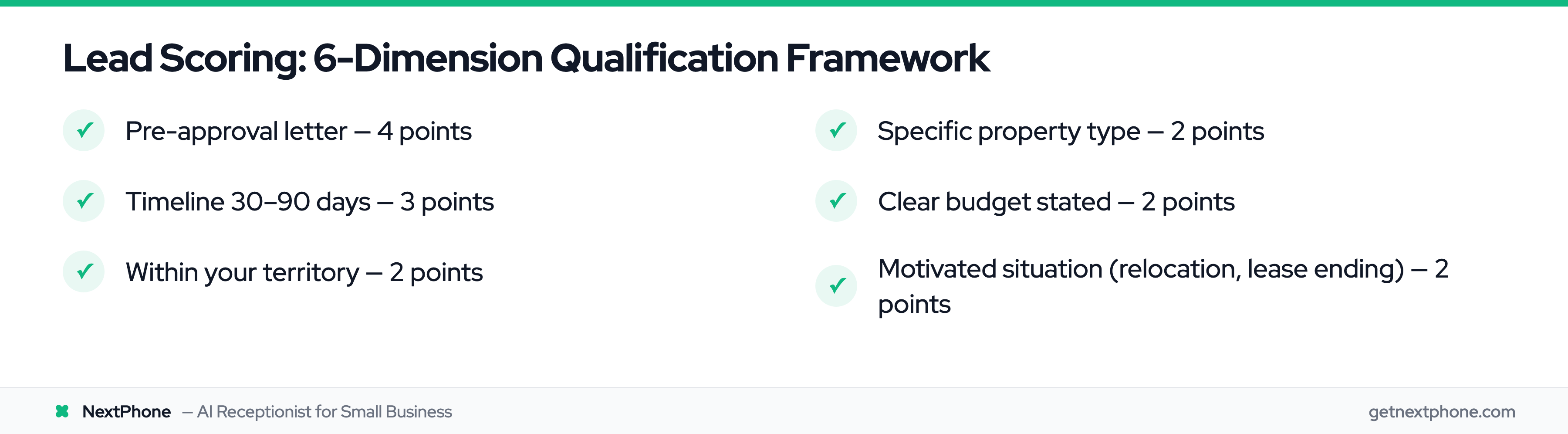
The 6-Dimension Real Estate Lead Qualification Framework
Top-performing agents evaluate every lead across six critical dimensions. Here's the framework that separates qualified buyers from time-wasters.
1. Price Range & Budget Qualification
Ask tactfully: "What price range are you comfortable exploring?"
This is professional. You're saving everyone time by showing properties they can actually afford. Red flag: Buyers who want to tour $800K homes but mention a $400K budget. That's champagne taste on a beer budget, and it wastes your Saturday.
2. Pre-Approval Status (The #1 Filter)
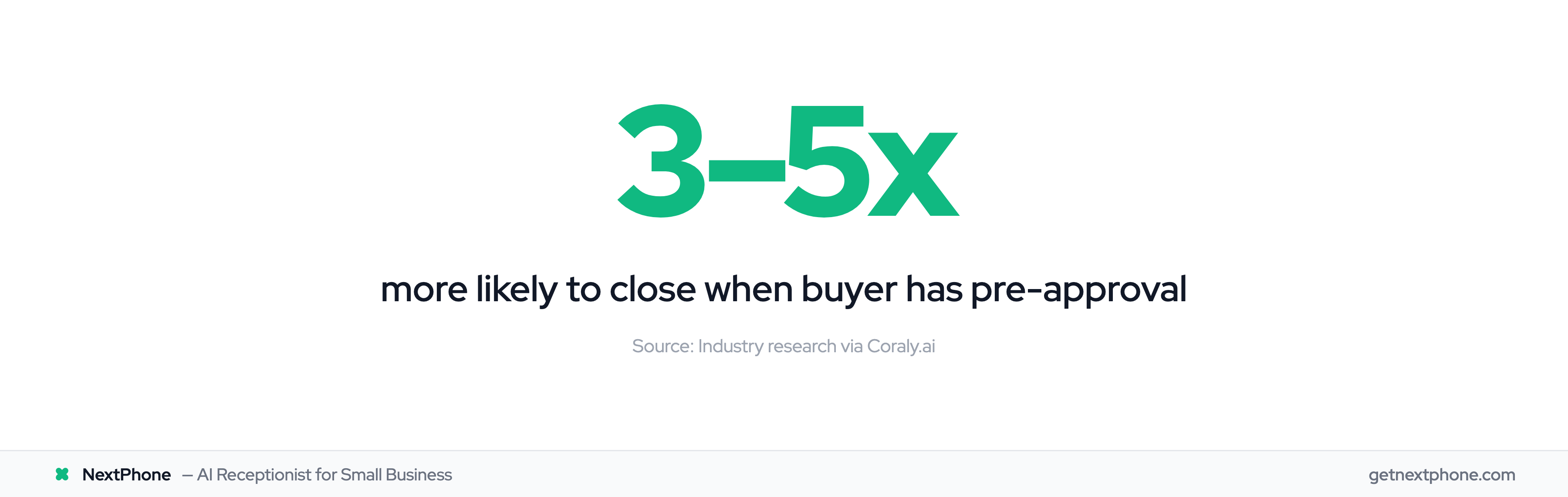
This is your most important qualifier. According to industry research, prospects who have pre-approval letters are 3-5 times more likely to close than those who haven't taken this step.
Ask directly: "Have you spoken with a lender yet, or would you like me to recommend someone?"
Pre-approved buyers are serious. They've verified their finances, know their purchasing power, and can move quickly when they find the right property. No pre-approval? Send them to a lender before you start scheduling showings.
Cash buyers are different: ask for proof of funds instead.
3. Timeline Urgency
When someone says "just looking," believe them. Put them in a long-term nurture campaign, not your active showing rotation.
Qualify timeline with: "When are you looking to move?"
- Hot leads (30-90 days): Job relocation, lease ending, growing family, already sold current home. Priority 1.
- Warm leads (3-6 months): Actively searching, attending open houses, talking to lenders. Priority 2.
- Cold leads (6+ months or "someday"): Browsing for ideas, not ready to commit. Automated follow-up only.
Among the calls we see from real estate customers, urgency language (phrases like "need to move soon," "lease is up," or "we're relocating for work") consistently marks the highest-converting leads. These callers have external pressure driving their timeline and respond well to fast, organized follow-up.
4. Geographic Territory
Confirm the lead is in your service area. Ask: "What neighborhoods or areas are you considering?"
If they want properties outside your market knowledge or licensing territory, route them to an appropriate agent. Don't waste time learning a new area for one lead.
5. Property Type & Preferences
Single-family, condo, townhouse, land, commercial: each requires different expertise. Ask: "What type of property are you looking for?"
First-time homebuyers need education. Investors want numbers and ROI. Luxury buyers expect white-glove service. Match the lead to your strengths, or refer them to a specialist.
6. Agent Matching & Specialization
Not every lead should go to the same agent. Smart brokerages route based on specialization:
- Buyer agent vs listing agent
- Residential vs commercial specialist
- Investor-focused vs first-time homebuyer specialist
- Luxury market vs entry-level
Route leads to agents with relevant expertise and availability. A lead that lands with the right specialist converts 2-3x more often than generic assignment.
Identifying Browsers vs Serious Buyers
Some leads will never close. Learning to spot them early protects your calendar and commission.
Red Flags for Browsers
- Vague timeline: "Maybe sometime next year, we'll see"
- No pre-approval and no urgency to get one
- Unrealistic expectations: "I want a 4-bedroom in the best school district for $200K"
- Poor communication: Won't respond to texts or calls
- Constantly changing requirements: "Actually, now I think I want a condo instead"
Real estate lead experts note that top performers evaluate prospects across four dimensions: financial readiness, decision-making power, motivation, and purchase timeline. Browsers fail on at least two of these.
Green Flags for Serious Buyers
- Has pre-approval letter or proof of funds
- Specific timeline with external pressure (lease ending, job relocation)
- Clear must-haves and deal-breakers
- Responsive communication
- Asks about next steps: "What's the process for making an offer?"
Serious buyers talk about numbers, timelines, and logistics. Browsers ramble about features and "getting back to you."
The Quick Filter
Within the first two minutes of any call, ask about timeline, pre-approval, and budget. If they can't answer those three questions, they're not qualified yet.