Your phone rings. A potential customer needs a quote. But you're on a job site with no way to answer. The call goes to voicemail. They call the next contractor. You just lost $3,500.
This scenario plays out thousands of times daily for small businesses. In our analysis of 13,175 calls from 47 home services contractors over 7 months, we found that 74.1% of customer calls go completely unanswered.
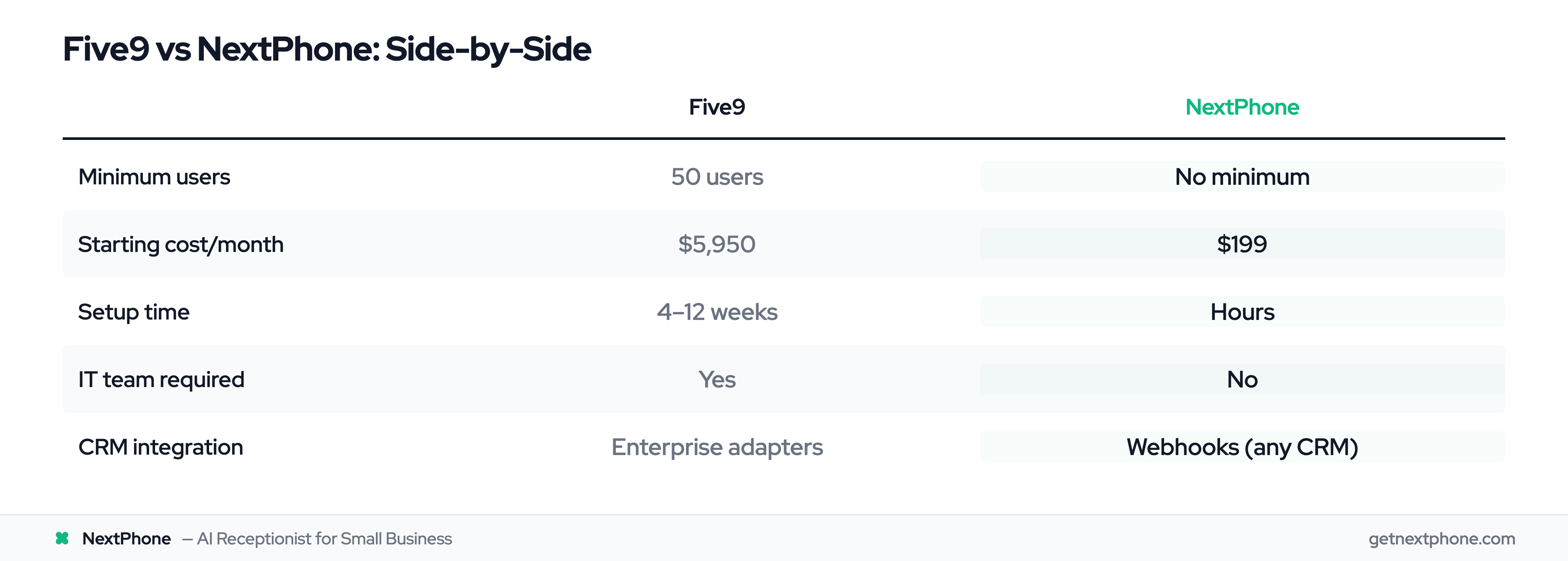
Here's what's ironic: many small business owners researching "Five9 integration" discover a platform built for 50-500 person contact centers with monthly costs starting at $5,950. According to Dialpad's 2025 research, 94% of IT leaders report that their organizations need integration across every function. But integration doesn't matter if you're missing three out of every four customer calls.
This post covers what Five9 integration actually offers, who it's built for, what it costs, and right-sized alternatives for small businesses that need to answer calls first and integrate second.
What is Five9?
Cloud Contact Center Platform Overview
Five9 is a cloud-based contact center platform that's been around since 2001. The company pioneered cloud contact centers when most businesses were still using on-premise phone systems with clunky hardware.
Today, Five9 processes billions of calls per year with 99.999% uptime reliability. That's the kind of infrastructure you need when you're running a 500-person customer service center that can't afford to go down.
Enterprise Scale and Reliability
Five9 isn't a small business phone system. It's a comprehensive CCaaS (Contact Center as a Service) platform designed for organizations with dedicated IT teams, compliance requirements, and complex workflows across multiple departments.
The platform includes workforce management, quality monitoring, analytics dashboards, AI-powered routing, and deep integrations with enterprise software systems. For Fortune 500 companies and large call centers, Five9 delivers the reliability and features they need.
Who Five9 Is Built For
According to CloudTalk's pricing analysis, Five9 requires a 50-user minimum across all plans. This isn't a bug—it's by design.
Five9 targets enterprise teams: customer service departments with 50+ agents, sales teams with complex CRM workflows, healthcare systems with HIPAA requirements, and financial services with compliance needs. If you're managing 100 customer service representatives across three locations, Five9 makes sense.
If you're a 5-person roofing company that can't answer calls while you're on a roof, Five9's $5,950/month minimum probably doesn't.
Five9 Integration Capabilities
CRM Integrations (Pre-Built Adapters)
Five9 offers pre-built contact center integrations with the major enterprise CRM platforms:
- Salesforce - Full integration with screen pops, click-to-dial, call logging
- ServiceNow - Native integration for IT service management workflows
- Microsoft Dynamics 365 - Deep integration with Microsoft's business applications
- Oracle Service Cloud - Pre-built adapter for Oracle customers
- Zendesk - Contact center integration for support teams
These aren't basic integrations. They're sophisticated adapters that embed Five9's telephony controls directly into your CRM interface. Agents see customer data the moment a call comes in, log interactions automatically, and trigger workflows based on call outcomes.
For CRM systems not on this list, Five9's Agent Desktop Toolkit Plus (ADT+) provides a framework of REST APIs and reference UIs for custom integration. But building custom integrations requires developer resources and technical expertise.
API and SDK Options
Five9's API and SDK capabilities are extensive. REST APIs provide access to reporting data, agent management, call controls, and administrative functions. The platform supports webhook notifications, real-time event streams, and bidirectional data sync.
For developers, Five9 offers documentation, code samples, and a developer program. You can build custom integrations with internal business systems, ERP platforms, billing software, or proprietary applications.
This level of API access is powerful—if you have the development team to use it.
Unified Communications Integration
Five9 integrates with unified communications platforms like Microsoft Teams, Zoom Phone, and RingCentral. This allows contact center agents to collaborate with back-office teams without switching between applications.
Recent Platform Updates
In August 2025, Five9 launched Five9 Fusion for Epic, embedding advanced contact center capabilities directly into Epic's EHR system. This integration helps healthcare organizations deliver patient experiences without forcing agents to toggle between systems.
These kinds of specialized, industry-specific integrations show Five9's enterprise focus. Building integrations for the world's largest EHR system makes sense when your customers are hospital networks, not solo practitioners.
The Pricing Reality
Five9 Pricing Tiers
Five9 offers five pricing tiers with different feature sets:
- Digital - $149/user/month (digital channels, no voice)
- Core - $119/user/month (voice-only features)
- Premium - $169/user/month (digital + voice)
- Optimum - $199/user/month (adds workforce management)
- Ultimate - $299/user/month (full enterprise features)
These per-user prices look reasonable until you hit the requirement buried in the fine print.
The 50-User Minimum Requirement
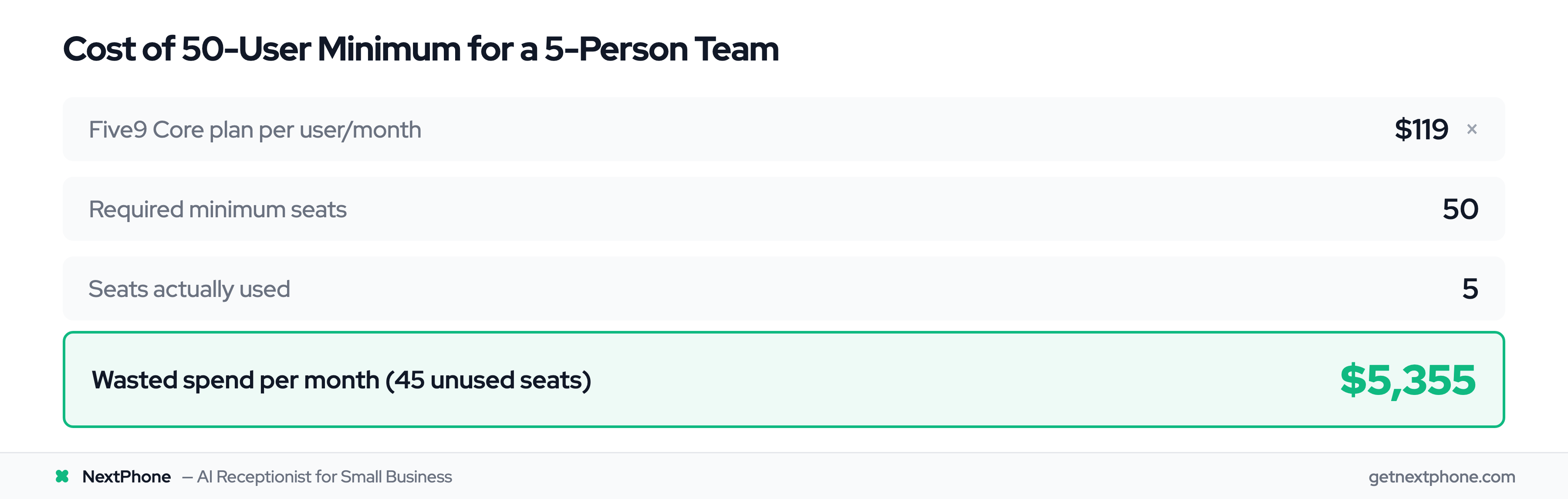
Every Five9 plan requires a minimum of 50 users. CloudTalk's pricing guide confirms this across all tiers.
Let's do the math:
- Core plan: $119 — 50 users = $5,950/month ($71,400/year)
- Premium plan: $169 — 50 users = $8,450/month ($101,400/year)
- Ultimate plan: $299 — 50 users = $14,950/month ($179,400/year)
Annual contracts are typical, and additional costs for AI agents, advanced analytics, and premium integrations can increase these totals further.
True Cost Breakdown for Small Businesses
If you're a 5-person contractor team, you'd pay for 45 unused seats. That's $5,355 per month ($64,260 per year) for licenses nobody uses.
Compare that to NextPhone at $199/month ($2,388/year) with no user minimums. That's a 97% cost reduction—$69,012 in annual savings.
For enterprise teams with 50+ actual users, Five9's pricing makes sense. The per-user cost is competitive with other enterprise CCaaS platforms. But for small businesses, the 50-user minimum makes Five9 financially impractical.
Contact Center Integration Challenges
Common Integration Obstacles
Contact center integration isn't as simple as flipping a switch. According to NovelVox's research on integration challenges, integration challenges hinder the digital transformation efforts of 85% of organizations.
Common obstacles include:
- Legacy system compatibility - Older CRM or business systems that don't have modern APIs
- Disconnected data silos - Customer information scattered across multiple platforms that don't communicate
- Technical expertise requirements - Need for dedicated IT teams or external consultants
- Extended implementation timelines - Complex integrations can take 3-6 months to deploy
Setup Time and Technical Requirements
Five9 implementation typically takes 4-12 weeks depending on complexity. You'll need to configure call routing rules, integrate with your CRM, set up user permissions, migrate phone numbers, train agents, and test workflows before going live.
For enterprise organizations with dedicated IT teams, this is manageable. For small businesses, it's a significant resource commitment that delays time-to-value.
Why Integration Doesn't Matter if Calls Go Unanswered
Here's the paradox: small businesses spend months researching contact center platforms and integration capabilities while missing 74.1% of their customer calls.
In our analysis of 13,175 calls from 47 home services contractors over 7 months, we found that for the typical contractor receiving 42 calls per month, 31 calls go completely unanswered. If just 20% of those would have converted at an average $3,500 project value, that's $21,700 per month in lost revenue—or $260,400 per year.
One plumber with 76 missed calls in a single month told us: "I didn't even know I was missing that many calls until I saw the data. I just thought business was slow."
You can't integrate calls you're not answering. For small businesses, the priority is call answering first, integration second.
NextPhone: Integration Without Enterprise Complexity
Built for Small Business Call Handling
NextPhone is an AI receptionist for small business that focuses on what small businesses need most: answering every call in under 5 seconds.
The AI handles routine questions (hours, pricing, services), qualifies leads, collects contact information, routes urgent calls to your phone, and sends follow-up messages. It's trained on your business—your services, pricing, availability, and knowledge base—so it sounds like it works for you.
Integration Capabilities That Matter for SMBs
NextPhone doesn't try to be Five9. It delivers the integration capabilities small businesses actually need:
- HTTP Webhooks - Push call data to any CRM system (HubSpot, Salesforce, Pipedrive, Zoho, or custom platforms)
- Email Notifications - Automatic summaries after each call with transcript and recording links
- SMS Integration - Send follow-up texts to callers with booking links or additional information
- Call Transfer - Route urgent calls or specific request types to your phone immediately
- Calendly Integration - Collect appointment preferences and send booking links
These integrations cover what most small businesses need: capturing lead information in their CRM, getting notified about calls, and following up with customers. You don't need 500 integration options if you only use three.
Setup Time: Hours, Not Months
NextPhone setup takes hours, not weeks. You configure your AI receptionist by providing your website URL (the AI analyzes it to understand your business), defining call routing rules, and connecting integrations with simple webhook configuration.
No IT team required. No 12-week implementation timeline. You're answering calls the same day.
When to Choose NextPhone vs Five9
The decision comes down to business size and needs:
-
Choose Five9 if you have:
-
50+ contact center agents
-
Dedicated IT team or technical resources
-
Enterprise budget ($70,000+ per year for contact center software)
-
Complex compliance requirements (HIPAA, PCI, SOC 2)
-
Multi-department workflows requiring sophisticated routing
-
Choose NextPhone if you have:
-
Small team (1-20 employees)
-
Need for AI call answering more than call center management
-
Small business budget (under $5,000/year for phone systems)
-
CRM integration needs without enterprise complexity
-
Priority on speed to value (operational in hours, not months)
For most small businesses researching "Five9 integration," NextPhone delivers what they're actually looking for: a way to stop missing calls and automatically log customer information in their CRM, without paying for 45 unused enterprise contact center seats.
Frequently Asked Questions
Can Five9 integrate with my existing CRM?
Yes, Five9 offers pre-built integrations with Salesforce, ServiceNow, Microsoft Dynamics, Oracle, and Zendesk. For other CRM systems, the Agent Desktop Toolkit Plus (ADT+) provides REST APIs for custom integration. However, integration setup typically requires IT resources and can take several weeks to configure and test properly.
What's the minimum commitment for Five9?
Five9 requires a 50-user minimum across all pricing tiers. With pricing starting at $119/user/month, that means a $5,950/month minimum commitment. Annual contracts are typical, though specific terms vary by agreement. For teams under 50 people, this means paying for unused seats—which is why Five9 is designed for enterprise organizations, not small businesses.
How long does Five9 integration take to set up?
Five9 implementation typically takes 4-12 weeks depending on complexity and the number of integrations required. You'll need dedicated IT resources for API configuration, testing, workflow setup, and agent training. Pre-built CRM integrations are faster to deploy than custom integrations, but even standard implementations require significant setup time. For comparison, NextPhone setup takes hours with simple configuration.
Is Five9 worth it for small businesses?
Five9 is designed for enterprise teams with 50+ agents, dedicated IT resources, and large budgets. With a $5,950/month minimum, it's cost-prohibitive for most small businesses. Small businesses missing 74.1% of calls need call answering capability first, not enterprise contact center management. NextPhone delivers the core capability SMBs need—AI call answering plus CRM integration—at $199/month.
What's the difference between Five9 and NextPhone?
Five9 is a comprehensive enterprise contact center platform for managing large teams of agents across multiple channels. NextPhone is an AI receptionist for small businesses that focuses on call answering and basic integration. Five9 requires 50+ users, costs $5,950+/month, takes weeks to implement, and includes full CCaaS features. NextPhone works for any team size, costs $199/month, takes hours to implement, and delivers AI call answering with CRM integration webhooks.
Does Five9 use AI?
Five9 introduced its Genius AI suite in November 2025, adding AI capabilities for routing, quality management, and analytics. However, many AI features rely on third-party integrations rather than native functionality. For small businesses, NextPhone offers native AI call answering built directly into the platform—conversation handling, transcription, intelligent routing, and CRM data extraction work out of the box without requiring additional integrations or configuration.
Can I connect NextPhone to my CRM like Five9?
Yes, NextPhone supports HTTP webhooks to push call data to any CRM system including HubSpot, Salesforce, Pipedrive, and Zoho. Setup is simpler than Five9—you configure a webhook URL, map the data fields you want to capture, and test the integration. This takes minutes to configure compared to weeks for enterprise CCaaS platforms. NextPhone also includes SMS notifications, email summaries, and call transfer capabilities.
Choose the Right Integration for Your Business Size
Five9 is a powerful contact center platform with deep integration capabilities. For enterprises with the team size and budget to use it properly, it delivers the reliability and features large organizations need.
But for small businesses, the math doesn't work. A $5,950/month minimum for 50 users makes Five9 enterprise-only. More importantly, small businesses missing 74.1% of their customer calls don't need sophisticated contact center management—they need to answer the phone.
NextPhone delivers what small businesses actually need: AI that answers every call, collects customer information, integrates with your CRM via simple webhooks, and costs $199/month with no user minimums. You're operational in hours, not months.
Stop missing calls while shopping for enterprise contact centers. NextPhone answers every call, integrates with your CRM, and costs $199/month—no minimums, no complexity. Try it free for 14 days.