You're spending $3,000 a month on Google Ads. You're getting 100 calls. But you're only booking 35 appointments.
Here's the thing: if you could improve your call-to-booking conversion rate from 35% to 50%, you'd generate an extra $52,500 in revenue this month. Without spending another dollar on marketing.
Most service businesses obsess over getting more calls. More Google Ads. Better SEO. Bigger marketing budgets. But they completely ignore the massive opportunity sitting right in front of them: converting the calls they already get.
We've answered more than 2,000,000 business calls. And the industry research is shocking: 74.1% of calls to home services businesses go unanswered. Even when businesses did answer, their booking rates were all over the map, from 31% to 77%.
The businesses that cracked the code on call-to-booking conversion didn't spend more on marketing. They built a systematic framework to diagnose problems, test solutions, and measure results.
This post gives you that exact framework.
What Is Call-to-Booking Conversion Rate?
Your call-to-booking conversion rate tells you what percentage of answered calls turn into scheduled appointments or booked jobs.
The math is simple: (Booked Appointments ÷ Total Calls Answered) × 100.
If you answer 100 calls and book 35 appointments, your booking rate is 35%. If you answer 26 calls and book 9 appointments, your booking rate is also 35%. But your effective revenue is completely different.
Why "Calls Answered" Matters
Here's where most businesses get tripped up. Your booking rate only applies to calls you actually answer.
If 100 people call you but you only answer 26 of them, you can't book the other 74. Unanswered calls have a 0% conversion rate. Every single time.
That's why you need to track two separate metrics:
- Call answer rate: What percentage of incoming calls do you actually answer?
- Call-to-booking rate: What percentage of answered calls turn into appointments?
Your true conversion rate is answer rate × booking rate.
Example: 26% answer rate × 35% booking rate = 9.1% effective conversion from total call volume.
Why This Metric Matters More Than Call Volume
You can't grow indefinitely by just increasing call volume. At some point, you hit diminishing returns on marketing spend.
But improving your booking rate? That's pure profit.
Take a service business getting 100 calls per month with a $3,500 average job value:
- At 35% conversion: 35 bookings = $122,500/month
- At 50% conversion: 50 bookings = $175,000/month
- Difference: $52,500/month = $630,000/year
Same marketing spend. Same call volume. 52% more revenue.
That's why your call-to-booking conversion rate is the highest-leverage metric in your business. It directly reveals the quality of your phone experience, and your ability to turn high-intent leads into paying customers. Phone calls convert 10-15x better than web leads-marketing-statistics), making call optimization your highest-ROI investment.
Our data from 1,446,980 calls shows that booking or rescheduling an appointment is the single most common reason people call, and requesting a quote or estimate is among the top reasons too. These are high-intent calls. They should be converting at 70%+. If they're not, you're leaving massive revenue on the table.
For comparison, Chili Piper's 2025 benchmark of 4 million form submissions found that 66.7% of qualified forms successfully book meetings, more than double the 30% industry average. Typeform reports 47% average completion rate vs 21% industry average for optimized forms. The same principle applies to phone calls: qualified leads should convert at much higher rates than your overall average.
Industry Benchmarks: What's a Good Booking Rate?
You can't improve what you can't benchmark. So let's establish what "good" actually looks like.
Service Business Benchmarks by Trade
According to ServiceTitan's analysis of thousands of home service businesses:
- Overall home services average: 42%
- Plumbing: 43% (highest, with the least seasonal variation)
- HVAC: 38% (varies by season, higher in shoulder seasons)
- Electrical: 41%
- Garage door/water treatment: 31%
Why does plumbing convert better? Simple: urgency. When you need a plumber, you need them now. Plumbing emergencies don't wait.
HVAC conversions fluctuate because much of the demand is planned maintenance or seasonal preparation. Less urgency = more shopping around = lower booking rates.
Performance Tiers: Where Do You Stack Up?
Here's how to grade your current booking rate:
- Below 30%: Poor: you have significant opportunity for improvement
- 30-50%: Good: typical for most service businesses
- 50-70%: Excellent: you're optimizing effectively
- 70%+: Top performer (example: Black Diamond Plumbing in Chicago at 77%)
- Theoretical maximum: 90% with exceptional training and systems
Unbounce data shows the average conversion rate is 2.9%, with the top 25% achieving 5.31%+. The CRO tools market has grown to $5.07B in 2025 with 223% average ROI.
If you're at 35% right now, don't feel bad. You're right in the middle of the pack. For B2B context, average appointment setting conversion is just 2.23%. Service businesses typically perform much better. But there's a clear path to 50-70% with systematic optimization.
The Reality Check Most Businesses Miss
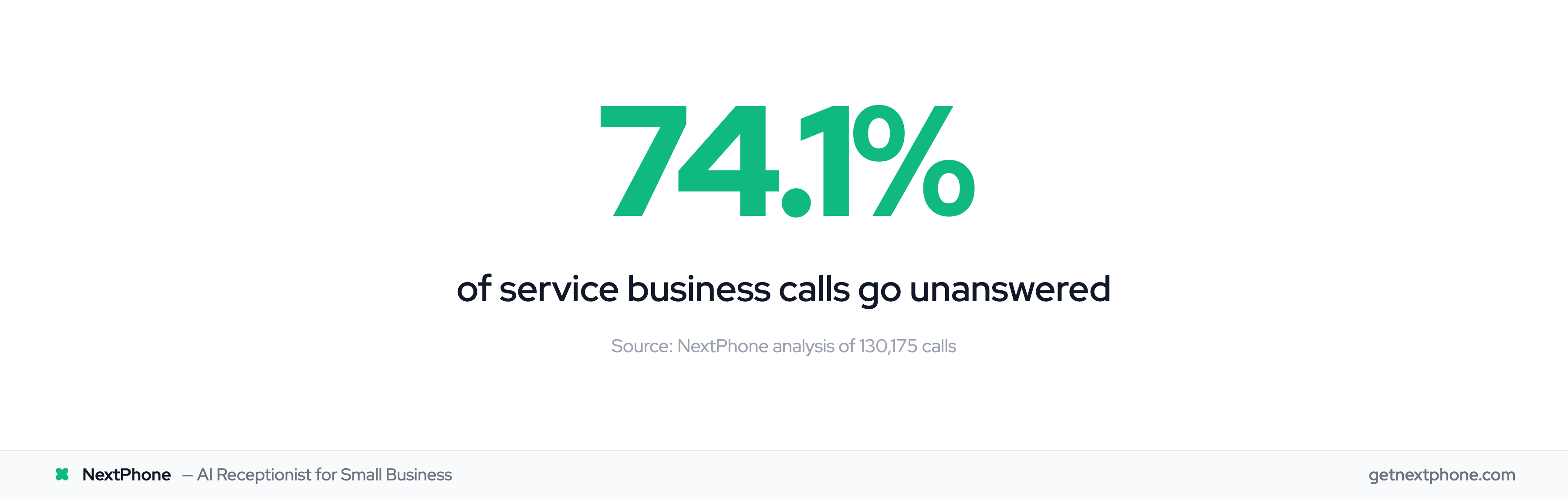
Here's the hard truth: industry benchmarks for call answer rates show that businesses typically answer 54-69% of calls.
Industry research on home services businesses found something far worse: 74.1% of calls go unanswered.
Let that sink in. Three out of four callers couldn't reach a human.
Even if you have a "good" 40% booking rate, if you're only answering 30% of your calls, your effective conversion is just 12%. You're losing 88% of your potential revenue before you even get a chance to have a conversation.
The unanswered call crisis is a conversion rate disaster.
The CRO Framework: Your 4-Step Optimization Playbook
Most conversion rate optimization advice is just a scattered list of tips. "Answer faster." "Be more friendly." "Ask for the booking."
That's guesswork.
You need a systematic framework that top performers use to achieve 77%+ booking rates. Here's exactly how they do it:
- Establish Baseline Metrics - Know where you are
- Identify Drop-Off Points - Diagnose the specific problem
- Test Solutions - Implement improvements based on data
- Measure & Iterate - Prove ROI and keep optimizing
This framework is data-driven, not opinion-driven. It focuses your effort on the biggest opportunities. It produces measurable ROI at every step. And it's repeatable for continuous improvement.
What you need to make this work:
- Call tracking and analytics
- Call recording and transcription
- Baseline data (at least 50-100 calls for statistical significance)
- A/B testing capabilities
NextPhone provides all of this automatically. But the framework works regardless of your tools. You just need the data.
Step 1: Establish Your Baseline Metrics
You can't optimize what you don't measure. Before you change anything, you need to know exactly where you are right now.
The 5 Critical Metrics to Track
1. Call Answer Rate
Formula: (Calls Answered ÷ Total Incoming Calls) × 100
Industry average: 54-69%. Industry research shows 74.1% of calls go unanswered. This is your first problem to fix.
AI virtual receptionist systems achieve 100% answer rates. If you're missing even 30% of calls, this is your biggest lever.
2. Call-to-Booking Rate
Formula: (Appointments Booked ÷ Calls Answered) × 100
Benchmark: 30-50% is typical, 50-70% is excellent.
Track this by marketing source. Your Google Ads calls might convert at 45% while organic calls convert at 30%. That tells you which sources bring higher-intent leads.
3. Qualification Pass Rate
What percentage of callers are actually qualified prospects?
Our data shows scheduling requests are the single most common reason people call, with quote requests and urgency language ranking among the top reasons too. These are your high-intent calls.
If your qualification rate is low, you don't have a conversion problem. You have a marketing problem. You're attracting the wrong callers.
4. Objection Types & Frequency
Are most objections about price? Timing? Service area? Trust?
You can't answer this question without call transcription. Pattern recognition across dozens of calls reveals what's really blocking conversions.
This tells you what to address proactively in your scripts.
5. Time-to-Answer & Call Timing
Industry data shows morning calls have the highest booking rates. After 6pm, conversion drops to 21% for large businesses and 9% for small businesses.
Speed matters too. AI receptionists answer in under 5 seconds. Humans typically take 30+ seconds, if they answer at all.
How to Collect This Data
You need three things:
- Call tracking software (with Google Analytics integration)
- Call recording and transcription
- CRM integration for booking attribution
NextPhone provides all of this out of the box. You get full call transcription, automatic categorization of call types, booking attribution, and real-time dashboards.
Collect baseline data for at least 2-4 weeks. Track by day of week, time of day, and marketing source. You're looking for patterns that tell you where to focus.
Step 2: Identify Where Callers Drop Off
Here's what your call conversion funnel actually looks like:
- 100 Incoming Calls
- 26 Calls Answered (74 lost: biggest drop-off)
- 20 Qualified Prospects (6 weren't a fit)
- 15 Overcome Objections (5 had price/timing concerns)
- 9 Bookings Scheduled (6 couldn't find a convenient time or didn't commit)
Each stage is a potential bottleneck. Your job is to find the biggest leak and fix it first.
Drop-Off Point #1: Before the Phone Is Answered
Industry research on home services businesses found that 74.1% of calls go unanswered.
This is THE biggest conversion killer in service businesses. Nothing else even comes close.
Every unanswered call has a 0% conversion rate. If you're missing three out of four calls, you're leaving massive revenue on the table.
Quick math: Missing just one emergency call per week costs you approximately $16,800 per month in lost revenue.
The Solution: AI receptionists answer 100% of calls in under 5 seconds. This single change typically improves bookings by 284% without any other optimization.
Drop-Off Point #2: During Qualification
You need to qualify callers to ensure they're a good fit. But too many questions create friction. Too few questions and you waste time on bad-fit leads.
What to listen for in call recordings:
- Does the caller sound frustrated with your questions?
- Are you asking relevant questions or just following a generic script?
- Do you recognize high-intent signals like urgency language?
Lead gen forms average 9.09% conversion, with 74.5% completion once started. Phone calls should beat these numbers since the prospect has already shown higher intent.
Our data shows approximately one in four callers explicitly requests a callback. Are you capturing these? Or are they falling through the cracks because your CSR forgot to follow up?
Drop-Off Point #3: At Pricing Discussion
Here's a stunning stat: Only 35% of customer service agents actually ask for the booking, according to analysis of 60+ million calls. Invoca's analysis of 60M+ calls shows 46% lead conversion rate for phone calls, with 37% converting during the call and 61% speaking directly with a representative.
If you don't ask, they won't book.
Pricing objections are really value objections. If the caller goes silent after you mention price, or says "let me think about it," you haven't established enough value.
What to listen for:
- Does the caller disengage after price is mentioned?
- Are you offering options (good/better/best) or a single price?
- Do you frame price in terms of value delivered?
Drop-Off Point #4: During Scheduling
"I'll have to check my calendar and call you back" is conversion death.
Friction in the scheduling process loses bookings. If you offer limited time slots, require callbacks to confirm, or don't have evening/weekend availability, you're hemorrhaging conversions.
What to listen for:
- How many back-and-forth exchanges does it take to find a time?
- Do you offer flexible options or a "take it or leave it" slot?
- Can you book on the spot, or do you need to callback after checking availability?
Using Analytics to Identify Your Bottleneck
Call transcription reveals patterns that are invisible otherwise.
Compare calls that convert vs. calls that don't. What's different? Where does the conversation break down?
AI analysis can categorize drop-off reasons automatically. You get a dashboard that shows you: "42% of non-converting calls dropped off during pricing discussion."
Now you know exactly what to fix.
Focus on your biggest leak first. Don't try to optimize everything at once.
Step 3: Test Solutions to Your Biggest Bottleneck
Once you've identified your #1 conversion bottleneck, it's time to test a solution.
Don't implement everything at once. Change one variable, measure the impact, then move to the next improvement.
Solution #1: Fix the Unanswered Call Crisis
If 74% of your calls go unanswered (and statistically, they probably do), start here.
Traditional solutions include hiring more staff or implementing call rotation systems. But that's expensive and still leaves gaps.
Modern solution: AI receptionists.
- 100% answer rate (never misses a call)
- Under 5 seconds to answer (speed matters for conversion)
- Consistent qualification (no variation in script quality)
- Captures all callback requests (roughly one in four callers asks for one)
- Full transcription for analysis
ROI Example:
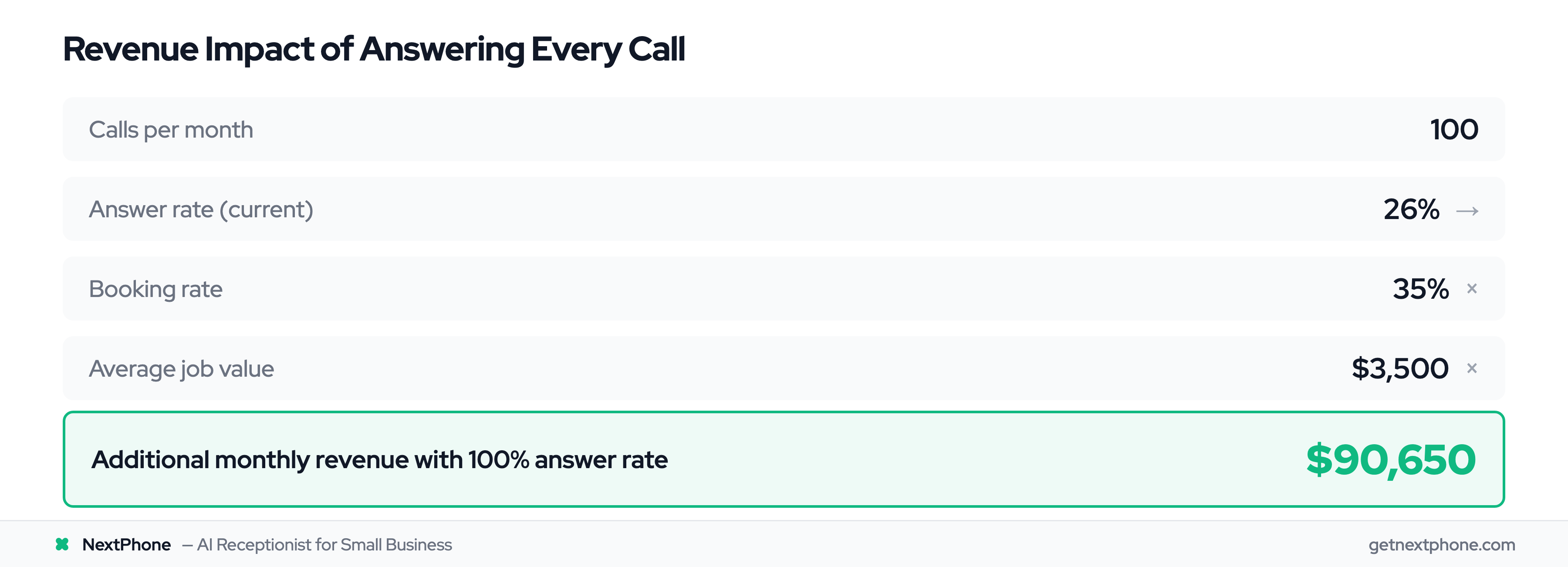
- Current state: 26 answered calls out of 100, 35% booking rate = 9 bookings
- With AI receptionist: 100 answered calls, 35% booking rate = 35 bookings
- Improvement: +284% more bookings from the same marketing spend
At $3,500 per job, that's an extra $90,650 per month. Your AI receptionist costs maybe $500-1,000/month.
That's a 9,000% ROI.
Solution #2: Refine Your Call Scripts Based on Data
Call transcription analysis shows you exactly what's working and what's not.
If price objections are your #1 bottleneck, address value before mentioning price. If timing is the issue, offer flexible scheduling first. If trust is the concern, mention credentials early ("We're licensed and insured with over 500 five-star reviews").
Here's a proven script optimization framework:
-
Opening (15 seconds): Empathy + establish authority
- "I understand, a broken water heater is stressful. We've helped over 300 families in [city] with this exact issue."
-
Qualification (45 seconds): 3-5 key questions max
- Focus on what actually determines fit, not generic questions
-
Value proposition before pricing (30 seconds): Establish value first
- "We can have a licensed plumber there today, diagnose the issue in 15 minutes, and give you a firm quote before starting any work."
-
Overcome objections (45 seconds): Price anchoring and social proof
- "Most water heater replacements run $1,800-2,400. We've done this 500+ times with a 4.9-star rating."
-
Ask for the booking (30 seconds): Direct call to action
- "I have a 2pm slot today or 9am tomorrow. Which works better for you?"
A/B Testing Protocol:
- Test one script variable at a time
- Run each variant for at least 50 calls (100+ is better)
- Track booking rate by script version
- Keep what works, discard what doesn't
Research shows A/B testing cold call scripts can yield 27% conversion increases with just 350 calls tested. Similarly, email CTA A/B testing achieves 49% click-through improvement, with personalized CTAs yielding 42% higher conversion.
Solution #3: Reduce Scheduling Friction
Offer real-time booking, not "let me check and call you back."
Provide multiple time slot options immediately. Have evening and weekend availability for callers with day jobs.
CRM integration lets you see availability instantly. AI can access your calendar and book appointments on the spot: no callbacks, no friction. CRM automation can increase lead conversion by up to 300%.
Solution #4: Train for High-Intent Signals
Our data shows urgent calls rank among the top reasons people call. So do explicit scheduling requests.
These high-intent calls should convert at 70%+. If they're not, you're missing your easiest conversions.
Train your receptionists (or configure your AI) to recognize and prioritize these calls. Rush the scheduling. Remove friction. Make it stupid-simple to book.
The Testing Protocol
- Implement ONE change at a time
- Run for 2-4 weeks or 100+ calls (whichever comes first)
- Compare results to baseline metrics
- Keep what works, discard what doesn't
- Move to the next bottleneck
This is how you get from 35% to 50% to 70%. Not with guesswork. With data-driven iteration.