A customer calls your plumbing business. "Do you service tankless water heaters?" Simple question.
Generic AI response: "Let me have someone call you back to answer that."
The customer hangs up. Calls the next plumber. Gets a "yes" immediately. Books them instead.
You just lost a $2,800 water heater installation because your AI didn't know what you do.
This happens constantly with generic AI receptionists. They sound like script readers at an outsourced call center because they don't actually know your business. In our analysis of 130,175 calls from 45 home services contractors, we found that even when calls get answered, inaccurate or vague responses cost opportunities.
AI customization solves this. 85% of customer service leaders plan to pilot conversational GenAI in 2025—but generic implementations fail. This guide shows what information AI can be trained on, how automatic extraction works with tools like Website Analyzer, and why deep personalization matters for capturing revenue.
Why Generic AI Falls Short for Your Business
You've seen the promise: AI receptionist answers every call, never misses an opportunity, costs less than a human. But there's a catch most services don't mention.
Sounds Like a Script Reader, Not an Employee
Generic AI uses pre-written templates that don't match your specific business. It's trained on general responses that could apply to any company in your industry—or any industry at all.
A customer asks your electrical contracting business: "Do you handle commercial work or just residential?"
Generic AI has no idea. It defaults to: "We handle a variety of electrical services. Would you like to schedule a consultation?" That's not an answer. The customer wanted "yes" or "no" with maybe a brief detail about commercial capabilities.
They recognize immediately that this AI doesn't actually know your business. 82% of customers expect an immediate response—generic, vague answers don't cut it.
Gives Wrong or Vague Answers
Worse than sounding generic is giving incorrect information. An HVAC contractor told us their generic AI service kept telling customers they were open on Sundays—they're not. Another roofing company had their AI quote pricing that was two years out of date.
Custom AI agents trained on company-specific data provide more accurate and relevant responses than generic solutions. But most businesses using basic AI services are stuck with one-size-fits-all templates that can't answer:
- "Do you service my specific equipment brand?"
- "What's your service radius?"
- "Do you charge extra for emergency calls?"
- "What's your cancellation policy?"
The AI either says "I don't know" or makes something up. Neither builds trust.
Breaks Down on Unexpected Questions
A customer calls your pool service company asking: "Can you come today? We're having a party tomorrow and there's algae."
Generic AI hears "party" and "tomorrow" but doesn't understand the urgency. It offers to schedule something next week. The customer hangs up frustrated.
Script-driven AI can only handle exact phrases it was programmed for. Anything outside that narrow scope breaks the conversation. Personalized AI interactions handle context and nuance—but only when they're actually trained on your business.
COMPARISON BOX Generic AI Response: "What service are you interested in?"
What Customer Needed: "Yes, we can do same-day emergency service. We have an opening at 2 PM today. There's a $75 rush fee. Does that work?" /COMPARISON BOX
AI Customization: Training AI on YOUR Business
AI customization means training the AI on your specific business information, not generic templates or industry defaults. A voice AI receptionist trained on your business sounds like it actually works there.
What Customization Means in Practice
When you customize an AI receptionist, you're feeding it your company's knowledge base: your services, your pricing, your policies, your service area, your hours, your specialties. The AI learns what makes your business unique.
An HVAC company that specializes in Carrier and Trane systems trains their AI to know those brands specifically. When someone asks "Do you work on Carrier equipment?" the AI says "Yes, Carrier is actually one of our specialties—we're certified Carrier dealers" instead of "Let me check on that."
That specificity builds instant credibility.
The "Native Business Feel" Difference
The goal isn't just accuracy—it's making the AI feel like it actually works there. Like it's a receptionist who's been with your company for years and knows the business inside and out.
Customers should think they're talking to someone who knows your company, not an outsourced service reading from a script. That's the "native feel."
Our AI is trained on each company's existing database and knowledge base. It uses internal context to answer accurately and consistently. A customer calling can't tell the difference between this and a human employee who genuinely knows the business.
Beyond Scripts: Conversational Intelligence
True customization isn't just memorizing FAQs. It's understanding context well enough to have real conversations.
A caller asks: "My basement is flooding—can you help?"
Script-based AI looks for keyword "flooding," finds match, says scripted response.
Conversational AI understands this is an emergency plumbing situation requiring immediate response. It knows your emergency pricing, knows who's on call, knows your typical response time, and responds naturally: "That's an emergency. We can have someone there within the hour. Emergency calls start at $200 plus our standard rates. What's your address?"
Same information, but delivered like a human would—not like reading from a template.
Training Data: What Your AI Can Learn
The depth of customization depends on what information you train the AI on. More data means more accurate, helpful responses.
Website Content & Service Descriptions
Your website is the richest source of business information. Every service page, about page, FAQ, and blog post contains knowledge about what you do and how you do it.
AI trained on specific business data can handle 80% of customer inquiries without human intervention—but only if it has access to comprehensive information.
A general contractor's website might detail: framing, drywall installation, interior remodeling, kitchen renovations, bathroom remodels, deck building, and finish carpentry. AI trained on this content knows exactly what services to mention when a caller asks "What kind of work do you do?"
Policies, Procedures & FAQs
Beyond services, customers ask about how you operate:
- What's your cancellation policy?
- Do you offer warranties?
- What payment methods do you accept?
- Do you pull permits?
- How far in advance do I need to book?
These procedural questions trip up generic AI but are straightforward for customized AI trained on your actual policies.
Pricing Information & Service Areas
If your pricing is public, AI can quote it directly. If it's variable, AI can explain the factors and offer to provide a specific quote.
For service areas, AI can be trained on zip codes, city names, or radius from your location. "Do you service Riverside?" gets an immediate, accurate yes or no.
Hours, Locations & Contact Info
Basic but critical. AI needs to know:
- Hours of operation (including holidays)
- Multiple locations if applicable
- Best contact methods
- Emergency contact procedures
An electrician told us their previous AI service kept telling customers to call during business hours—when customers were already calling during business hours. The AI's hours data was wrong. Simple information, huge impact when it's incorrect.
Industry-Specific Knowledge
This is where customization really shines. Every industry has specific terminology, equipment brands, code requirements, or certifications that matter to customers.
HVAC: SEER ratings, tonnage, heat pumps, ductless mini-splits, refrigerant types Plumbing: PEX vs copper, tankless vs tank water heaters, sewer line vs drain cleaning Electrical: 200-amp service, GFCI outlets, code compliance, commercial vs residential Roofing: Shingle types (architectural, 3-tab), underlayment, flashing, warranty terms
AI trained on your industry knowledge speaks your customers' language.
How Website Analyzer Extracts Your Business Information Automatically
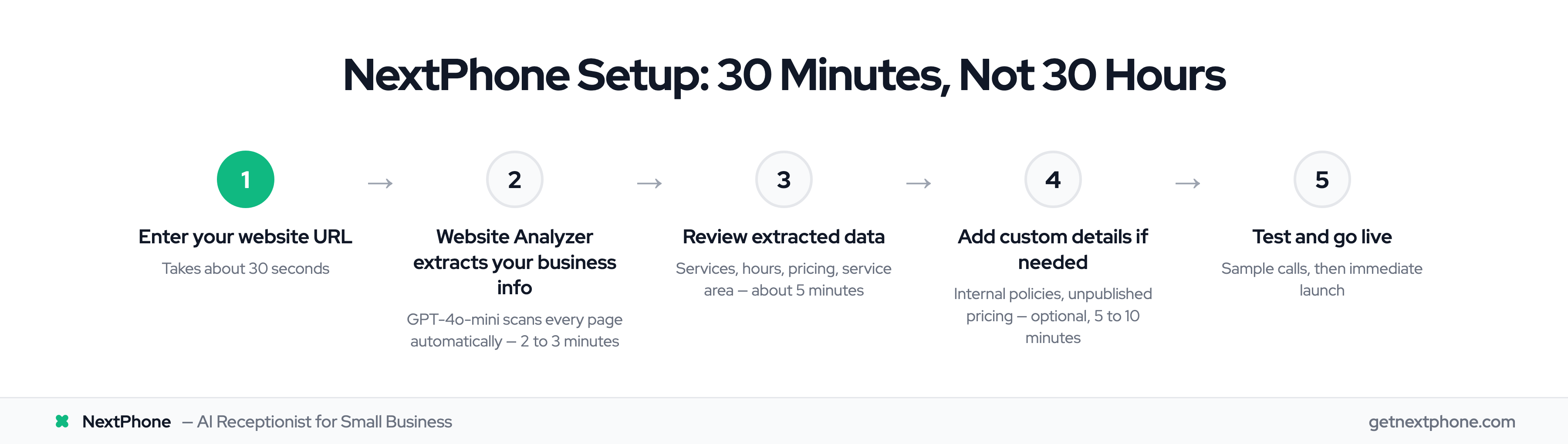
Here's where setup gets exponentially easier. Instead of manually typing all your business information into forms, NextPhone's Website Analyzer does it automatically.
What Website Analyzer Does
Website Analyzer is an AI-powered tool that reads and understands your entire website. You provide your URL. It analyzes every page, extracts key business information, and uses that to train your AI receptionist.
No data entry forms. No copying and pasting content. Just: paste URL, wait a few minutes, review what it extracted.
GPT-4o-mini Intelligent Extraction
The technology behind this is OpenAI's GPT-4, specifically the GPT-4o-mini model optimized for intelligent content extraction. This isn't simple text scraping—it's AI understanding the meaning and context of your website content.
GPT-4 demonstrates improved accuracy in domain-specific tasks when fine-tuned on relevant data. Website Analyzer uses this capability to intelligently identify what information matters for training your receptionist AI.
What Gets Extracted Automatically
When Website Analyzer scans your site, it pulls:
Business basics: Company name, description, industry, specialties Services offered: Full list of what you do, including details from service pages Hours of operation: When you're open, including special hours or seasonal changes Contact information: Phone numbers, service areas, locations Knowledge base: Common questions, policies, procedures mentioned on your site Suggested questions: Based on your content, questions customers likely ask
An HVAC company runs Website Analyzer on their site. In three minutes, it extracts:
- Business name: "Arctic Comfort HVAC"
- Services: AC repair, furnace installation, duct cleaning, maintenance plans
- Specialties: Carrier and Trane certified, commercial and residential
- Hours: M-F 8am-6pm, Saturday 9am-3pm, 24/7 emergency service
- Service area: 30-mile radius from main location
- Pricing notes: $89 diagnostic fee, emergency calls add $200
All automatically. No typing.
Setup Takes Minutes, Not Days
Traditional AI customization requires building conversation flows, writing scripts, testing responses, debugging failures. Takes hours or days depending on complexity.
Website Analyzer runs in minutes. You review the extracted data, add any custom details it couldn't pull from your website (like internal policies not published publicly), and you're ready to test.
For a small business owner who doesn't want to become an AI engineer, this is the difference between "too complicated, I'll stick with my answering service" and "I can actually do this."
Deep Training vs Surface Training: What's the Difference?
Not all AI customization is equal. The depth of training dramatically affects how well AI performs.
Surface Training: FAQs Only
Surface training means the AI knows answers to a pre-defined list of FAQs. Ten questions, ten memorized answers.
This is barely better than generic AI. As soon as a customer asks something outside those ten questions, the AI breaks. "Let me have someone call you back."
Mid-Level Training: Website Content
Mid-level training includes your full website content. All service descriptions, all about pages, all blog posts. The AI has substantially more context.
This handles most common questions well. But it still struggles with nuanced scenarios, complex policies, or questions that require combining multiple pieces of information.
Deep Training: Full Knowledge Base + Policies
Deep training includes everything: website content, internal policies, procedures, pricing structures, service protocols, industry knowledge, common edge cases.
Well-trained AI assistants report 60% reduction in repetitive customer inquiries because the AI can actually handle complex questions. McKinsey research shows AI can improve productivity by 30-50% when properly deployed.
A caller asks: "Do you offer same-day emergency service on weekends, and how much extra does that cost compared to regular appointments?"
- Surface training: "Let me check on that"
- Mid-level training: "Yes, we offer emergency services"
- Deep training: "Yes, we offer same-day emergency service 24/7 including weekends. Emergency calls have a $200 premium on top of our standard $89 diagnostic fee. We can typically arrive within 90 minutes."
The deep-trained response answers the full question with specific details.
Which Level Your Business Needs
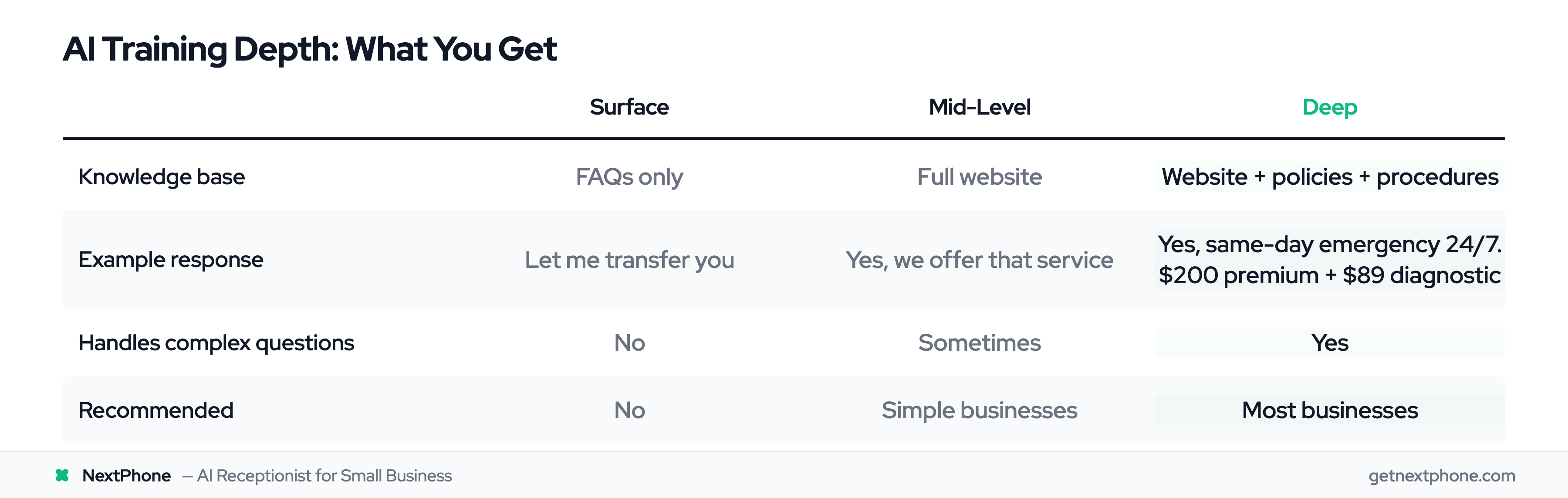
For most businesses, mid-to-deep training is essential. Surface training creates more frustration than it solves—customers still can't get answers.
The good news: With Website Analyzer's automatic extraction, you get mid-level training by default. Your entire website content becomes the AI's knowledge base. You can move to deep training by adding internal policies and procedures that aren't on your public site.
| Training Level | What It Knows | Example Response Quality | Best For |
|---|---|---|---|
| Surface | Basic FAQs only | "Let me transfer you" | Not recommended |
| Mid-Level | Full website content | "Yes, we offer that service" | Simple businesses with straightforward services |
| Deep | Website + policies + procedures | "Yes, same-day emergency 24/7. $200 premium plus $89 diagnostic fee" | Most businesses—trades, services, professional services |