
The term "AI copilot" has moved out of aviation cockpits and coding environments into something you might not expect: customer service. And for businesses that have spent years fighting against frustrating chatbots and voicemail black holes, this shift represents something genuinely different.
For too long, "AI customer service" meant robotic voices asking you to press 1 for sales, then failing to understand anything you actually said. Customers hated it. Business owners knew it was driving people away. But the alternative - staffing phones 24/7 - wasn't realistic for most small businesses.
Here's what that cost looks like in reality: In our analysis of 130,175 calls from 45 contractors over a 7-month period, 74.1% went unanswered. Nearly three out of four potential customers couldn't reach someone. That's not a minor inefficiency - it's a revenue crisis hiding in plain sight.
AI copilot technology changes this equation. Not through science fiction promises, but through voice-capable AI that answers every call, understands what callers need, and knows when to bring in a human. An AI virtual receptionist represents the practical application of this technology for businesses of all sizes. A Gartner survey reveals 85% of customer service leaders will explore or pilot conversational GenAI in 2025, and McKinsey's 2024 State of AI research shows GenAI adoption spiking across industries. This is what the next evolution of customer service actually looks like.
What Is an AI Copilot for Customer Service?
The "copilot" terminology matters here. In aviation, a copilot doesn't replace the pilot - they work alongside them, handling tasks, monitoring systems, and taking over when needed. The pilot makes the important calls, but the copilot ensures nothing falls through the cracks.
AI copilot for customer service follows the same philosophy. It's not about replacing your team. It's about ensuring every customer interaction gets handled, even when your team is busy, off-site, or asleep.
AI Copilot vs Traditional Chatbots
If you've interacted with customer service chatbots over the past decade, you probably have low expectations for AI. Those frustrations are valid - traditional chatbots earned their reputation.
Traditional chatbots:
- Follow pre-written scripts with limited branching
- Struggle when customers phrase things differently than expected
- Work only with text, not phone calls
- Get confused easily and loop back to the beginning
- Feel robotic and frustrating to interact with
AI copilot:
- Understands natural language and caller intent
- Adapts to different phrasings and contexts
- Handles voice conversations naturally—industry voice-AI research documents this acceleration
- Learns from interactions and improves
- Knows when to escalate to humans
The difference isn't just technical sophistication—it's practical capability. A chatbot asks "Press 1 for sales, press 2 for support." An AI copilot understands when someone says, "I need someone to look at my furnace - it's making a weird noise and my house is getting cold." Gartner predicts agentic AI will resolve 80% of common customer service issues autonomously by 2029.
Major players are investing heavily: Dialpad launched its Agentic AI Platform in October 2025. And Gartner predicts 30% of Fortune 500 companies will offer service through only a single AI-enabled channel by 2028.
What AI Copilot Can Actually Do
Modern AI copilot technology for customer service handles:
- Phone calls with natural conversation, not robotic menus
- Caller intent recognition - understanding what people actually need
- Appointment scheduling and rescheduling
- Message taking with accurate details captured
- Emergency routing to on-call staff when situations are urgent
- Spam filtering to protect your time from robocalls
- 24/7 availability without overtime costs
The key distinction: AI copilot doesn't try to be a human. It's an always-available assistant that handles routine interactions professionally while escalating complex situations appropriately. SMB AI adoption surged 41% (from 39% to 55%) in 2025, and the OECD's report on AI adoption by SMEs confirms small businesses are closing the AI gap with larger enterprises.
The Problem AI Copilot Solves: Missed Calls, Lost Revenue
Before discussing solutions, we need to be honest about the problem. And the problem is bigger than most business owners realize.
The Missed Call Crisis
In our analysis of 130,175 calls from 45 contractors over a 7-month period, we found that 74.1% went unanswered.
Let that sink in. Contractors - people whose entire business depends on answering when customers call - missed nearly three quarters of their incoming calls. Not because they don't care about customer service. Because they were on job sites, helping other customers, driving, or simply unavailable at that moment.
Industry research shows this isn't unique to contractors. Small businesses across sectors miss 60-80% of incoming calls. When you're actually doing the work your business exists to do, you can't be sitting by the phone.
What Happens to Those Missed Calls
Here's where it gets expensive:
- 62% of callers won't leave a voicemail
- 85% won't call back if they don't reach you the first time
- They move on to your competitor
In service industries especially, the first business to answer often wins. ServiceTitan's home services industry trends report shows how critical response time has become. When someone's AC breaks in summer or their basement starts flooding, they're calling multiple businesses. Whoever picks up gets the job.
The Dollar Impact
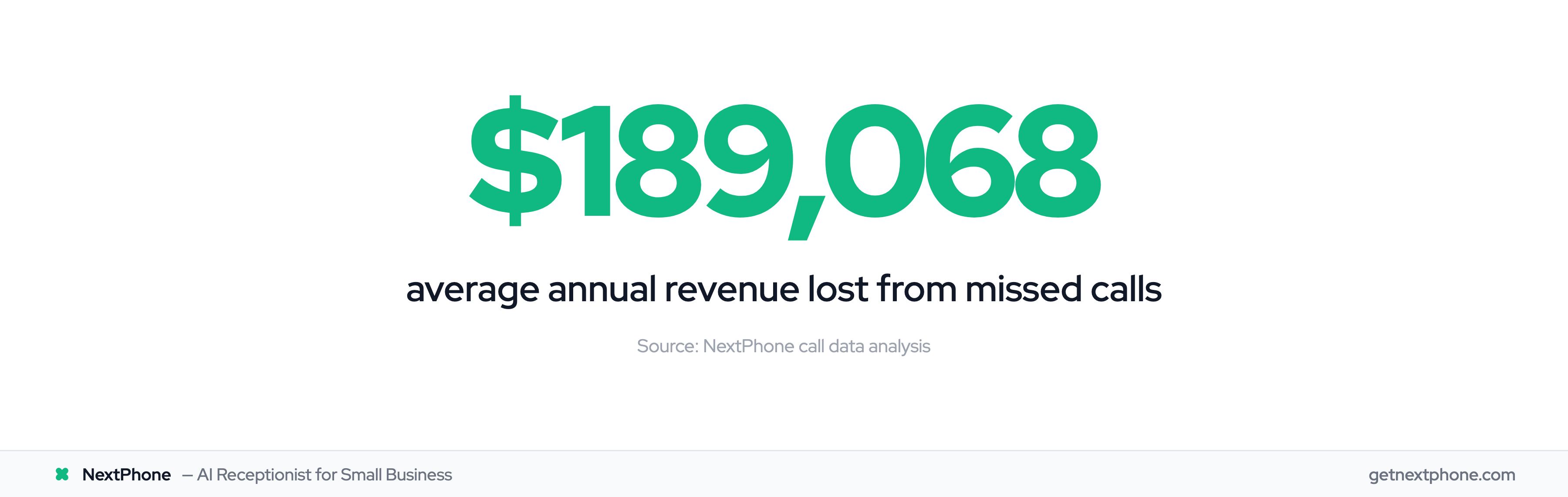
Our data shows contractors lose an average of $189,068 per year from missed calls.
That's not a projection or estimate - it's calculated from actual call volumes, miss rates, and average project values. At $3,500 per project, that's 54 jobs walking out the door annually. Even at $400 per service call, that's 470 lost service calls per year.
Think about what you'd do with an extra $189,000 in annual revenue. That's not theoretical money—it's business you're currently losing because calls aren't getting answered. 91% of SMBs using AI say it has boosted their revenue.
Anthropic's Economic Index tracks AI usage patterns across industries, and Census Bureau data shows how AI has impacted businesses and workers, with adoption accelerating across all sectors.
Why Traditional Solutions Fall Short
Business owners aren't unaware of this problem. They've tried solutions:
Voicemail: Most callers won't leave one. The 62% stat isn't speculation - it's observed behavior. People have learned that voicemails often go unreturned, so they don't bother.
Live answering services: Better, but expensive. Quality services run $400-800/month, often with per-call or per-minute charges that add up. And many only cover business hours, missing the after-hours calls that are often emergencies.
Additional staff: A full-time receptionist costs approximately $4,100/month when you include salary, benefits, payroll taxes, and training. That's $49,200 per year for coverage during business hours only - no nights, weekends, or holidays.
Call back later: By the time you call back, the customer already called your competitor and scheduled the work.
The problem wasn't awareness. Business owners knew they were missing calls. The problem was lack of accessible solutions. McKinsey reports 78% of organizations are using AI in at least one business function—but until recently, that adoption was concentrated in large enterprises with dedicated IT teams. AWS identifies 2025 as the inflection point for cloud migration, making AI infrastructure accessible to businesses of all sizes.
AI copilot technology changes that equation.
How AI Copilot for Customer Service Works
Understanding the technology helps evaluate whether it fits your business. Here's what happens when a customer calls a business using AI copilot.
Understanding Caller Intent
When a call comes in, AI copilot doesn't just detect keywords - it processes meaning.
"I need someone to look at my furnace" gets recognized as an HVAC service request—ServiceTitan's HVAC statistics show these emergency calls peak during extreme weather. "My basement is flooding!" triggers emergency protocols. "What are your hours?" gets answered directly.
This intent recognition draws from natural language processing - the same technology powering virtual assistants on phones and smart speakers, but trained for business contexts.
The AI doesn't need callers to use specific phrases. Whether someone says "schedule an appointment," "book a time," or "when can someone come out," the AI understands they want to schedule service.
Urgency and Emergency Detection
Not all calls are equal. Some need immediate attention; others can wait for business hours.
Our data shows 15.9% of calls contain urgency language - words and phrases signaling time-sensitive needs. Within that, 6.2% are true emergencies requiring immediate response.
AI copilot detects urgency through multiple signals:
- Specific keywords ("emergency," "flooding," "no heat," "fire")
- Tone and cadence of speech
- Time of call (3 AM calls are more likely urgent)
- Situation description
Emergency calls route immediately to on-call staff - even at 2 AM on a Sunday. Non-urgent calls get handled with appropriate scheduling or callback requests. The caller gets help; you get to sleep when there's no real emergency. Studies show AI provides a 40% productivity boost, with 77% of C-suite executives confirming these gains. The business process automation market is projected to grow from $13.7B to $41.8B by 2033.
24/7 Availability Without the Overhead
AI copilot never sleeps. Sunday at 6 AM, Christmas afternoon, random Tuesday at 3 AM - every call gets answered.
This isn't just convenient; it's competitively significant. Emergencies don't follow business hours. The homeowner whose water heater fails on Saturday morning is calling multiple plumbers. The one with AI copilot answering captures that emergency call and the revenue it represents.
And unlike human staff, AI copilot doesn't degrade with fatigue. Call number one and call number one hundred get the same consistent, professional handling.
Seamless Handoff to Humans
Good AI copilot technology knows its limits.
When calls require human judgment - complex estimates, highly emotional situations, technical decisions - the AI routes appropriately. The caller's information and context transfer with them, so they don't have to repeat everything.
This handoff capability is what distinguishes AI copilot from automation that frustrates customers. The AI handles what it can handle well, and ensures humans get involved where human judgment matters. Salesforce's State of Service Report shows AI is transforming customer service delivery. Nextiva's 2026 customer service statistics highlight the trends shaping the future of business communication.
Key Benefits of AI Copilot for Customer Service
Let's get specific about what AI copilot delivers for businesses.
Never Miss Another Call
The math is straightforward:
- Before AI copilot: 74.1% of calls unanswered
- With AI copilot: 100% answer rate
Every call gets answered - first ring, every time. No voicemail, no "sorry I missed you," no customer moving to your competitor because nobody picked up.
For service businesses, this alone justifies the technology. When first-to-answer wins, answering every call is a competitive advantage.
Cost Savings That Make Sense
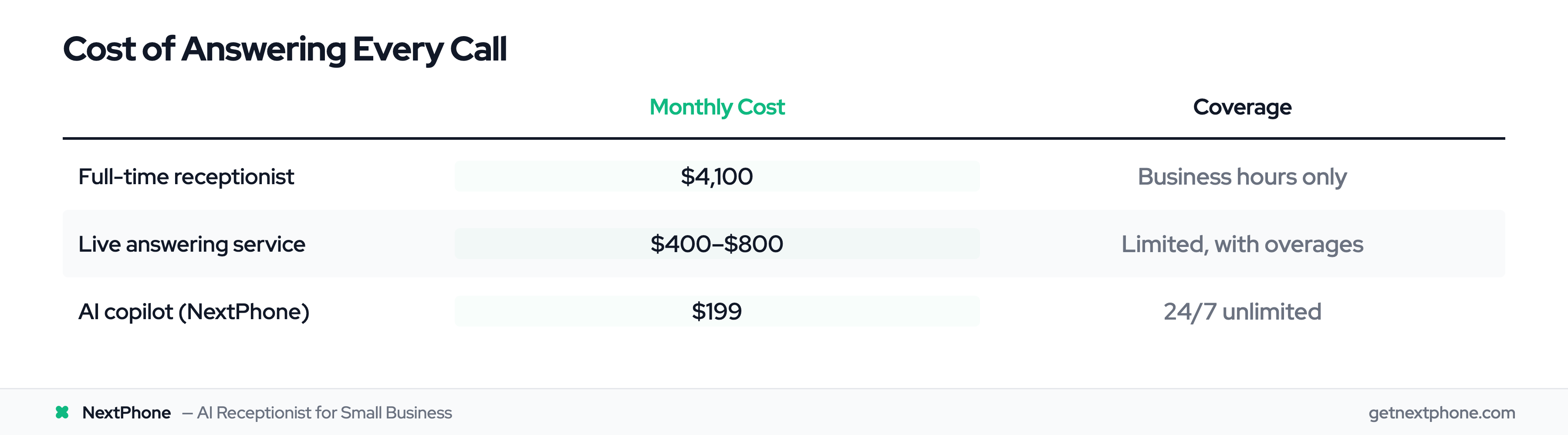
Compare the options:
| Option | Monthly Cost | Coverage |
|---|---|---|
| Full-time receptionist | $4,100 | Business hours only |
| Live answering service | $400-800 | Limited, often with overages |
| AI copilot (NextPhone) | $199 | 24/7 unlimited |
AI copilot delivers 95% cost savings versus hiring and 50-75% savings versus live answering services - with better coverage.
The economics work at any business size. A solo contractor paying $199/month gets the same 24/7 coverage that used to require significant staff investment.
Consistent Customer Experience
Human receptionists have good days and bad days. Busy periods mean rushed interactions. Training new hires takes time, and turnover restarts the cycle.
AI copilot provides consistent quality for every caller. The customer calling at 5 PM on your busiest day gets the same professional experience as someone calling Tuesday morning when things are slow.
This consistency shapes customer perception. When every call gets answered professionally, your business feels organized and responsive - because it is. Accenture's Technology Vision 2025 highlights AI autonomy as a key trend.
Emergency Handling That Protects Revenue
Remember: 6.2% of calls to contractors are true emergencies. Let's look at what that means financially.
One emergency HVAC job in summer: $1,500+ revenue. One emergency plumbing call: $800+ revenue. One emergency after-hours electrical issue: $1,200+ revenue.
Missing one emergency call per month costs more than a full year of AI copilot service. Proper routing ensures emergencies reach you immediately while non-emergencies don't interrupt your evening. Deloitte's research on GenAI in Customer Service shows the transformative impact. Twilio's latest report highlights conversational AI's rapid adoption, with a 31-point satisfaction gap between business perception and customer reality.
Spam Filtering That Saves Time
Our data shows 7% of business calls are spam or robocalls. For a business receiving 50 calls per month, that's 3-4 spam calls wasting your time.
AI copilot filters these before they reach you. Instead of answering to discover it's a robocall about car warranties, you only get notified about real customers.
Data and Insights You Can Use
Every call gets logged with details: time, duration, caller intent, outcome. Over time, this data reveals patterns:
- When do customers call most often?
- What services do they ask about?
- How many callbacks were requested? (Our data shows 25.4% of callers request callbacks)
- What's your actual call volume?
These insights inform business decisions—staffing, service offerings, marketing focus. AI-related tasks on Zapier grew 760% in 2 years, showing how automation is becoming central to business operations.