
A Denver HVAC company changed three words in their AI receptionist's greeting. Instead of "Thanks for calling," they switched to "We're here to help." The result? Booking rates jumped 18% over the next two weeks.
Three words. Nearly one-fifth more appointments.
Here's what's wild: most businesses never test their greetings at all. They write something that sounds professional, plug it in, and hope for the best. Meanwhile, they're leaving serious revenue on the table—small script tweaks can double response rates.
You wouldn't launch a website without testing different headlines or CTAs. Why would you treat your phone greeting any differently? Especially when calls convert 10-15 times better than web leads-marketing-statistics).
In this guide, you'll learn the complete framework for A/B testing call scripts - from forming a hypothesis to calculating statistical significance. Whether you're using an AI virtual receptionist or training human agents, you'll know exactly which greeting turns more callers into customers.
But here's the challenge: how do you know which greeting actually works better? Let's start with why it matters so much.
Why Your Greeting Makes or Breaks Conversion Rates
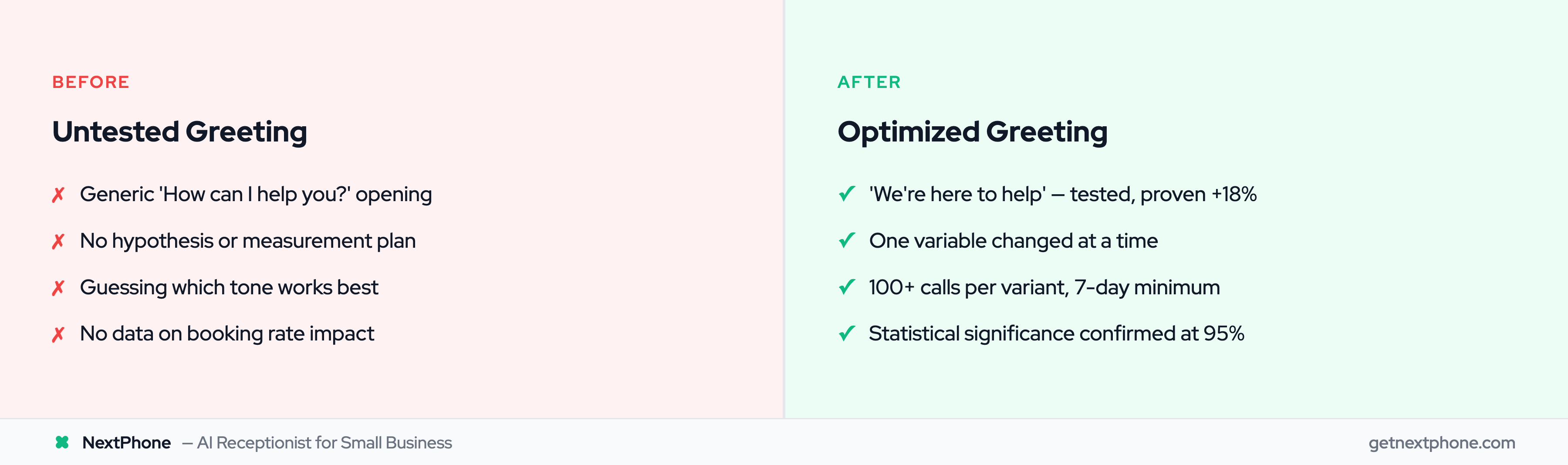
The first five seconds of a phone call determine everything. That's when your caller decides whether to engage, ask their question, or hang up and call your competitor.
The stakes are higher than most people realize.
The First Five Seconds Determine Everything
Research shows that 60% of customers still prefer calling businesses. But here's the catch - 80% won't leave a voicemail if you don't answer. They'll just call the next company on Google.
We've analyzed 130,175 calls across 45 home services businesses over seven months. The data is clear: 74.1% of calls go unanswered without an AI receptionist. That's nearly three out of four potential customers you're missing.
When an AI receptionist answers in under 5 seconds, your greeting becomes THE first impression. There's no small talk or rapport building beforehand. Those opening words carry all the weight.
Studies on greeting optimization show that well-crafted greetings achieve 97% interaction rates compared to generic ones. That's the difference between "How can I help you?" and actually helping.
Small Changes, Big Results
One call center implemented proper greeting protocols across their team. The result? A 47% increase in appointments set. They didn't change their service offering or pricing. Just how they answered the phone.
Here's another perspective: phone calls are 10-15 times more likely to convert than web leads. When someone picks up the phone, they're already higher intent. Your greeting either capitalizes on that momentum or kills it.
Our data from those 130,175 calls reveals something fascinating: 25.4% of callers explicitly request callbacks, 7.7% want scheduling, and 6.9% are asking for quotes or estimates. That's over 40% of calls with clear conversion intent.
These aren't people browsing your website or "just looking." They're ready to do business. The question is whether your greeting moves them forward or creates friction.
So how do you find the greeting that actually moves the needle? That's where A/B testing comes in.
The A/B Testing Framework for Call Scripts
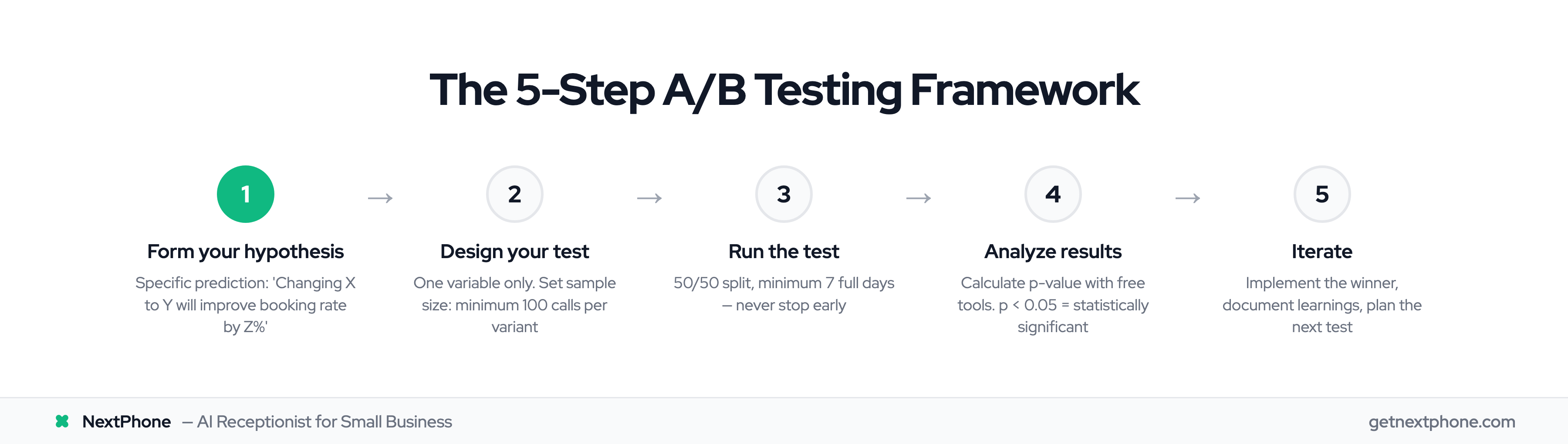
A/B testing isn't complicated. You're just comparing two greeting versions with real calls to measure which performs better. But doing it right requires structure. The CRO tools market reached $5.07B in 2025 with 223% average ROI—these methodologies work.
What Is A/B Testing for Call Greetings?
Here's how it works: you split your incoming calls 50/50 between two different greetings (we'll call them Variant A and Variant B). You measure conversion metrics for each. Then you determine whether the difference is statistically significant or just random chance.
Instead of guessing which greeting sounds better in a conference room, you let real customer behavior tell you what actually works.
For home services businesses, this is particularly valuable. You've got high call volume - often 20 to 100+ calls per day - which makes testing feasible. Unlike low-volume B2B sales where you might wait months for significant data, you can get results in one to two weeks.
The Five-Step Testing Process
Every successful greeting test follows the same framework:
1. Form Your Hypothesis: Start with a specific prediction. "A friendly greeting will improve booking rate by 10% compared to a professional greeting."
2. Design Your Test: Choose exactly one variable to test. Set your sample size requirement. Define how you'll measure success.
3. Run the Test: Split traffic evenly between variants. Run for the minimum required duration - never stop early.
4. Analyze Results: Calculate whether your results are statistically significant. Did Variant B really perform better, or could it be random chance?
5. Iterate: Implement the winner. Document what you learned. Plan your next test.
The most common mistake? Testing multiple things at once. If you change the greeting tone AND the questions AND the CTA simultaneously, you'll never know which change drove results.
Test one variable at a time. Always.
Testing Tip: If you receive 50 calls per day, you'll reach 100 calls per variant (200 total) in 4 days. But you should still run for a full week to account for weekday vs. weekend variance. Monday callers often behave differently than Saturday callers.
Let's break down each step with real examples you can use.
Step 1: Forming Your Test Hypothesis
A good hypothesis isn't "let's try a friendlier greeting." That's too vague. You need specificity.
Anatomy of a Good Hypothesis
Use this format: "Changing [variable] from [A] to [B] will improve [metric] by [amount]."
Here are real examples:
Example 1: "Changing the greeting from 'How can I help you?' to 'I can help you schedule service right now' will improve booking rate by 10%."
Example 2: "Using a friendly tone instead of a formal tone will increase callback request conversion by 15%."
Example 3: "Asking about service needs before company introduction will reduce call duration by 20 seconds while maintaining the same booking rate."
Notice what makes these hypotheses testable: they're specific, they're measurable, and they focus on one variable.
Common Greeting Variables to Test
Not all variables have equal impact. Here's the priority hierarchy based on what drives the most significant results:
-
Priority 1: Greeting warmth - Friendly vs. professional vs. neutral tone. This often creates the biggest conversion differences.
-
Priority 2: Opening statement - Lead with your company name vs. lead with a helper statement ("We're here to help").
-
Priority 3: Question structure - Open-ended ("What can I help with?") vs. directed ("Are you calling to schedule or get a quote?") vs. multiple choice.
-
Priority 4: CTA placement - Offer to schedule early in the greeting vs. qualify first, then offer scheduling. Research shows personalized CTAs yield 42% higher conversion.
-
Priority 5: Qualification order - Ask about their need before collecting details vs. collect contact info first.
Home Services Examples
Your greeting should match your typical caller intent. Here are industry-specific variations:
Emergency Services (HVAC, Plumbing:
- Variant A: "We can help right away. Is this an emergency?"
- Variant B: "What's happening with your system? I'll get you the help you need."
Routine Service:
- Variant A: "Thanks for calling. Are you ready to schedule service?"
- Variant B: "Thanks for calling. What service do you need help with today?"
After-Hours Calls:
- Variant A: "You've reached us after hours. Leave your details and we'll call first thing tomorrow morning."
- Variant B: "Thanks for calling! I'm available 24/7. What project can I help with?"
Once you have your hypothesis, it's time to design a valid test.
Designing Your A/B Test
This is where most people get the math wrong. Let me make it simple.
Calculate Your Sample Size
You need at least 100-200 calls per variant. That's the industry standard for statistical validity.
Why? Because with fewer calls, you can't distinguish between real performance differences and random chance. Flip a coin 10 times and you might get 7 heads - but that doesn't mean the coin is biased. Flip it 200 times and patterns become meaningful.
For greeting tests, here's the quick reference:
- 20 calls per day: You'll reach 100 calls per variant in 10 days
- 50 calls per day: You'll reach 100 calls per variant in 4 days
- 100 calls per day: You'll reach 100 calls per variant in 2 days
However - and this is critical - don't stop as soon as you hit 100 calls. Run for at least 7 full days regardless of sample size. Why? Because Mondays are different from Fridays, and weekdays are different from weekends.
If you want to get technical about it, use a sample size calculator. You'll input your baseline conversion rate (say, 15% of calls book appointments) and your minimum detectable effect (say, you want to detect a 3% improvement to 18%). The calculator will tell you exactly how many calls you need.
The math accounts for statistical power (typically 80%) and confidence level (typically 95%). These are industry standards.
Choose Your Success Metrics
Pick one primary metric. Just one.
For most home services businesses, this should be booking rate - the percentage of calls that result in a scheduled appointment. That's what drives revenue.
Other options for your primary metric:
- Callback request conversion: Did they leave contact info for you to call back?
- Quote request completion: Did you successfully gather information for an estimate?
- Call duration: Sometimes shorter is better (efficiency), sometimes longer (engagement)
Track secondary metrics too, but don't optimize for them:
- Average call duration
- Customer satisfaction (if you're using post-call surveys)
- Qualification rate (percentage who answer key questions)
- Hang-up rate before completion
With NextPhone's call analytics dashboard, all of these metrics are tracked automatically. You don't need to manually count conversions or time calls.
Set Your Test Duration
Minimum: 7 full days. No exceptions.
Don't stop early even if one variant appears to be winning after day 3. Statistical significance calculations assume you're running to completion. Peeking at results and stopping early introduces bias.
Extend your test if:
- Results are very close (less than 5% difference)
- Performance is inconsistent day-to-day
- A holiday or special event happened during the test period
- You haven't reached minimum sample size yet
For seasonal businesses like HVAC, be mindful of context. A greeting tested during summer's peak A/C repair season might perform differently during mild spring weather.
Now you're ready to see what greeting variations actually work.
Proven Greeting Variations to Test
Let's get specific. Here are copy-paste ready greetings you can test right now, organized by common testing scenarios.
Friendly vs. Professional Greetings
This is the most popular first test - and for good reason. Tone dramatically affects caller comfort and willingness to engage.
Variant A - Friendly Approach: "Hi! Thanks for calling ABC Plumbing. We're here to help with all your plumbing needs. What brings you in today?"
Variant B - Professional Approach: "Thank you for calling ABC Plumbing. This is Sarah, your plumbing specialist. How may I assist you?"
When to test this: You're unsure about audience preference, or you handle a mix of emergency and routine calls.
Hypothesis example: "A friendly greeting will improve booking rate by 10% for routine service calls by making callers feel more comfortable."
Direct vs. Open-Ended Questions
Some callers appreciate guidance. Others want to explain in their own words. Test which your audience prefers.
Variant A - Direct/Guided: "Thanks for calling ABC Heating & Cooling. Are you calling to schedule service, get a quote, or speak with a technician?"
Variant B - Open-Ended: "Thanks for calling ABC Heating & Cooling. What can we help you with today?"
When to test this: You have high call volume with mixed intents (some scheduling, some questions, some quotes).
Hypothesis example: "Guided questions will reduce call duration by 20% while maintaining booking rate by helping callers articulate their needs faster."
Remember, our data shows 25.4% request callbacks and 7.7% want scheduling. The direct approach might surface these intents faster, reducing friction.
CTA Placement: Early vs. Late
Should you offer to schedule right away, or qualify the caller first? Both approaches have merit.
Variant A - Early CTA: "Hi! I can get you scheduled right away. What day works best for you?" (Then ask qualifying questions about service needed)
Variant B - Late CTA: "Hi! What service do you need help with today?" (Qualify first, then offer scheduling)
When to test this: Most of your calls are high-intent scheduling requests, not general questions.
Hypothesis example: "Leading with scheduling CTA will improve booking rate by 15% by reducing friction for ready-to-book callers."
Industry-Specific Greeting Tests
Tailor your tests to your service type:
HVAC Emergency Calls:
- Variant A: "Is this an emergency? We can dispatch a technician right away."
- Variant B: "What's happening with your system? I'll make sure you get help quickly."
Plumbing Quote Requests:
- Variant A: "I can provide a ballpark quote over the phone, or schedule an on-site estimate. Which would you prefer?"
- Variant B: "Tell me about your project and I'll help you get accurate pricing."
General Contractor After-Hours:
- Variant A: "You've reached us after hours. Please leave your name, number, and project details. We'll call you first thing tomorrow."
- Variant B: "Thanks for calling! I'm available to help 24/7. What project are you planning?"
Testing Tip: Align your greeting with your most common call intent. Based on NextPhone's analysis of 130,175 calls, over 40% are high-intent (scheduling, quotes, callbacks). Make sure your greeting serves these callers well.
With your variations ready, here's how to run the test properly.