The Yelp Call Attribution Problem: Tracking What You Can't Capture
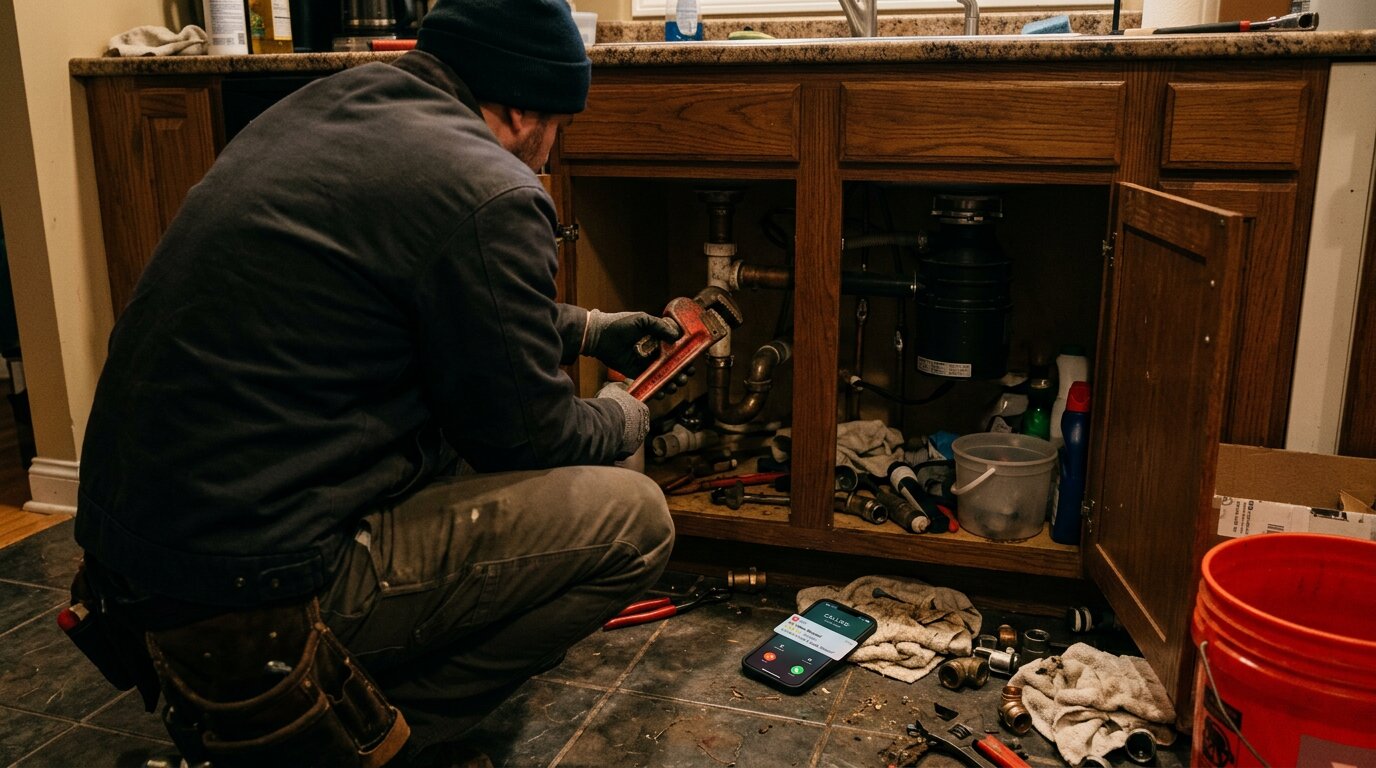
Your Yelp listing shows 4.8 stars. Customers read glowing reviews about your emergency plumbing service. Someone's pipe bursts at 8 PM. They call your number from Yelp. It goes to voicemail. They call the next contractor. You just lost a $4,200 job.
This happens more than you think. Industry research shows 74.1% of calls to home services businesses go unanswered, including calls to contractors like you. That's three out of every four potential customers calling someone else.
Why Yelp Calls Are Hard to Track
The attribution problem is real. A customer calls your business. Did they find you on Yelp? Google? A referral? Without proper tracking, you're flying blind on which marketing channels actually drive calls.
Yelp is a major lead source for local businesses. Customers research you, read reviews, check your star rating, then call. But you don't know any of that context when you answer (if you answer). You have no idea if they saw your 5-star reviews or called to complain about your 1-star.
The Cost of Missing Review-Driven Calls
Let's do the math. Typical contractor receives 42 calls per month. About 30% come from Yelp. That's 13 calls. At a 74.1% miss rate, 10 of those Yelp calls go straight to voicemail.
If just 20% of those calls would convert at an average $3,500 project value, you're losing $7,000 per month from Yelp alone. That's $84,000 per year in missed revenue from one marketing channel. Research shows 42% of SMBs lose $500+ per month to missed calls, and businesses with strong Yelp presence lose even more.
How Yelp Call Tracking Works (And Why It's Not Enough)
Yelp knows this is a problem. They've built tracking tools. But tracking who called isn't the same as actually answering the call.
Yelp's Free Call Reporting
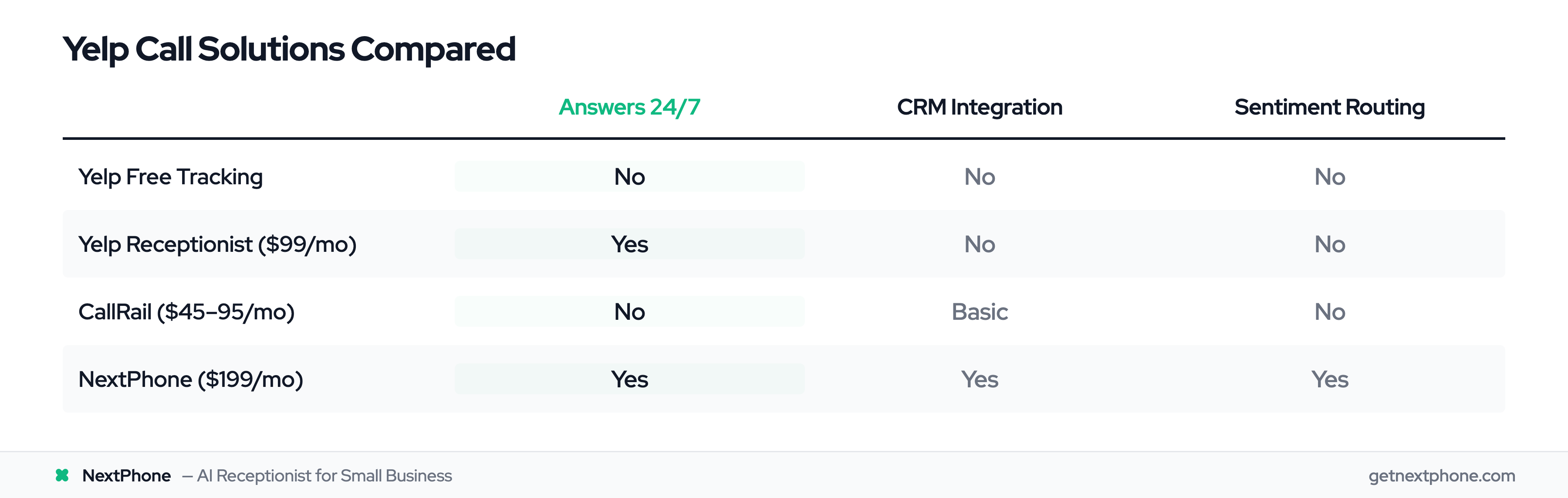
If you're a Yelp advertiser, you get free call reporting. Yelp's call tracking replaces your phone number with a forwarding number (or multiple numbers) to track which calls came from your Yelp listing.
For each call, you can see the date, time, duration, and a partial phone number. The data lives in your Yelp for Business dashboard. You can track average call duration, time of day, and total calls received versus answered.
This is helpful for attribution. You can finally prove Yelp is generating calls. But it doesn't solve the core problem: you're still missing most of those calls.
Third-Party Call Tracking (CallRail)
Some businesses use third-party call tracking services like CallRail to get more detailed data. You place a unique tracking number on your Yelp listing, and CallRail logs every call: full caller ID, recording, transcription.
This gives you better data than Yelp's native tracking. You can see the full phone number (not masked), listen to recordings, and integrate basic data with your CRM.
But again: tracking ` answering. CallRail tells you who called. It doesn't pick up the phone at 8 PM when you're at dinner.
What Tracking Doesn't Solve
Here's what basic call tracking misses:
- Availability: You still can't answer when you're on a job site, on a ladder, or after hours
- Context: You don't know the caller's sentiment (excited vs angry), urgency level, or which review triggered the call
- Integration: Data lives in Yelp's dashboard or CallRail's system, not automatically synced to your CRM where you manage leads
One Reddit user put it perfectly: "I get tons of calls from my Yelp listing but have no idea which ones actually came from there vs Google." Another said: "Yelp's call tracking is garbage. They mask the number so I can't even call customers back."
The Gaps: After-Hours Calls, Spam Filtering, and Integration
Beyond basic tracking, there are three big problems nobody talks about.
When Yelp Calls Actually Happen (After Hours)
Customers don't just search Yelp during business hours. They browse reviews at night. They research contractors while watching TV. Emergency searches happen at 2 AM when a pipe bursts.
A lot of calls to home services businesses happen outside standard 9-5 hours. That means plenty of potential customers are calling when you're closed, at dinner, or asleep.
Yelp searchers expect instant answers. They're comparing multiple contractors. If you don't answer, they move to the next listing. Response speed matters more than your star rating.
The Spam Problem Nobody Talks About
Not all Yelp calls are legitimate customers. A meaningful share are spam or robocalls: competitors calling to gather pricing, sales reps pitching services, automated calls.
Without intelligent filtering, you're wasting time on junk calls or paying an answering service to screen spam. Every spam call answered is time away from real customer conversations.
Yelp's AI Answering Services (Host & Receptionist)
Yelp launched two AI-powered solutions in October 2025 to address the answering problem. Yelp Receptionist ($99/month) handles calls for local businesses, and Yelp Host ($149/month) manages restaurant reservations.
Both services answer 24/7, ask qualifying questions, and capture lead information. They're pre-trained on your Yelp business data and fully customizable. This follows a broader trend: 85% of customer service leaders will explore or pilot customer-facing conversational GenAI in 2025, and 65% of businesses are already using AI in some capacity.
The limitation? They're locked into Yelp's ecosystem. Yelp Receptionist doesn't integrate with your CRM (HubSpot, Salesforce, Pipedrive). It doesn't send follow-up SMS. It doesn't filter spam using your existing criteria. And it costs $99-149/month for basic answering, no sentiment routing, no advanced integration.
Review Sentiment + Call Routing: Understanding Context Before You Answer
Here's what nobody else is doing: connecting review sentiment to call handling.
Why Caller Sentiment Matters
Think about the customer journey. Someone searches "emergency plumber near me" on Yelp. They see your listing. They read reviews. Their emotional state is shaped by what they just read.
Excited caller (saw 5-star review): "I saw you have amazing reviews for emergency service. Can you help me today?"
Angry caller (saw 1-star review or left one themselves): "I saw you charged someone $800 for a simple repair. Is that true?"
Same business, same phone number, but completely different calls. One needs friendly booking assistance. The other needs careful conflict resolution.
One business owner on a forum said: "Customer left a 1-star review, then called. I answered not knowing they were angry. Would've prepared differently if I knew."
How AI Detects Review Context
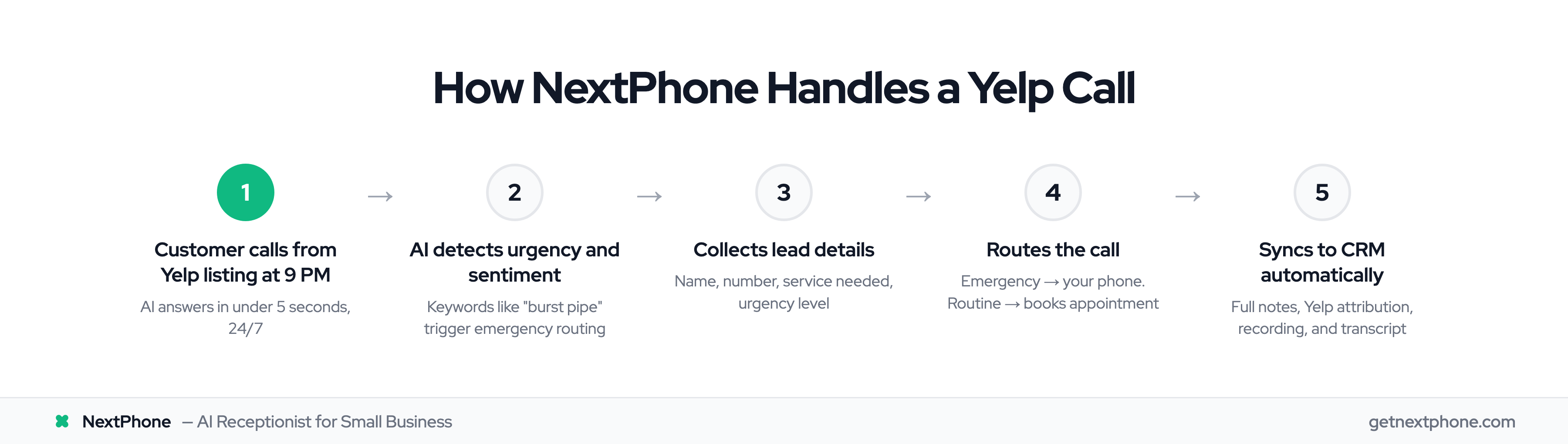
Modern voice sentiment analysis uses AI and natural language processing to detect positive, negative, or neutral emotion in real-time. It transcribes the call and analyzes tone, keywords, and speech patterns.
Urgent calls rank among the top reasons people call, using language like "emergency," "urgent," or "ASAP." True emergencies are a recurring reason too: pipe burst, no power, AC out in 95-degree heat.
An AI receptionist can detect:
- Urgency keywords: "emergency," "broken," "flooded," "burst pipe"
- Sentiment indicators: Frustrated tone, angry language, or enthusiastic praise
- Review references: "I saw your reviews," "someone complained about," "loved your 5-star rating"
Smart Routing Based on Sentiment
Once the AI understands context, it can route intelligently:
- Positive + routine: AI handles the entire call, books appointment, collects info, sends confirmation
- Negative + complaint: Route immediately to owner for personal attention and conflict resolution
- Urgent + emergency: Transfer to your phone while AI gathers details (location, nature of emergency, contact info)
- After-hours + non-urgent: AI collects information, schedules callback for next business day, sends confirmation SMS
This is the missing link. Tracking tells you they called from Yelp. AI answering picks up the phone. But sentiment-based routing ensures the right person handles the right call at the right urgency level.