
Here's the truth most business owners don't want to hear: 74.1% of your calls currently go unanswered. Your customers already know you're not picking up - they're hearing your voicemail greeting right now.
The #1 question we hear about AI receptionists isn't "How does it work?" or "What does it cost?" It's this: "Will customers know it's AI receptionist technology, and will they care?"
This fear is understandable. You don't want to deceive your customers. You've built your business on trust and personal relationships. The thought of "tricking" people with automation feels... wrong.
But here's the better question: Will your customers care if it's AI - as long as their call gets answered in under 5 seconds, they get accurate information, and their problem gets solved?
In this guide, we'll tackle the transparency question head-on. You'll learn the legal requirements (spoiler: there usually aren't any), real customer reaction data, practical disclosure scripts for different approaches, and industry-specific best practices. Most importantly, you'll discover how transparency - when paired with effective AI - actually builds trust rather than damaging it.
Will Customers Know It's an AI Receptionist?
Let's start with the obvious question: Can customers tell they're talking to AI?
The Technology Reality
Modern AI voice technology has improved dramatically. Today's AI receptionists sound natural, handle conversational flow, and adapt to different contexts. They're nothing like the robotic "press 1 for sales" systems your customers hate.
That said, some customers will know immediately - especially tech-savvy callers or those specifically listening for AI indicators. Others won't notice or won't care enough to analyze whether they're talking to a human or AI.
Detection depends on several factors: the complexity of the conversation, the customer's familiarity with AI voice systems, the naturalness of the AI's voice, and frankly, whether the customer is even paying attention to that detail.
But here's the critical insight: whether customers know isn't actually the question that matters most.
What Customer Data Actually Shows
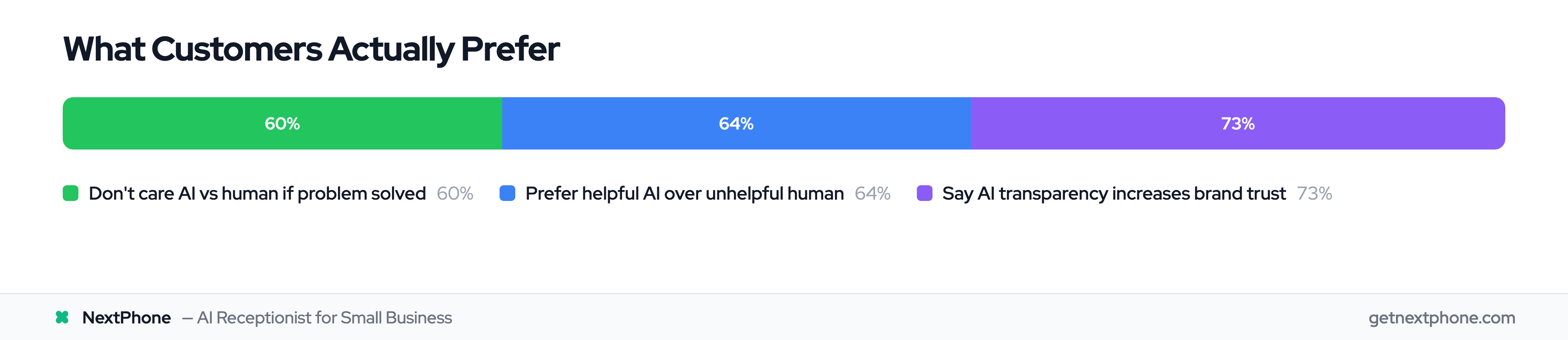
The data challenges our assumptions about what customers want. According to Zendesk's CX Trends Report, 60% of customers don't care whether AI or a human helps them - as long as their problem gets solved.
Gartner's research shows complexity here: 64% of customers would prefer companies didn't use AI for customer service, and 53% would consider switching to a competitor. But the same research shows that 64% say they'd prefer helpful AI over an unhelpful human. Think about that—the issue isn't AI itself, it's poor AI implementation.
And J.D. Power's customer satisfaction studies found that call answer speed (getting picked up in under 30 seconds) ranks higher in satisfaction scores than the human versus AI distinction.
Your customers aren't conducting philosophical debates about artificial intelligence. They're trying to book an appointment, check your hours, or get a quick question answered. Speed and accuracy matter more than the technical classification of who's helping them.
The Real Customer Preference Hierarchy
Here's what customers actually prefer, ranked from most to least desirable:
- Fast, helpful AI - Answers in under 5 seconds, provides accurate information, solves their problem immediately
- Slow, helpful human - Eventually answers (after 45+ seconds), eventually provides correct information, solves problem with delays
- Fast, unhelpful human - Picks up quickly but doesn't know the answer, transfers repeatedly, creates frustration
- Voicemail - No answer at all, requiring callback waiting and phone tag
That fourth option? That's where 74.1% of calls currently go in traditional setups. While you're worrying about whether customers will "accept" AI, they're already accepting your voicemail greeting - and then calling your competitor who actually answered.
NextPhone's AI virtual receptionist answers in under 5 seconds. Industry average human answer time is 45+ seconds. When humans are even available - which, again, they're not for 74% of calls.
The question isn't "Will customers know it's AI?" The question is "Will customers finally get their calls answered?"
Are You Required to Disclose Your AI Receptionist?
Before diving into transparency strategies, let's address the legal question: Do you actually have to tell customers you're using an AI receptionist?
Federal Regulations
At the federal level, there's no blanket requirement to disclose AI phone answering systems. The FTC's guidelines on AI disclosure focus on preventing deceptive practices rather than mandating disclosure.
The key legal standard is this: you can't make false claims about having a human receptionist if you're using AI. But simply not mentioning it? That's not deception under current federal law.
The deceptive practices standard means you can't actively lie. If your website says "Our friendly human receptionists are standing by," that's a problem. But if you simply say "Call us at [number]" and AI answers, that's legally acceptable in most contexts.
That said, federal regulations are just the baseline. Industry-specific rules, state laws, and professional ethics standards may require more.
Industry-Specific Requirements
Healthcare Practices (Medical, Dental, Therapy:
Healthcare regulations require privacy protections for patient information - and those protections apply equally to AI and human staff. The regulations don't explicitly require you to disclose that an AI is handling calls.
However, healthcare transparency standards are higher than most industries. Patient trust is paramount, and sensitive health information requires extra care.
Best practice for healthcare: Disclose upfront, especially when handling appointment scheduling or any patient information. Frame it positively: "Thank you for calling [Practice Name]. This is our AI receptionist."
Legal Practices (Attorneys, Law Firms):
The American Bar Association has issued guidance on technology-assisted communication. While not creating a hard requirement, ABA opinions recommend disclosure when AI handles initial client contact.
Attorney-client privilege and professional responsibility standards mean lawyers must supervise AI systems and ensure client confidentiality. Many state bar associations suggest upfront disclosure as the safest practice.
Best practice for legal: Disclose for new client calls and explain attorney supervision. "Good morning, [Law Firm Name]. This is our AI scheduling assistant, supervised by our attorneys. I can help you book a consultation."
General Business (Retail, Services, B2B):
For most general business contexts, there are no specific disclosure requirements. Customer service, retail, professional services, and B2B companies have flexibility in their approach.
About 41% of small and medium businesses now use some form of AI phone answering, according to Software Advice, and disclosure practices vary widely. Your industry norms and brand values should guide your decision.
The Ethical Standard
Legal compliance is the floor, not the ceiling. Even when disclosure isn't required, transparency can build trust.
PwC's AI Trust Study found that 73% of consumers say transparency about AI use increases their trust in a brand. That's nearly three-quarters of customers viewing honesty as a positive factor.
Ethics isn't just about avoiding legal problems - it's about building long-term customer relationships. When in doubt, disclose. But disclose strategically.
Frame transparency positively: "Our AI receptionist ensures you never miss a call" positions AI as a customer service enhancement. "We use a bot because we can't afford a receptionist" makes you sound cheap.
The ethical standard and the business strategy align here: honest disclosure, positioned well, creates competitive advantage rather than liability.
AI Receptionist Disclosure Strategies (Three Approaches)
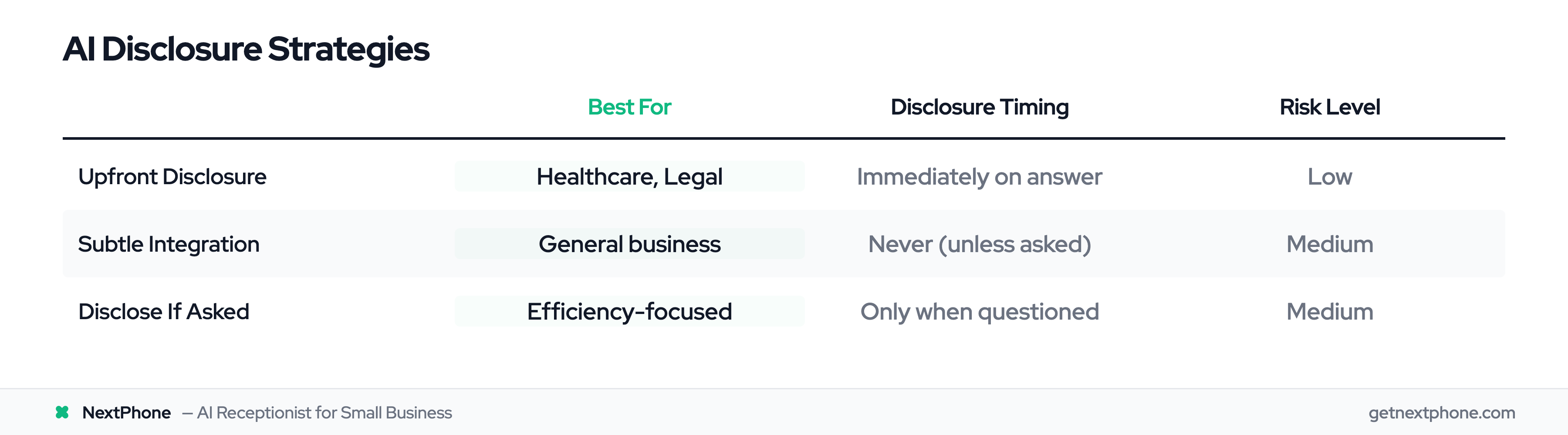
There's no one-size-fits-all disclosure strategy. Your approach should depend on your industry, customer base, brand values, and how confident you are in your AI's performance.
Let's explore three disclosure approaches with specific scripts you can adapt.
Approach #1 - Upfront Disclosure
When to Use This Approach:
Use upfront disclosure for healthcare and legal practices where professional standards suggest it. Also use it when your customer base explicitly values transparency, or when your AI is so effective that disclosure becomes a feature rather than a concern.
Upfront disclosure works best when you're confident your AI will deliver excellent service. If customers hear "AI receptionist" and then get fast, accurate help, transparency reinforces your credibility.
Script Examples:
Professional/Transparent: "Thank you for calling [Business Name]. You've reached our AI receptionist, and I can help you with scheduling, questions about our services, or connect you with our team. How can I help you today?"
Friendly/Benefit-Focused: "Hi, this is [Business Name]'s AI assistant. I'm available 24/7 to help you schedule appointments, answer common questions, or get you to the right person. What can I help you with?"
Healthcare-Specific: "Good morning, [Practice Name]. This is our AI receptionist. I can help you schedule appointments, request prescription refills, or connect you with our medical staff for urgent matters. How can I assist you?"
Legal-Specific: "Thank you for calling [Law Firm]. This is our AI scheduling assistant. I can book consultations with our attorneys, answer general questions about our practice areas, or connect you with our legal team. What brings you in today?"
Pros of Upfront Disclosure:
- Builds immediate trust through honesty
- Positions AI as a feature ("24/7 availability") rather than hiding it
- Eliminates any potential "gotcha" moment if customers figure it out later
- Meets professional standards for regulated industries
- Demonstrates confidence in your AI's quality
Cons of Upfront Disclosure:
- Some customers may have initial bias against AI
- Requires high confidence in your AI's performance
- May prompt unnecessary requests for human transfer before AI can demonstrate value
Approach #2 - Subtle Integration
When to Use This Approach:
Use subtle integration for general business settings where disclosure isn't required and your focus is on service delivery. This works well with tech-savvy customer bases that care more about results than process.
Subtle integration lets the quality of the interaction speak first. Customers experience fast, helpful service, and the AI/human question becomes irrelevant to most.
Script Examples:
Natural Introduction: "Good morning, [Business Name]. How can I help you today?"
During conversation, natural language cues: "Let me pull up your account information..." "I can schedule that appointment for you right away..." "I've got your confirmation sent to your email."
Professional Signoff: "Thanks for calling [Business Name]. I've got you scheduled for [time] on [date]. You'll receive a confirmation text shortly. Is there anything else I can help you with?"
The Subtle Approach in Practice:
You're not hiding that it's AI - you're just not leading with that label. If customers ask directly, you answer honestly (see Approach #3 for scripts). But you let the quality of service define the interaction rather than the technology delivering it.
Pros of Subtle Integration:
- No immediate label bias affecting customer perception
- Lets service quality speak first
- Natural conversation flow without technical disclaimers
- Works well when AI quality is high enough that detection isn't an issue
Cons of Subtle Integration:
- Some customers may feel misled if they later realize it's AI
- Requires excellent AI performance to avoid obvious detection
- May not be appropriate for industries with higher transparency expectations
- Could create trust issues if customers value disclosure
Approach #3 - Disclose Only If Asked
When to Use This Approach:
Use on-request disclosure when legal requirements don't mandate upfront disclosure and your focus is purely on problem-solving rather than process explanation.
This approach works when customer satisfaction data shows people care about outcomes more than methods. It's efficient and customer-centric: if they don't ask, they probably don't care.
How to Handle "Are you a real person?"
This question will come up. Here's how to handle it with honesty and confidence:
Direct and Helpful: "I'm an AI assistant for [Business Name], and I can help you with scheduling, service questions, and connecting you with our team. Would you like me to assist you, or would you prefer to speak with a team member directly?"
Confidence-Building: "I'm [Business Name]'s AI receptionist. I handle scheduling and common questions 24/7. For anything complex, I'll connect you with our team right away. How can I help you today?"
Emphasize Capabilities: "I'm an AI system, and I can get you scheduled immediately, answer questions about our services, or transfer you to our staff. What works best for you?"
The Key: Answer honestly, briefly, and immediately redirect to solving their problem. Most customers who ask aren't looking for a philosophical discussion about AI - they just want to know if you can help them.
Pros of Disclose-If-Asked:
- Focuses on results first, process second
- Most efficient approach for routine inquiries
- Respects customer preferences (those who care will ask)
- Aligns with data showing most customers don't care AI vs. human
Cons of Disclose-If-Asked:
- May be perceived as lack of transparency by some customers
- Not appropriate for regulated industries (healthcare, legal)
- Requires excellent handling of direct questions
- Could create issues if customers later feel they were misled
Which Approach Should You Choose?
If you're in healthcare or legal: Approach #1 (upfront disclosure) If you're in general business with transparency-focused brand: Approach #1 If you're in general business focused on efficiency: Approach #2 or #3 If your AI quality is exceptional: Approach #1 turns disclosure into a feature If you're uncertain: Approach #2 offers middle ground
The right choice depends on your specific context, but all three approaches can work when executed well.
Positioning Your AI Receptionist (Words Matter)
How you talk about your AI receptionist matters as much as whether you disclose it. The right framing builds customer confidence. The wrong framing makes you sound cheap or desperate.
Let's fix that.
Frame as Enhancement, Not Replacement
Your AI receptionist isn't a "replacement" for something you're too cheap to afford. It's an enhancement that provides capabilities human-only setups can't match.
Instead of saying:
- "We use a bot to answer calls"
- "We can't afford a full-time receptionist, so we use AI"
- "Our automated system will take a message"
- "We've replaced our receptionist with technology"
Say this:
- "Our AI receptionist ensures you never miss a call, even after hours"
- "We're available 24/7 through our AI phone system"
- "Our AI assistant can schedule you immediately while we're on the call"
- "We've enhanced our availability with AI that answers in under 5 seconds"
Notice the difference? Same technology, completely different positioning. One sounds like a downgrade; the other sounds like improved service.
Emphasize Capabilities, Not Cost Savings
Never position AI as a money-saving measure to customers. Position it as a service-enhancing capability.
Good Positioning Examples:
Service Quality Angle: "We've implemented AI phone answering to guarantee you can reach us anytime, day or night, without ever hitting voicemail."
Consistency Angle: "Our AI receptionist provides consistent, accurate information every single time you call - no 'let me check' or 'I'm not sure.'"
Availability Angle: "Unlike traditional office hours, our AI assistant is ready to help you 24/7/365, including weekends and holidays."
Speed Angle: "Our AI answers in under 5 seconds, so you're never stuck waiting on hold or listening to endless ringing."
Harvard Business Review research found that companies framing AI as "enhancement" rather than hiding it saw 23% higher customer satisfaction scores. The transparency isn't the issue - how you position that transparency determines customer perception.
Lead with Benefits Your Customers Care About
Your customers don't care about your operational decisions. They care about their experience. Lead with what matters to them.
What Customers Actually Want:
- Fast answer times - AI delivers: under 5 seconds vs. 45+ second industry average
- Accurate information - AI delivers: consistent responses with no "let me check" delays
- Immediate action - AI delivers: books appointments, routes calls, provides info while you're on the call
- 24/7 availability - AI delivers: no more "sorry, we're closed" or after-hours voicemail
The Positioning Message:
"You're not using AI because you're cheap or cutting corners. You're using it because you value your customers' time and want them to actually reach you when they call."
That's the message. That's the positioning. That's how transparency becomes a strength rather than a weakness you're trying to hide.
Disclosure Best Practices by Industry
Transparency best practices aren't universal - they're industry-specific. What works for a retail store won't work for a medical practice. Let's break down recommendations by industry.
Healthcare Practices (Medical, Dental, Therapy)
Recommended Transparency Level: HIGH - Upfront disclosure
Why Healthcare Is Different:
Patient trust is the foundation of healthcare relationships. Patients share sensitive health information and expect high privacy standards. Regulatory compliance is legally required, but patient comfort requires going beyond minimum legal requirements.
Disclosure builds confidence that you're taking their privacy seriously and meeting professional standards.
Recommended Approach:
Disclose upfront with emphasis on privacy protections and smart forwarding for sensitive situations.
Example Script:
"Thank you for calling [Practice Name]. This is our AI receptionist. I can help you schedule appointments, request prescription refills, answer questions about our services, or connect you with our medical team for urgent matters. All conversations are private and secure. How can I assist you today?"
Key Compliance Notes:
- Your AI system must be compliant with healthcare privacy standards (encryption, secure data handling, privacy protections)
- Same security standards apply to AI as to human staff
- Document your AI phone system in your privacy practices notice
- Provide clear path to human staff for sensitive health discussions
- Train your AI to recognize and escalate urgent medical situations
The Healthcare Advantage:
When positioned well, AI disclosure in healthcare demonstrates you're investing in patient access. "Our AI ensures you can schedule appointments 24/7, even when our office is closed" shows commitment to patient convenience.
Legal Practices (Attorneys, Law Firms)
Recommended Transparency Level: HIGH - Upfront disclosure for client-facing calls
Why Legal Is Different:
Attorney-client privilege, professional responsibility standards, and bar association ethics rules create higher transparency expectations. Attorneys must supervise technology-assisted communication and ensure client confidentiality.
The ABA's guidance recommends disclosure when AI handles initial client contact, and many state bar associations have adopted similar positions.
Recommended Approach:
Disclose upfront with emphasis on attorney supervision and client confidentiality protections.
Example Script:
"Good morning, [Law Firm Name]. This is our AI scheduling assistant, and all our AI systems are supervised by our attorneys. I can help you book a consultation, answer general questions about our practice areas, or connect you with our legal team for case-specific matters. Attorney-client confidentiality applies to all communications. How can I assist you?"
Key Compliance Notes:
- Attorneys must supervise AI system configuration and responses
- Client confidentiality protections apply to AI interactions
- Disclosure is recommended (and required in some jurisdictions) for initial client contact
- Clear attorney availability for substantive legal questions
- Document AI use in client communications policies
The Legal Advantage:
Transparency demonstrates professionalism and tech-savviness. "We use AI to ensure potential clients can always reach us" shows you're modernizing client service while maintaining professional standards.
General Business (Retail, Services, B2B)
Recommended Transparency Level: FLEXIBLE - Choose based on brand values
Why General Business Is Different:
Without industry-specific regulations, you have flexibility to choose the disclosure approach that matches your brand values and customer expectations.
The data shows 60% of customers don't care whether AI or human helps them if their problem gets solved. This gives you room to focus on service quality over process disclosure.
Recommended Approach:
Choose the disclosure strategy that aligns with your brand positioning and customer base. Test different approaches and monitor customer satisfaction.
Example Scripts:
Retail/Consumer (Subtle approach): "Thanks for calling [Store Name]. I can help you with store hours, product availability, current promotions, or connect you with our team. What are you looking for today?"
Professional Services (Upfront approach): "Good afternoon, [Company Name]. This is our AI assistant, and I'm here to help schedule consultations, answer service questions, or route you to the right department. How can I assist?"
B2B (Benefit-focused approach): "Good morning, [Company Name]. I'm available 24/7 to help with order status, technical support requests, or connecting you with your account manager. What can I do for you?"
The General Business Advantage:
You can A/B test disclosure approaches and let customer feedback guide your strategy. If customer satisfaction scores are identical between disclosure approaches, choose the one that feels most authentic to your brand.
Remember Zendesk's finding: 60% of customers don't care AI versus human if the problem is solved. For general business, focus on solving problems excellently, and transparency strategy becomes secondary.