
You're under a sink, water spraying everywhere, phone ringing in your pocket. By the time you dry your hands and pull it out, it's gone to voicemail. The customer calls the next plumber. You just lost a $3,500 job.
This happens every single day to field service contractors. You're excellent at your trade, but you can't answer the phone while you're working. ServiceM8 helps you manage jobs brilliantly—but it can't answer the calls that create those jobs in the first place.
Here's how NextPhone fills that gap.
What Is ServiceM8?
Job Management Built for Field Service
ServiceM8 is job management software built specifically for trade contractors and home service businesses. If you're a plumber, electrician, HVAC technician, cleaner, or locksmith, ServiceM8 is designed for you. ServiceM8 manages $22B+ in jobs worldwide across 30 countries.
The platform handles everything after you win a job: digital job cards, scheduling, quotes, invoicing, and payments. Your technicians get a mobile app (iOS primarily) that shows their schedule, job details, customer info, and allows them to complete checklists, capture photos, and get customer signatures—all paperless.
Who Uses ServiceM8
ServiceM8 originated in Australia and has grown 248% over the past three years, earning a 94% user satisfaction rating. The target market is clear: small to mid-size field service operations, typically ranging from solo operators up to teams of 20 staff.
Pricing reflects this positioning. ServiceM8 starts at $29 per month for a single user and scales to about $119 per month for 10 users. The job-volume-based pricing model means you pay for what you use, not rigid per-seat tiers.
Core Features
ServiceM8 shines at workflow management. You can create job templates for common service types, automate scheduling based on technician availability and location, send quotes directly from the field, and sync everything with accounting platforms like Xero and QuickBooks.
The platform also integrates with thousands of apps via Zapier (which serves 2.2 million+ businesses), Make, and other automation platforms. It offers an Open API and webhook support for custom integrations.
But here's what it doesn't do: answer your phone.
The One Thing ServiceM8 Can't Do: Answer Your Phone
ServiceM8 Manages Jobs, Not Calls
ServiceM8 is excellent at managing jobs once you have them. The challenge is getting those jobs in the first place. When a customer calls your business, ServiceM8 can't pick up. You have to answer, qualify the lead, and manually enter their information into the system.
That's fine if you're sitting at a desk. But you're not. You're in an attic. On a ladder. Under a house. Hands covered in grease, drywall mud, or worse.
The Field Service Reality
Our analysis of 130,175 customer service calls from 45 home services contractors over 7 months revealed a harsh truth: field service professionals work with their hands, not their phones. Industry data shows 60% of companies say labor shortages affect job completion—there's no time to answer phones when you're short-staffed.
62% of companies say finding clients is their biggest challenge—yet they miss calls when customers actually reach out.
Plumbers are under sinks with water running. Electricians are in breaker boxes where safety protocols prevent phone use. HVAC technicians are on roofs installing condensers. You physically cannot answer your phone during most of your workday.
And when you can answer? You're trying to have a conversation with a potential customer while simultaneously working, which means you're either giving poor service on the call or doing poor work on the job.
After-Hours Coverage Gap
Here's another problem: 73% of real estate customer calls happen outside standard 9-5 business hours, and home services see similar patterns. 62% of home service companies say finding clients is their biggest challenge—yet they miss calls when customers actually reach out. Customers call when their problem becomes urgent—evenings, weekends, early mornings.
ServiceM8 doesn't help here either. It's job management software, not a 24/7 answering service. Calls during off-hours go straight to voicemail.
Customers don't leave detailed voicemails. They call the next contractor. Your competition answers, you lose.
What Missed Calls Cost Field Service Contractors
The 74.1% Problem
In our study of 130,175 calls to home services contractors, we found that 74.1% went completely unanswered. That's three out of every four potential customers calling someone else.
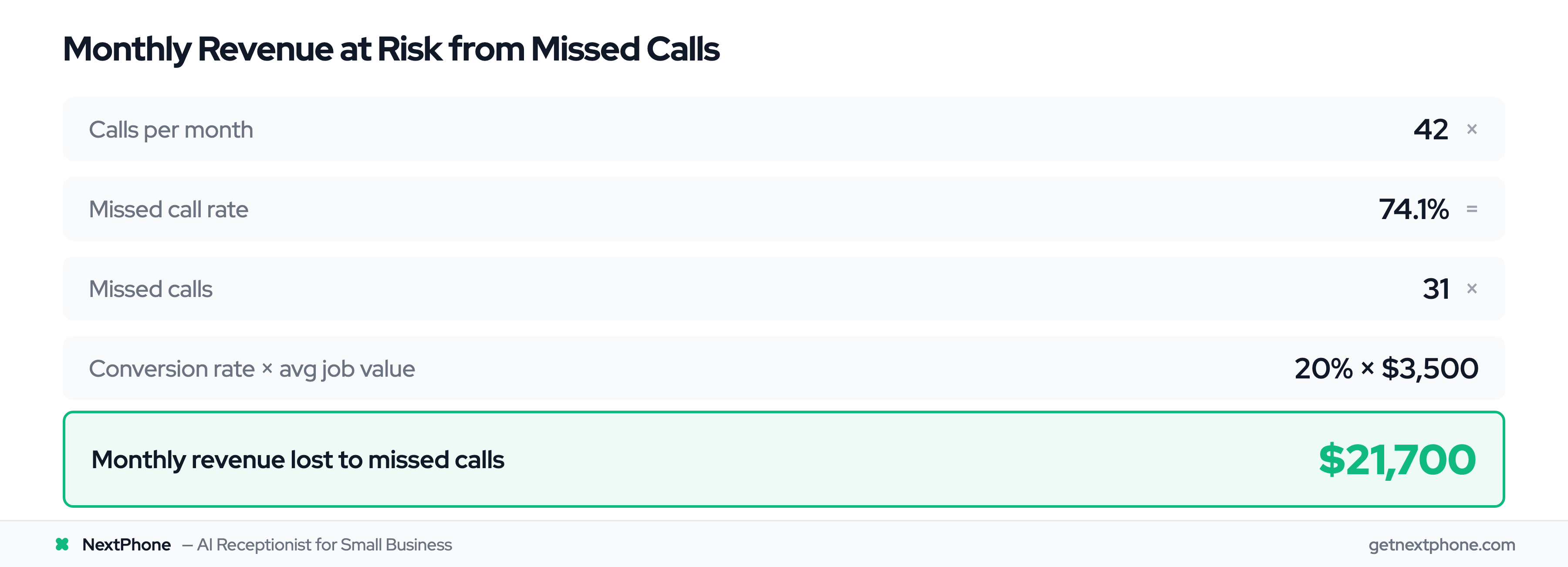
For a typical contractor receiving 42 calls per month, here's the math:
- 42 calls/month — 74.1% missed = 31 missed calls
- 31 missed calls — 20% conversion rate = 6.2 lost jobs
- 6.2 lost jobs — $3,500 average job value = $21,700 per month in lost revenue
- Annual impact: $260,400
That's a quarter million dollars per year walking out the door because you couldn't answer your phone.
Emergency Call Economics
The revenue impact is even worse for emergency calls. We found that 15.9% of all customer calls contain urgency language: "emergency," "urgent," "ASAP," "right now."
These aren't tire-kickers. These are customers with burst pipes, no power, broken AC in 95-degree heat, or heaters out in winter. Emergency jobs average $4,200—significantly higher than routine service calls.
For a business receiving 42 calls monthly, that's roughly 7 emergency calls per month. Miss just one per week, and you're losing $16,800 per month in high-value work.
Callback Requests That Never Happen
Here's another insight from our data: 25.4% of callers explicitly request a callback. "Please call me back." "Have someone call me." "I need a return call."
Without a systematic tracking system, most of these callback requests fall through the cracks. You listen to a voicemail hours later, meaning to call back, and forget. Or you write it on a sticky note that gets lost. Or you're just too busy.
The customer moves on. One plumber in our study had 76 missed calls in a single month and said, "I didn't even know I was missing that many calls until I saw the data. I just thought business was slow."
Business wasn't slow. His phone just wasn't being answered.
Call-to-Job Automation: NextPhone + ServiceM8
The Integration Workflow
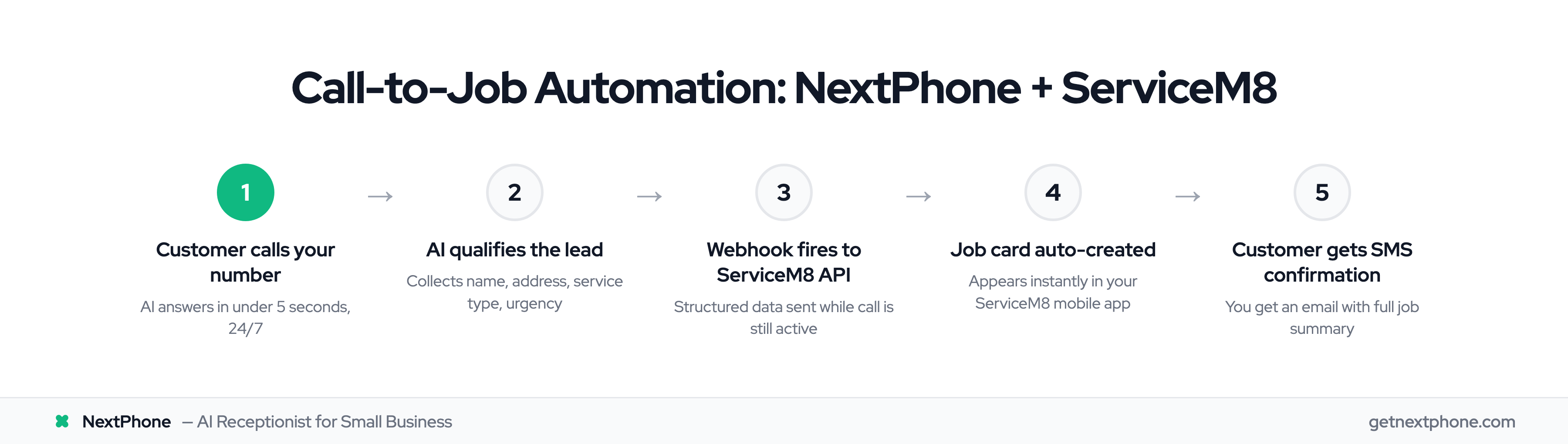
ServiceM8 is brilliant at managing jobs. NextPhone is brilliant at answering phones. Together, they create a seamless call-to-job automation system.
Here's how it works:
- Customer calls your business number
- NextPhone AI receptionist answers in under 5 seconds
- AI conducts a natural conversation, asking qualifying questions
- AI collects all data needed for a ServiceM8 job card
- During the call, NextPhone triggers an HTTP webhook integration that sends data to ServiceM8's Open API
- ServiceM8 automatically creates a job card with customer details
- You receive an email notification with job summary
- Customer receives an SMS confirmation
- Job appears instantly in your ServiceM8 mobile app
No manual data entry. No missed calls. No lost leads.
What Happens During the Call
The NextPhone AI receptionist isn't a rigid phone tree. It's conversational AI trained on your business.
When a customer calls, the AI introduces itself naturally: "Hi, you've reached ABC Plumbing. I'm the AI assistant. How can I help you today?"
The AI then asks the questions you'd ask:
- What's your name?
- What service do you need?
- What's the address?
- Is this an emergency or can it wait for regular scheduling?
- What's the best phone number to reach you?
The customer answers in natural language. The AI understands, asks follow-up questions if needed, and confirms the information before ending the call.
Automatic Job Card Creation
While the AI is still talking to the customer, it's simultaneously creating the ServiceM8 job card.
The webhook integration maps the collected data to ServiceM8 fields:
- Customer name — Client Name
- Phone number — Contact Details
- Service requested — Job Description
- Address — Job Address
- Urgency level — Job Status (Quote vs. Work Order) and Priority tags
By the time the call ends, the job is already in your system. You open your ServiceM8 mobile app, and there it is—ready to schedule.
Emergency Call Routing
Not every call should go to AI. True emergencies need a human immediately.
NextPhone's AI is trained to recognize emergency language: "burst pipe," "no power," "gas smell," "AC not working and it's 95 degrees." When it detects urgent keywords, it routes the call to your phone instantly while simultaneously creating an urgent job card in ServiceM8.
You talk to the customer directly. You decide how quickly you can respond. Meanwhile, the job details are already captured in ServiceM8 so you don't have to scramble for a pen or try to remember everything the customer said.
Our data shows 15.9% of calls contain urgency language. That's roughly 7 emergency calls per month for a typical 42-call/month business. The integration ensures you never miss these high-value opportunities.