It's 3:15 PM on Tuesday afternoon. A storm just blew through your area. Ten phones ring at exactly the same time.
Your receptionist picks up line one. "Thank you for calling, how can I help you?"
Callers two through ten get a busy signal. They hang up. They Google "roofer near me" again. They call the next number. That contractor answers. You never knew they called.
42% of SMBs lose $500+ per month to missed calls. According to 8x8's research, 73% of customers who encounter a busy signal will not call back, moving directly to a competitor. At $8,500 for an average roofing job, you just lost $62,900 in potential revenue in a single minute.
82% of customers expect an immediate response when they call. This is the multi-call management problem. Let's break down why it happens and how parallel call processing solves it.
The 1-Call-at-a-Time Bottleneck
Why Humans Can Only Handle One Call
The limitation is obvious but worth stating: a human being can't talk to two people simultaneously. Your receptionist might be the most efficient, experienced, professional person you've ever hired. Doesn't matter. When two calls come in at the same moment, they can only answer one.
As one plumber in our study of 130,175 calls told us: "I didn't even know I was missing that many calls until I saw the data." In that analysis across 45 home services contractors over 7 months, 74.1% of calls went unanswered. Insufficient capacity wasn't the only reason, but contractors consistently reported busy signals during peak periods.
Traditional Phone System Capacity Limits
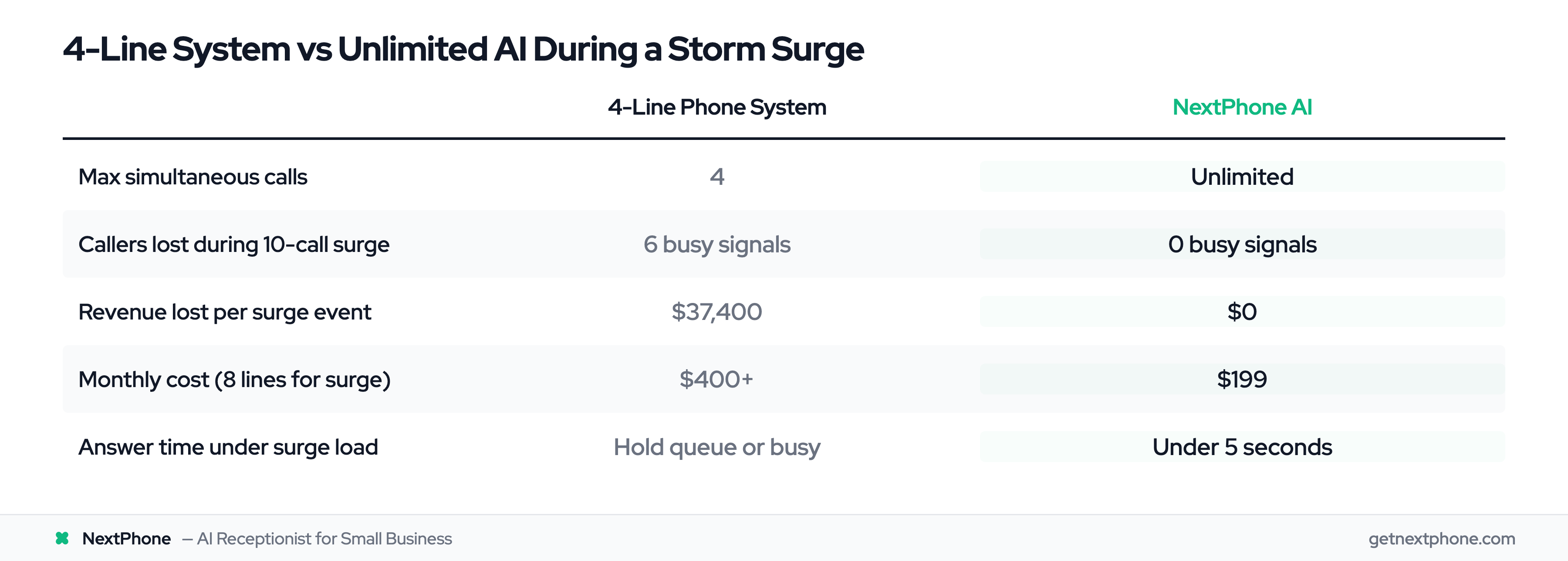
Traditional phone systems are built on physical lines. One line = one call. If you have a 4-line phone system, you can handle exactly 4 simultaneous calls. The 5th caller gets a busy signal or endless hold music.
"But I have call forwarding!" Sure. You forward to your cell phone. That's still one call. You hire three employees with phones. Now you can handle four calls simultaneously. The 5th, 6th, 7th callers still get busy signals.
The problem compounds. Let's say you invest in a proper setup:
- 4 phone lines at $40/line = $160/month
- 4 receptionists to answer those lines
- All four are available and ready
Ten calls come in at once. Six callers get busy signals. You're still losing 60% of that surge.
The Queue Fallacy
"What about call queues?" Here's what actually happens when someone encounters a queue during a high-volume event:
What you imagine: Caller hears pleasant hold music, waits patiently for 2 minutes, gets answered, books the job.
What actually happens: Caller hears "All representatives are busy. Your estimated wait time is 8 minutes." They hang up within 15 seconds and call your competitor.
When someone has an emergency (burst pipe, AC failure in 98-degree heat, storm damage), they're not waiting 8 minutes. They're calling every contractor simultaneously until someone answers.
According to RingCentral, "Auto attendants can handle unlimited simultaneous calls, while live receptionists can only manage one call at a time." This isn't a training issue or an efficiency problem. It's a fundamental limitation of human capacity.
When Capacity Actually Matters: Surge Scenarios
The average home services contractor receives about 42 calls per month. That sounds manageable. At that rate, you're getting maybe 2 calls per business day. Your single receptionist or answering service can handle that easily.
Here's the problem: calls don't distribute evenly. They cluster around specific events. And those clusters are exactly when the highest-value jobs come in.
Storm Season for Roofing Contractors
A hailstorm hits Tuesday afternoon at 2 PM. By 3 PM, you've received 12 calls. By end of day Wednesday, you've gotten 47 calls total.
According to ServiceTitan's analysis, "roofing sees 400% surge after major storms." Your normal 2 calls per day becomes 25+ calls in 24 hours.
But the real crunch isn't spread across 24 hours. It concentrates during business hours. Between 9 AM and 11 AM Wednesday morning, you get 12 calls within a 2-hour window. At 10:15 AM, 8 people are calling you simultaneously.
If you have 4 phone lines, 4 callers get through. Four get busy signals.
Those 4 who got busy signals? They don't leave voicemails asking you to call back. They call the next contractor on the list. That contractor has an AI system that answers all 10 of their simultaneous calls. They book all 10 jobs.
Heat Waves for HVAC Companies
It's 97 degrees at 2 PM on a Thursday in July. Every AC unit in a 10-mile radius is straining. Half of them fail between 2 PM and 4 PM—the hottest part of the day.
Your phone explodes. Not with steady call flow. With surges. At 3:30 PM, you have 7 simultaneous callers. All of them are emergencies. All of them are willing to pay premium rates for same-day service.
Your 3-line system handles 3 calls. Four people get busy signals. Those four emergency calls—worth $600-1,200 each in same-day service fees—go to competitors.
ServiceTitan notes that "HVAC contractors experience 300% increase in call volume during extreme weather." Again, not spread evenly. Concentrated in the exact hours when systems fail under peak load.
Winter Freezes for Plumbers
Temperature drops to 15 degrees overnight. Pipes freeze. At 6 AM when people wake up and turn on faucets, pipes burst.
Between 6 AM and 9 AM, you get 15 calls. These aren't "when you have time" calls. These are "my basement is flooding right now" emergencies worth $2,000-5,000 each.
At 7:45 AM, 6 people are calling you at the exact same moment. You have 2 phone lines because that's what handles your normal volume perfectly. Four callers get busy signals.
Those four flooded basements? Four of your competitors are handling them.
Neighborhood Events for Electricians
Power surge takes out half the houses on a street. Fifteen homeowners all need an electrician. They're all calling contractors at the same time because they all lost power at the same moment.
Your phone rings 8 times simultaneously at 11 AM. You answer 1. Maybe 2 if you have a basic multi-line system. Six to seven people get busy signals.
The Real Cost of Busy Signals
What Happens When Customers Get Busy Signals
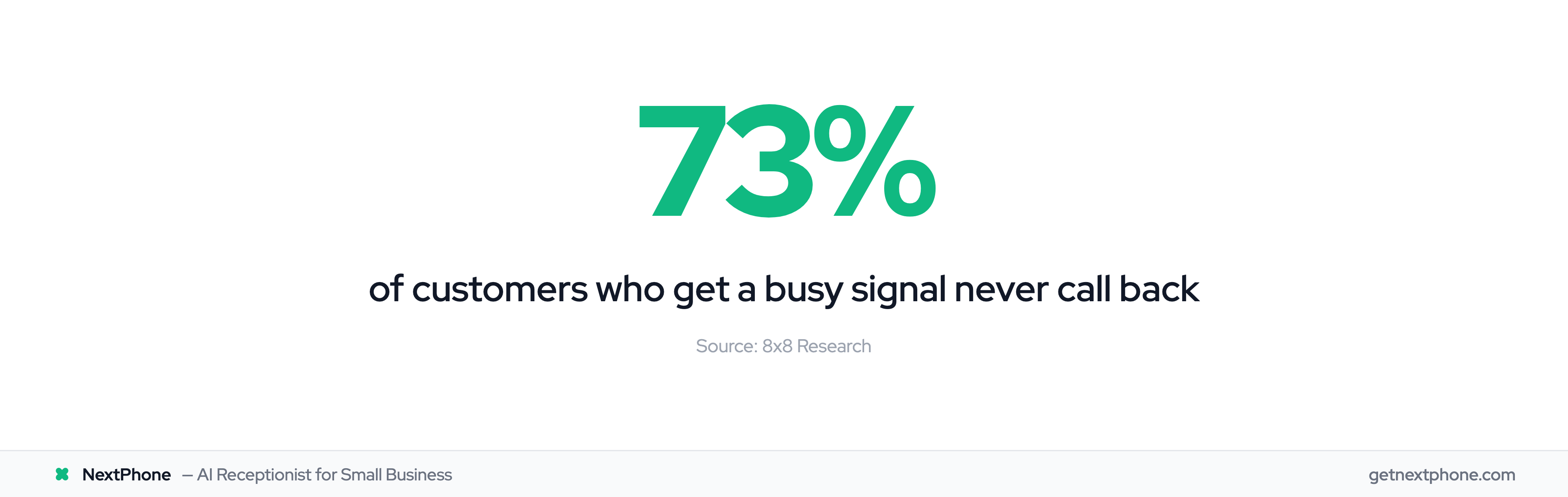
Here's what doesn't happen: They don't write down your number, wait an hour, and try again.
Here's what does happen:
- They hear the busy signal
- They press back in their phone
- They tap the next contractor in the search results
- That contractor answers
- They book the job
- They're done searching
The entire process takes 45 seconds. You lost a $8,500 roofing job, a $3,200 HVAC repair, or a $4,500 emergency plumbing call in less than a minute.
You don't get a notification. You don't see a missed call (busy signals often don't log). You don't know it happened. The revenue just vanishes.
The Math on Lost Storm Revenue
Let's use the roofing storm scenario with real numbers:
Your system: 4 phone lines, 4 maximum simultaneous calls Storm surge: 10 simultaneous calls at peak (conservative estimate) Result: 6 callers get busy signals
What happens to those 6 callers:
- 73% don't call back (8x8 research) = 4.4 customers lost
- Average roofing job: $8,500
- Lost revenue per surge event: 4.4 — $8,500 = $37,400
That's one storm. One Tuesday afternoon. $37,400 gone.
Annual Impact Across Multiple Events
How many surge events do you experience per year?
- Roofing contractors: 3-4 major storms in your area = $112,200-$149,600/year lost
- HVAC contractors: 5-8 extreme heat or cold days = $93,000-$186,000/year lost
- Plumbers: 2-3 freeze events plus summer peak = $74,800-$112,200/year lost
These aren't theoretical numbers. This is actual revenue walking away because your phone system physically cannot handle the volume during the exact moments that matter most.
What Is Parallel Call Management?
Sequential vs Parallel Call Processing
Sequential processing: Handle one call. Finish it. Move to the next call. Repeat.
This is how humans work. This is how traditional phone systems work. One line, one call, one conversation at a time.
Parallel processing: Handle multiple calls at exactly the same time. Call #1, call #2, and call #50 all receive attention simultaneously with zero waiting.
Think of it like checkout lines at a store:
- Sequential: One checkout lane. Doesn't matter if there are 50 customers—everyone waits in line.
- Parallel: The moment a customer arrives, a new checkout lane opens instantly. 50 customers? 50 lanes open simultaneously.
How VoIP Enables Unlimited Capacity
Traditional phone systems are limited by physical infrastructure. Copper lines. Physical switches. Hardware capacity. One line = one call is a hard physical limitation.
VoIP (Voice over Internet Protocol) removes that limitation. According to Nextiva, "Traditional phone systems are limited by physical lines. VoIP systems can handle hundreds of simultaneous calls on the same infrastructure."
Your internet connection doesn't care if you're loading one website or ten websites simultaneously. Each request is processed in parallel. VoIP phone systems work the same way. Each call is a data stream. Your infrastructure can handle hundreds of parallel data streams.
Why AI Scales Infinitely
A voice AI receptionist takes this one step further. Each incoming call spawns an independent AI instance:
- Call #1 comes in — AI instance #1 launches — handles conversation
- Call #2 comes in 0.5 seconds later — AI instance #2 launches — handles conversation independently
- Calls #3-#100 come in simultaneously — 98 new AI instances launch — all handle conversations in parallel
There's no shared bottleneck. Each AI instance has its own processing power, memory, and response capability. Call #1 doesn't slow down call #100. Call #100 gets identical service to call #1.
As Dialpad notes, "Cloud-based phone systems scale instantly without hardware changes, handling surge capacity automatically." No manual setup. No provisioning. No "upgrade your plan to handle more calls." It just works.
How AI Handles 100+ Simultaneous Calls
Independent Call Processing
When 50 people call at the exact same second, here's what happens:
Traditional system with 4 lines:
- Calls 1-4: Answered
- Calls 5-50: Busy signal
- Customers 5-50: Call your competitor
AI system with parallel processing:
- Calls 1-50: All answered simultaneously
- Average answer time: Under 5 seconds
- All 50 customers: Connected, helped, information captured
In our analysis of 130,175 calls, NextPhone's AI answered calls in under 5 seconds on average. That response time doesn't change whether it's the only call that hour or the 50th simultaneous call of a surge event.
No Quality Degradation
Here's what doesn't happen when call volume spikes:
- AI doesn't get "stressed" or "overwhelmed"
- Response time doesn't slow down
- Understanding doesn't degrade
- Answers don't become generic or rushed
Call #1 at 9 AM during a slow period gets the same quality as call #87 during a 3 PM storm surge. The AI has the same knowledge, same response capability, same ability to answer questions, book appointments, take detailed messages, and identify emergencies.
Instant Response Regardless of Volume
No hold music. No "all representatives are busy." No queue announcements.
Every single caller—whether they're the first call of the day or the 100th simultaneous call during a crisis—hears the phone ring 2-3 times and then gets answered. Immediately. No waiting.
85% of customer service leaders will pilot conversational GenAI in 2025. The psychological impact on customers is significant. When someone calls during a crisis (storm damage, AC failure, burst pipe), the first contractor who answers in real-time wins the job. Not the contractor with the best price or the best reputation. The one who answers the phone.
If you answer in 4 seconds and your competitor puts them in a queue for 2 minutes, you win. If 10 people call you simultaneously and you answer all 10 while your competitor can only handle 2, you book 10 jobs while they book 2.