Your phone rings at 6 PM. A homeowner needs a quote for a kitchen remodel. Budget is $25,000, they're ready to book. But your team left at 5. The Mitel desk phone in your office sits silent. The call goes to voicemail. They call the next contractor.
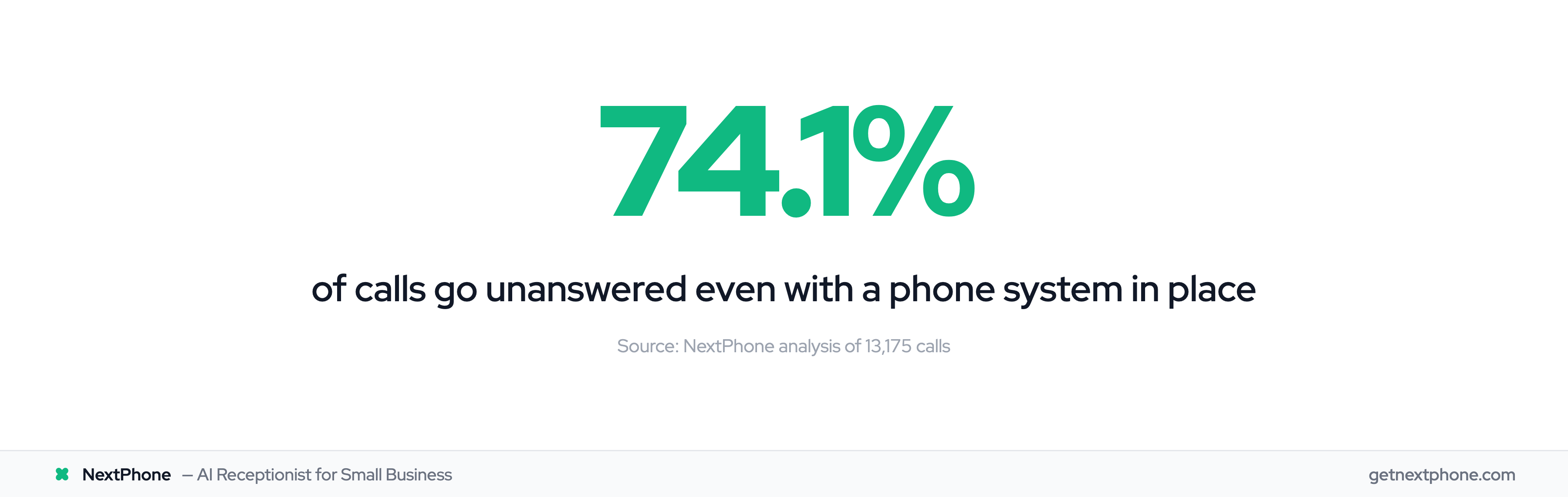
Industry research shows 74.1% of calls to home services contractors go completely unanswered, even when businesses had phone systems in place. The problem is availability.
This post explores how AI receptionists like NextPhone can work alongside your existing Mitel system or replace it entirely, giving small businesses the coverage they need without the enterprise complexity.
What is Mitel? (Enterprise Phone System Overview)
Mitel is one of the established players in enterprise phone systems, serving over 12,177 customers with a 12.62% market share in the business phone systems segment. Mitel's merger with Unify created a combined platform serving 75+ million users, making it the 2nd largest UC provider. The company offers both traditional PBX (on-premise) and cloud-based VoIP solutions designed for mid-size to large businesses.
Mitel's Market Position
Mitel recently received the Leader designation for 2026 in the Contact Center Globe, positioning itself as an enterprise-grade solution with extensive capabilities. Their systems are particularly strong in contact center environments where call routing, queue management, and integration with business systems matter.
Integration Capabilities
Where Mitel shines is integration depth. The company offers 200+ integration partners including Salesforce, Microsoft Dynamics 365, Google Workspace, and NetSuite. For developers, Mitel provides a Media Services API that can manage calls on both cloud and on-premise PBX systems.
Deployment Options
Mitel gives businesses control over deployment: choose from cloud (MiCloud), on-premise (MiVoice), or hybrid models. This flexibility appeals to organizations with specific security or compliance requirements that prevent full cloud adoption.
Why Businesses Are Reconsidering Mitel
End-of-Life Concerns
Mitel's partnership landscape has shifted significantly. RingCentral took over Mitel's cloud offering at the end of 2021, and some Mitel products face end-of-life concerns. While technical support continues until 2029 for some systems, businesses worry about security patches, firmware updates, and replacement parts becoming scarce after 2025.
Integration Complexity
Here's where enterprise systems trip up small businesses: Mitel integration demands specialized IT knowledge. Setting up CRM integration through Mitel's API isn't a 10-minute task. It requires developers, testing cycles, and ongoing maintenance. For a three-person plumbing company, that's overkill.
The Real Problem: Missed Calls
But there's a bigger issue that no amount of integration fixes: desk phones don't answer themselves.
Industry research shows 74.1% of calls to home services businesses go unanswered. That's 31 missed calls per month for a typical contractor receiving 42 calls. At a 20% conversion rate and $3,500 average project value, that's $21,700 in lost revenue every month, $260,400 per year.
Having a Mitel system doesn't solve the availability problem. You can integrate it with Salesforce perfectly, but if no one's there to answer the phone at 6 PM when a customer calls, the integration doesn't matter.
Beyond Traditional Phone Systems: The AI Receptionist Approach
Traditional VoIP Alternatives
Most Mitel alternatives articles point you toward other VoIP providers: RingCentral, Nextiva, 3CX. These are solid systems, but they're still desk-phone dependent. You're swapping one PBX for another. The 6 PM call still goes unanswered because no one's in the office.
The AI-First Difference
AI receptionists solve a different problem. Instead of replacing your phone hardware, they replace the receptionist role, answering every call, 24/7, with no human required.
Here's what happens:
- Customer calls at 9 PM
- AI answers in under 5 seconds
- AI gathers information (name, phone, service needed, urgency)
- AI books appointments, answers common questions, or routes emergencies to your phone
- Call data syncs to your CRM automatically
We found that approximately one in four callers explicitly asks for a callback. Without a system tracking those requests, they disappear. AI receptionists log every callback, schedule every follow-up, and close the loop.
What AI Receptionists Actually Do
Think of it as your first line of defense:
- Quote requests: AI gathers details, schedules estimate
- Scheduling: AI checks availability, books appointment
- Emergency calls: AI detects urgency (urgent calls using keywords like "urgent," "emergency," "ASAP" rank among the top reasons people call), routes immediately to your phone
- Common questions: AI answers from your business knowledge base (hours, pricing, service areas)
The difference between VoIP and AI: AI actually answers the phone.
NextPhone + Mitel: A Hybrid Integration Approach
You have two paths forward with NextPhone and your existing Mitel system.
Option 1: AI Front Line + Mitel Backend
Keep your Mitel system for internal communication, but let NextPhone handle incoming customer calls.
Here's how it works:
- Forward your main business number to NextPhone
- NextPhone AI answers every call
- For routine inquiries (quotes, scheduling, questions), AI handles it completely
- For complex calls or when customer requests a person, AI transfers to your Mitel extension
This gives you 24/7 coverage without replacing your entire phone infrastructure. Your team keeps their Mitel desk phones and extensions. But customers never hit voicemail again.
Option 2: Full Replacement
Many small businesses discover they don't need the Mitel system at all.
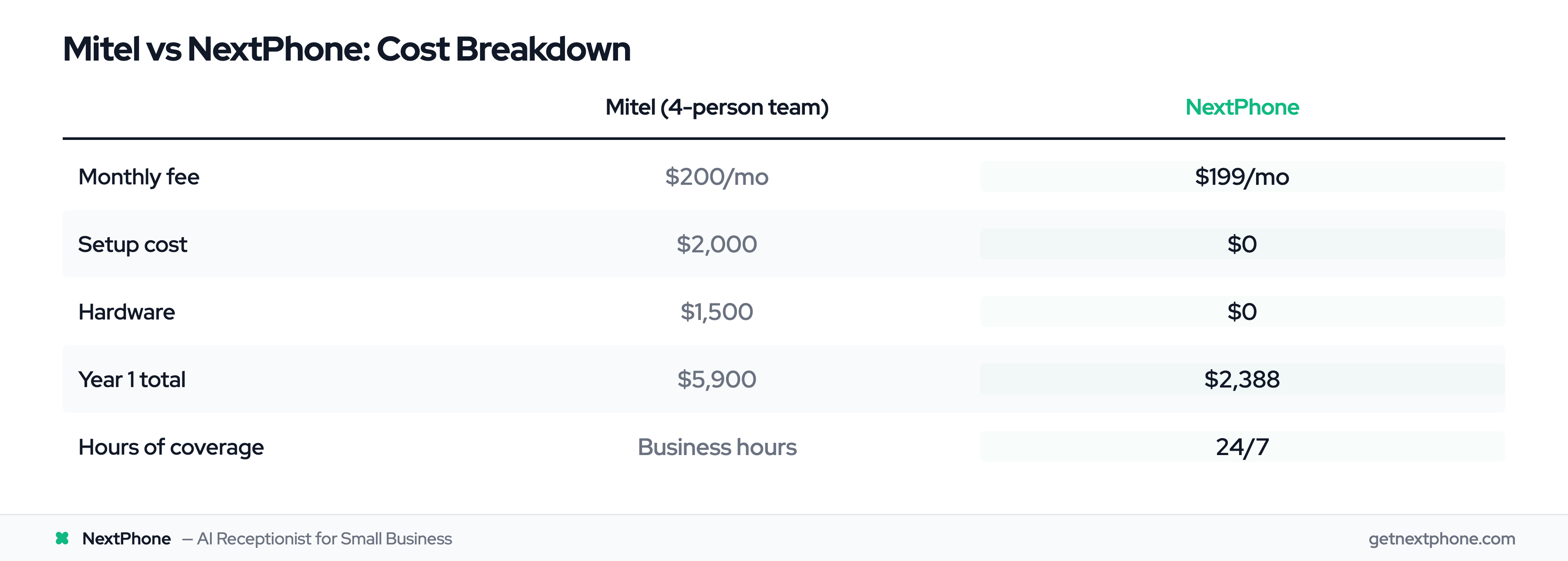
A solo electrician paying $80/month per user for three employees ($240/month) plus hardware and maintenance costs can switch to NextPhone on flat monthly plans from $199: unlimited calls, no per-user fees, no hardware to maintain.
The AI handles everything a receptionist would: answering calls, taking messages, booking appointments, routing emergencies. For businesses without complex internal communication needs, it's a simpler stack.
Simple Webhook Integration
NextPhone doesn't require complex API integration. Instead, it uses HTTP webhooks: template-based connections that work with any system.
Want to push call data to your CRM? Create a webhook pointing to HubSpot, Salesforce, or your custom endpoint. NextPhone sends structured data (caller name, phone, inquiry details) automatically after each call.
No developer required. Setup takes hours.