
Email notifications after calls are automatic alerts sent to your inbox whenever a phone call ends — whether you answered it, missed it, or an AI receptionist handled it. They range from simple "missed call" alerts to full AI-generated summaries with transcripts, action items, and urgency levels.
Below we cover how to set them up on any system, then show how AI-powered call summaries take notifications further for businesses losing revenue to forgotten follow-ups.
How to Set Up Email Notifications After Calls
Phone Carrier Voicemail-to-Email
Most major carriers offer voicemail-to-email as a basic notification option:
Verizon: Enable Visual Voicemail in the My Verizon app → Settings → Voicemail → turn on email delivery. Sends voicemail recordings and transcriptions to your email.
AT&T: AT&T Visual Voicemail settings → Notifications → enable email forwarding. Available on most postpaid plans.
T-Mobile: T-Mobile Visual Voicemail → Settings → Email a copy. Attaches the voicemail audio file to the email.
These are basic — you get the voicemail recording and a rough transcription. No call summaries, no caller intent, no action items.
VoIP and Business Phone Systems
Most business phone systems include email notifications in their settings:
- Google Voice: Settings → Voicemail → Enable email notifications. Sends transcribed voicemails to your Gmail.
- RingCentral: Admin Portal → Phone System → Notifications → configure missed call and voicemail email alerts.
- Grasshopper: Settings → Extensions → Notifications → enable email delivery for calls and voicemails.
- OpenPhone: Workspace Settings → Notifications → configure email alerts per team member.
These give you missed call alerts and voicemail transcriptions, but still require you to manually piece together what the caller needed.
AI-Powered Call Summary Emails
AI receptionist platforms like NextPhone send a different kind of notification: a complete summary of the entire conversation — whether you answered or the AI handled it — with the caller's name, what they needed, urgency level, and specific next steps. This is what the rest of this guide covers.
The Hidden Cost of Forgotten Follow-Ups
You promise a customer you'll call them back with a quote. Then three more calls come in. By the end of the day, you've forgotten who needed the callback.
In our analysis of 130,175 calls from 45 home services contractors over 7 months, 25.4% of customers explicitly requested callbacks. That's roughly 11 callback requests per month for a typical contractor receiving 42 calls monthly.
Without a systematic way to track these requests, 80% of callbacks never happen. Customers move on to the next contractor. You lose the job without even knowing you were in the running.
86% of workers say poor communication causes workplace problems.
Why Callbacks Fall Through the Cracks
You're under a sink fixing a leak when your phone rings. The customer asks about a bathroom remodel and wants a detailed quote. You say "I'll call you back this afternoon." Then you finish the job, drive to the next appointment, handle two emergency calls, and head home.
The callback? Completely forgotten.
This isn't a memory problem. It's a systems problem. When you're working with your hands, you can't write down callback requests. When you're juggling five jobs in a day, mental notes don't cut it. Without a tracking system, there's no accountability.
The Math on Lost Revenue
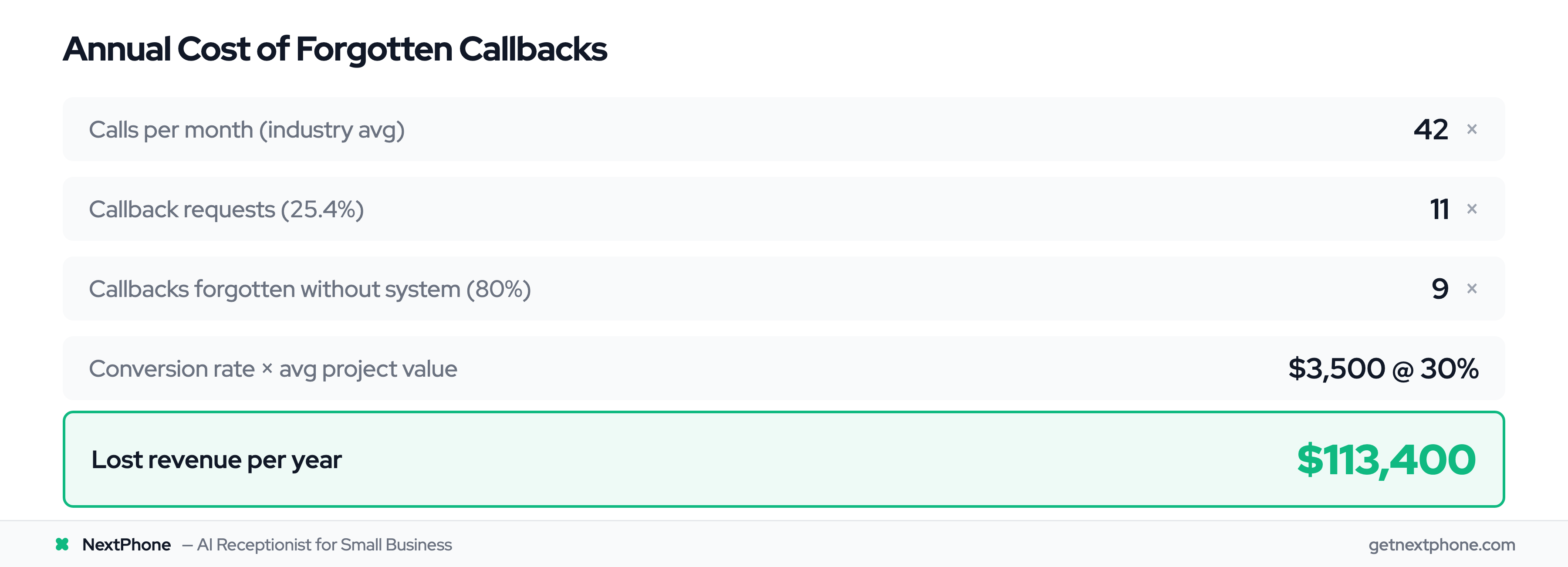
Let's run the numbers for a typical home services contractor:
- 42 calls per month (industry average)
- 25.4% include callback requests = 11 callbacks needed per month
- Without tracking, 80% are forgotten = 9 lost callbacks per month
- At a 30% conversion rate and $3,500 average project value
- Lost revenue: $9,450 per month = $113,400 per year
That's more than enough to hire a full-time employee. But you're not trying to hire someone—you're just trying to remember to call people back.
Real Scenarios from Home Services
An electrician finishes a service call in an attic. While up there, the customer mentions wanting a panel upgrade and asks for a quote. The electrician says "I'll email you an estimate tomorrow." Three more service calls happen that day. The estimate never gets sent.
A plumber gets a call at 10 AM about a kitchen renovation. She's in the middle of replacing a water heater. She tells the customer she'll call back after 2 PM with pricing. By 2 PM, she's on another job. The callback doesn't happen.
As one plumber told us: "I didn't even know I was missing that many calls until I saw the data."
Email notifications after calls prevent this entirely. After every conversation—whether you answered it or your voice AI receptionist handled it—you get an email with the caller's information and what they needed. No more relying on memory. No more lost revenue.
What Are Email Notifications After Calls?
Automated Email Delivery After Every Call
Email notifications after calls are exactly what they sound like: automatic emails sent to you (and your team) immediately after a phone call ends. These aren't just voicemail transcripts—they're comprehensive summaries of every conversation, whether you answered the call or not.
The system works like this: Call ends — AI processes the conversation — Email generated with summary and details — Sent to designated team members — You take appropriate action.
No manual steps. No logging into a dashboard. The information arrives in your inbox within seconds of the call ending.
Real-Time vs Scheduled Notifications
Most modern systems send emails in real-time, typically within 10-15 seconds of the call ending. This is critical for emergency situations. When a customer calls about a burst pipe at 11 PM, you need to know immediately, not when you check your daily digest the next morning.
Some systems also offer digest modes—a single email summarizing all calls from the day. This works well for office managers who want an overview without inbox overload. You can typically configure both: real-time for emergencies, daily digest for routine calls.
Who Receives the Emails
One of the most powerful features is routing different notifications to different people based on call type:
- Owner receives emergency calls only
- Office manager gets all calls
- Sales team gets new lead inquiries
- Service manager gets scheduling requests
- Billing department gets payment questions
This prevents inbox overload while ensuring the right person sees every call. 77% of Fortune 100 companies use Slack, achieving 338% ROI through better communication. As CloudTalk notes, "Automated notifications are real-time alerts that let you know when important events happen—like an incoming call, a missed call, a voicemail, or a new message."
What's Included in Call Notification Emails
Caller Information and Context
At minimum, every email notification includes:
- Caller's name (if provided or identified)
- Phone number (tap-to-call enabled on mobile)
- Date and time of call
- Call duration
- Whether the call was answered or went to voicemail
But modern systems include much more.
AI-Generated Call Summaries
This is where email notifications get powerful. Instead of just getting a transcript (a wall of text to read through), you get an AI-generated summary that extracts the key information:
Example email summary: "John Smith called at 2:34 PM requesting emergency AC repair. His system stopped working this morning. He needs same-day service and mentioned a budget of $500-800. Marked as URGENT. Action: Call back within 30 minutes."
According to Dialpad's research, their system "automatically sends all the attendees a recap email that contains the recording and searchable transcript, action items, and more."
The AI identifies:
- What the caller wanted (intent)
- Level of urgency (routine, urgent, emergency)
- Specific details (budget, timeline, location)
- Clear next steps (action items)
Transcripts and Recordings
Beyond the summary, you get access to the complete conversation:
- Full transcript: Searchable text of the entire call, broken down by speaker
- Audio recording: Link to listen to the actual conversation
- Timestamps: Jump to specific parts of the call
This is valuable for training new team members, resolving disputes ("I never said that"), and quality assurance.
Action Items and Next Steps
The best systems extract specific action items from the conversation:
- "Send estimate for bathroom remodel by Friday"
- "Schedule follow-up call for next Tuesday at 10 AM"
- "Email product specs mentioned during call"
- "Add to CRM as hot lead - ready to buy"
These become your to-do list without any manual effort.
Key Benefits of Email Notifications
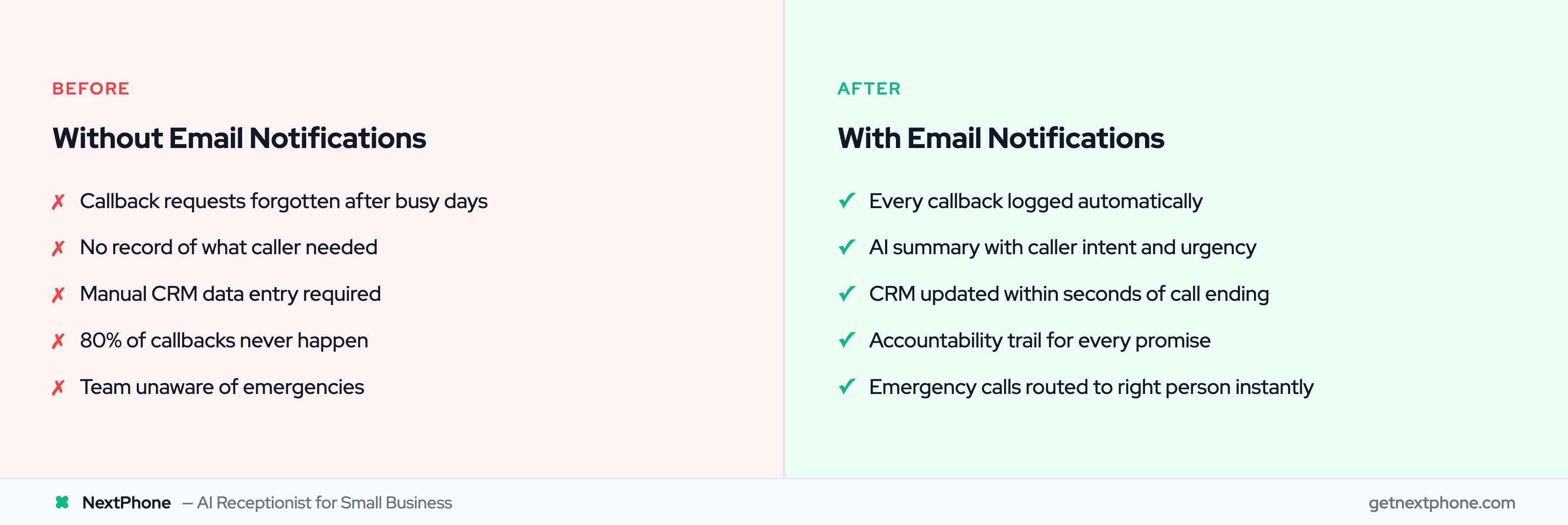
Never Miss a Callback Request Again
We've already covered the revenue impact—$113,400 per year recovered by simply following up on callback requests. But the benefit goes beyond money.
Customer experience improves dramatically. When you call someone back as promised, you build trust. When you forget, you look unprofessional. Email notifications eliminate the "I forgot" excuse entirely.
The email serves as both reminder and reference. You know exactly what you promised, when you promised it, and what details the customer provided.
Team Coordination Without Meetings
In a typical three-person HVAC company, the owner handles installations, the office manager schedules jobs, and a tech handles warranty work. Email notifications let each person stay informed without constant check-ins:
- Owner gets notifications for emergency calls and new installation leads
- Office manager receives all calls for scheduling and coordination
- Tech lead sees warranty and technical support inquiries
Everyone knows what's happening without meetings, group texts, or "Did anyone talk to the customer about X?" conversations.
According to NUACOM, "Email notifications eliminate the risk of missed communication by providing immediate awareness of missed calls, helping you follow up promptly and avoid lost sales opportunities."
Accountability and Follow-Up Tracking
When every call generates an email, there's a paper trail. You can search your inbox for "John Smith" and find every conversation you've had with that customer. No more "I think we talked about this three months ago but I'm not sure what we decided."
Managers can review their team's call handling without listening to dozens of recordings. A quick scan of email summaries shows who followed up promptly and who let leads go cold.
Training and Quality Assurance
New employees learn faster by reading email summaries from experienced team members. "This is how Sarah handles pricing questions." "This is how Mike deals with difficult customers."
You can forward particularly good (or bad) call summaries to your team as teaching moments. This is far easier than saying "listen to recording #247 from last Tuesday."
As Woodpecker points out, "A follow-up email provides a written record of the conversation which can be referred back to for clarification and accountability." According to email marketing benchmarks, open rates now average 38%+, up from 20-25% previously.
CRM Integration and Workflow Automation
Automatic CRM Updates
Email notifications become even more powerful when integrated with your CRM. Instead of manually entering call details into HubSpot or Salesforce after every conversation, the integration does it automatically:
- New caller? Contact created in CRM
- Existing customer? Call logged on their record
- Action items? Tasks created and assigned
- Hot lead? Sales pipeline updated
According to MCI's research on CRM telephony integration, "CTI allows for automated CRM workflows triggered by call events. After a call ends, the integration can automatically update customer records, create follow-up tasks, or trigger email notifications." 53% of SMBs use email marketing most for acquisition and retention, with 60% of consumers having purchased from a marketing email.
Triggering Follow-Up Workflows
Email notifications can trigger multi-step workflows:
- Call ends with callback request
- Email notification sent to team
- CRM creates follow-up task for tomorrow at 10 AM
- If not completed, reminder email sent to manager
- Second reminder after 48 hours
This level of automation ensures callbacks actually happen.
Integration with Project Management Tools
For contractors managing multiple jobs, email notifications can create tasks in project management tools like Asana, Monday, or ClickUp. A call about a change order automatically becomes a task assigned to the project manager.
As Zapier notes, "By logging call details, triggering alerts, and updating contact records, teams can respond faster and maintain better visibility into communication gaps." Automated emails generate $42 ROI for every $1 spent and account for 37% of email sales while comprising only 2% of volume.
Types of Email Notifications
Missed Call Notifications
When a call goes unanswered and the caller leaves a voicemail (or hangs up), you get a notification that includes:
- Caller information
- Voicemail transcript (if one was left)
- Suggested callback priority based on urgency detection
- Time they called (for context on when they expect a callback)
In our study of 130,175 calls, 74.1% went unanswered. That's three out of every four potential customers. Missed call notifications ensure you can follow up on every single one.
Answered Call Summaries
When you or your AI receptionist answers a call, the notification includes:
- Complete conversation summary
- What was discussed and agreed upon
- Action items for you or your team
- Who handled the call (if multiple team members)
These are valuable even when you were on the call yourself. How often do you forget details from a conversation you had three days ago? The email gives you a permanent record.
Emergency Call Alerts
Calls marked as emergencies get special treatment:
- Sent immediately to designated person (owner's cell, emergency line)
- Marked high-priority in subject line: "EMERGENCY: Burst pipe - John Smith"
- Includes location and callback number prominently
- Often sent via multiple channels (email + SMS + push notification)
In our call data, 15.9% of calls contained urgency language like "emergency," "urgent," or "ASAP." 6.2% were true emergencies like burst pipes, power outages, or AC failures in extreme heat. These calls can be worth $4,200+ and require immediate response.
A plumber getting an email at 2 AM marked "EMERGENCY: Burst pipe flooding basement" knows exactly what they're dealing with before they even call back.
How NextPhone Delivers Instant Email Notifications
NextPhone includes automatic email notifications for every call—no setup required, no per-email charges.
Here's how it works: After each call your AI receptionist handles, the system generates a professional HTML email via the Resend API and delivers it to your team within 10-15 seconds. The email includes:
- Caller's name and phone number (tap-to-call enabled)
- AI-generated summary of the conversation
- Link to view the full transcript
- Link to listen to the call recording
- Context about your business (for multi-business owners)
You can customize who receives notifications based on call type. Emergency calls go to your cell phone. New sales leads go to your sales team. Billing questions go to your office manager.
The system integrates with your CRM via HTTP webhooks, automatically logging call details without manual data entry. One contractor told us this feature alone saved his office manager 10 hours per week.
All of this is included in NextPhone's starting at $199/month plan with unlimited calls and unlimited email notifications. Compare that to hiring a receptionist at $35,000 per year to manually track and log every call.
Even better: the AI actually handles the calls, not just logs them. Your customers get answers immediately. You get organized summaries. Nothing falls through the cracks.
Never miss a callback again. See NextPhone's email notifications in action.
Frequently Asked Questions
Can I customize what information is included in email notifications?
Yes, most systems allow you to customize notification content. You can choose which fields to include (caller info, summary length, transcript, recording), set different templates for different call types (emergency vs routine), and adjust the level of detail.
NextPhone includes all key information by default—caller details, AI-generated summary, and links to full transcripts and recordings. You can customize notification recipients and routing rules to ensure the right people see the right calls. Learn more about customization options.
Will I get overwhelmed with too many emails?
This is a valid concern for high-volume businesses. The solution is smart routing: send different call types to different people. For example, the owner might only receive emergency notifications, while the office manager gets all calls, and sales teams only see new lead inquiries.
Many systems also offer digest mode—a single daily email summarizing all calls instead of individual notifications. You can combine approaches: real-time for emergencies, daily digest for routine inquiries.
How quickly are emails sent after a call?
Modern systems send email notifications within seconds of the call ending. AI processing (generating the summary, extracting action items) typically takes 5-15 seconds.
Real-time delivery is critical for emergency calls. When a customer reports a burst pipe, you need to know immediately, not 20 minutes later. NextPhone delivers notifications within 10-15 seconds of call completion.
Are email notifications secure for customer data?
Yes, professional systems use encrypted email delivery and secure storage for recordings and transcripts. Links to transcripts and recordings are typically password-protected or use secure tokens (not sent as email attachments).
Customer data is handled securely.
Can email notifications integrate with my CRM?
Absolutely. Email notifications can trigger CRM workflows through direct integrations or automation platforms like Zapier and Make. When a call ends, the integration can automatically create a new contact, log the call on an existing record, and create follow-up tasks.
NextPhone offers HTTP webhooks that work with any CRM including HubSpot, Salesforce, Pipedrive, and Zoho. The call summary, transcript, and action items are sent to your CRM automatically—no manual data entry required. See CRM integration options.
What's the difference between email notifications and voicemail-to-email?
Voicemail-to-email only works for missed calls where the caller leaves a voicemail — essentially a basic voicemail transcription feature. Email notifications work for ALL calls—answered and missed, with or without voicemail.
More importantly, email notifications include AI-generated summaries with action items and urgency detection, not just voicemail transcripts. You get structured information (what they wanted, when they need it, suggested next steps) instead of a wall of text to read through.
How much do email notifications cost?
Pricing varies by provider. Some charge per email ($0.01-0.05 per notification), which adds up quickly for high-volume businesses. Others charge per user per month ($20-50) with unlimited notifications. Enterprise solutions can cost $100+ monthly.
NextPhone includes unlimited email notifications in the $199/month plan—no per-email charges, no user limits. Compare this to hiring a receptionist at $35,000 per year ($2,900/month) to manually track calls. See pricing plans for details.
Start Capturing Every Customer Call
Email notifications after calls aren't just a nice feature—they're essential for preventing lost revenue. When 25.4% of your customers request callbacks and 80% of those requests are forgotten without a tracking system, you're leaving $113,400 per year on the table.
AI now saves marketers 13 hours per week, with 109 billion emails sent in 2025 achieving 40.4% average open rates. Modern email notification systems do more than alert you to missed calls. They extract action items, route emergencies to the right people, integrate with your CRM, and create accountability across your team. All without requiring you to remember anything or manually log call details.
The businesses winning in 2026 aren't necessarily the ones with the biggest marketing budgets. They're the ones that answer every call and follow up on every promise.