
Your phone rings at 6:15 PM Friday. A potential client was just arrested on DUI charges. His arraignment is Monday morning. The call goes to voicemail. He calls the next attorney. You just lost a $7,500 retainer.
This scenario plays out thousands of times daily in law firms across the country. Research shows that 35% of calls from prospective legal clients go completely unanswered—a national study estimates this costs the legal industry $109 billion annually.
Meanwhile, 87% of people seeking legal representation hire the first lawyer they actually speak with. Speed matters more than almost any other factor—research confirms that lead response time directly impacts close rates.
The stakes are high. Legal cases range from $2,000 to $15,000+ in value. For a firm receiving 50 calls per month, if 35% go unanswered (17-18 calls), and just 20% of those would have converted at $5,000 average case value, that's $17,000-$18,000 per month in lost revenue. Annually, that's $204,000-$216,000 in opportunity cost.
The solution isn't just answering the phone—or hiring an answering service. You need a systematic legal intake qualification workflow that captures every opportunity, screens for conflicts and jurisdiction issues, assesses urgency and statute of limitations concerns, and routes qualified leads to the right attorney—all while delivering an excellent first impression. AI lead qualification automates this entire intake screening process.
Why Legal Intake Qualification Matters: The Cost of Missed Opportunities
Legal intake qualification is the first line of defense for your firm's profitability, risk management, and reputation. Yet according to legal marketing statistics, 64% of law firms never respond to leads that contact them.
Revenue Impact of Missed Calls

The math is brutal. If your firm receives 50 calls per month and 35% go unanswered (the industry average), you're missing 17-18 potential clients monthly. At a conservative 20% conversion rate and $5,000 average case value, that's $17,000-$18,000 in lost monthly revenue. Over a year, that's $204,000-$216,000 in opportunity cost.
But it gets worse. According to Martindale-Avvo research, 80% of legal consumers will contact another attorney if they don't hear back within 48 hours. Your competitors aren't waiting.
According to our analysis of 1,446,980+ customer service calls across industries, approximately one in four callers explicitly asks for a callback. Without systematic tracking, most of these callback requests fall through the cracks. For law firms, where relationship and trust matter enormously, failing to return a call isn't just lost revenue—it's damaged reputation.
Ethics Risks: Conflicts of Interest
Conflict of interest is the most cited legal malpractice error year after year, driving higher insurance premiums and costing law firms millions in fines, sanctions, and lost work.
Missing a conflict during intake creates liability exposure that can:
- Require withdrawal from representation mid-case
- Result in malpractice claims from damaged clients
- Trigger bar grievances and disciplinary action
- Disqualify your entire firm from lucrative matters
- Damage your professional reputation
Automated conflict checking during intake prevents these costly mistakes before engagement. We'll cover the technical process in detail below.
Statute of Limitations Exposure
Every day that passes between when a prospective client contacts you and when you actually speak with them increases the risk that statute of limitations deadlines slip through the cracks. Personal injury cases typically have 1-3 year statutes (varies by state). Medical malpractice is often 2 years from discovery. Contract disputes are usually 4-6 years.
If a personal injury caller mentions their accident happened 2 years and 11 months ago in a state with a 2-year statute, you have less than 30 days to investigate, sign them up, and file. Missing that call or delaying intake by even a week could mean missing the deadline entirely—and facing a malpractice claim.
The Complete Legal Intake Qualification Workflow
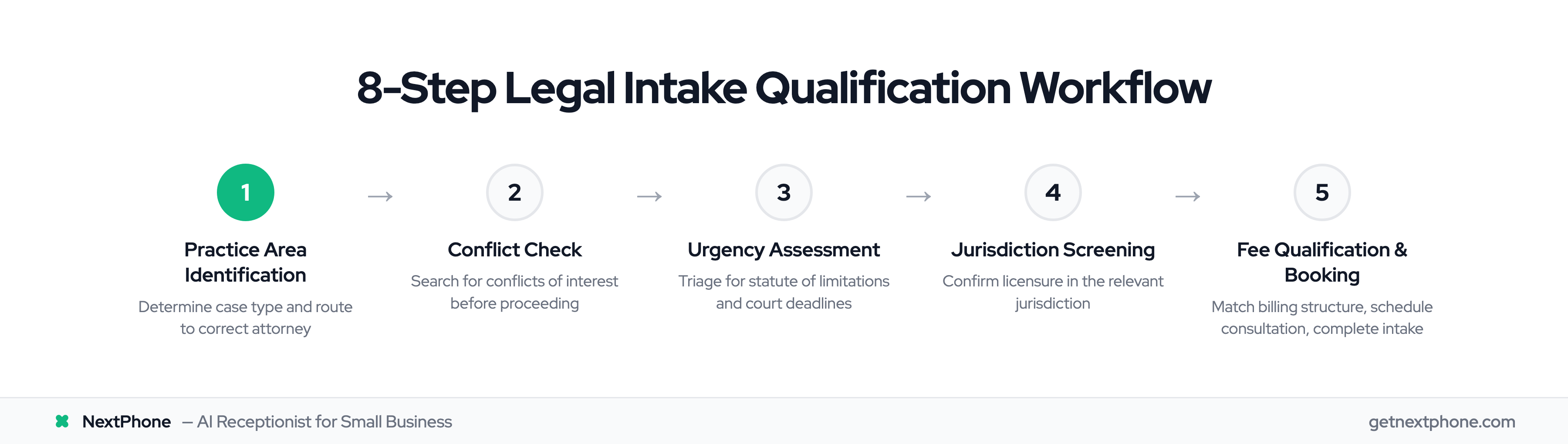
Effective legal intake qualification follows an 8-step framework that balances client experience, risk mitigation, and operational efficiency:
- Practice area identification - Determine case type and route to appropriate attorney
- Conflict check - Search for conflicts of interest before proceeding
- Case urgency assessment - Triage for statute of limitations and time-sensitive matters
- Jurisdiction screening - Confirm you're licensed to practice in relevant jurisdiction
- Fee structure qualification - Match case to appropriate billing arrangement (contingency, hourly, flat fee)
- Consultation booking - Schedule initial meeting with correct attorney
- Intake form completion - Collect detailed case information and documents
- Referral handling - Provide professional path forward for cases you can't accept
Each step serves a specific purpose. Practice area routing ensures the right attorney handles the matter. Conflict checks prevent ethics violations. Urgency assessment prioritizes time-sensitive cases. Jurisdiction screening avoids unauthorized practice. Fee qualification aligns client expectations. Consultation booking captures the opportunity. Intake forms prepare attorneys efficiently. Referrals maintain professional goodwill.
Modern intake systems complete this workflow in 5-10 minutes through automation, compared to 20-30 minutes with manual processes. According to legal practice management data, 78% of law firms now use legal CRM solutions to streamline intake and improve consistency. Clio's 2024 Legal Trends Report found that 79% of legal professionals now use AI daily—up from just 19% in 2023.
Step 1: Practice Area Identification & Routing
The first question in legal intake is simple: "What brings you in today?" or "What type of legal help do you need?"
The answer determines everything that follows—which attorney is qualified to help, what questions to ask, how to structure fees, and whether the case fits your firm's practice areas.
Why Practice Area-Specific Questions Matter
A family law intake needs different information than a criminal defense intake. Personal injury requires accident details and medical records. Estate planning focuses on assets and beneficiaries. Business law asks about entity types and transactions.
Generic intake questions waste time and miss critical information. Practice area-specific templates ensure you capture what matters for case evaluation.
Practice Area Question Templates
Here are qualification questions for the five most common practice areas in solo and small firm practices:
Family Law Qualification Questions:
- What is your current marital status and when were you married?
- Do you have children? (Names, ages, custody preferences)
- What are the grounds for divorce or separation?
- What are your primary concerns? (Asset division, child custody, support, alimony)
- Are there any domestic violence issues or is a protective order needed?
- Is the other party represented by an attorney?
- What's your desired outcome and timeline?
Criminal Defense Screening Questions:
- What specific charges have been filed against you?
- When and where were you arrested?
- Are you currently detained, or have you been released? What are your bail conditions?
- Do you have a court date scheduled? When and where?
- Do you have any prior criminal history?
- What evidence or witnesses exist related to your case?
- What did you tell law enforcement during your arrest or questioning?
Personal Injury Assessment Questions:
- When and where did the incident occur?
- What type of accident was it? (Auto collision, slip and fall, medical malpractice, product liability, workplace injury, etc.)
- What injuries did you sustain and what medical treatment have you received?
- What is your current medical status? Are you still treating?
- What insurance coverage applies? (Yours, other party's, medical insurance)
- Do you have photos, police reports, medical records, or witness information?
- When exactly did this happen? (Critical for statute of limitations screening)
Estate Planning Intake Questions:
- What is your age, marital status, and do you have children or other dependents?
- Do you currently have any estate planning documents? (Will, trust, power of attorney, healthcare directive)
- What assets do you own? (Real estate, investments, business interests, retirement accounts)
- What are your primary goals? (Probate avoidance, tax planning, special needs trust, business succession, charitable giving)
- Are your beneficiary designations on retirement accounts and insurance current?
- What's your timeline and urgency for completing this?
Business Law Qualification Questions:
- What type of entity do you have or need? (LLC, corporation, partnership, sole proprietor)
- What is the nature of your legal need? (Formation, contract review/drafting, M&A transaction, dispute resolution, regulatory compliance)
- What industry are you in and how large is your business?
- If there's a transaction, what are the key details and timeline?
- Do you need immediate help with a specific issue or ongoing general counsel?
- Are there regulatory considerations we should know about?
- What's your budget and timeline for this matter?
These questions accomplish three goals simultaneously: they qualify whether the case fits your practice, they gather essential facts for attorney review, and they identify red flags that might disqualify the case (expired statute, wrong jurisdiction, conflict of interest, etc.).
Step 2: Automated Conflict Check Before Engagement
Conflict of interest checks are not optional. They're an ethics requirement under ABA Model Rules 1.7 and 1.9 and a critical step in intake that prevents malpractice exposure.
What Conflict Checking Searches For
A conflict exists when representing a new client would be directly adverse to a current or former client, or when there's a significant risk that your representation would be materially limited by your responsibilities to another client.
Conflicts arise from:
- Current or former clients on the opposing side
- Related parties (spouses, family members, business partners, subsidiaries)
- Co-parties with diverging interests
- Personal relationships with opposing parties
- Financial interests adverse to the client
A basic name match isn't enough. Modern conflict checks must search for relationship connections across your entire database.
How Automated Conflict Checking Works
Manual conflict checks involve searching through filing cabinets, spreadsheets, or scrolling through case management databases. This takes 15-20 minutes and relies on perfect memory and record-keeping.
Automated conflict check software completes the same search in 30 seconds by:
- Searching across multiple databases - Current clients, former clients, opposing parties, related individuals and entities, consultation-only contacts
- Cross-referencing relationships - Not just exact name matches, but family relationships (spouse, children), business affiliations (partners, shareholders, subsidiaries), co-parties in other matters
- Flagging potential conflicts - System highlights matches and relationship connections for attorney review
- Documenting the check - Creates audit trail showing conflict check was performed, when, and results
- Integrating with intake workflow - Conflict check happens automatically when new contact is entered, before consultation is booked
Popular platforms like Clio, MyCase (trusted by 18,000+ law firms), Lawmatics, PracticePanther (serving tens of thousands of firms in 170 countries), and Intapp Conflicts all include automated conflict checking integrated with their legal CRM and case management systems.
Why This Matters
Conflict of interest is the most cited legal malpractice error year after year. Automated conflict checking reduces this risk dramatically by:
- Completing comprehensive searches in seconds instead of minutes
- Searching relationship connections that human reviewers might miss
- Creating documented audit trails for ethics compliance
- Catching conflicts before engagement letters are signed
For example, your firm represents John Smith in a business dispute. Jane Smith calls for a divorce consultation. Automated conflict checking flags that Jane is married to John (your current client). Without automation, this connection might not surface until after you've accepted Jane's case—forcing withdrawal, creating malpractice exposure, and damaging client relationships.
Step 3: Case Urgency Assessment & Statute of Limitations Screening
Not all legal matters are created equal. Some require immediate attention. Others can wait weeks for an initial consultation. Effective intake includes urgency triage to ensure time-sensitive matters get priority treatment.
Urgency Triage Framework
In our analysis of call patterns across industries, calls with urgency keywords like "emergency," "urgent," or "ASAP" rank among the top reasons people call. For law firms, urgency assessment is even more critical given statute of limitations deadlines, court dates, and time-sensitive legal protections.
Legal intake urgency falls into three categories:
Emergency (Immediate Attorney Contact Required):
- Criminal arrest with upcoming arraignment or detention hearing
- Domestic violence with safety concerns requiring protective order
- Deadline expiring within 72 hours (statute, filing deadline, response deadline)
- Court appearance scheduled within 48 hours
- Emergency custody or restraining order needs
- Time-sensitive business transaction with imminent closing
Urgent (Priority Consultation Within 1-3 Days):
- Statute of limitations within 30-90 days
- Court response deadline within 2 weeks
- Recently terminated employee considering claims
- Business dispute with ongoing losses
- Recently served with lawsuit
- Criminal charges filed with court date within 2 weeks
Standard (Schedule Within 1-2 Weeks):
- General legal planning (estate, business formation, contracts)
- Ongoing disputes without immediate deadlines
- Consultation for future needs
- Second opinions
- Preventative legal advice
Statute of Limitations Screening by Practice Area
Statute of limitations varies dramatically by case type and jurisdiction. During intake, asking "When did this happen?" or "When did you discover this issue?" flags potential statute problems before they become malpractice claims.
Common statute periods:
Personal Injury: 1-3 years from injury date (varies by state)
- California: 2 years
- Texas: 2 years
- Florida: 4 years (2 years for medical malpractice)
- New York: 3 years
Medical Malpractice: Typically 2 years from discovery or reasonable discovery date (discovery rule applies)
Contract Disputes:
- Written contracts: 4-6 years (most states)
- Oral contracts: 2-3 years (most states)
Employment Law:
- Discrimination/harassment: 180-300 days to file EEOC charge, then lawsuit
- Wage claims: 2-3 years
Property Damage: 2-6 years depending on state
Criminal Prosecution: No statute for prosecution, but speedy trial rights apply
Family Law: Generally no statute for divorce/custody, but property division and support modification have deadlines
Red Flag Questions for Time-Sensitive Matters
During intake, these questions identify urgency:
- "When exactly did this incident/injury/discovery occur?"
- "Have you spoken with other attorneys about this?" (If yes, why didn't they take it? Statute issue?)
- "Do you have any upcoming court dates or deadlines?"
- "When were you served with legal papers?"
- "When were you arrested or charged?"
- "When did you first notice the problem/injury?"
If a personal injury caller says the accident happened 2 years and 10 months ago in a state with a 2-year statute, you have a serious problem. Either they're already barred from filing, or you have mere weeks to investigate, sign them up, and file before the deadline expires.
This is an emergency that requires immediate attorney contact—not a standard intake process that takes 5-7 days to complete.
Step 4: Geographic Jurisdiction Screening
Attorneys are licensed state-by-state. Providing legal advice or representation in a jurisdiction where you're not licensed constitutes unauthorized practice of law under ABA Model Rule 5.5—a serious ethics violation.
Essential Jurisdiction Questions
During intake, ask:
- "Where are you located?" (Physical location of the caller)
- "Where did the incident occur?" (For personal injury, criminal matters, business disputes)
- "Where will the case be filed?" (Court jurisdiction)
- "Where is the property located?" (For real estate matters)
- "Where do you operate your business?" (For business law matters)
If the answers don't match a jurisdiction where you're licensed to practice, you have limited options.
Multi-State Practice Options
Option 1: Decline and Refer
The safest approach when you're not licensed in the relevant jurisdiction is to decline representation and provide a referral to a qualified attorney in that state. We'll cover referral best practices in Step 8.
Option 2: Co-Counsel with Local Attorney
For matters where you have relevant expertise but lack local licensing, you can associate with a local attorney licensed in that jurisdiction. The local attorney acts as co-counsel, ensuring compliance with local rules while you provide substantive expertise.
This is common in complex litigation, class actions, or specialized practice areas.
Option 3: Pro Hac Vice Admission
"Pro hac vice" (Latin for "for this occasion") allows attorneys to seek temporary admission to practice in a specific case in a jurisdiction where they're not generally licensed.
Requirements typically include:
- Association with local counsel (required in most jurisdictions)
- Application to the court
- Fee payment
- Demonstration of good standing in home jurisdiction
- Appearance limited to that specific case
Pro hac vice is case-specific, not ongoing authorization, and isn't practical for intake calls—it's a post-engagement step if you decide to take the case.
Option 4: Uniform Bar Exam and Reciprocity
Thirty-nine states now accept the Uniform Bar Exam (UBE), which makes cross-admission easier for attorneys who took the UBE. Some states also offer admission by motion for attorneys licensed elsewhere who meet experience requirements (typically 5+ years of active practice).
If you regularly receive calls from a neighboring state, seeking admission there might make business sense.
States Without Reciprocity
Some states make multi-state practice particularly difficult:
- California: No reciprocity; attorneys must take California bar exam (though a shorter version exists for attorneys with 4+ years of practice in good standing)
- Alabama, Arizona, Delaware: No reciprocity
- Florida: Very limited reciprocity
Virtual Practice and Jurisdiction
Even if you're meeting with clients virtually or providing remote services, you must be licensed in the jurisdiction where you're providing legal advice. Physical location doesn't exempt you from jurisdiction requirements.
If a Florida attorney provides legal advice via Zoom to a California resident about California law, that's unauthorized practice in California—even though the attorney never left Florida.
Step 5: Fee Structure Qualification & Retainer Discussion
Different case types require different fee structures. During intake, you need to assess which billing arrangement fits the case and whether the client can meet those terms.
Contingency Fee Cases
Contingency fees work best for cases with monetary recovery potential where clients can't afford hourly rates. The attorney receives a percentage of the recovery (typically 33.3% if settled before lawsuit, 40% if case proceeds to litigation or trial), and the client pays nothing upfront.
Common contingency fee practice areas:
- Personal injury (auto accidents, slip and fall, medical malpractice)
- Employment discrimination and wrongful termination
- Some business litigation (breach of contract with clear damages)
- Class actions
- Insurance bad faith claims
Ethics note: Contingency fees are prohibited in criminal defense and divorce cases under ABA Model Rule 1.5.
According to industry fee structure guides, typical contingency percentages are:
- 33.3% (one-third) if settled before lawsuit filed
- 40% if lawsuit filed or case goes to trial
- Some agreements include higher percentages (45-50%) for appeals
Qualification questions for contingency cases:
- "Do you have insurance coverage for this incident?" (Insurance = recovery potential)
- "What are your estimated damages?" (Case value must justify contingency work)
- "Have you received any settlement offers?" (Indicates liability and value)
Hourly Rate Cases
Hourly billing works for cases without direct financial recovery potential, ongoing legal needs, or where clients have ability to pay for attorney time regardless of outcome.
Common hourly rate practice areas:
- Criminal defense
- Family law (divorce, custody, support)
- Business transactions and general counsel
- Contract negotiation and drafting
- Regulatory compliance
- Estate planning (though many firms use flat fees)
- Civil litigation defense
Hourly rates vary widely based on attorney experience, firm size, and geographic market. Typical ranges:
- Solo/small firm: $200-$400/hour
- Mid-size firm: $300-$500/hour
- Large firm: $400-$800+/hour
Retainer deposits: Most hourly arrangements require an upfront retainer deposit (typically $3,000-$25,000 depending on case complexity). The attorney bills against this deposit, and clients replenish when it's depleted.
Qualification questions for hourly cases:
- "What's your budget for legal fees on this matter?"
- "Are you able to provide a retainer deposit upfront?" (Typical: $5,000-$10,000)
- "Do you understand that fees are based on time spent, regardless of outcome?"
Flat Fee Arrangements
Flat fees provide price certainty for defined-scope projects with predictable work.
Common flat fee practice areas:
- Estate planning (wills, trusts, powers of attorney)
- Simple uncontested divorce
- Business entity formation (LLC, corporation)
- Simple contract drafting
- Trademark registration
- Residential real estate closings
Typical flat fee ranges:
- Simple will: $500-$1,500
- Comprehensive estate plan (will, trust, POA, healthcare directive): $2,000-$5,000
- LLC formation: $1,000-$3,000
- Uncontested divorce: $1,500-$5,000
- Residential closing: $500-$2,000
Qualification questions for flat fee cases:
- "What's the scope of what you need?" (Ensure it fits defined scope)
- "Are there complications that might expand the scope?" (Business assets in divorce, complex trust needs, etc.)
Hybrid Fee Structures
Some cases combine fee structures:
- Reduced hourly + success bonus: Lower hourly rate ($150/hour instead of $300) plus percentage bonus if case succeeds
- Flat fee for phase 1 + contingency for phase 2: Flat fee for investigation and filing, then contingency on recovery
- Hourly with cap: Hourly billing up to maximum cap, providing some cost certainty
During intake, explain the fee structure clearly and assess whether the client can meet the terms. This sets expectations and prevents fee disputes later.