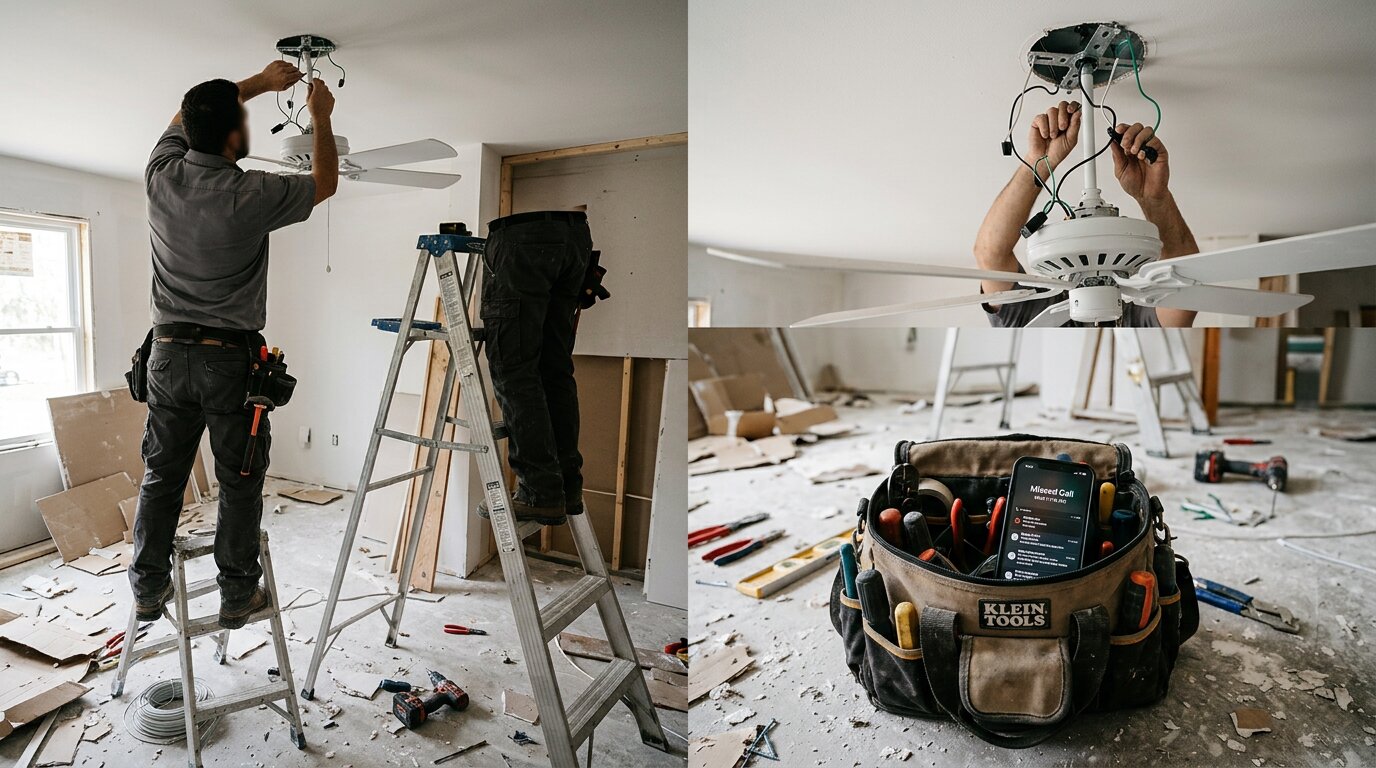
Your phone rings. You're on a ladder installing a ceiling fan. Your hands are covered in drywall dust. The call goes to voicemail. That customer calls the next electrician on their list.
Industry research shows 74.1% of calls to home services contractors go completely unanswered. Invoca's analysis puts the figure at 62% of calls to home services businesses and quantifies the revenue that costs. That's three out of every four potential customers calling someone else.
AnswerConnect solves this problem. They're one of the most reputable human answering services in the industry. But here's the catch: their per-minute pricing model creates a new problem: the more successful you get, the higher your bills climb.
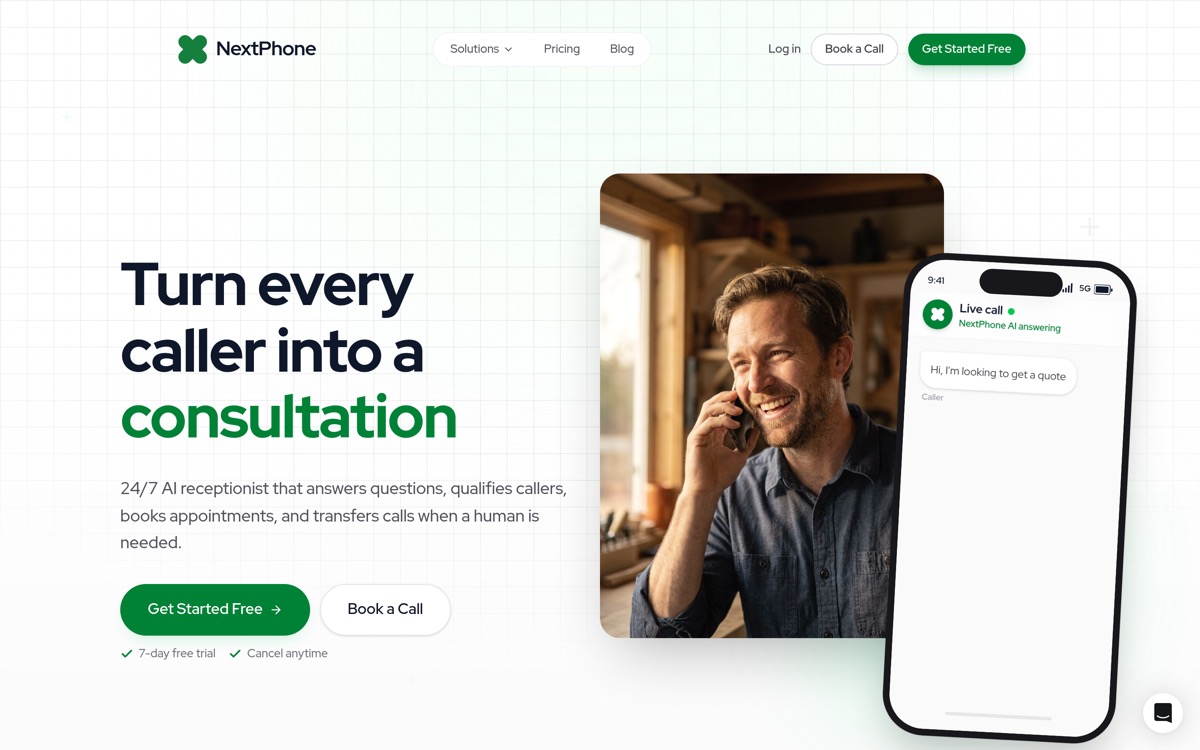
This guide compares AnswerConnect to AI receptionist alternatives. The reality: AnswerConnect no longer publishes its prices (its pricing page is a quote form as of October 5, 2026), so you can't see what 200 calls a month will cost until sales quotes you, while NextPhone's $199 Pro plan stays at $199 at any volume. 85% of customer service leaders will pilot conversational GenAI in 2025. The shift to AI is happening now. Unless you're a medical practice with complex diagnostic triage, AI delivers the same caller experience (99% caller satisfaction) at about 1/5 the cost.
What is AnswerConnect?
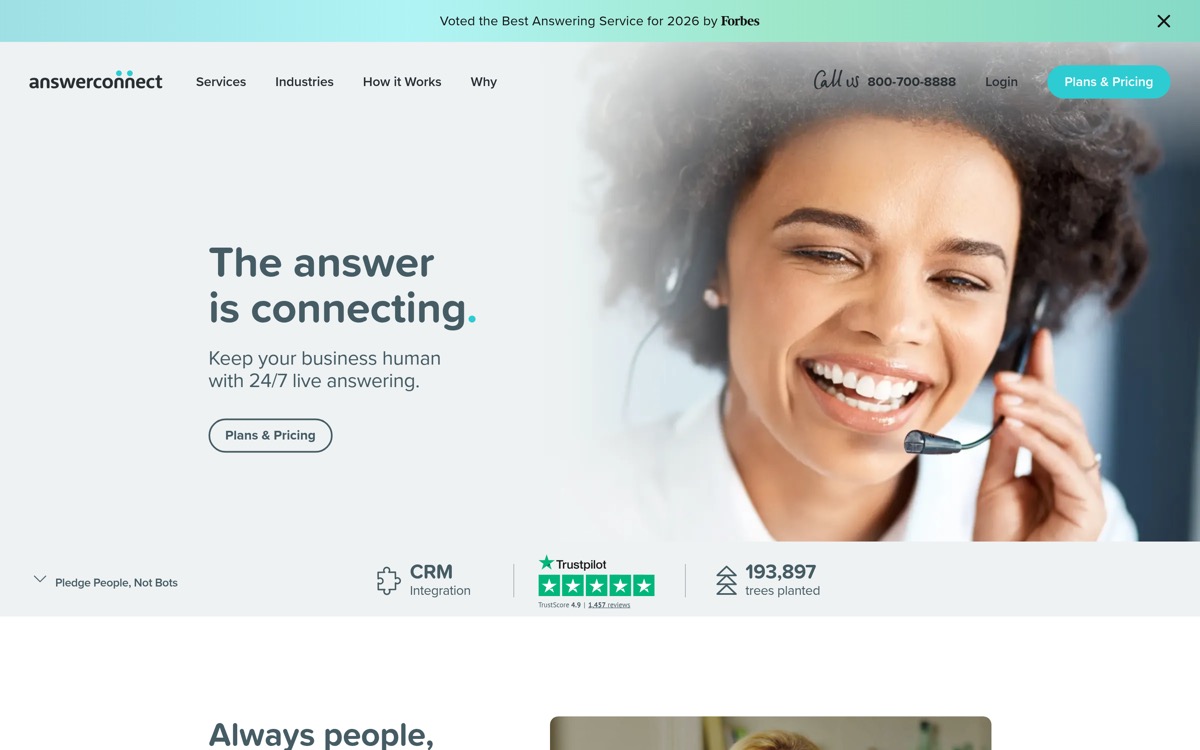
AnswerConnect is a premium human answering service headquartered in Portland, Oregon. Forbes named them the #1 answering service in 2025, and they maintain a 4.7 out of 5 rating on G2 and 4.9 out of 5 on Trustpilot with over 1,300 reviews.
Their core offering includes:
- 24/7 live answering by US-based receptionists
- Bilingual support (English and Spanish)
- CRM integration with popular platforms
- Appointment scheduling and booking
- Custom call scripts tailored to your business
- Message taking and call routing
AnswerConnect claims to answer 99% of calls within one to four rings. For businesses that need a human touch on every call, they deliver.
The quality isn't the question. The question is whether that quality justifies the cost, especially as your business grows.
How AnswerConnect Pricing Works
AnswerConnect uses a per-minute pricing model. You pay for every minute their receptionists spend on your calls.
Here's how their US plans break down:
Prices checked against each provider's own pricing page on October 5, 2026.
| Minutes Included | Monthly Cost | Cost Per Minute |
|---|---|---|
| 200 minutes | Quote only | Not published |
| 300 minutes | Quote only | Not published |
| 400 minutes | Quote only | Not published |
AnswerConnect stopped publishing US prices: as of October 5, 2026 its pricing page is a quote form. The 200-, 300- and 400-minute plan sizes are the ones it last published on September 22, 2026; ask sales for the current price and the setup fee, which its terms say it charges without publishing the amount.
The math gets tricky fast. If your average call lasts 3 minutes, the 200-minute plan covers about 66 calls per month. Go over your minutes and you'll pay a per-minute overage rate that AnswerConnect now quotes privately.
Unlike some competitors, AnswerConnect includes 24/7 coverage without night or weekend surcharges. That's a genuine advantage. But the per-minute model still means your monthly bill fluctuates based on call volume and call duration, two things you can't always control.
The Per-Minute Scalability Trap
Here's where AnswerConnect's pricing model creates problems: your success makes your bills unpredictable.
Consider a roofing contractor during storm season. Normally they get 40 calls a month. After a major storm, calls spike to 150. With AnswerConnect, that contractor just went from needing about 120 minutes to about 450, past even the 400-minute plan and into overage, right when they're busiest and least able to deal with billing surprises.
That volatility is the norm, not the exception. Home services call volume swings hard from month to month. Some months are slow. Others are slammed. Per-minute pricing punishes you during your best months.
One contractor on a business forum (an unsourced user report) put it bluntly: a single storm week pushed them past 500 minutes and far above their usual bill, and while they liked the service, they said they needed predictable costs.
Another wrote: "The quality is amazing but I'm nervous every time we have a busy week. Success shouldn't mean budget anxiety."
This is the scalability trap. The more your business grows, the more calls you receive, and the more your answering service costs. At a certain volume, the math stops working.
AI Receptionist: A Different Approach
| Feature | Human (AnswerConnect) | AI receptionist (NextPhone) |
|---|---|---|
| Pricing model | Per-minute, quote only (no published price as of October 5, 2026) | Flat monthly plans from $199, unlimited calls |
| Answer speed | 1-4 rings | Under 2 seconds |
| Availability | 24/7 (included) | 24/7 (included) |
| Emergency routing | Script-dependent | Automatic detection |
| Scalability | Cost increases with volume | Fixed cost |
AI receptionist services take a fundamentally different approach. Instead of billing per minute, most charge a flat monthly rate for unlimited calls. The virtual receptionist market has grown to $6.26 billion, reflecting this shift in how businesses handle phone coverage.
Here's how they work:
An AI virtual receptionist answers your calls conversationally: not with "press 1 for sales" IVR menus, but with natural language. A caller says "I need an estimate for a bathroom remodel" and the AI understands, asks relevant questions, and either handles the request or routes the call appropriately.
Modern AI receptionists can:
- Answer in under 2 seconds (faster than most human services)
- Provide 24/7 coverage with no night or holiday premiums
- Handle routine inquiries (hours, pricing, scheduling)
- Detect urgency keywords and route emergencies to your phone immediately
- Integrate with CRMs to log leads automatically
- Send SMS follow-ups with booking links
The technology has improved dramatically. In our call data, urgent calls rank among the top reasons people call, using language like "emergency," "urgent," or "ASAP." AI systems can detect these patterns and escalate immediately, something rigid call scripts can't do.
Human Answering vs AI Receptionist:
| Feature | Human (AnswerConnect) | AI Receptionist |
|---|---|---|
| Pricing Model | Per-minute (quote only: no published rate as of October 5, 2026) | Flat monthly plans from $199, unlimited calls |
| Answer Speed | 1-4 rings | Under 2 seconds |
| Availability | 24/7 (included) | 24/7 (included) |
| Handles Routine Calls | Yes | Yes |
| Emergency Routing | Script-dependent | Automatic detection |
| CRM Integration | Yes (varies) | Yes (CRM sync on $299 Growth plan) |
| Scalability | Cost increases with volume | Fixed cost |
Cost Comparison: AnswerConnect vs AI at Different Volumes
At 200 calls a month, AnswerConnect is quote only (about 600 billable minutes to price, no published rate as of October 5, 2026), against $199 a month for unlimited calls on AI.
Let's run the numbers at different call volumes. We'll assume average 3-minute call duration for AnswerConnect and compare to a $199/month unlimited AI service. AnswerConnect no longer publishes a plan price or an overage rate, so the table shows the minutes you would need it to quote rather than a dollar total.
| Monthly Calls | AnswerConnect Cost | AI Receptionist | Minutes AnswerConnect Would Bill |
|---|---|---|---|
| 50 calls | quote only | $199 | 150 |
| 100 calls | quote only | $199 | 300 |
| 200 calls | quote only | $199 | 600 |
| 300 calls | quote only | $199 | 900 |
AnswerConnect's US pricing page is a quote form as of October 5, 2026, so no published price is shown. Minutes assume a 3-minute average call; AnswerConnect bills each call in whole minutes, rounded up. Ask for the one-time setup fee.
Use the minutes column when you ask for a quote. At 50 calls per month you need about 150 minutes. At 100 calls, about 300. At 200 calls, about 600. At 300 calls during a busy season, about 900 minutes in a single month, and a per-minute quote climbs with every one of them while the AI column stays at $199.
For a contractor averaging 150 calls per month, that is about 450 billable minutes every month on per-minute answering, against one flat price on AI.
When AnswerConnect last published prices (September 22, 2026), its smallest US plan already cost more than flat-rate AI, and overage applied past the largest plan's 400 minutes, about 130 calls. Get the current numbers in writing, because on per-minute pricing the gap widens fast as volume increases.