The 2am Test: When "24/7" Becomes Real
It's 2:30am on a Saturday. A homeowner's pipe just burst, and water is flooding their basement. They're panicking, searching for emergency plumbers on their phone.
Your business comes up first in the search results. They call.
If you're using a traditional receptionist or most answering services, that call goes to voicemail. The homeowner immediately calls the next plumber on the list. That's a $3,500 emergency job you just lost—not because you couldn't do the work, but because you couldn't answer the phone.
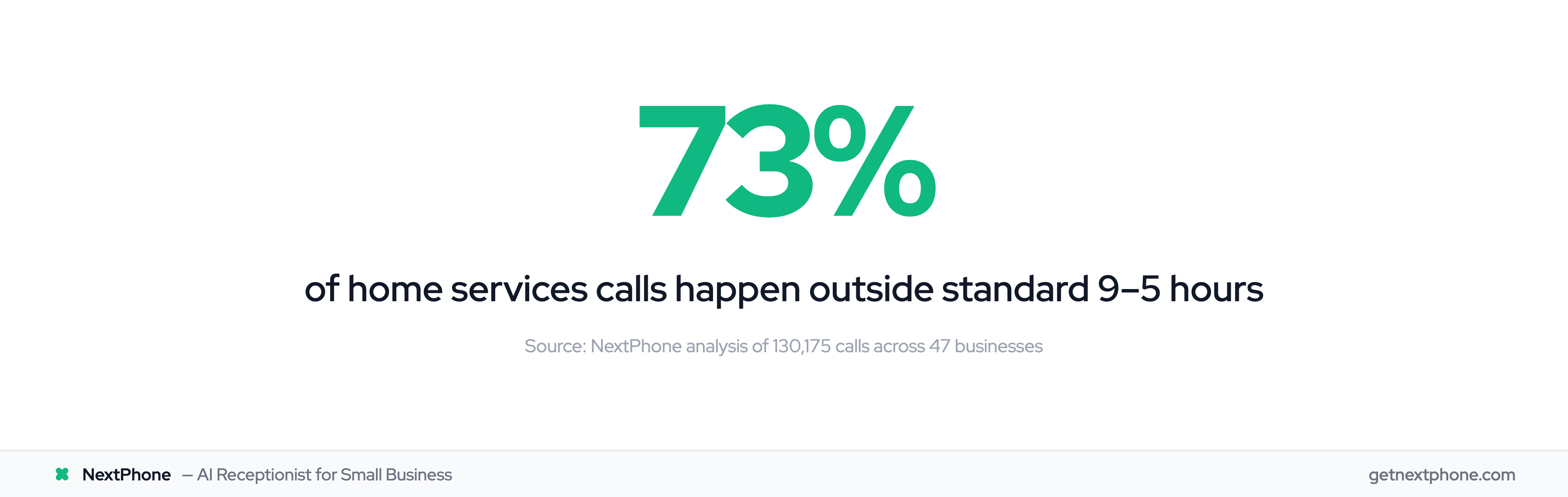
This scenario plays out thousands of times every night across the country. In our analysis of 130,175 calls from 45 home services businesses over 7 months, we found that 73% of calls happened outside standard 9-5 business hours. Even more striking: 15.9% of all calls contained urgency language like "emergency," "urgent," or "ASAP."
These calls can't wait until morning. And they won't.
The question isn't whether 24/7 availability matters. The question is whether the "always-on" promise from AI receptionists is real or just marketing talk. Let's find out.
Why 24/7 Availability Isn't Optional Anymore
The After-Hours Reality: When Your Customers Actually Call
Here's what traditional business thinking tells you: most customers call during business hours, so that's when you need coverage.
Here's what the data actually shows: you've got it backwards.
Our analysis of 130,175 calls revealed that 73% happened outside the standard 9-5 window. Think about that. Nearly three out of every four potential customers are calling when traditional receptionists aren't working.
For home services businesses, this makes perfect sense. Your customers are at work during your business hours. They're dealing with their home issues early morning, evenings, and weekends—when they're actually home.
The Cost of "We'll Call You Back Tomorrow"
When a customer gets voicemail instead of a person, most don't leave a message. They call the next business on their list.
But some do leave messages requesting callbacks. In our data, 25.4% of calls included explicit callback requests. Without a systematic way to track and complete these callbacks, about 80% never happen. The business gets busy, the message gets lost, the customer moves on.
For a typical contractor receiving 42 calls per month, that's 11 callback requests monthly. If 9 of those are never returned, and just 30% would have converted at an average $3,500 project value, that's $9,450 per month in lost revenue—$113,400 per year.
Emergency Calls Can't Wait Until Morning
Here's where after-hours availability becomes critical: emergency work is your highest-value work.
Our data shows that emergency jobs average $4,200 compared to routine work. When someone's AC dies in 95-degree heat or their pipe bursts at midnight, they need help now. They'll pay premium rates, and they'll call whoever answers first.
If you're unavailable and a competitor picks up instantly, you don't just lose that job. You lose a customer who will remember which business was there when they desperately needed help.
A plumber in our dataset missed 76 calls in one month—most of them after-hours. His reaction when he saw the data: "I didn't even know I was missing that many calls until I saw the data. I just thought business was slow."
Business wasn't slow. He was just closed when customers were calling.
Decoding "99.9% Uptime": What It Actually Means
Every AI receptionist service claims "24/7 availability." But what does that actually guarantee?
This is where uptime SLAs (Service Level Agreements) matter—and where you can separate real always-on service from marketing promises.
Breaking Down the Numbers: Uptime SLA Math
A 99.9% uptime SLA means the system is guaranteed to be operational 99.9% of the time. Sounds great, but what does that mean in practice?
Let's do the math. There are 8,760 hours in a year. With 99.9% uptime:
- Maximum downtime allowed: 8.76 hours per year
- That's less than one full business day annually
Compare that to different uptime levels. Major cloud VoIP providers like Nextiva offer 99.999% uptime serving 100,000+ businesses:
- 99% uptime = 87.6 hours downtime per year (more than 10 full business days)
- 99.9% uptime = 8.76 hours downtime per year (about one business day)
- 99.99% uptime = 52.56 minutes downtime per year (less than one hour)
- 99.999% uptime ("five nines") = 5.26 minutes downtime per year
Each additional "nine" represents a 10x improvement in reliability. Going from 99% to 99.9% means 90% less downtime. That seemingly small 0.9% difference equals 78.84 hours—nearly two full work weeks.
How 99.9% Compares to Human Availability
Now let's compare AI uptime to human receptionist availability.
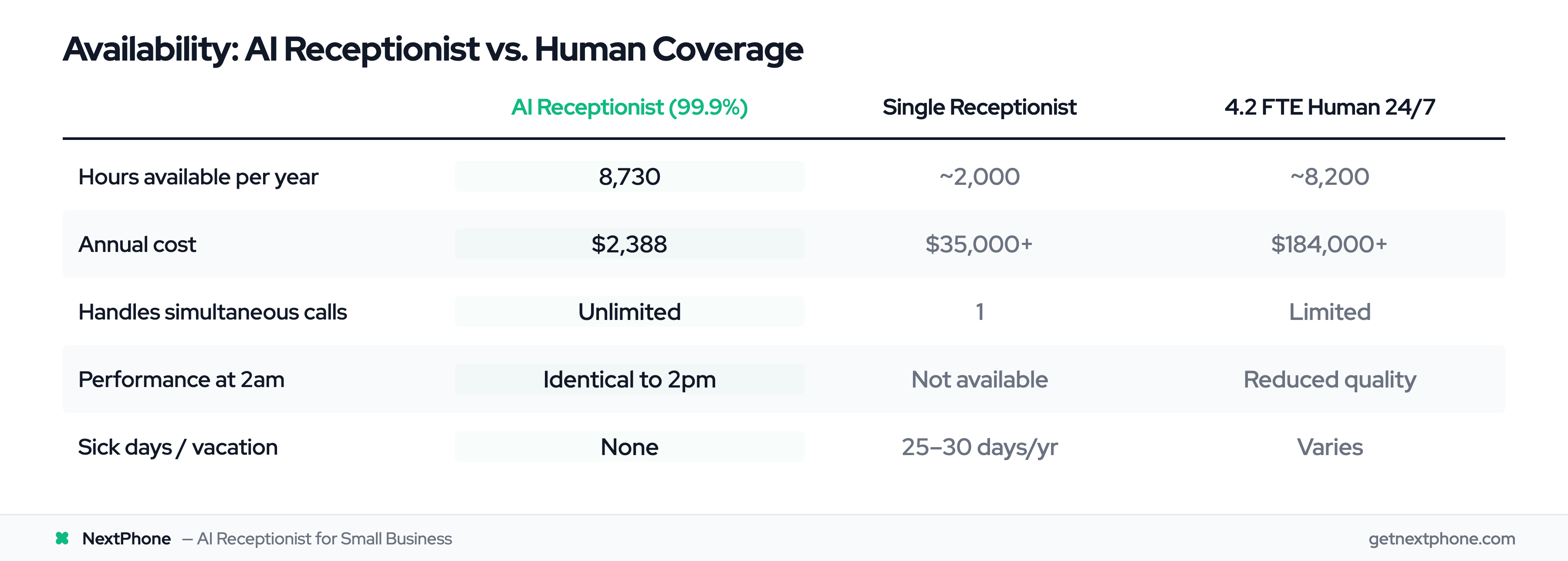
The average employee takes 10-15 sick days per year plus 15 days of PTO. That's 25-30 days unavailable—and that's before accounting for lunch breaks, coffee breaks, appointments, or the fact that humans don't work nights and weekends without expensive shift coverage.
Do the math on a single receptionist working standard business hours (40 hours/week, 50 weeks/year accounting for PTO):
Total hours worked: 2,000 hours per year
- Percentage of the year: 22.8%
Even with perfect attendance, they're unavailable 77.2% of the time.
Want true 24/7 human coverage? You need 4.2 full-time employees to cover every hour with shift overlaps, sick day coverage, and vacation backup. At a median customer service salary of $35,000, that's $147,000 per year minimum—before benefits, training, or management overhead.
An AI receptionist at 99.9% uptime is available 8,730 hours per year. A human working standard hours: 2,000. That's 6,730 additional hours of coverage—337% more availability—at a fraction of the cost.
Why Every "Nine" Matters
You might think, "What's 8 hours of downtime per year? That seems fine."
For some businesses, it is. But consider this: if those 8.76 hours happen to fall during a storm when you're getting 20 emergency calls per hour, you just lost 175 potential customers—and the revenue that comes with them.
The difference between 99.9% and 99.99% uptime (8.76 hours vs. 52 minutes annually) might seem minor until your system goes down during your busiest period of the year.
Higher uptime SLAs cost more to deliver because they require more sophisticated infrastructure. Most business phone alternatives now offer 99.9%+ uptime as a baseline expectation. But for businesses where calls equal revenue, every minute of availability matters.
The Infrastructure Behind Always-On: How It Works
So how do AI receptionist systems achieve 99.9%+ uptime? It's not magic—it's architecture.
Cloud-Based Architecture: No Single Point of Failure
Traditional phone systems run on a single server in a single location. If that server fails—power outage, hardware failure, network issue—your entire phone system goes down. You have a single point of failure.
Cloud-based AI receptionists work differently. They're distributed across multiple servers in multiple data centers. If one server fails, traffic automatically routes to healthy servers. No single point of failure means no catastrophic outages.
This is the fundamental architectural difference that enables high uptime.
Multi-Region Redundancy and Automatic Failover
Enterprise-grade AI receptionist systems go further with multi-region deployment. Instead of all servers in one data center, they're spread across geographically separate regions—US-East, US-West, Europe, for example.
If an entire data center loses power or connectivity, traffic automatically fails over to another region. This happens in under one second. The caller never knows anything went wrong.
According to AWS architecture best practices, multi-region deployments can achieve 99.99%+ uptime by eliminating regional single points of failure. The infrastructure is designed assuming failures will happen—and routing around them automatically.
Think of it like having backup generators at multiple locations, not just one. If the power grid fails in Virginia, your system is already running in Oregon.
Real-Time Monitoring and Health Checks
Here's how the system knows when to trigger failover: continuous health monitoring.
Every few seconds, monitoring systems check whether each server is healthy and responding correctly. If a server stops responding or starts returning errors, it's immediately removed from the pool of available servers. Traffic routes to healthy servers only.
This happens automatically, 24/7, without human intervention. Issues are detected and resolved before they impact calls.
Advanced systems also monitor performance metrics: response times, error rates, capacity usage. If any metric exceeds acceptable thresholds, alerts go to engineering teams immediately.
What Happens When Something Goes Wrong
Even with all this redundancy, things can still go wrong. Bugs get deployed. Unexpected issues arise. So what happens then?
With proper architecture:
- Automatic failover keeps the system running on healthy infrastructure
- Health checks prevent bad servers from receiving traffic
- Monitoring alerts notify engineering teams immediately
- Rollback procedures revert to the last known good version quickly
- Redundant phone infrastructure ensures call routing continues even during platform issues
The goal isn't to never have problems—that's impossible. The goal is to detect and resolve problems faster than they impact customers.
Most downtime that counts against SLA happens during planned maintenance windows, which are typically scheduled for low-traffic periods and measured in minutes, not hours.
Proving "Always-On": Three Reality Checks
Infrastructure explanations are one thing. Real-world performance is another. Here are three concrete ways to validate whether "24/7" is real or marketing.
Reality Check 1: 2am Performs Exactly Like 2pm
Traditional answering services claim 24/7 coverage, but if you dig deeper, they often have "reduced staff" during nights and weekends. What that means in practice: slower pickup times, longer hold times, lower quality responses.
AI doesn't have shifts. There's no "night crew" with less training or fewer people. The same system answering calls at 2pm answers calls at 2am—same response time (under 5 seconds), same AI model, same training, same quality.
Test this yourself: call an AI receptionist at 3am on a Sunday. Then call at 11am on a Tuesday. You should get identical performance. If pickup is slower or quality differs, you don't have true 24/7—you have reduced after-hours service.
With NextPhone, average pickup time is under 5 seconds regardless of time, day, or call volume. The AI that answers emergency calls at midnight on Christmas is the same AI answering quote requests at noon on a Tuesday.
Reality Check 2: Surge Capacity (1 Call or 100 Calls Simultaneously)
Here's another test: what happens when call volume spikes?
When a storm hits and everyone needs emergency repairs, 50 customers might call within minutes. A human receptionist handles one call at a time. Everyone else gets a busy signal or voicemail.
Traditional answering services handle some surge capacity, but during peak periods they put callers on hold. Wait times balloon from 30 seconds to 2-3 minutes. Quality suffers as agents rush through calls.
AI receptionists handle parallel calls without degradation. Whether it's 1 call or 100 simultaneous calls, each caller gets instant pickup and full attention. The system scales automatically.
Cloud infrastructure makes this possible. When call volume increases, the system automatically provisions more computing resources. When volume drops, it scales back down. You get unlimited surge capacity without planning for it or paying extra.
This is the difference between a phone tree that puts people on hold and a system that answers every call immediately, no matter how many are coming in.
Reality Check 3: Zero Breaks, Holidays, or "Off Hours"
The most obvious advantage of AI is also the most significant: it never needs a break.
No lunch breaks. No coffee breaks. No bathroom breaks. No sick days. No vacation days. No holidays. No shift changes. No "reduced staffing" periods.
A traditional answering service might claim 24/7, but check their contract. Many have reduced coverage on holidays, slower response times at night, or higher per-call rates for after-hours service.
An AI receptionist answers calls on Thanksgiving at 3am exactly the same as it answers calls on a Tuesday at 11am. There's no difference in availability, quality, or cost.
For businesses with emergency service components, this is crucial. When a customer's heater fails on Christmas Eve or their AC dies on July 4th, they need help immediately. The business that's genuinely available wins that customer—and often their loyalty going forward.