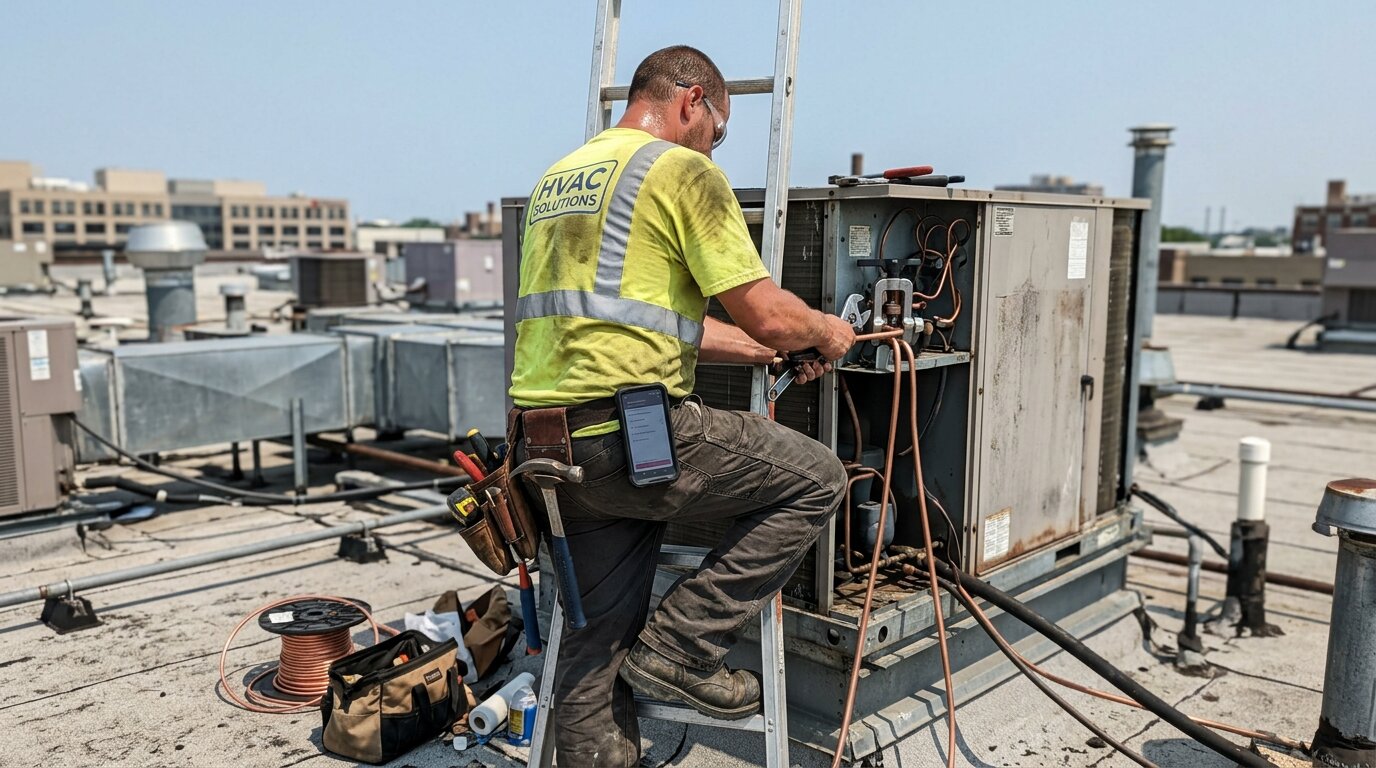
You're on a ladder installing a new HVAC unit in 95-degree heat. Your T-Mobile business phone buzzes in your pocket. You can't answer: you're 15 feet up with tools in both hands.
That call was a homeowner with an AC emergency willing to pay $3,500 for same-day service. They called the next contractor. You never even knew they called.
This scenario plays out dozens of times per month for field service businesses. You're doing the work that pays the bills, but you're missing the calls that could grow your business. The cruel irony: the better you are at your job, the more calls you miss.
Here's how T-Mobile for Business and NextPhone solve this with a mobile-first AI integration that keeps you connected without adding desk phones, receptionists, or complicated systems.
The Mobile-First Contractor Problem
Field Work Makes Phone Answering Impossible
Contractors face a simple physical reality: you can't answer your phone when you're working.
Roofers are on steep pitches installing shingles. Plumbers are under houses in crawl spaces. Electricians are in attics running wire. HVAC techs are on ladders with refrigerant lines. Your hands are dirty, you're using power tools, or you're in a position where reaching for your phone is unsafe.
Traditional office workers can grab their desk phone between emails. Field service professionals operate in a completely different environment.
The Real Cost of Missed Calls
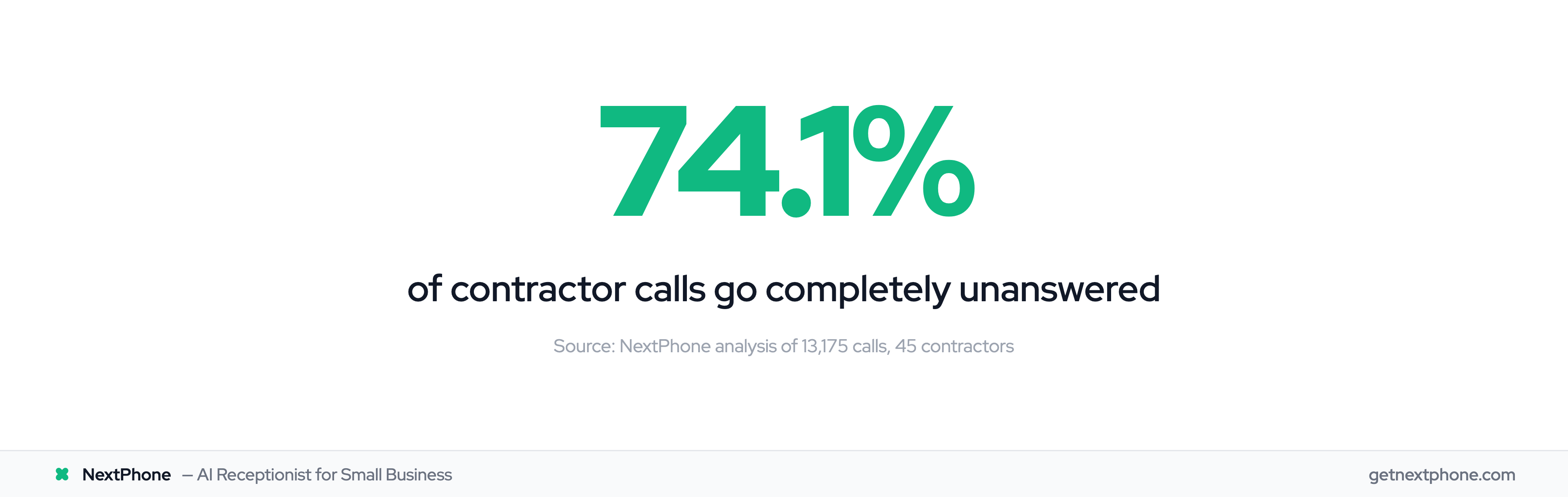
We've answered more than 2,000,000 business calls for home services contractors and others. The data is brutal: industry research shows 74.1% of calls to home services businesses go completely unanswered. That's three out of every four potential customers calling someone else.
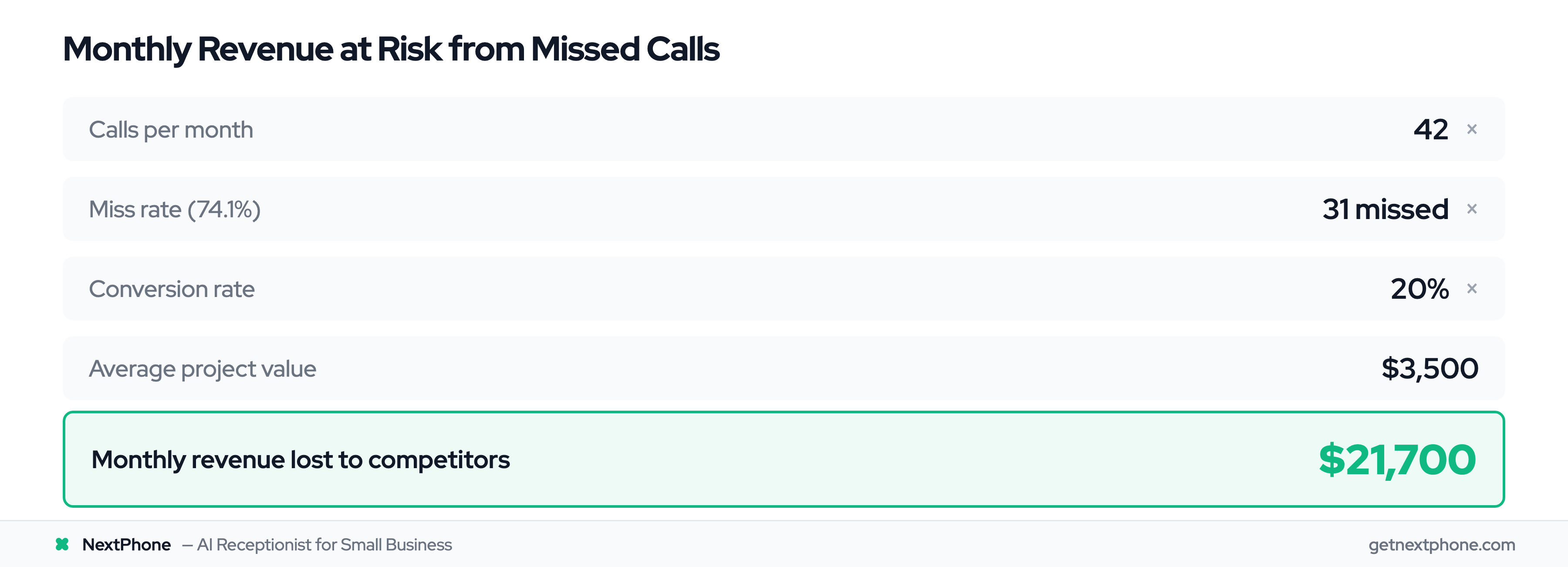
For a typical contractor receiving 42 calls per month, that means 31 missed calls. If just 20% of those would have converted at an average project value of $3,500, you're losing $21,700 per month. That's $260,400 per year in revenue going to competitors who answered faster.
Even more concerning: urgent calls with language like "emergency," "urgent," or "ASAP" rank among the top reasons people call. These emergency jobs average $4,200, significantly higher than routine work. Missing one emergency call per week costs $16,800 per month.
Why Traditional Solutions Don't Work for Mobile Businesses
Desk phone systems don't help when you're never at a desk. Traditional answering services cost $500-800 per month with per-call limits and slow response times. Hiring a full-time receptionist runs $35,000 per year ($2,900/month) plus benefits, and they still can't answer calls at 10 PM when pipes burst.
You need a solution built for how you actually work: mobile-first, always available, and smart enough to know when to handle calls versus when to interrupt you.
T-Mobile for Business: Built for Mobile-First Companies
T-Mobile Business Plans Overview
T-Mobile for Business offers unlimited data plans specifically designed for businesses that operate on the move. T-Mobile delivered $66.2B in service revenue in 2024 with 6.1M net customer adds, making it one of the strongest carriers for business communications. Their Business Unlimited plans start at $45 per month per line with six or more lines, providing unlimited talk, text, and high-speed 5G data with no annual contracts.
The plans include features beyond consumer offerings: international data and texting in 215+ countries, mobile hotspot capabilities (ranging from 5GB to 100GB depending on tier), and video streaming from 480p to 4K quality based on your plan level.
For field service contractors who work across town or across the state, these plans provide the connectivity foundation without requiring office infrastructure or landlines.
5G Coverage for Field Service Workers
T-Mobile was recognized as the "Best Network" based on analysis by Ookla of Speedtest Intelligence data from the first half of 2025. T-Mobile also offers best 5G coverage at 54% according to Statista. Their 5G network covers urban, suburban, and many rural areas: exactly where contractors work.
This nationwide coverage matters when you're driving between job sites, working in new construction areas, or serving customers in outlying communities. Your phone works reliably whether you're in downtown or 30 minutes outside the city limits.
For businesses running on mobile-first operations, this reliable connectivity becomes your business lifeline. Real-time communication, GPS navigation between jobs, photo uploads for estimates, and instant customer notifications all depend on network reliability.
Why T-Mobile vs AT&T and Verizon
According to carrier comparison studies, T-Mobile outperforms Verizon and AT&T in several key metrics including speed and consistency. Here's how the major carriers stack up for small business:
Pricing Comparison (per line/month):
- T-Mobile Business Unlimited: $45-85 depending on tier
- AT&T Business Unlimited: $50-75 depending on tier
- Verizon Business Unlimited: $30-70 depending on tier
Value Proposition:
- T-Mobile offers aggressive pricing with valuable extras for mobile teams
- Verizon leads in rural coverage reliability
- AT&T provides strong bundling flexibility with internet and VoIP
For contractors and field service businesses, T-Mobile's combination of competitive pricing, strong 5G coverage, and true mobile-first approach makes it an ideal foundation for business communications.
Mobile-First Business Communication in 2025
The Shift to Mobile-Only Business Operations
We're witnessing a fundamental change in how small businesses operate. According to business communication trends research, around 3 billion people worldwide will have 5G internet access in 2025, making mobile communications one of the biggest focal points for businesses of all kinds.
Younger entrepreneurs are skipping traditional office setups entirely. Why pay for office space, desk phones, and receptionists when you can run a six-figure contracting business from your truck and mobile phone?
Mobile-optimized tools allow teams to make and receive business calls, attend video meetings, and collaborate in real-time from wherever they are, using any device. Cloud-based platforms replace filing cabinets and landlines.
This shift also saves money. Businesses can save up to 75% on communication costs when switching from traditional phone systems to modern solutions. For contractors operating on thin margins, that's significant.
5G Enabling Real-Time AI Applications
The adoption of 5G networks enables technologies that weren't practical before. With latency under 50 milliseconds and speeds exceeding 100 Mbps, 5G supports real-time AI call processing, instant notifications to mobile devices, and seamless cloud application performance.
This technical capability is what makes mobile + AI integration actually work. When a customer calls, AI can answer instantly, process natural language in real-time, access your business information from the cloud, and transfer the call to your mobile, all within seconds over T-Mobile's 5G network.
The infrastructure is finally here to support truly mobile business operations augmented with AI assistance.
The Hybrid Solution: Mobile Carrier + AI Receptionist
Why AI Augments (Not Replaces) Your Mobile
You don't want to replace your T-Mobile mobile phone. You want to make sure every call to that number gets answered professionally, even when you can't pick up.
That's where the hybrid model works. You keep your T-Mobile business number for personal use, direct calls with customers, and emergencies. NextPhone AI serves as your always-available backup that handles calls when you're unavailable.
Think of it like having a receptionist who only picks up when you can't. The difference: this receptionist works 24/7, costs $199 per month instead of $35,000 per year, and never calls in sick.
The Best of Both Worlds
Here's how the hybrid model works in practice:
Routine Calls: Customer calls asking "What are your hours?" or "Do you service my area?" or "Can I get an estimate?" The AI answers instantly with accurate information based on your business, books appointments, and sends you a summary. You never had to stop working.
Emergency Calls: Customer calls saying "My basement is flooding" or "The AC stopped working and it's 95 degrees." The AI detects urgency keywords, immediately transfers the call to your T-Mobile mobile, and you're talking to the customer within seconds. They got a professional answer instantly, then reached you directly for the emergency.
In our analysis of the calls we answer, approximately one in four callers asks for a callback. With traditional voicemail, most of these callback requests get forgotten or delayed. The AI automatically logs these, sends you notifications, and can even text the customer a booking link while you're finishing your current job.
Meanwhile, true emergencies requiring immediate response are a recurring reason people call: exactly the type of calls worth interrupting your work for. The AI routes these to you while handling everything else.
How T-Mobile + NextPhone Integration Works
Call Forwarding: The Technical Foundation
The integration uses call forwarding that's already built into your T-Mobile service. No special equipment, no additional phone lines, no complicated setup.
Call forwarding is a standard carrier feature that redirects incoming calls based on conditions you set. VoIP call forwarding routes calls over the internet and redirects incoming calls to different numbers based on preset conditions, whether you're busy, don't answer, or your phone is off.
You configure your T-Mobile number to forward unanswered calls to your NextPhone number. That's it. The technical setup takes about two minutes through your phone settings or T-Mobile app.
What Happens When a Call Comes In
A customer dials your T-Mobile business number: the same number on your truck, website, and business cards. Nothing changes from the customer's perspective.
If you answer your T-Mobile phone, you talk to them directly. Normal call, no AI involved.
If you don't answer within 3-4 rings (because you're on a ladder, under a house, or already on another call), T-Mobile automatically forwards the call to NextPhone. This happens seamlessly in under a second.
The AI answers in under 2 seconds with your customized business greeting. The customer hears something like "Thanks for calling ABC Plumbing, this is the virtual assistant. How can I help you today?"
From there, the AI engages in natural conversation, answers questions based on your business information, collects details, and either handles the inquiry completely or transfers to your mobile if it's urgent.
Keeping Your T-Mobile Number
Your T-Mobile business number stays exactly the same. You're not changing phone numbers or confusing customers with multiple numbers to remember.
The beauty of call forwarding is it's completely invisible to callers. They dial the number they've always dialed. You keep your number portability, your marketing materials don't change, and customers experience zero disruption.
You can disable forwarding anytime through your T-Mobile settings if you want to handle all calls yourself for a day. It's your number, under your complete control.
Emergency Routing and Intelligent Call Transfer
AI Detects Urgency Keywords
Not all calls are created equal. A quote request can wait until you're between jobs. A burst pipe at midnight can't.
NextPhone's AI analyzes conversation in real-time for urgency indicators. Keywords like "emergency," "urgent," "ASAP," "flooding," "no power," "no heat," or "not working" trigger immediate escalation protocols.
In our analysis of 1,446,980 business calls, urgent calls rank among the top reasons people call. These high-priority calls deserve to interrupt your workday because they're often your highest-value opportunities. Emergency work also tends to bill higher than routine jobs, on the order of $4,200 versus $3,500.
The AI understands context beyond explicit words like "emergency." "My AC stopped working and it's 95 degrees with a newborn in the house" gets treated as urgent even without the word "emergency."
Instant Transfer to Your T-Mobile Mobile
When urgency is detected, the AI can transfer the call mid-conversation to your T-Mobile phone. The customer doesn't get dropped or sent to voicemail. They experience a seamless handoff.
"I understand this is urgent. Let me connect you directly to our technician who can help you right away. Please hold for just a moment."
Your phone rings. You see it's a transferred emergency call. You answer and the customer is already on the line, ready to explain the situation.
This works over T-Mobile's 5G network with virtually zero latency. The call transfer happens in 2-3 seconds, and you're talking to the customer who needs immediate help.
You decide the transfer rules. All emergencies always transfer? Only during business hours? Only certain types of urgent situations? You configure the AI to match how you want your business to operate.