
You're reading this because you're considering replacing your receptionist with AI, and you probably feel conflicted about it.
That's normal. This is a people decision that affects someone's livelihood. But it's also a business decision driven by real needs: better coverage, lower costs, and scalability that one person can't provide.
Here's the truth: you can be both business-smart and empathetic. 85% of customer service leaders will explore or pilot conversational generative AI in 2025, and 65% of businesses are already using AI. You can improve operations while treating your team with respect. This guide shows you exactly how to migrate from human receptionist to a voice AI receptionist using a clear 2-4 week timeline, thoughtful communication, and multiple transition paths that consider both business needs and human impact.
Let's start by understanding where you are and which path makes sense for your situation.
Before You Start: Honest Assessment
Not every business should migrate from human to AI receptionist. Before you commit, ask yourself if this transition genuinely makes sense.
When Migration Makes Sense
The strongest case for AI receptionist migration includes:
High call volume that overwhelms one person. If your receptionist is constantly on the phone and calls still go to voicemail, you've outgrown a single-person solution. In fact, 62% of calls to home services businesses go completely unanswered, and industry research puts the missed-call rate as high as 74.1%. That's potential customers and revenue slipping away.
Need for after-hours coverage. Your customers call at 6 PM, on weekends, during holidays. A human receptionist works 40 hours per week maximum. AI works 168 hours per week without breaks, sick days, or vacations.
Budget constraints. A full-time receptionist costs approximately $35,000 per year in salary alone (the receptionist median wage is $17.90/hr ($37,230/year)) plus benefits, taxes, and overhead. For small businesses, that's often 15-20% of total payroll.
Routine, predictable call patterns. If 80% of calls are appointment scheduling, basic FAQs, or simple routing, AI handles these exceptionally well, and learns to handle them better over time.
Growth plans. As you scale, call volume increases. Hiring a second receptionist doubles costs. AI scales infinitely at the same price.
When to Reconsider
Migration might not be right if:
Your reception role is highly relationship-driven with regular VIP clients who expect personal connection. If your receptionist knows clients' kids' names and remembers their preferences, that human touch matters.
You have very low call volume (under 20 calls per week). The ROI timeline extends significantly when volume is minimal.
Your receptionist holds unique institutional knowledge that's difficult to transfer. If they've been with you 15 years and know every system, process, and relationship, proceed carefully.
Your company culture is built on personal service above all else. Some businesses differentiate specifically on the human element.
If migration makes sense, you have three paths forward.
Three Transition Paths (Choose Yours)
There's no single "right" way to migrate from human receptionist to AI. The best path depends on your business needs, budget, and current employee situation.
Path 1: Complete Role Evolution
In this scenario, your receptionist doesn't leave. They evolve into a new role entirely. AI takes over phone duties, and your employee transitions to higher-value work.
How it works: The receptionist becomes an Operations Coordinator, Customer Success Manager, or Executive Assistant. They manage the AI dashboard, handle only complex escalations, and absorb additional responsibilities like vendor management, inventory oversight, or customer outreach.
Best for: Small teams (under 10 people) where the receptionist can realistically take on other duties without being overwhelmed. Works especially well when you have operational gaps that need filling.
Example transformation:
- Before: Full-time receptionist answering phones, greeting visitors, basic admin
- After: Operations Coordinator managing AI system, vendors, inventory, customer success initiatives, and handling only VIP calls or complex situations
Timeline: 3-4 weeks to allow for proper training and transition
Employee impact: Potentially positive if positioned as promotion with maintained or increased compensation. Requires buy-in and enthusiasm for new challenges.
Path 2: Hybrid Model (Recommended)
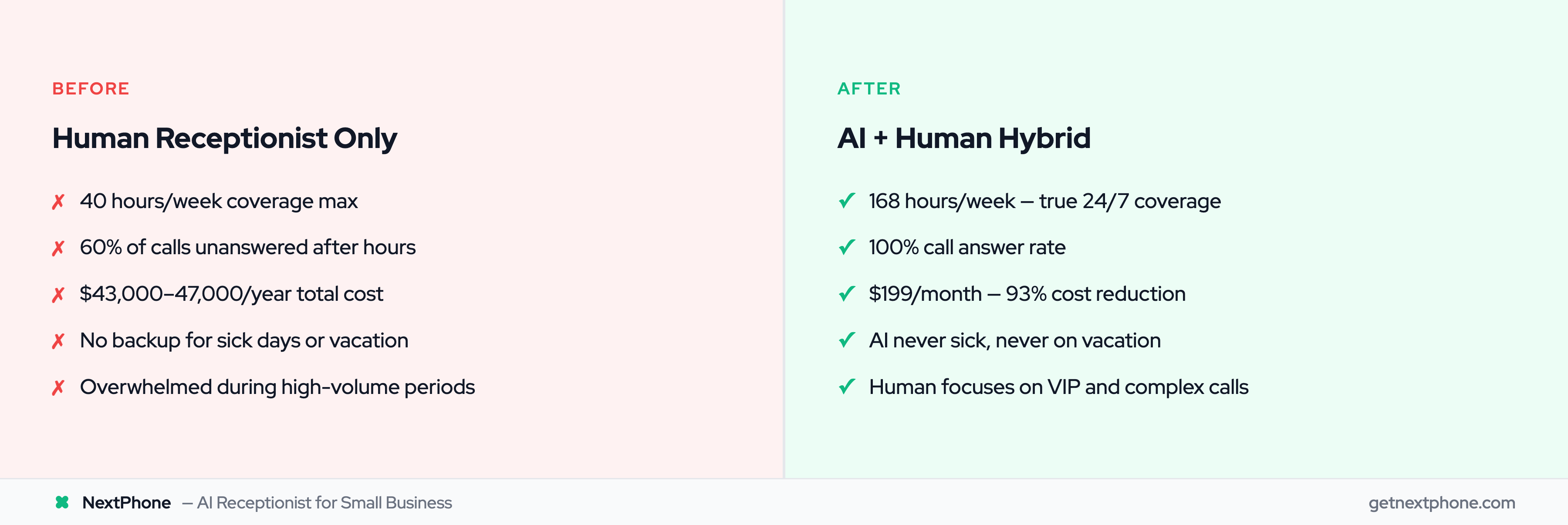
AI handles the bulk of routine calls 24/7, while your human receptionist focuses on high-value interactions and relationship management. This is often the sweet spot.
How it works: AI answers all calls initially. Routine matters (appointments, FAQs, basic routing) are handled completely by AI. Complex situations, VIP clients, or sensitive issues are seamlessly transferred to your human team member.
Division of labor:
AI handles:
- Appointment scheduling and confirmations
- Frequently asked questions
- Basic call routing
- After-hours and weekend calls
- High-volume periods
Human handles:
- VIP client calls
- Complex problem-solving
- Sensitive conversations
- Complaint resolution
- Relationship building
- AI system oversight
Best for: Businesses with varied call complexity where some calls genuinely benefit from human judgment and empathy, but most are routine. McKinsey research shows AI can improve productivity 30-50% in customer service settings.
Timeline: 2-3 weeks with gradual handoff
Employee impact: Generally positive. Role becomes more strategic and less repetitive. Receptionist maintains employment with more interesting work.
Path 3: Separation with Support
Sometimes the right answer is to eliminate the position entirely and provide fair transition support. This is the hardest path emotionally, but sometimes the most honest.
How it works: You provide adequate notice (2-4 weeks minimum), fair severance (typically 2-4 weeks of pay), strong references, and job search support if possible. AI takes over the full function.
Best for: Organizations that are right-sizing, facing genuine budget crises, or where the receptionist has expressed desire to move on but hasn't yet. Also appropriate when no viable alternative role exists.
Ethical considerations you must address:
- Notice period: 2-4 weeks minimum. Surprise terminations damage your reputation and culture.
- Severance: At minimum, 2 weeks of pay. Consider 1 week per year of service for longer-tenured employees.
- References: Provide strong, honest recommendations.
- Support: If possible, offer resume review, LinkedIn recommendations, or connections to opportunities.
- Benefits: Continue health insurance through notice period and potentially COBRA assistance.
Timeline: 2-4 weeks
Employee impact: Negative in the short term, but can be managed with dignity and support. Some employees may actually welcome the change if they were considering leaving anyway.
Regardless of which path you choose, here's the week-by-week process to execute it right.
The 2-4 Week Transition Timeline
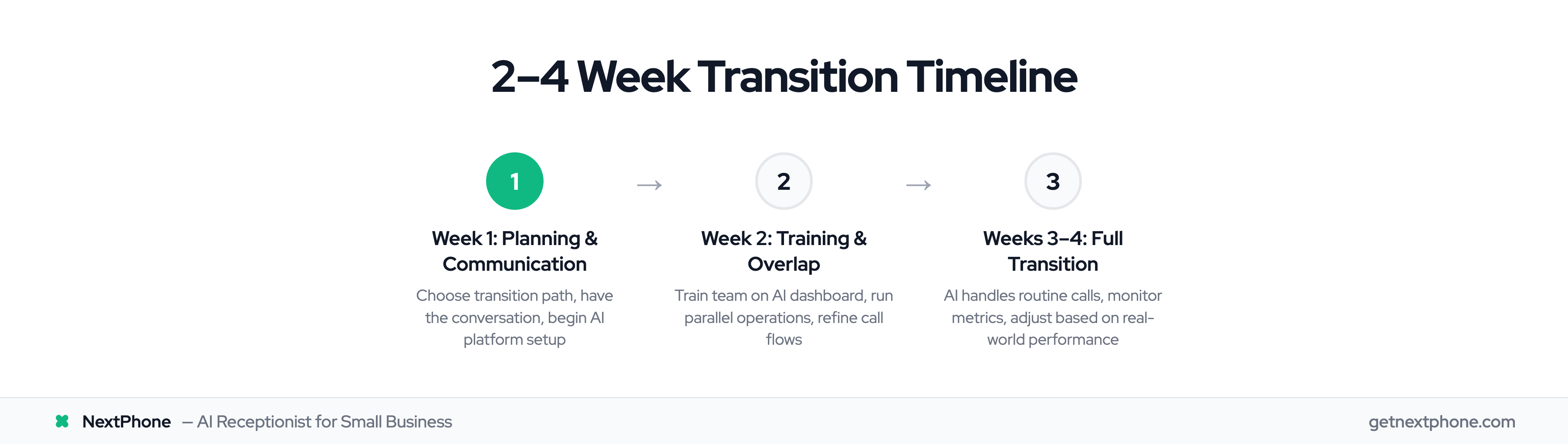
Let's get tactical. Here's exactly what to do each week to migrate from human receptionist to AI smoothly and ethically.
Week 1: Planning and Communication
Day 1-2: Internal Planning
Before you talk to anyone, get your ducks in a row.
Choose your transition path definitively. Hybrid, evolution, or separation? Don't go into the conversation without knowing what you're proposing.
Draft your communication plan. What will you say? What options will you offer? What support will you provide?
Determine specifics. If role evolution, what's the new title, responsibilities, and compensation? If separation, what's the severance package? If hybrid, what's the division of labor?
Select your AI receptionist platform. Research options now so you can provide a timeline. NextPhone, for instance, is live about 5 minutes after you sign up.
Day 3-4: The Conversation
This is the hardest part. Schedule a private meeting with your receptionist. Choose a private space, allow adequate time (30-60 minutes), and prepare for emotional reactions.
What to say:
"[Name], I need to discuss some changes to our reception function. We're implementing an AI receptionist to handle phone calls 24/7. I want to be clear: this isn't about your performance. You've done excellent work. But our business needs have evolved, and we need phone coverage beyond what any single person can provide.
Here's what I'm proposing: [explain your chosen path: role evolution, hybrid model, or separation with support]. I want to make this transition as smooth as possible for you. Let's talk through what this means and answer any questions you have."
Be prepared for:
- Shock and silence
- Tears or anger
- Questions about why, when, and what's next
- Requests for time to process
What to do:
- Listen without interrupting
- Validate their feelings ("I understand this is difficult")
- Stick to facts while showing empathy
- Offer to revisit conversation in 24 hours after they process
- Have tissues ready
Day 5-7: AI Platform Selection and Setup
While your receptionist processes the news, begin technical setup.
Choose your AI receptionist platform based on features, ease of use, and transition support. NextPhone offers quick setup, intuitive dashboards, and hybrid capabilities built in, ideal for smooth transitions.
Begin configuring call flows. What happens when someone calls? How should AI respond to common questions? When should calls transfer to humans?
Create your knowledge base. Feed the AI information about your business, services, hours, and common scenarios.
Test with internal calls before going live.
Week 2: Training and Overlap
For Role Evolution or Hybrid Path:
Train your receptionist on the AI dashboard (2-4 hours total). Modern platforms like NextPhone are designed for non-technical users, so training is straightforward.
Core skills to cover:
- Monitoring call logs and transcripts
- Adjusting AI responses when needed
- Setting up call routing rules
- Managing escalations and transfers
- Analyzing performance metrics
Start gradual handoff. Let AI handle a percentage of calls while your receptionist monitors performance, identifies issues, and provides feedback. This parallel operation builds confidence.
Define new responsibilities clearly. If the role is evolving, document exactly what the new position entails. If hybrid, clarify which calls go to AI versus human.
For Separation Path:
Process all necessary paperwork: final paycheck calculations, severance agreements, benefits continuation, and references.
Maintain normal duties during notice period, but begin testing AI in parallel on a secondary line or during specific hours.
Provide job search support: resume review, LinkedIn recommendations, or introductions to contacts if you're able.
For all paths:
Test AI extensively with real-world scenarios. Place test calls for common situations. Document edge cases that need refinement.
Refine scripts and responses based on testing. AI improves quickly when you feed it better information.
Create escalation protocols. When should calls go to humans? How does that handoff work? Test the transfer process.
Week 3-4: Full Transition
Go live with AI handling routine calls. Depending on your path, this means:
- Evolution: AI handles all calls, employee monitors dashboard and manages new role
- Hybrid: AI answers all calls initially, transfers complex ones to human
- Separation: AI handles all calls, former employee has departed
Daily check-ins for the first week. Review call logs together (if employee is staying). Identify issues, adjust responses, and refine the system.
Adjust based on real-world performance. You'll discover scenarios you didn't anticipate. That's normal. Modern AI learns and adapts quickly.
Announce to the broader team. Communicate the change to everyone, emphasizing what's staying the same (great customer service) and what's improving (24/7 coverage, faster response times).
Celebrate the transition. If your receptionist is staying in a new role, publicly celebrate their evolution and expanded responsibilities. If they're departing, recognize their contributions and wish them well publicly.
Success Metrics to Monitor
How do you know the transition worked?
Answer rate: You should see 99%+ of calls answered. If not, troubleshoot routing issues.
Customer satisfaction: Monitor feedback. Most customers care about quick, accurate help, not whether it's AI or human.
Call handling time: AI typically handles routine calls faster than humans, freeing up time for complex issues.
Employee satisfaction (if hybrid/evolution): Check in regularly. Is the new arrangement working? Are they overwhelmed or underwhelmed?
Cost savings: Track actual savings. Most businesses save 80-93% on reception costs.
After-hours call volume: You'll likely discover you were missing more calls than you realized. Many businesses see 30-40% of total calls coming outside business hours once 24/7 coverage exists.
The conversation itself is often the hardest part. Here's how to handle it with care.
Communication Best Practices: Having the Hard Conversation
Let's be honest: telling someone their job is changing or ending is uncomfortable. But it's your responsibility to do it well.
What to Say (and What Not to Say)
Do say:
"This is about business evolution, not your performance." Make it clear this isn't personal or performance-based. Most receptionists will immediately wonder what they did wrong. Shut that down immediately.
"I want to be transparent about what's changing and why." Honesty builds trust, even in difficult moments. Explain your business reasoning clearly.
"Here are your options and how I can support you." Don't just deliver bad news. Deliver solutions, paths forward, and concrete support.
"I value your contributions and want to ensure your success." Recognition matters. Acknowledge what they've brought to the role before explaining why it's changing.
Don't say:
"This is nothing personal." While well-intentioned, it dismisses the very real personal impact on their life. It IS personal to them, even if it's business for you.
"Everyone's doing this." Comparison doesn't make job loss easier. It actually makes people feel more replaceable.
"You'll be fine." You don't know that, and it sounds dismissive of legitimate concerns about bills, health insurance, and career trajectory.
"The AI is better." Even if true, this is unnecessarily hurtful. Focus on business needs (24/7 coverage, scalability) rather than direct comparison.
Handling Emotions
Expect emotional reactions. This is someone's livelihood, identity, and financial security. Normal reactions include:
Shock and silence. Give them time. Don't rush to fill the silence. Let them process.
Sadness or tears. Have tissues available. Offer a glass of water. It's okay to acknowledge "I know this is hard news."
Anger or defensiveness. Stay calm. Don't get defensive yourself. Listen to concerns without arguing.
Immediate questions. They'll want to know: When? Why? What did I do wrong? What happens to my benefits? How much severance? Have answers ready.
Don't rush the conversation. Block out 45-60 minutes minimum. If they need time to process and reconvene, offer to meet again the next day.
Team Communication
Once you've told your receptionist, you need to communicate with the broader team.
Timing: Tell the receptionist first, privately. Then announce to the team within 24-48 hours. Don't let rumors spread.
Format: Team meeting or company-wide email, depending on size.
Message: Frame as business evolution, not punishment. Emphasize what's improving (24/7 coverage, never missing calls, allowing team members to focus on higher-value work). Thank the departing employee publicly if they're leaving, or celebrate their new role if they're staying.
Address concerns: Be prepared for questions like "Am I next?" Reassure team that this decision is specific to the reception function and business needs.
Celebrate contributions: Recognize the receptionist's work publicly. If they're leaving, consider a send-off event or gift. If they're staying, publicly celebrate their new role.
Once you've communicated the change, it's time for training.