
A Spanish-speaking homeowner calls three HVAC companies for emergency AC repair on a 95-degree Saturday afternoon.
Company 1: Voicemail in English only. They hang up and call the next company.
Company 2: English-speaking receptionist answers. The homeowner struggles to explain "el aire acondicionado no funciona" in broken English. Frustrated, they hang up and try one more.
Company 3: An AI receptionist answers and immediately detects Spanish. "—Gracias por llamar a Smith HVAC! —C—mo puedo ayudarle?" The homeowner explains their emergency comfortably in their native language. The AI collects details, routes the call to a bilingual technician, and books the $1,200 emergency service call.
The third company wins—not because they have better service or lower prices, but because they removed the language barrier.
In the United States, 41 million people speak Spanish at home. Latino buying power reached $1.9 trillion in 2023 and continues growing faster than any other demographic segment. Yet most small businesses—especially in home services, healthcare, and retail—lose these customers simply because they can't communicate effectively.
Bilingual voice AI receptionist technology solves this problem by automatically detecting which language a caller speaks and responding naturally in Spanish or English without requiring bilingual human staff.
This guide explains how bilingual AI works, why it matters for your business, and how to implement Spanish-English call handling to capture the Latino market.
The Latino Market Opportunity for Small Businesses

The numbers are staggering—and growing.
Market Size
41 million Spanish speakers in the US (13% of the population) $1.9 trillion in annual Latino buying power (2023) Fastest-growing demographic: Latino population increased 23% from 2010-2020 while overall US population grew just 7%
Industries with Highest Latino Customer Percentages
- Home Services (HVAC, Plumbing, Electrical, Roofing: 25-35% of customer base in major metros (Los Angeles, Miami, Houston, Phoenix, San Antonio)
- Healthcare: 18% of US population is Hispanic/Latino
- Retail & Hospitality: 30-40% in urban markets
- Automotive Services: 20-30% nationwide
The Language Barrier Problem
Despite this massive market, most small businesses fail to serve Spanish-speaking customers effectively:
- 67% of Latino customers prefer to be served in Spanish when given the option (Pew Research)
- 57% of businesses lose Latino customers due to language barriers (National Hispanic Business Association)
- $130 billion in annual revenue is left on the table because businesses can't communicate with Spanish-speaking customers
Real scenario from our data: A plumbing company in Phoenix analyzed their missed calls and found 22% were from Spanish-speaking callers who hung up within 10 seconds of reaching English-only voicemail. That was 9 calls per month—at 20% conversion and $3,500 average job value, they were losing $6,300 monthly ($75,600/year) just from language barriers.
Why Bilingual AI Matters
Hiring bilingual staff is expensive. There are 438,521 bilingual customer service workers in the US, but demand far exceeds supply:
- Bilingual receptionists command 10-20% wage premium
- Finding qualified bilingual candidates is challenging
- Coverage gaps during lunch, breaks, vacations
Traditional bilingual answering services are limited:
- Cost $600-1,000/month for 24/7 coverage
- Variable quality depending on agent
- Limited to call volume caps
Bilingual AI provides:
- 24/7 coverage in both languages
- Consistent quality
- Unlimited calls
- $199/month (same cost as English-only)
You tap into a multi-trillion-dollar market without hiring additional staff or increasing costs.
How Automatic Language Detection Works
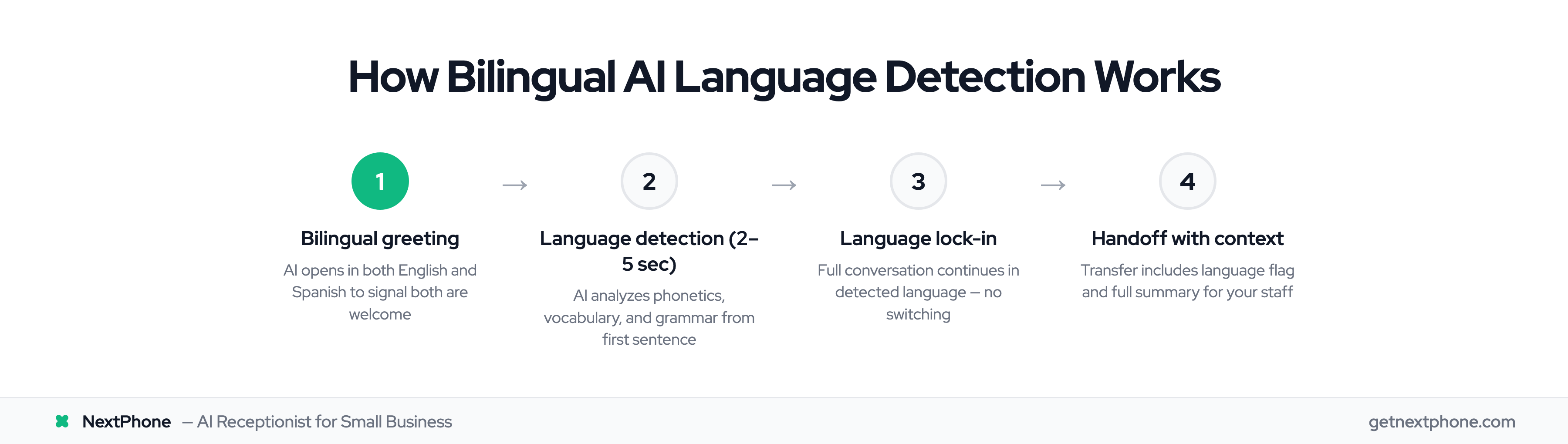
Modern AI receptionists don't require callers to "press 1 for English, presiona dos para espa—ol." They automatically detect and respond in the caller's language within seconds.
Here's how it works:
Step 1: Initial Greeting (Bilingual)
The AI answers with a bilingual greeting: "Thank you for calling Smith HVAC. Gracias por llamar a Smith HVAC. How can I help you? —C—mo puedo ayudarle?"
This signals to callers that both languages are supported.
Step 2: Language Detection (2-5 Seconds)
As soon as the caller speaks, the AI analyzes:
- Phonetic patterns: Spanish pronunciation differs from English (rolled R's, different vowel sounds, etc.)
- Vocabulary: Spanish words like "necesito," "ayuda," "reparaci—n" vs English "need," "help," "repair"
- Grammar structure: Spanish syntax differs from English (adjectives after nouns, verb conjugations, etc.)
Detection happens in real-time during the caller's first sentence.
Step 3: Language Lock-In
Once detected, the AI responds fully in that language for the rest of the call.
Example:
- Caller: "Hola, necesito ayuda con mi aire acondicionado."
- AI: "—Claro! Puedo ayudarle con eso. —Cu—l es el problema con su aire acondicionado?"
From that point forward, the entire conversation continues in Spanish—no switching, no confusion.
Step 4: Handoff with Context
If the call transfers to a human (you or your staff), the system flags which language was used. If you have bilingual staff, the call routes to them. If not, the AI has already collected all necessary information in Spanish, so your English-speaking team has full context to serve the customer even without speaking Spanish themselves.
Accuracy
Modern AI language detection is 98%+ accurate within the first sentence. In rare cases where detection is uncertain (bilingual speaker mixing languages), the AI politely asks: "Would you prefer to continue in English or Spanish? —Prefiere continuar en ingl—s o espa—ol?"
Spanish Voice Quality: Natural, Not Robotic
Early AI voices sounded robotic—flat, monotone, obviously synthetic. That's changed dramatically.
Modern AI Spanish voices:
Natural Pronunciation
- Proper Spanish phonetics (rolled R's, soft vowels, correct stress patterns)
- Conversational flow, not word-by-word reading
- Appropriate pauses and intonation
You can't tell it's AI. Callers frequently don't realize they're speaking with an automated system until explicitly told.
Regional Accent Support
Spanish varies by region. A Mexican customer expects different pronunciation than a Cuban customer.
NextPhone supports:
- Mexican Spanish (neutral Latin American accent, most widely understood)
- Caribbean Spanish (Puerto Rican, Dominican, Cuban pronunciation)
- South American Spanish (Colombian, Venezuelan variations)
- Castilian Spanish (Spain, less common in US but available)
You select the accent that matches your customer base. If you're in Los Angeles or Houston, Mexican Spanish is standard. In Miami, Caribbean Spanish feels more natural to customers.
Emotional Tone
AI voices adjust tone appropriately:
- Warm and friendly for greetings
- Concerned and helpful for emergencies
- Professional for business inquiries
Example tones:
- "—Hola! —C—mo puedo ayudarle hoy?" (Warm, welcoming)
- "Entiendo que esto es una emergencia. Voy a conectarlo con nuestro t—cnico ahora mismo." (Urgent, reassuring)
- "Su cita est— confirmada para el martes a las 2 de la tarde." (Professional, clear)
Cultural Customization Beyond Translation
True bilingual service isn't just translating English scripts word-for-word into Spanish. Cultural customization matters.
Formal vs Informal Address
Spanish has formal "you" (usted) and informal "you" (t—). The choice depends on context:
Formal (usted):
- Business settings
- First-time callers
- Elderly customers
- Professional services (legal, medical, financial)
Informal (t—):
- Casual settings
- Established customer relationships
- Younger demographics (some prefer t— from the start)
NextPhone lets you choose: Default to formal (usted) with option to switch to informal (t—) for repeat customers, or start informal for casual business types.
Example formal: "—En qu— puedo ayudarle?" (How can I help you? - formal) Example informal: "—En qu— puedo ayudarte?" (How can I help you? - informal)
Culturally Appropriate Greetings
Spanish-speaking cultures often use longer, warmer greetings than English business norms.
English: "Thank you for calling Smith HVAC. How can I help?" Literal Spanish translation: "Gracias por llamar a Smith HVAC. —C—mo puedo ayudar?" Culturally appropriate Spanish: "—Buenos d—as! Gracias por comunicarse con Smith HVAC. Es un placer atenderle. —En qu— puedo ayudarle hoy?"
The latter feels more natural and respectful to Spanish-speaking callers.
Service Vocabulary
Certain service terms have multiple Spanish translations. Cultural customization chooses the most commonly used:
"Plumber":
- plomero (Mexican Spanish, most common in US)
- fontanero (Spain)
- gasfiter (Chile) — Use "plomero" in US contexts
"HVAC technician":
- t—cnico de aire acondicionado (literal, understood everywhere)
- t—cnico de climatizaci—n (Spain/formal) — Use "t—cnico de aire" or "t—cnico de HVAC" in US
"Quote/Estimate":
- cotizaci—n (formal estimate)
- presupuesto (estimate/quote)
- estimado (anglicism, common in border states) — "Cotizaci—n" is most professional
Emergency Language
During emergencies, cultural norms shift. Spanish-speaking customers expect:
- Immediate acknowledgment of urgency
- Reassuring language
- Clear next steps
Example emergency response: "Entiendo perfectamente. Esto es una emergencia y voy a ayudarle de inmediato. Voy a conectarlo con nuestro t—cnico de emergencias ahora mismo. Por favor, qu—dese en l—nea."
(I understand perfectly. This is an emergency and I'm going to help you immediately. I'm connecting you with our emergency technician right now. Please stay on the line.)
Notice: Reassurance ("voy a ayudarle de inmediato"), urgency acknowledgment ("esto es una emergencia"), clear action ("voy a conectarlo").