AI receptionist or human receptionist - which should you choose?
The question assumes you have to pick one. You don't.
Most small businesses miss 74% of their calls. In our analysis of 13,175 calls from 45 contractors, neither AI alone nor human alone solved this completely. The businesses capturing the most revenue aren't choosing sides - they're strategically combining both.
This guide compares AI and human receptionists honestly. We'll show what each does better, reveal the hidden costs of both, and explain why hybrid wins. No sales pitch - just data and practical recommendations. Twilio's research shows a 31-point satisfaction gap: 90% of businesses think customers are satisfied, but only 59% actually are—highlighting the need for the right balance between AI and human interaction.
Quick Comparison: AI vs Human Receptionist at a Glance
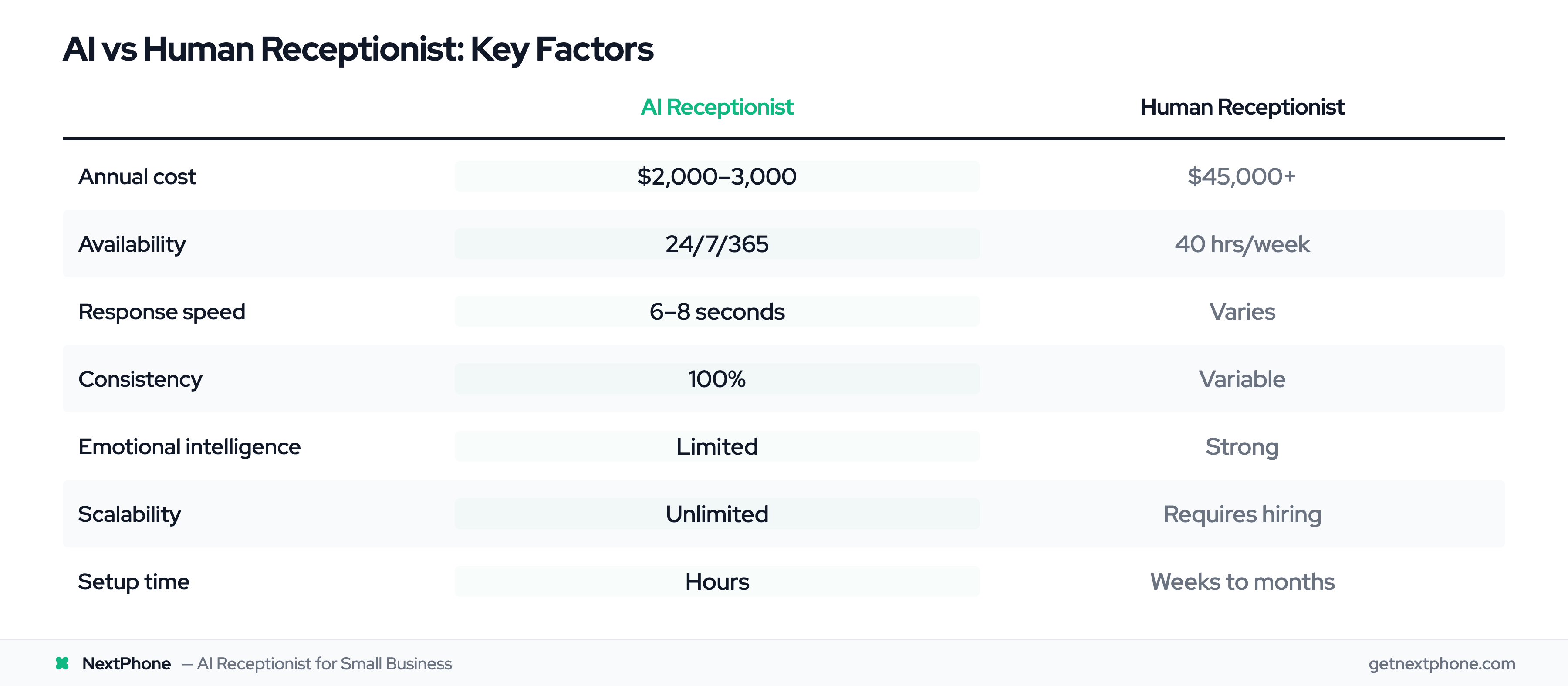
Before diving deep, here's the summary:
| Factor | AI Receptionist | Human Receptionist |
|---|---|---|
| Annual Cost | $2,000-3,000 | $45,000+ |
| Availability | 24/7/365 | 40 hours/week |
| Response Speed | 6-8 seconds | Varies |
| Consistency | 100% consistent | Variable |
| Complex Situations | Routes to human | Handles directly |
| Emotional Intelligence | Limited | Strong |
| Scalability | Unlimited | Requires hiring |
| Setup Time | Hours | Weeks to months |
Neither option wins across the board. Each excels in different situations, which is exactly why the either/or framing is wrong.
Cost Comparison: The Full Picture
Human Receptionist: True Total Cost
The Bureau of Labor Statistics puts the average receptionist salary at $35,000 per year. But that's not your actual cost.
Add benefits, payroll taxes, and overhead (roughly 30%), and you're at $45,500 annually.
But wait - there's more:
- Training: 2-4 weeks of paid learning curve
- Turnover: Average receptionist tenure is 2-3 years; each replacement costs $5,000+ to recruit and train
- Coverage gaps: Sick days, vacation, lunch breaks need backup
- Overtime: After-hours coverage requires premium pay or additional staff, often prompting businesses to consider an answering service alternative
Real-world total for reliable human coverage: $50,000-60,000/year once you account for backup coverage and turnover.
AI Receptionist: What You're Really Paying
AI receptionist pricing ranges from $95/month (limited calls) to $300+/month (enterprise features).
NextPhone charges $199/month with unlimited calls - that's $2,388/year.
Additional costs to consider:
- Setup time: 1-2 hours (usually free)
- Integration: Typically included
- Training the AI: 2-3 hours of your time
True total cost: $2,400-3,000/year including your time investment.
The Math Is Clear - But Incomplete
Annual savings: $43,000+ switching from human to AI.
But here's what pure cost comparison misses: capability differences. If AI can't handle your complex calls, those savings become lost revenue. If human can't provide 24/7 coverage, you're still missing calls.
The real question isn't "which costs less?" It's "where should I invest each dollar for maximum return?"
Availability & Response Speed
Coverage Hours Reality
Human receptionist: 40 hours per week (assuming full-time). That's 24% of the total hours in a week.
- Lunch breaks: 1 hour daily = 5 hours/week uncovered
- Sick days: Average 5 per year
- Vacation: 2-3 weeks per year
- Before 9 AM and after 5 PM: Voicemail
AI receptionist: 168 hours per week. 100% of available hours.
- No breaks, no sick days, no holidays
- Answers at 3 AM on Christmas
- Never asks for time off
- Consistent coverage regardless of weather, illness, or personal issues
Response Speed Comparison
When a call comes in:
AI receptionist: Answers in 6-8 seconds. Every time. No variation.
Human receptionist: Depends on current activity, other calls, distractions. Generally fast during working hours, but voicemail outside them.
After-Hours: Where the Money Is
In our data, 15.9% of calls contained urgency language. Many came outside business hours.
One HVAC contractor missed 23 after-hours emergency calls. At $1,200 per emergency job, that's $27,600 in lost revenue - just from calls that came when the office was closed.
For businesses with emergency services or customers who call evenings/weekends, 24/7 availability isn't a nice-to-have. It's essential.
Accuracy & Consistency
Information Accuracy
AI receptionist: 85-95% accuracy on routine inquiries. Information comes from a knowledge base you control. When you update hours or pricing, AI's information updates instantly across all calls.
Human receptionist: Accuracy varies based on training quality, memory, and tenure. New hires make more mistakes. Even experienced staff occasionally give outdated information or make errors under pressure.
Message Capture Quality
AI receptionist: Verbatim transcription. Customer says "My name is Michael Thompson, that's T-H-O-M-P-S-O-N, call me at 555-234-8876 anytime except Thursday mornings." You get exactly that.
Human receptionist: "Some guy named Mike Thomson or Thompson, I think. Left a number but I'm not sure I got it right. Said to call back, I forget when works for him."
This isn't hypothetical. In our analysis, businesses regularly lost leads due to incomplete message capture. AI eliminates this problem entirely.
Day-to-Day Consistency
AI receptionist: Monday at 9 AM and Friday at 4:55 PM are identical. No tired Mondays, no checked-out Fridays, no bad days affecting service quality.
Human receptionist: Human variability. Great employees still have off days. Personal issues, fatigue, and mood affect performance.
Human advantage: Humans can recognize when something "feels off" and ask clarifying questions naturally. AI follows patterns; humans detect exceptions.
Customer Experience Reality
The 64% Elephant in the Room
According to Gartner's 2024 survey, 64% of customers would prefer companies didn't use AI for customer service. Research confirms this human preference—93% of US consumers prefer human agents over AI, with 78% saying humans resolve problems faster and 84% saying more accurately.
That statistic scares many business owners. But context matters.
That 64% experienced bad AI: endless loops, inability to reach humans, frustrating scripts that go nowhere. They're not rejecting AI - they're rejecting terrible implementation.
When AI Actually Improves Experience
Consider the alternative to AI: voicemail or endless ringing.
Scenario A (No AI): Customer calls at 6 PM. Rings 5 times. Voicemail. Customer hangs up, calls competitor.
Scenario B (AI): Customer calls at 6 PM. AI answers in 6 seconds. "Thanks for calling. How can I help?" Answers their question about hours, books appointment, customer satisfied.
For simple questions, instant AI beats callbacks by hours or days.
Salesforce research shows 82% of customers expect faster service than ever. AI delivers speed. The 64% who "don't want AI" often prefer AI over waiting—62% of customers prefer chatbots over waiting for human agents.
The key insight: 77% are more willing to use AI if they know how to reach a human when needed.
When Human Touch Is Essential
Some calls genuinely need humans:
- Upset customers: "I'm furious about the job your guys did last week." This needs empathy, not scripts.
- Complex problems: "My circuit breaker trips sometimes but not always, and there's an intermittent burning smell." This needs expertise and clarifying questions.
- High-stakes sales: "$80,000 commercial renovation? Let's discuss your vision." This needs relationship building.
The solution isn't choosing one - it's routing appropriately.
What AI Handles Better (Honest Assessment)
Let's be clear about where AI genuinely outperforms humans:
Repetitive Questions
"What are your hours?" "Do you service my area?" "How much for a standard service call?"
In our analysis, 6.5% of calls were these exact repetitive questions. AI answers them perfectly every time, freeing humans for work that actually needs expertise.
Appointment Scheduling
Customer wants Thursday 2-4 PM. AI checks calendar in real-time, books 2:30, sends confirmation. Done in 60 seconds.
Human receptionist: "Let me check... can I call you back?" Phone tag ensues. Appointment maybe booked in 2 days.
Our data shows 7.7% of calls were scheduling requests. AI handles these with zero friction.
After-Hours Coverage
You're asleep. Customer's pipe bursts at 2 AM.
With AI: Call answered, emergency detected, routed to your on-call phone within seconds.
Without AI: Voicemail. Customer calls three competitors. First one who answers gets the $1,500 job.
Spam Filtering
7% of calls in our study were spam and robocalls. That's hundreds of interruptions per year.
AI recognizes patterns, blocks spam automatically. You never hear about it. Human receptionists answer every call, wasting time on "extended car warranty" pitches.
Perfect Message Capture
AI captures every detail verbatim. No forgotten names, no missed phone numbers, no "I think he said..." approximations.
For a business losing leads to incomplete information, this alone justifies AI cost.
When Smart Forwarding Kicks In (The 5-10%)
AI resolves 90-95% of calls. Here's when smart forwarding routes to your phone:
Complex Problem Descriptions
"My AC runs for 10 minutes then shuts off, but only on hot days, and there's water under the unit sometimes but not always."
AI captures the full description. Smart forwarding routes to you with all context. You ask the right diagnostic questions and schedule the appropriate technician. No stranger is making this judgment call—you are.
Upset Callers
Customer calls frustrated about a previous job. They need reassurance.
Smart forwarding detects negative sentiment and routes to your phone. YOU de-escalate and save the relationship. Your voice, your empathy—not a paid agent reading a script.
High-Value Opportunities
$75,000 whole-house renovation? Smart forwarding routes immediately with all captured details.
AI handled the initial contact and captured their interest. You close the deal. In our data, 6.9% of calls were quote requests—these forward to you automatically.
Judgment Calls
"Can you squeeze me in today? I know it's last-minute..."
Smart forwarding routes these to your phone. You know your schedule, your customers, and when to make exceptions. That's YOUR judgment, not a stranger's.
Unusual Situations
First-time situations with no template. AI takes a detailed message or forwards to you immediately.
The real comparison: without AI, these calls go to voicemail. With AI + smart forwarding, every caller reaches someone—and the 5-10% that need you reach YOU.
Scalability Comparison
Growth Scaling
AI: Business grows from 40 calls/month to 400? Same $199/month. Unlimited calls, no additional cost.
Human: Same growth requires hiring additional staff. Each new receptionist adds $45,000+ annually. Growth becomes a budget negotiation.
Volume Spikes
Storm season hits. Roofers go from 20 calls/day to 200.
AI: Handles all 200 simultaneously. No wait times, no overflow to voicemail.
Human: Overwhelmed. Calls go unanswered or wait in queue. Temporary staff takes weeks to hire and train.
Seasonal Demands
HVAC: Slammed in summer and winter, slower spring and fall.
AI: Same price regardless of season. Scales up automatically, scales down without layoffs.
Human: Difficult to staff correctly. Understaffed during peaks, overstaffed during lulls.
When to Choose AI Receptionist
AI is the right primary choice when:
After-hours coverage is critical You have emergency services or customers who call evenings/weekends. Missing those calls costs revenue.
High call volume with simple questions Most calls are FAQs, scheduling, or information requests. AI handles 60-70% without human intervention.
Budget under $45,000/year You can't afford full-time human coverage. AI gives professional answering at fraction of cost.
Scaling quickly Growth comes in spurts. AI scales instantly without hiring delays.
Spam is significant problem You're wasting hours on robocalls. AI filters automatically.
Solo operation needing coverage You're doing the work yourself and can't answer calls. AI ensures every call gets answered.
When to Choose Human Receptionist
Human is the right primary choice when:
Customer base expects/demands human interaction High-end services where personal touch is the product. Luxury, concierge, or relationship-driven businesses.
Majority of calls are complex More than 50% of calls require expertise, consultation, or judgment. Simple routing can't solve the problem.
In-person reception also needed You need someone greeting walk-ins anyway. Phone coverage is secondary function.
Industry regulations require human Certain healthcare, legal, or financial services have human-interaction requirements.
High-value relationship sales Every call is potentially a $100K+ project. Investment in human relationship-building pays off.
The Hybrid Advantage: Best of Both Worlds
Why Neither Alone Is Optimal
AI-only problem: 64% customer skepticism. Complex situations mishandled. Emotional needs unmet. High-value sales lost.
Human-only problem: 74% of calls missed. After-hours abandoned. Costs prohibitive for small businesses. Coverage gaps during sick days, vacation, lunch.
Neither option alone captures all the value while avoiding all the problems.
The 60/30/10 Model
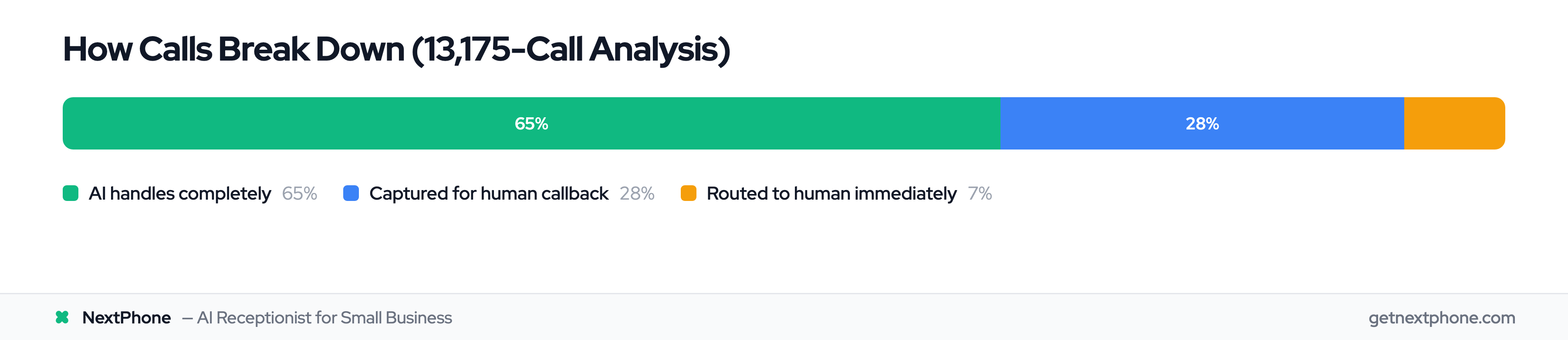
Based on our 13,175-call analysis, here's how calls typically break down:
-
60-70% of calls: AI handles completely
-
Hours and location questions
-
Pricing for standard services
-
Appointment scheduling
-
Service area confirmation
-
Message taking for callbacks
-
Spam filtering
-
25-30% of calls: AI captures for human callback
-
Complex quote requests
-
Technical questions requiring expertise
-
Follow-up on previous jobs
-
Detailed service discussions
-
5-10% of calls: AI routes to human immediately
-
Emergencies (6.2% in our data)
-
Upset/frustrated customers
-
Complex problem descriptions
-
High-value sales conversations
Real-World Hybrid Example
Plumber's Monday with hybrid AI:
9:15 AM - "What's your service area?" AI answers from knowledge base. Customer books appointment. Plumber: Still at first job, never interrupted.
11:47 AM - "I need a quote for bathroom renovation" AI captures details: 2 bathrooms, 1960s house, customer timeline, contact info. Plumber: Calls back at lunch, books site visit.
2:30 PM - "My water heater is leaking everywhere!" AI detects "leaking everywhere" = emergency. Routes to plumber's cell within 10 seconds. Plumber: Answers, quotes emergency rate, schedules 4 PM. $1,400 job captured.
4:45 PM - Robocall about car warranty AI identifies spam, blocks automatically. Plumber: Never hears about it.
Four calls. One needed immediate human attention. Others handled or filtered. Customer service improved. Plumber's time protected.
Cost Savings with Hybrid
Even adding a part-time human for complex calls (20 hours/week at $15/hour = $15,600/year) plus AI ($2,388/year) totals $18,000/year - still less than half the cost of full-time human alone.
And you get 24/7 AI coverage + human expertise when needed.
How to Implement Hybrid Model
Step 1: Define Your Routing Rules
Map your call types to handlers:
AI handles directly:
- Hours, location, service area questions
- Standard pricing inquiries
- Appointment booking
- Callback requests
- Spam identification
Route to human immediately:
- Emergency keywords (flooding, no heat, sparks, etc.)
- Customer asks for specific person by name
- Frustrated or angry tone detected
- Mentions complaint or problem with previous work
Capture for human callback:
- Quote requests for non-standard jobs
- Technical questions beyond knowledge base
- Anything AI is uncertain about
Step 2: Set Up AI for Routine Calls
Train AI on your specific business:
- Accurate hours (including holidays)
- Service offerings and pricing
- Service area boundaries
- Emergency keywords for your industry
- Common customer questions
Most AI platforms learn from your calls over time. Accuracy improves from 80% week one to 95%+ by month two.
Step 3: Reserve Human Time for High-Value
If you're adding part-time human coverage, focus those hours on:
- Following up on complex quotes
- Handling escalations
- High-value sales conversations
- Building customer relationships
Don't waste human hours on "What time do you close?" AI handles that.
Step 4: Measure and Optimize
Track weekly:
- How many calls did AI handle completely?
- How many needed human callback?
- How many were correctly routed as urgent?
- Any calls AI should have handled but didn't?
Adjust routing rules monthly based on data.
Frequently Asked Questions
Can AI completely replace a human receptionist?
Not for all businesses. AI handles 60-70% of typical calls excellently - routine questions, scheduling, message capture - but complex problem-solving, emotional situations, and high-value sales still need human expertise. The question isn't replacement but strategic combination.
Will customers be upset talking to an AI receptionist?
It depends on implementation. Poor AI with endless loops frustrates customers (that's where the "64% don't want AI" comes from). Good AI that answers instantly, handles simple queries, and quickly routes complex calls to humans actually improves satisfaction. Transparency and easy human escalation are key.
Is an AI receptionist cheaper than hiring a human?
Significantly - AI costs $2,000-3,000/year vs $45,000+ for full-time human. But pure cost comparison misses capability differences. The better question: how can you use each where they excel? Many businesses find hybrid (AI + part-time human) delivers better service at lower total cost than either alone.
How do emergency calls get handled with AI?
AI receptionists detect emergency keywords - "flooding," "no heat," "burst pipe," "sparks," "ASAP" - and route those calls to human immediately. Within seconds, not minutes. In our analysis, 6.2% of calls were emergencies that AI correctly identified and routed rather than trying to handle.
What's the biggest mistake businesses make choosing between them?
Treating it as either/or. Most successful businesses use both: AI for 24/7 coverage, instant FAQ answers, and perfect message capture; humans for complex problems, upset customers, and high-value relationships. The hybrid model outperforms either individual option.
How long does it take to implement each option?
AI receptionist: 1-2 hours setup, handling calls same day, fully optimized in 1-2 weeks. Human receptionist: 2-4 weeks recruiting, 2-4 weeks training, 3+ months to full productivity. AI is dramatically faster to deploy, but human brings capabilities AI can't match.
The Bottom Line: It's Not Either/Or
The AI receptionist vs human receptionist debate misses the point.
AI excels at: availability, consistency, cost efficiency, routine tasks, speed, and scale.
Humans excel at: complexity, empathy, judgment, relationships, and adaptation.
Neither is universally "better." Each wins in different situations.
The winning strategy is hybrid: AI answers every call instantly, handles the routine 60-70%, and routes complex situations to human expertise. You get 24/7 coverage at AI costs with human quality where it matters.
For businesses currently missing 74% of calls, the question isn't which to choose - it's how fast you can implement both.
Ready to stop missing calls while keeping the human touch where it matters? See how NextPhone's hybrid AI receptionist combines 24/7 AI coverage with intelligent human routing.